


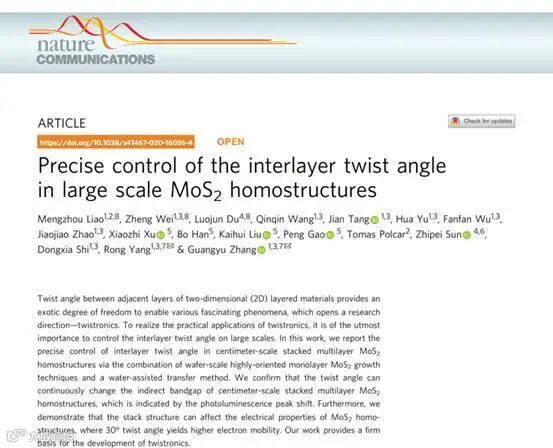
Published: 01 May 2020
导读
二维(2D)层状材料相邻层间的扭转角提供了一种奇特的自由度,并出现了各种有趣的现象,这就为Twistronics开辟了一个研究方向。层间扭转角的精确控制对实现Twistronics的实际应用,起到了至关重要的作用。本文采用外延生长法单和水助剂转移法相结合的方法,实现了对厘米级多层MoS2同质结构层间扭曲角的精确控制。并发现扭转角可以连续改变厘米级叠层MoS2同质结构的间接带隙。此外我们还证明了叠层结构可以影响MoS2同质结构的电学性质。该工作为Twistronics的发展提供了坚实的基础。
关键词
材料科学 纳米材料 二维材料
背景简介
什么是Twistronics?
近年来,二维(2D)材料及其异质结构因其独特的电学、光学和力学性能引起了人们的广泛关注。由于弱的范德华(vdW)相互作用主导层间耦合,因此vdW的同构和异构可以具有一定的自由度:层间扭曲角。扭转角决定着晶体的对称性,并可能导致各种有趣的物理行为,例如霍夫施塔特光谱,非常规的超导性,莫尔激子,隧穿电导,非线性光学和结构超润滑性。对这些特性的研究催生了一个新的研究领域,称为Twistronics,之所以这么称呼是因为它是扭曲与电子学的结合。因此,精准控制二维材料结构的层间扭转角是非常有必要的,这将为Twistronics的应用奠定基础。
Twistronics所面临的挑战:
先前的研究表明,可以通过转移方法或原子力显微镜尖端操作技术(AFM)小规模制造所需的扭转角。样本大小通常约为十微米,这严重阻碍了Twistronics的应用。还制造了较大的几层薄膜,但它们的层间扭曲角是随机的,且受晶粒尺寸和取向的限制。因此需要一种方法来大规模制备具有精确控制的层间扭转角的2D vdW均质/异质结构。
文章介绍
本文用外延生长法和水助剂转移法来制造这些扭曲的层。研究人员采用新的转移单原子二硫化钼层(MoS2)的方法,可以精确控制层之间的扭曲角。由于在转移过程中不需要聚合物,因此样品的界面相对清洁。本文证明通过控制扭曲角和超清洁界面,可以调节物理性能,包括低频夹层模式,能带结构和光电性能。该工作对于指导基于二维材料的twistronics学科的未来应用具有重要意义。
文章亮点
l 本文开发了一种新的合成策略,可获得具有大尺寸、精确控制的层数和层间扭曲角的MoS2均匀结构。
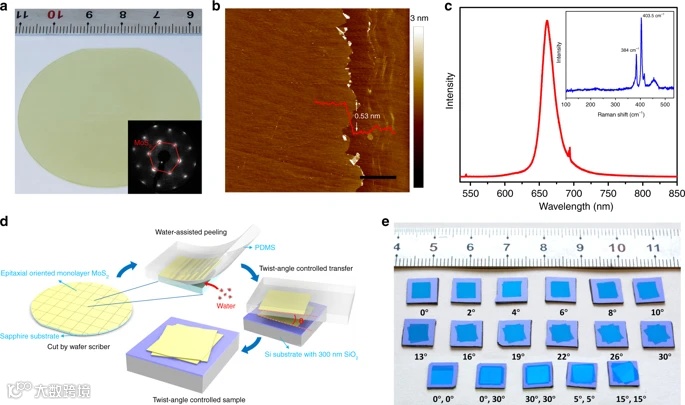
图1:多层MoS2同质结构的扭转角工程
a Image of as-grown MoS2 monolayer on a 2-inch sapphire wafer, inset is a typical LEED pattern of the as-grown wafer.
b AFM image of as-grown oriented MoS2 monolayer after scraping off the right part of MoS2 monolayer, scale bar 2 μm. The height of the film is ~0.53 nm.
c Raman and PL spectra of as-grown MoS2 monolayer.
dThe water-assisted transfer process. Polydimethylsiloxane (PDMS) are used as transfer medium.
e Image of multilayer MoS2 films with precise-controlled twist angles on Si substrates with 300 nm SiO2. Source data are provided as a Source Data file.
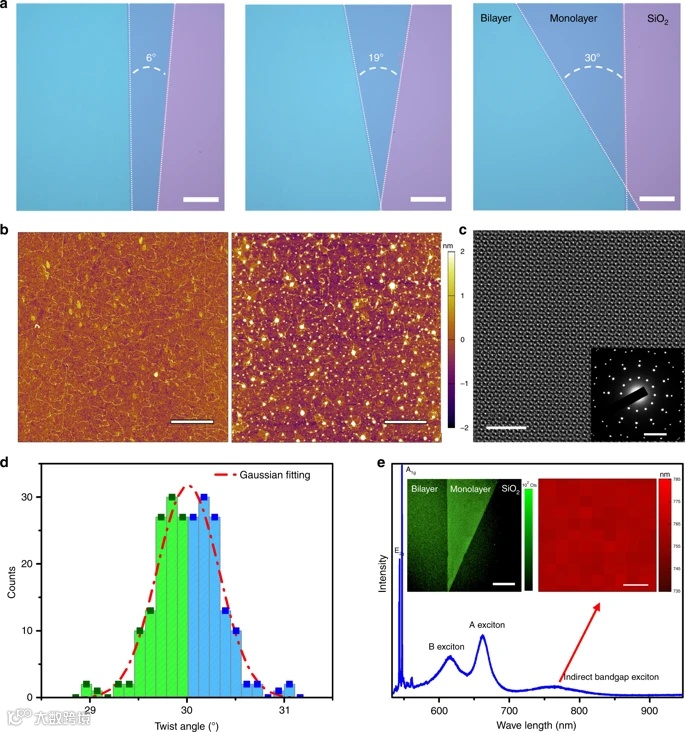
图2:高质量扭曲双层MoS2薄膜
a Optical Images of three typical transferred twisted bilayer MoS2 films on Si substrates with 300 nm SiO2: 6°, 19°, and 30°, scale bar 300 μm.
b AFM images of the transferred monolayer (left) and 30° bilayer (right) MoS2 films, scale bar 2 μm.
c STEM image after FFT filtering of 30° stacked bilayer MoS2 film, scale bar 3 nm; insert is electron diffraction pattern of 30° stacked bilayer MoS2 film, scale bar 5 nm−1.
d Twist angle distribution of eight different 30° stacked bilayer MoS2 film samples, red dash line is the Gaussian fitting. Blue region is just a copy of the green region, to make the chart symmetric.
e PL spectrum of 30° stacked bilayer MoS2 film. Left inset in e is the laser scanning confocal fluorescence microscopy image, scale bar 300 μm; the right inset is a 100 × 100 μm2 mapping of the indirect bandgap position, scale bar 20 μm. Source data are provided as a Source Data file.
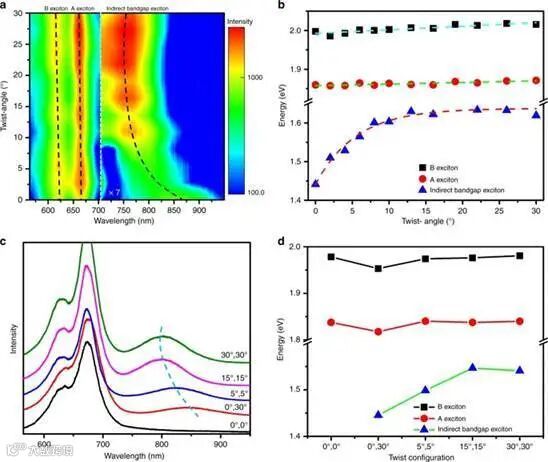
图3:扭曲的多层MoS2薄膜的PL光谱表征
a PL spectra of twisted bilayer MoS2 films as a function of twist angle; the signal intensity between 706 nm to 950 nm is multiplied by 7.
b Excitons’ energy as a function of the twist angle; dash lines are linear (A and B excitons) and exponential (indirect bandgap exciton) fitting.
c PL spectra of twisted trilayer MoS2 films with various twist configurations.
d Excitons’ energy as a function of twist configuration. Source data are provided as a Source Data file.
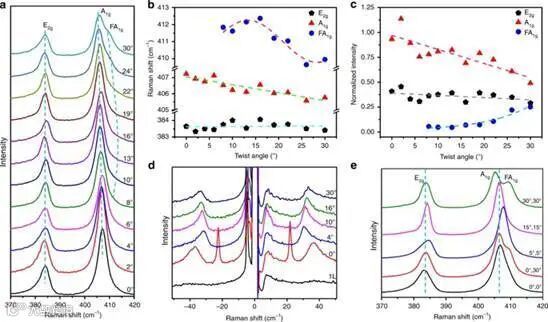
图4:扭曲的双层和三层MoS2薄膜的拉曼特性
a Raman spectra of a series of transferred bilayer MoS2 films with controlled twist angle, each Raman spectrum was calibrated and normalized by the position and intensity of silicon peak at 520.7 cm−1.
b The position of E2g, A1g, and FA1g Raman peaks as a function of twist angle, dash lines are linear (E2g, A1g) and sinusoidal (FA1g) fitting.
c The intensity of E2g, A1g, and FA1g Raman peaks as a function of twist angle, dash lines are linear (E2g, A1g) and exponential (FA1g) fitting.
d Low-wavenumber Raman spectra of monolayer and bilayer twisted MoS2 films.
e Raman spectra of trilayer twisted MoS2 films with different twist configuration. Source data are provided as a Source Data file.
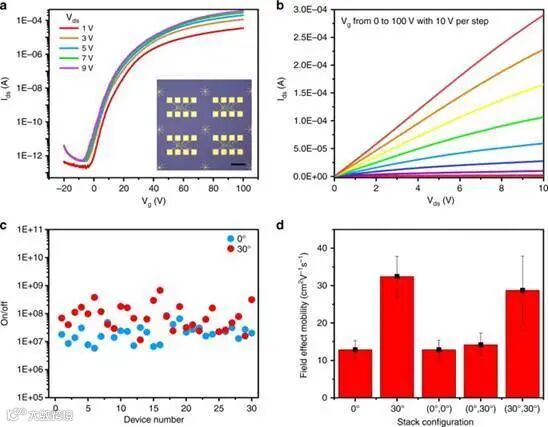
图5:扭曲的多层MoS2薄膜的电性能
a Electrical transfer curves of a typical 30° twisted bilayer MoS2 FET, inset is an optical image of a device array, scale bar 400 μm.
b Electrical output curves of a typical 30° twisted bilayer MoS2 FET.
c On/off ratio of 0° and 30° devices.
d Mobility statistics of twisted multilayer MoS2 films, error bars are Standard Deviations. Source data are provided as a Source Data file.
文章链接:
https://www.nature.com/articles/s41467-020-16056-4
导师简介:
张广宇,现任中国科学院物理研究所研究员、博士生导师,纳米实验室N07课题组长。
研究领域:纳米材料物理与器件
主要研究内容包括制备一维或二维纳米材料(如碳纳米管、石墨烯、纳米线等),利用微纳加工技术制作纳米尺度电子学/光学器件,并研究器件的基本的物理特性。
版权声明:
1) 本文仅代表原作者观点,不代表本平台立场,请批判性阅读。
2) 本文内容若存在版权问题,请联系我们及时处理。
3) 如作者对该文章有误解误读,请联系我们进行修改,欢迎各位老师进行批评指正。
4) 本文版权归科学材料站公众号所有,翻版必究。

投稿请联系contact@scimaterials.cn