


Version of record online: 27 April 2020
华南理工大学
导读
全无机钙钛矿半导体由于其优异的热稳定性,近年来受到人们越来越多的关注。尽管近年来全无机钙钛矿太阳能电池(PSCs)取得了显著的进展,但由于能量损失严重,它们仍然落后于有机-无机电池。因此,通过钙钛矿薄膜和器件界面的协同优化,进一步提高全无机PSCs的性能具有重要的意义。本文综述了无机PSCs在铅基和无铅组分方面的最新进展。讨论了全无机钙钛矿半导体材料和空穴/电子传输材料的物理性质,揭示了组成工程和界面改性的重要作用以及全无机PSCs在未来的发展前景和面临的挑战。
背景简介
1.什么是钙钛矿太阳能电池?
研究表明,无机单价阳离子Cs+可以满足ABX3结构的要求,取代MA+和FA+作为A位离子,形成高热稳定性的CsBX3钙钛矿(>350°C)。同时,CsBX3钙钛矿由于具有合适的宽禁带,也是制备串联太阳能电池的最佳选择。
2.全无机卤化物太阳能电池的发展
不久,研究人员制备了具有更稳定、更高效的CsPbX3钙钛矿结构的PSC,其PCE快速提高了10%以上。目前优化后的CsPbI3 PSC的PCE已达到19.03%,具有平面规则的异质结结构FTO/c-TiO2/CsPbI3/N,N-4-甲氧基苯基氨基-螺氧基甲)/Ag。除CsBX3外,许多其它类型的全无机卤化物钙钛矿已在理论上得到预测和合成。
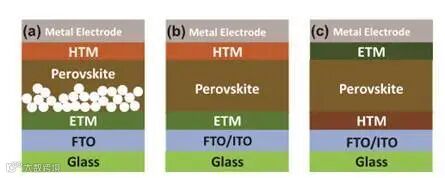
图1. 无机CsBX3 PSC结构。
文章介绍
最后,对CSBX3 PSC的关键问题进行了总结和解释,包括大的能量损失、环境不稳定性、晶体缺陷、Pb毒性、理论基础薄弱等。在解决这些问题的基础上,对今后的发展提出了一些建议,如有效的无掺杂传输材料的合成、钙钛矿缺陷的有效改性/钝化、器件的新的简单制备技术、理论基础的改进等。最后讨论了CsBX3 PSCs在光伏应用中的未来发展方向。
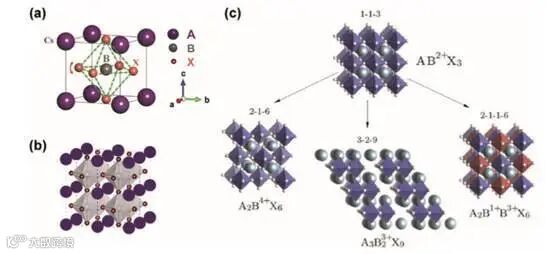
图2. CsBX3钙钛矿结构
a) Cubic phase structure of CsBX3 perovskite.
b) 3D network structure of CsBX3 perovskite.
c) Schematic relation between the crystal structures of typical and derivative CsBX3 perovskites. Reproduced with permission.
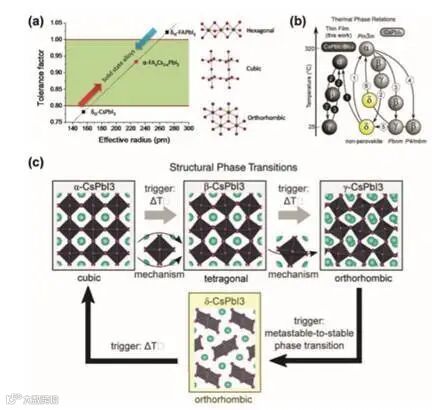
图3. 钙钛矿材料晶体结构与容限因子的关系
a) Correlations between tolerance factor and crystal structure of perovskite materials. Reproduced with permission. Polymorphic character and metastability of CsPbI3:
b) thermal phase relations of CsPbI3,
c) crystal structure of the different phases and their relative phase transitions. The transitions between the black phases are governed by the local Pb-centered octahedral (black) distortions, depicted here using one lead atom at the center and six iodide atoms at the edges (purple), confining the cesium cations
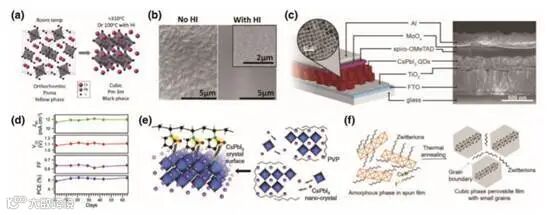
图4. CsPbI3相结构示意图
a) Diagrammatic structure of CsPbI3 phases.
b) Scanning electron microscopy (SEM) images of films fabricated with and without added HI, annealed at low and high temperatures, respectively.
c) Schematic (with TEM image of QDs) and SEM cross-section of the CsPbI3 solar cell.
d) Device performance characteristics over longer time scales. A typical device was periodically measured over a 64-day time period. Performance parameters were extracted from a J–V sweep from forward bias to short circuit. Between measurements, the device was stored in the dark in a desiccator. Reproduced with permission.
e) Mechanism of PVP-induced cubic phase stability: PVP anchored at the surface of CsPbI3 crystals via the combination between N/O and Cs. The negative state in CsPbI3 crystals surface reduces surface tension significantly and stabilizes cubic phase. Reproduced with permission.
f) Mechanism of CsPbI3 α-phase stabilization by zwitterion: the zwitterion molecules are expelled toward the grain surface and GBs during CsPbI3 grain growth, which maintains the small grains by impeding further grain growth. Reproduced with permission
文章链接:
https://onlinelibrary.wiley.com/doi/10.1002/aenm.202000183
老师简介:
Hin-Lap Yip(叶轩立) 男,华南理工大学教授,博士生导师。在Nature, Science, Nature Photonics, Adv. Mater., JACS,Energy Environ. Sci., Joule 等期刊发表SCI研究论文200余篇,工作引起众多国内及国际同行的高度评价和引用,论文被引用20000余次,H-指数为75,并连续于2014-2019年度入选全球“高被引科学家”。主持国家自然科学基金优秀国家重点实验室专项、中德合作研究项目、科技部国家重点基础研究发展计划课题、广州市科技计划、华南协同创新研究院创新中心等项目,参与基金委重大研究计划集成项目及科技部纳米科技重点专项项目
版权声明:
1) 本文仅代表原作者观点,不代表本平台立场,请批判性阅读。
2) 本文内容若存在版权问题,请联系我们及时处理。
3) 如作者对该文章有误解误读,请联系我们进行修改,欢迎各位老师进行批评指正。
4) 本文版权归科学材料站公众号所有,翻版必究。

投稿请联系contact@scimaterials.cn