大数跨境

北航程群峰教授NC:强强联合-MXene与石墨烯超韧性复合二维纳米片!

北航程群峰教授NC:强强联合-MXene与石墨烯超韧性复合二维纳米片! 科学材料站
2020-05-02
0
导读:本文作者提出了一种界面复合协同策略,获得了MXene功能化石墨烯复合薄膜(MrGO-AD)。该研究发现MXene纳米片与氧化石墨烯发会生Ti-O-C共价键交联的现象,并揭示了共价键交联的机理。
Published: 29 April 2020

导读

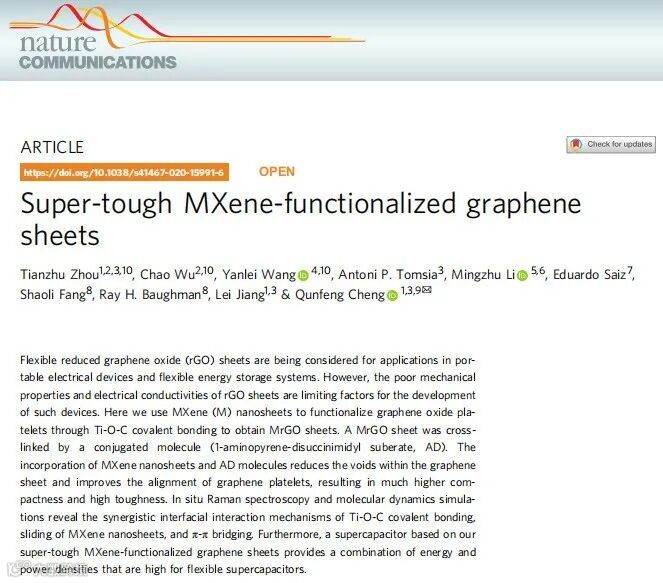
柔性还原氧化石墨烯(rGO)薄膜正被广泛应用于便携式电子器件和柔性储能系统中。然而,rGO薄膜较差的力学性能和导电性限制了其发展。本文使用MXene(M)纳米片通过Ti-O-C共价键合实现了氧化石墨烯片材的功能化。通过共轭分子(1-1-氨基吡啶-二琥珀酰亚胺基辛二酸酯,AD)使MrGO片交联。MXene纳米片和AD分子的结合减少了石墨烯片内的空隙并改善了石墨烯片的排列,从而获得了更高的致密性和韧性。原位拉曼光谱和分子动力学模拟揭示了Ti-O-C共价键合、MXene纳米片滑动和π-π桥连的协同界面作用机理。此外,基于超韧性MXene功能化石墨烯片的超级电容器可同时提供高能量功率密度。

关键词

机械和结构特性与设备  超级电容器  二维材料

背景简介

rGO薄膜的缺陷
由于对移动设备,特别是对便携式电子设备和柔性储能系统的需求不断增加,柔性氧化石墨烯(rGO)正被考虑用于此类应用。然而,rGO薄膜的主要缺点是其力学性能和导电性差。增强石墨烯薄膜的一种方法是引入不同的界面相互作用,如氢键、离子键、π-π、共价键以及不同界面相互作用的组合。

关键挑战
其中关键的挑战是如何同时提高柔性移动设备中rGO薄膜的机械性能和导电性。近年来,过渡金属碳化物(Ti3C2TxMXenes)因其高导电性、大比表面积、优异的电化学性能和良好的强度而被广泛研究。因此具有表面端接部分(Tx,例如OH、O和F)的MXene纳米片,是用于功能化GO薄膜的良好候选者。

文章介绍

   近日,北京航空航天大学的院程群峰教授团队教授等人在国际知名期刊Nature Communication(2018 IF:11.878)上发表发表题为“Super-tough MXene-functionalized graphene sheets”一文。周天柱博士、吴超教授、王艳磊副研究员为第一作者。

研究者们提出了一种界面复合协同策略,获得了MXene功能化石墨烯复合薄膜(MrGO-AD)。该研究发现MXene纳米片与氧化石墨烯发会生Ti-O-C共价键交联的现象,并揭示了共价键交联的机理。同时与π堆积作用结合,实现了共价键和π堆积作用的协同效应。MrGO-AD具有超高韧性、拉伸强度和电导率,其韧性高达~42.7 MJ m-3,而电导率达~1329.0 S cm-1。研究者们采取原位拉曼光谱和分子动力学模拟揭示了MXene功能化石墨烯薄膜材料优异韧性的机理,这归因于MXene与石墨烯之间的Ti-O-C共价键、MXene层间滑移作用以及π堆积作用间的协同效应。通过小角散射和广角散射研究发现这种Ti-O-C共价键和π堆积作用的界面协同,不仅降低了MXene复合薄膜的孔隙率,而且还提高了石墨烯的规整度。最后,以这种超韧导电的复合薄膜为电极,组装的柔性超级电容器表现出高的体积能量密度~13.0 mWh cm-3,在0º到180º下进行17000次弯曲循环后,容量保持率仍为~98%。

文章亮点

提出了一种界面复合协同策略,获得了兼具高力学性能和高电导率的MXene功能化石墨烯薄膜
1物理表征和相互作用
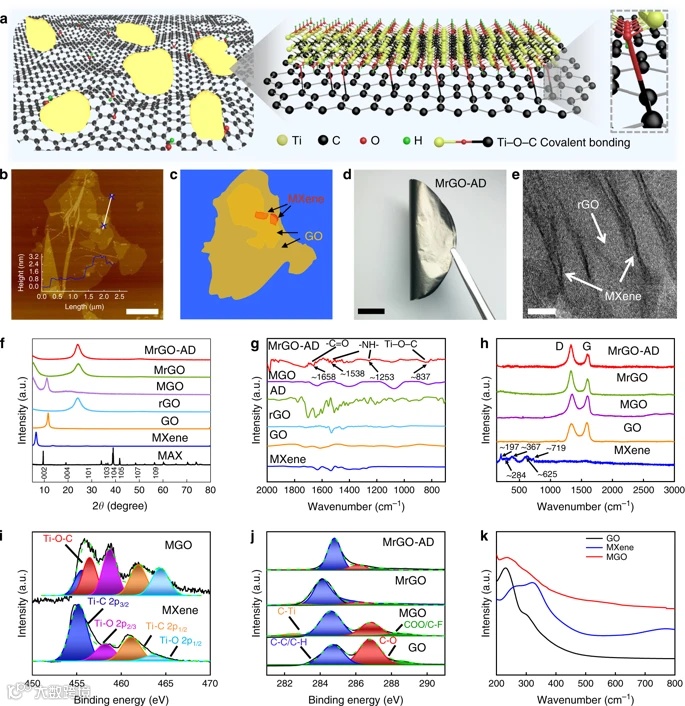
a. Schematic model of MXene-GO platelets showing the formation of Ti-O-C covalent bonding.
b. Atomic force microscope (AFM) of MXene nanosheet-functionalized GO platelets. Scale bar, 5 μm.
c. An illustration of the Mxene-functionalized GO platelets of b.
d. A photograph of a folded MrGO-AD sheet. Scale bar, 1 cm.
e. A high-resolution transmission electron microscopy (HR-TEM) image of the cross-section of the MrGO-AD sheet. Scale bar, 10 nm.
f. X-ray diffraction (XRD) patterns.
g. Comparisons of Fourier-transform infrared spectroscopy (FTIR) spectra.
h. Raman spectroscopy spectra of obtained sheets.
i. Ti 2p spectra of MXene and MGO sheets. A new peak at a binding energy of 456.5 eV indicates the formation of Ti-O-C covalent bonding between MXene and GO nanosheets.
j. Comparison of C 1s spectra. k UV-vis absorption spectra of MXene, GO, and MGO sheets. 

2:机械表征
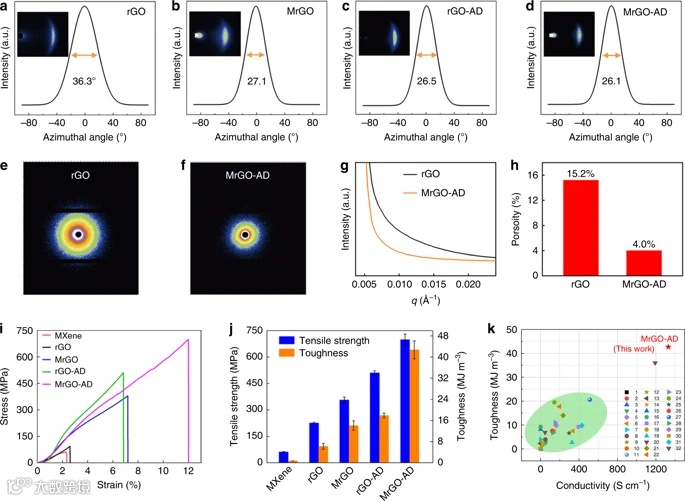
a-d. Azimuthal scan wide-angle X-ray scattering (WAXS) patterns (for a rotating anode X-ray source) showing the full width at half maximum (FWHM) of a rGO. b MrGO. c rGO-AD. d, MrGO-AD.
e, f. The corresponding small-angle X-ray scattering (SAXS) patterns for rGO and MrGO-AD.
g. Comparison of SAXS scattering intensities for rGO and MrGO-AD. These results indicate a decrease in porosity in going from rGO to MrGO-AD.
h. Bar graphs comparing the porosity of rGO and MrGO-AD.
i. Typical tensile stress–strain curves for the investigated sheets.
j. Bar chart comparing the toughnesses and conductivity of the obtained sheets.
k. Comparison of tensile strength and toughness MrGO-AD sheet with that of other graphene-based sheets. 

3:石墨烯片的增韧机理
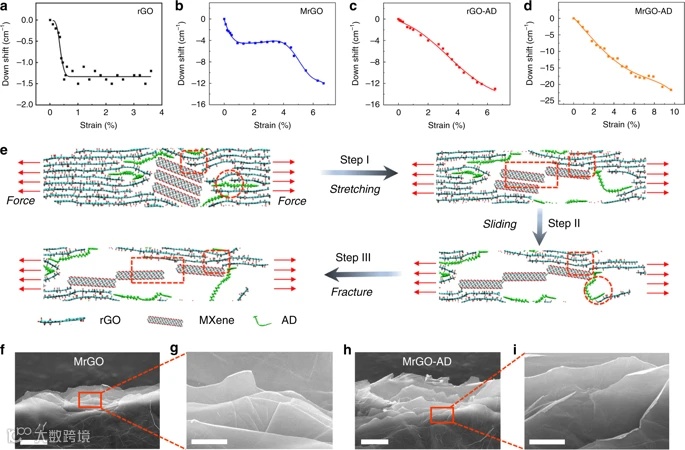
a–d The strain dependence of the downshift in Raman G-band frequency rGO, MrGO, rGO-AD, and MrGO-AD sheets.
e. The proposed fracture mechanism of the MrGO-AD sheet, according to molecular dynamics simulations. Ti–O-C covalent bonding between MXene nanosheets and rGO platelets (elliptical region), π-π bridging interactions between AD molecules and rGO platelets (circular region), and sliding between MXene nanosheets (rectangle region).
f–i Fracture morphology of the side views of MrGO (f, g) and MrGO-AD (h, i) sheets. Scale bar, 5 μm (f, h) and 1 μm (g, i). 

4:超级电容器的电化学表征
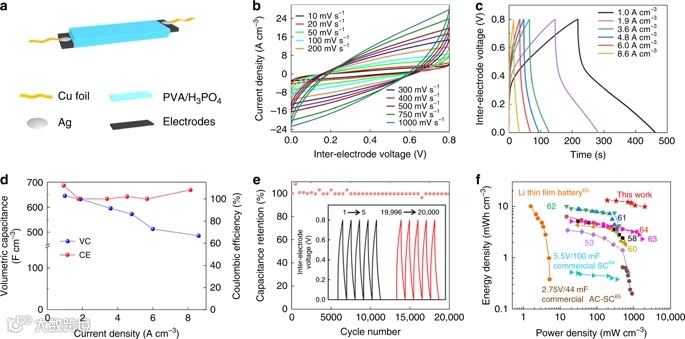
a. Illustration of the components of a flexible supercapacitor based on MrGO-AD sheets.
b. Cyclic voltammetry (CV) curves at scan rates of 10 to 1000 mV s−1 for the MrGO-AD supercapacitor.
c. GCD curves for the MrGO-AD sheet supercapacitor.
d. Volumetric capacitance of the MrGO-AD sheet supercapacitor for current densities from 1.0 to 8.6 A cm−3.
e. Capacitance retention during the cycling of a MrGO-AD supercapacitor.
f. Volumetric energy density and power density of the MrGO-AD supercapacitor compared with alternative energy storage systems.

5:严重弯曲对超级电容器的影响
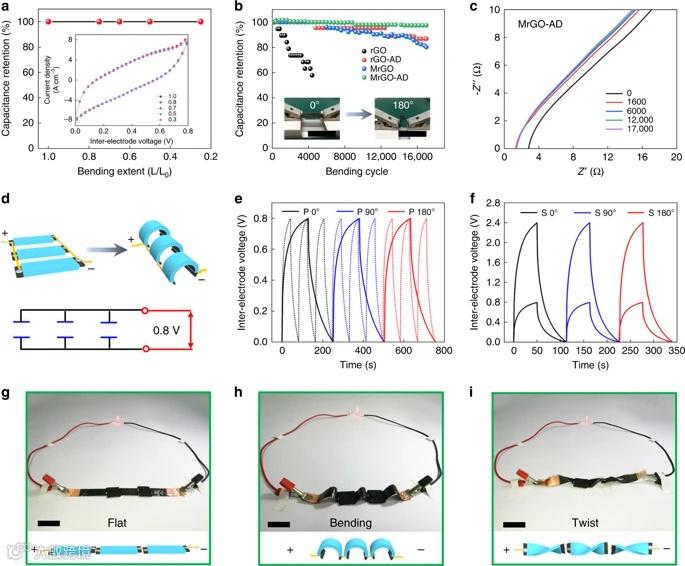
a. Capacitance retention as a function of the bending extent of the supercapacitor (which is defined as the ratio of the end-to-end separation in the bent supercapacitor to this separation for the non-bent supercapacitor).
b. Capacitance retention for supercapacitors based on rGO, rGO-AD, MrGO, and MrGO-AD sheets during up to 17,000 bending cycles to a bending extent of 25% (which corresponds to a 180° angle between supercapacitor ends). Scale bar, 2 cm (inset).
c. Nyquist plots for a MrGO-AD supercapacitor, which were measured after various cycles of bending to the 180° angle of b.
d. Schematic diagram of three in-parallel MrGO-AD supercapacitors (both unbent and with 180° angle bending) and the corresponding circuit diagram.
e. f. Galvanostatic charge-discharge curves for three e in-parallel and f in-series MrGO-AD supercapacitors.
g–i In-series operation of three MrGO-AD supercapacitors to light an LED (~1.7 V) when in g, flat. h, 180° bent. i in twisted states. Scale bar, 2 cm (g–i).

文章链接:
https://www.nature.com/articles/s41467-020-15991-6

导师简介:
程群峰
北京航空航天大学化学学院教授,博士生导师
研究领域:主要从事仿生纳米复合材料的研究工作,围绕纳米复合材料的界面作用及协同效应一关键科学问题,取得了一系列研究进展,提出了一种仿生构筑高强、高韧纳米复合材料的普适性策略。


版权声明:
1) 本文仅代表原作者观点,不代表本平台立场,请批判性阅读。
2) 本文内容若存在版权问题,请联系我们及时处理。
3) 如作者对该文章有误解误读,请联系我们进行修改,欢迎各位老师进行批评指正。
4) 本文版权归科学材料站公众号所有,翻版必究。
投稿请联系contact@scimaterials.cn
【声明】内容源于网络
0
0
科学材料站
内容 0
粉丝 0
科学材料站
总阅读0
粉丝0
内容0