



Publication Date: April 13,2020
Osaka Prefecture University
导读
基于特殊准结构模型用密度泛函理论计算了CaFe0.5Co0.5O3的电子态,发现CaFe0.5Co0.5O3的活性中心具有比母体化合物CaFeO3和CaCoO3更小的电荷转移能。这一发现表明,由组成金属的随机分布诱导产生的过渡金属离子周围的各种结构和电子环境有助于形成分散的电子能带结构,从而产生高活性的位点。
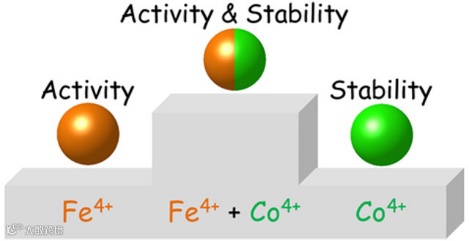
Fe-Co离子作用
关键词
放射学,氧化物,晶体结构,离子,钙钛矿
背景简介
1. 析氧反应应用阻碍与可能的解决办法
2. OER的高效催化剂
3. 研究Fe-Co增强催化活性的机理的方法
密度泛函理论(DFT)计算,特别是准空间结构(SQS)模型被广泛应用以来,可计算具有随机成分分布的固溶体系统的电子态。通过计算组成元素之间的相关函数,可获得具有相对较小的超级电池的合适的结构模型。
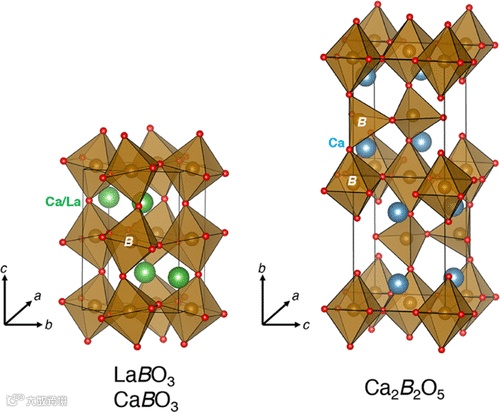
图1.晶体结构
文章介绍
近日,大阪府立大学的Ikuya Yamada教授与Hidekazu Ikeno教授在国际知名期刊Chemistry of Materials上发表题为“Enhanced Catalytic Activity and Stability of the Oxygen Evolution Reaction on Tetravalent Mixed Metal Oxide”的研究性论文。本文的第一作者为Masaya Kinoshita。
本文研究了几种Fe-Co混合金属氧化物的OER催化活性。无论晶体结构和价态如何,Fe-Co混合都能显著提高催化剂对OER的催化活性。CaFe0.5Co0.5O3具有异常高价的Fe4+和Co4+离子,表现出明显的催化活性,与BSCF相当。用SQS模型计算了CaFe0.5Co0.5O3的电子结构,结果表明,约一半的Fe和Co位的电荷转移能小于母体化合物,这使得OER成为高活性位。这一发现表明,由随机混合结构引起的过渡金属离子周围的各种环境有助于形成宽范围的电子能带结构,从而提高催化活性。
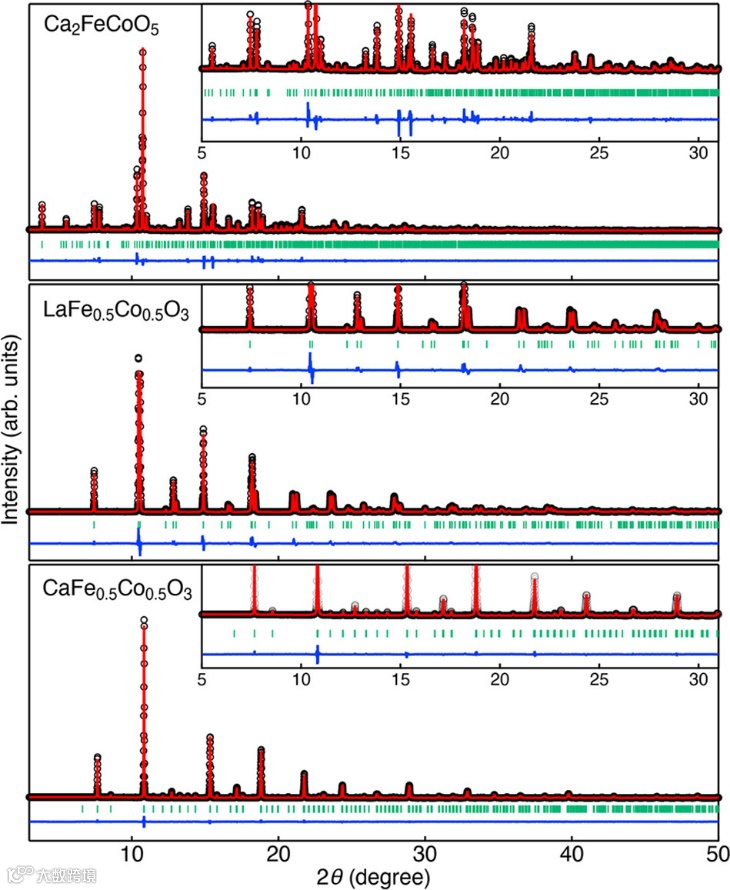
图2.SXRD数据的精细化结果
Rietveld refinement results of SXRD data for Ca2FeCoO5 (upper), LaFe0.5Co0.5O3 (middle), and CaFe0.5Co0.5O3 (bottom). Circles (black) and solid lines (red) represent observed and calculated patterns, respectively. The difference between the observed and calculated patterns is shown at the bottom (blue). The vertical marks (green) indicate the Bragg reflection positions. The wavelength was 0.49968 Å.
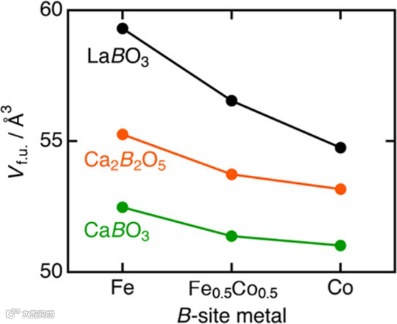
图3.晶格体积
Lattice volume per formula unit (Vf.u.) calculated from the Rietveld refinement result. The Vf.u. values for brownmillerite oxides (Ca2B2O5) were calculated assuming a half of chemical formula (CaBO2.5) for the sake of simplicity.
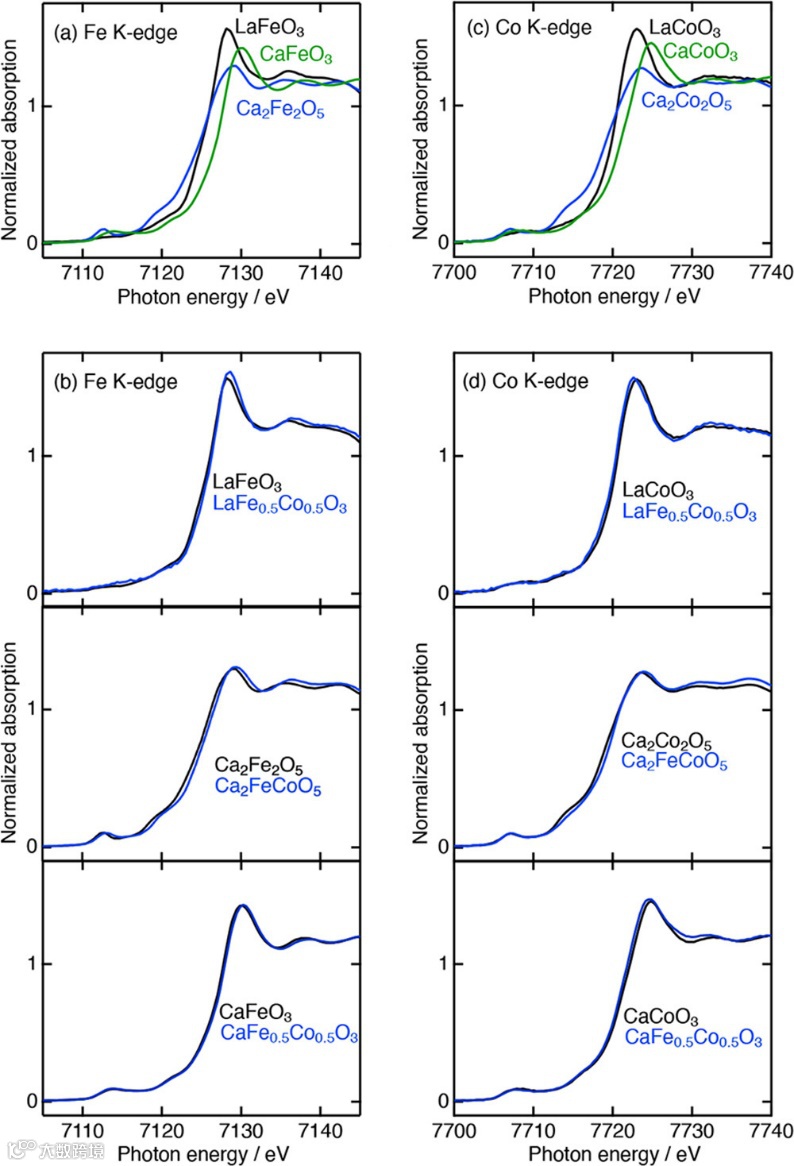
图4. XANES光谱
XANES spectra of (a and b) Co and (c and d) Fe K-edges for single-metal and mixed-metal oxides.
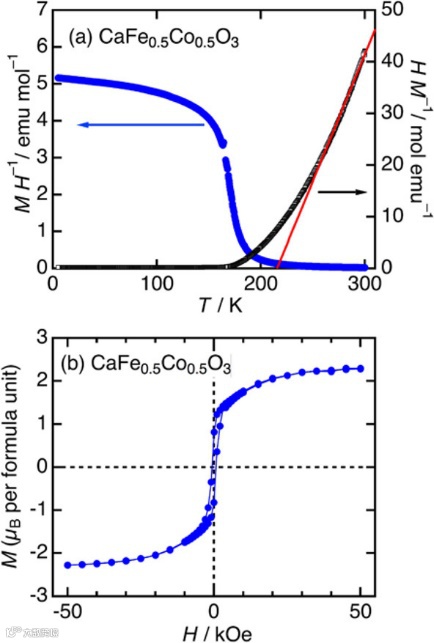
图5.磁化率、反磁化率与磁化曲线
(a) Temperature dependence of magnetic susceptibility (blue circles, left axis) and inverse susceptibility (black squares, right axis) for CaFe0.5Co0.5O3 measured in a field cooling of 1 kOe. The red line represents the fitting result obtained by using the Curie–Weiss formula.
(b) Isothermal magnetization curve for CaFe0.5Co0.5O3 at 5 K.
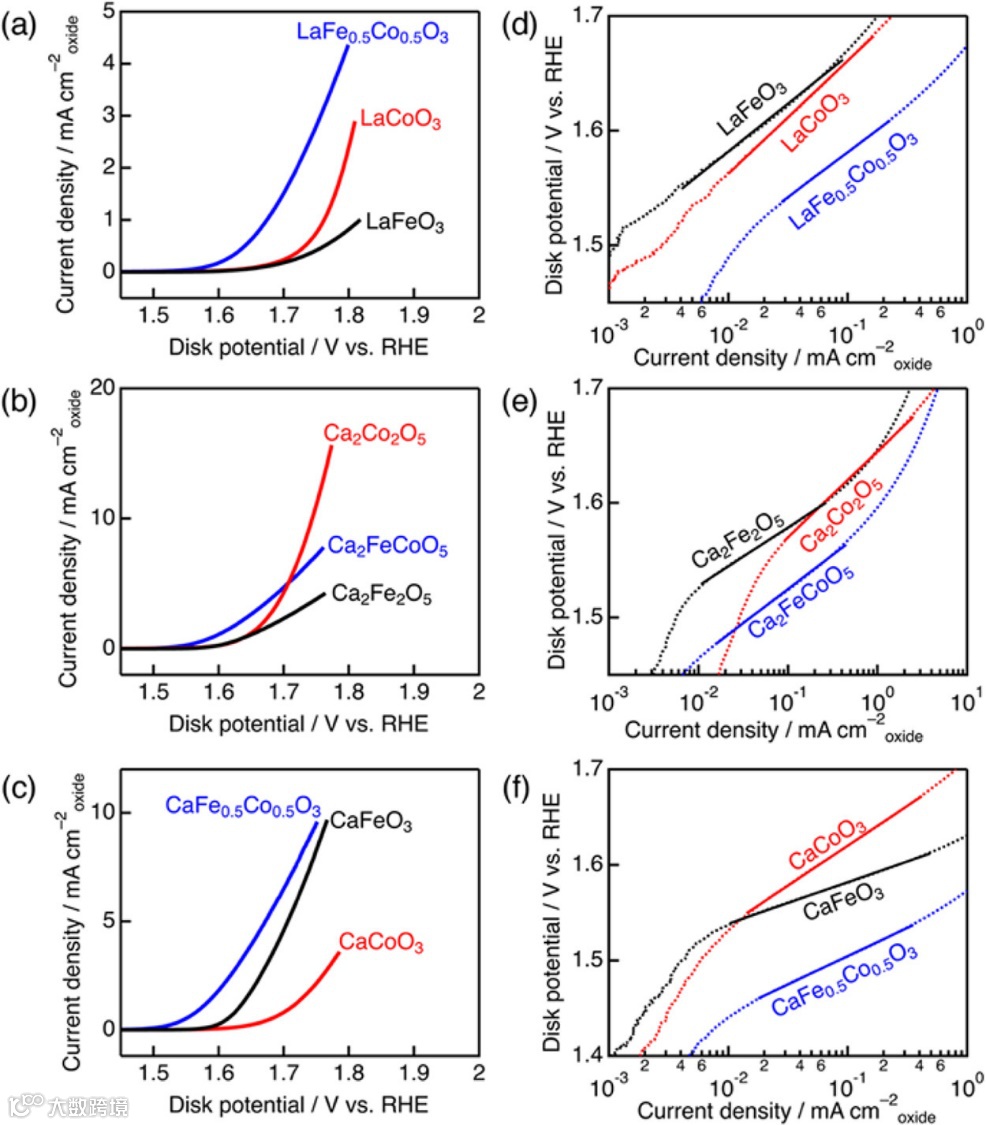
图6.线性扫描电压图与塔菲尔极化曲线图
(a-c) Linear sweep voltammograms for LaBO3, Ca2B2O5 and CaBO3.
(d-f) Tafel plots for LaBO3, Ca2B2O5 and CaBO3 (B = Fe, Co, and Fe0.5Co0.5).
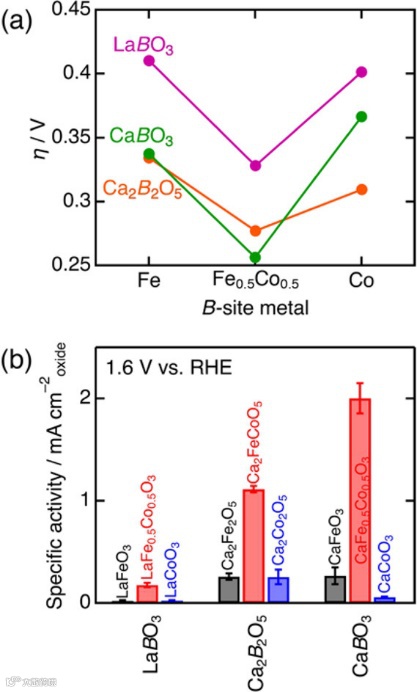
图7.过电位与比活性
(a) OER overpotential (η)
(b) specific activity for LaBO3, Ca2B2O5, and CaBO3 (B = Fe, Co, and Fe0.5Co0.5).
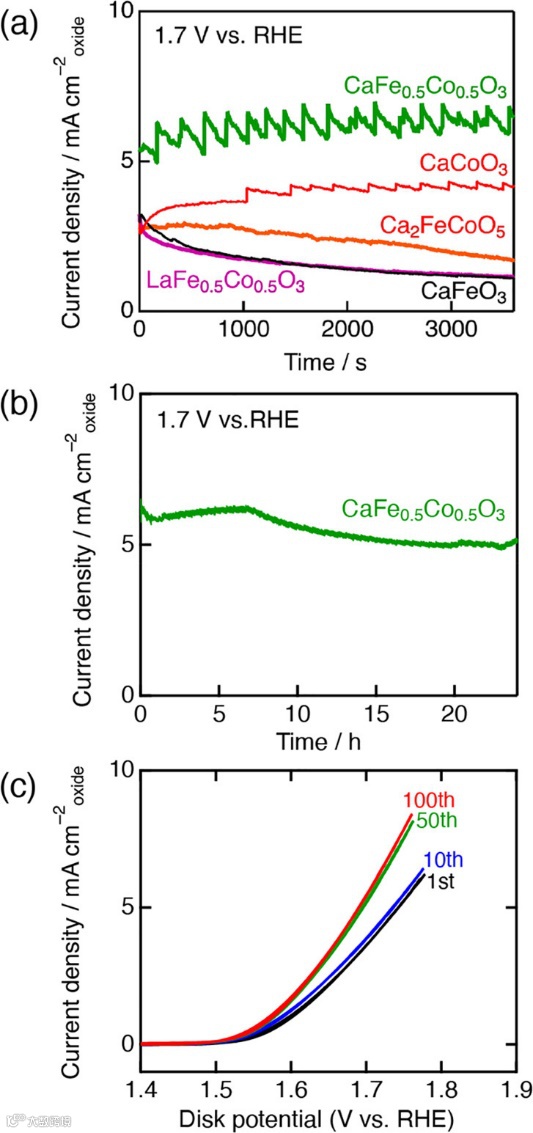
图8.计时电流图与循环伏安图
(a-b) Chronoamperograms measured at 1.7 V vs RHE in 1 h and 24 h. The sudden increases in current density for CaCoO3 and CaFe0.5Co0.5O3 are attributed to the removals of generated O2 bubbles.
(c) Cyclic voltammograms in 100 continuous measurements for CaFe0.5Co0.5O3.
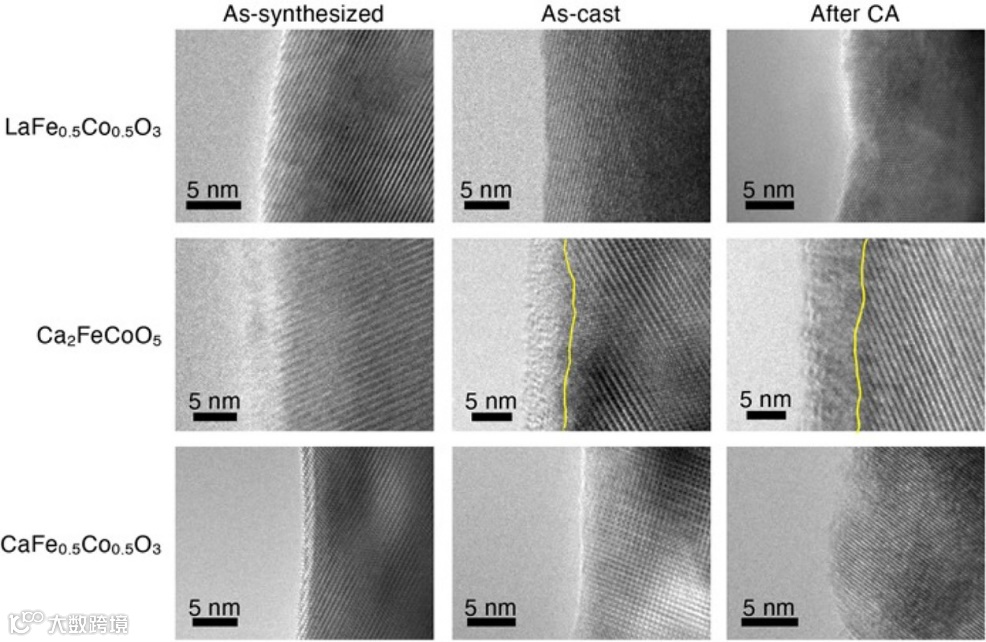
图9.HRTEM图
HRTEM images of Ca2FeCoO5, LaFe0.5Co0.5O3, and CaFe0.5Co0.5O3 as-synthesized, as-casted, and after chronoamperometry at 1.7 V vs RHE for 1h. The scale bars represent 5 nm. The yellow lines represent the boundaries between surface amorphous and bulk crystalline phases.
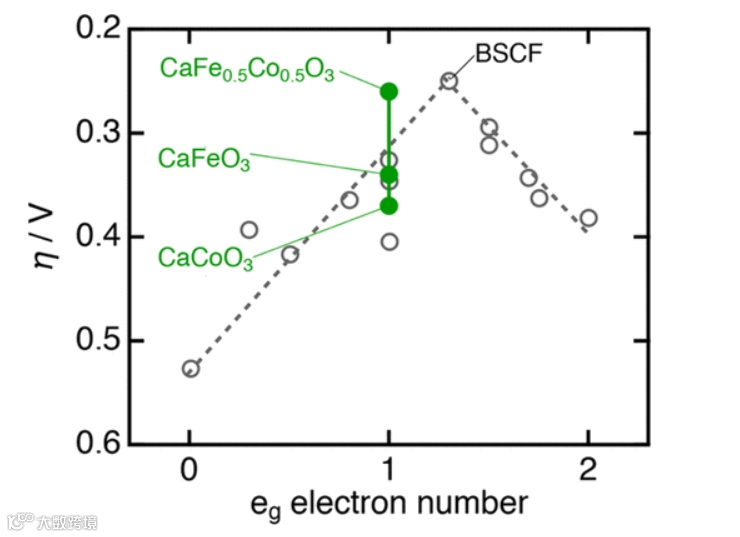
图10.电子数对比
OER overpotential (η) versus eg electron number for CaBO3 (B = Fe, Co, and Fe0.5Co0.5). Gray open circles represent the data taken from ref (11).
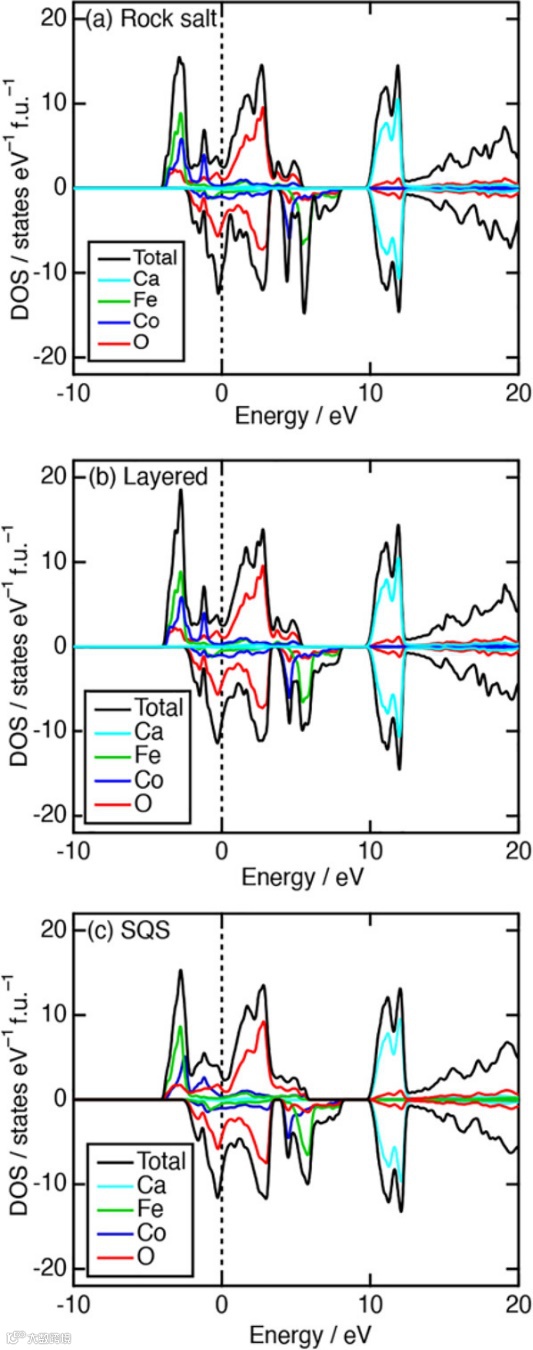
图11.全态密度与分波态密度
(a-c)Total and projected partial DOS for CaFe0.5Co0.5O3 calculated using rock-salt-type ordering and layered-type ordering of Fe and Co ions and the SQS model.
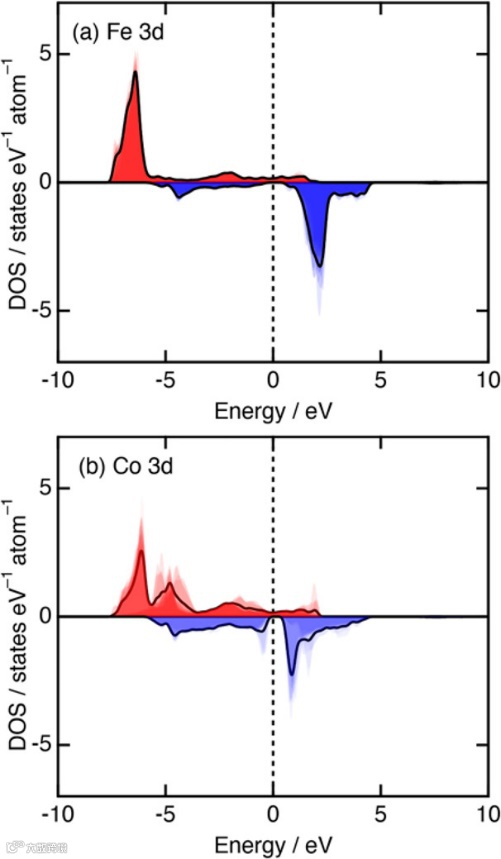
图12.使用SQS模型计算的投影态密度
Projected partial density of states (ppDOS) of Fe and Co 3d orbitals for CaFe0.5Co0.5O3 calculated using the SQS model. The lines represent the average DOS.
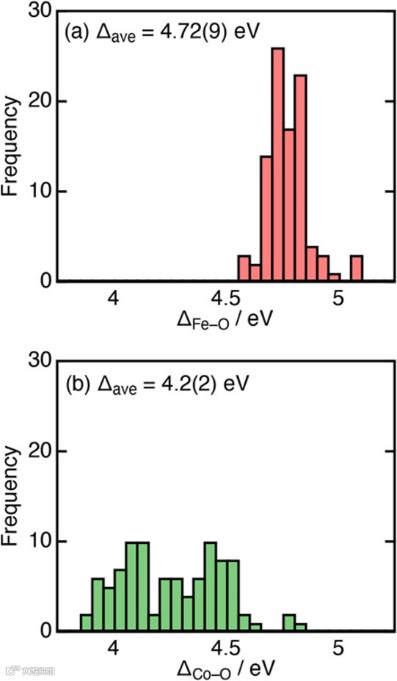
图13.SQS模型中能带中心电荷转移直方图
(a-b) Histogram of charge-transfer energies for Fe 3d–O 2p (ΔFe–O) and Co 3d–O 2p band centers (ΔCo–O) for the SQS model.
文章链接
https://pubs.acs.org/doi/10.1021/acs.chemmater.0c00061

【版权声明】
1) 本文仅代表原作者观点,不代表本平台立场,请批判性阅读。
2) 本文内容若存在版权问题,请联系我们及时处理。
3) 如作者对该文章有误解误读,请联系我们进行修改,欢迎各位老师进行批评指正。
4) 本文版权归科学材料站公众号所有,翻版必究。
投稿请联系contact@scimaterials.cn