


Available online 20 April 2020
南京大学
导 读
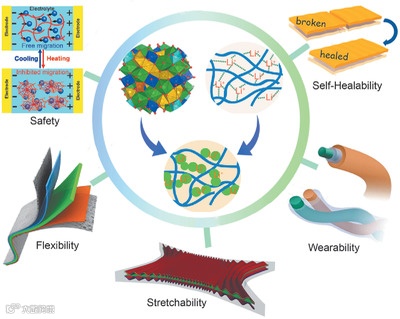
使用传统的液态电解质会产生挥发和泄漏,使电池的安全性受到严峻考验,而能够克服这些问题的固态电解质引起了越来越多的关注。本文首先介绍了三种主要的固态电解质(无机、聚合物和复合电解质),并对它们的结构和性能进行了比较。然后讨论了固态电解质在制造安全、灵活、可拉伸、可穿戴和自我修复的储能装置方面的优势。最后总结了该领域存在的挑战和可能的发展方向,对电池电解液的发展具有重要的指导意义。
关键词
电池,电池安全性,柔性器件,固态电解质,超级电容器
背景介绍
1.固态电解质相对于有机电解液用于储能器件的优势
可穿戴和可植入式设备强烈要求具有安全、柔软和多功能的不可或缺的储能系统。然而,商用储能设备的有毒和易燃有机液体电解质会造成重大的安全隐患,并且由于有机液体电解质的密封性很强,很难达到要求的柔韧性和延展性。
以无机陶瓷或聚合物为基体的固态电解质具有独特的优点:
a. 自支撑固体电解质简化了封装工艺和技术要求。
b. 机械强度高的无机陶瓷能使固体电解质有效抑制枝晶生长,从而防止短路,降低安全风险。
c. 聚合物固体电解质具有独特的弯曲刚度和弹性模量,使储能装置具有很高的柔韧性和延展性。
d. 由于聚合物链之间的复杂相互作用,所得到的储能装置具有更多的功能,如固体电解质的自修复等。
2.以固态电解质为基础的储能器件广泛应用
近几十年来,人们对一系列以固体电解质为基础的储能装置进行了广泛的探索,并期望在不久的将来能极大地改善我们的生活。例如,轻质、安全、灵活的储能装置可以直接佩戴在人体上,生物相容性储能装置可以植入组织或器官中,为体内医疗器械持续提供能量。
核心内容
在此,南京大学张晔副教授等人综述了储能器件用固态电解质的研究进展。该工作发表在国际知名期刊Advanced Functional Materials上,文章第一作者Tingting Ye。
本文首先介绍了固体电解质的种类、结构、性质和离子输运机理。重点介绍了安全、灵活、可拉伸、可穿戴和自我修复的储能装置(包括超级电容器、金属电池和金属空气电池)的制造和性能。最后,总结了固体电解质储能装置在实际应用中面临的挑战和前景,并提出了今后的研究方向。
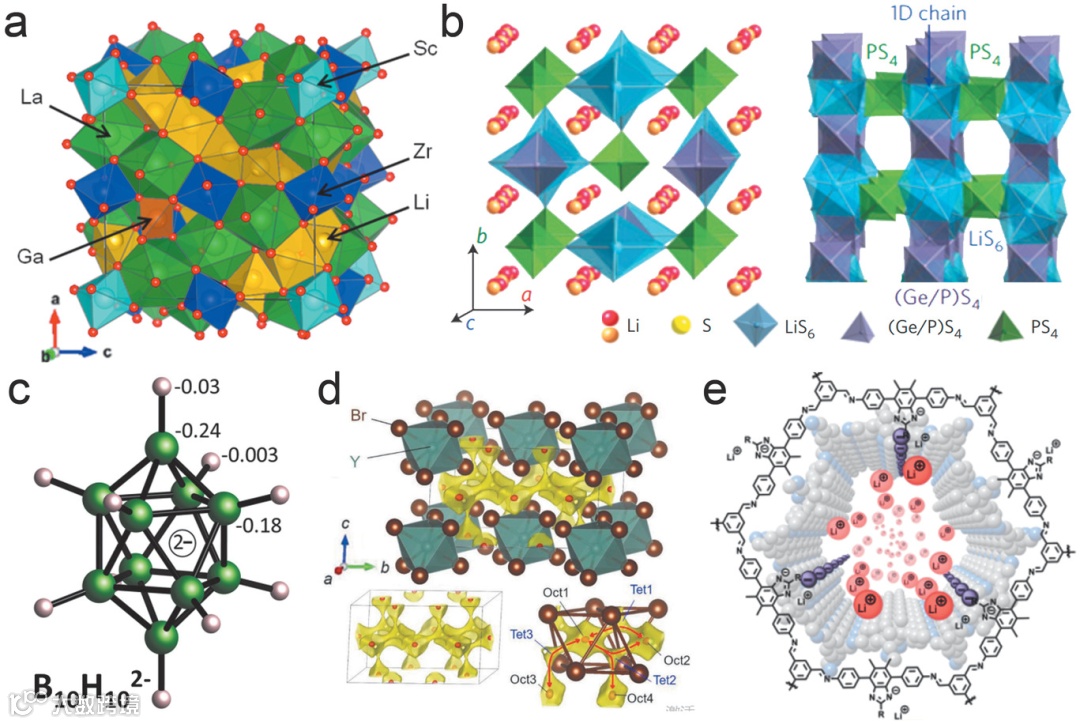
图1. 无机固态电解质
(a) The unit cell of Li54Ga1La24Zr15Sc1O96.
(b) Crystal structure of Li10GeP2S12 and framework structure of Li10GeP2S12. 1D chains are formed by LiS6 octahedra and (Ge0:5P0:5)S4 tetrahedra, and these chains are connected by a common corner with PS4 tetrahedra.
(c) Related geometries of the B10H102- anions.
(d) The crystal structures of Li3YBr6.
(e) The structures of imidazolate-ionic COF.
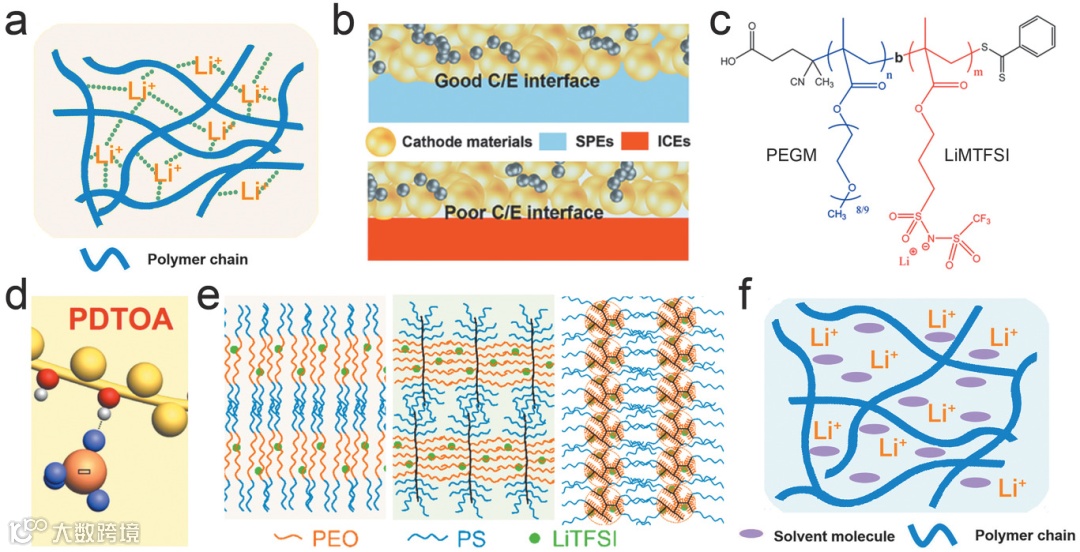
图2. 聚合物固态电解质
(a) Schematic diagram of polymer solid electrolytes.
(b) Schematic of physical contact of polymer solid electrolyte and inorganic solid electrolyte with electrode material.
(c) The molecular formula of the poly(PEGM)-b-poly(LiMTFSI) copolymer.
(d) Illustration of the interaction between thioamide groups in PDTOA and anions. (e) Illustration of the PEO-PS copolymers blended with LiTFSI).
(f) Schematic diagram of gel polymer electrolytes.
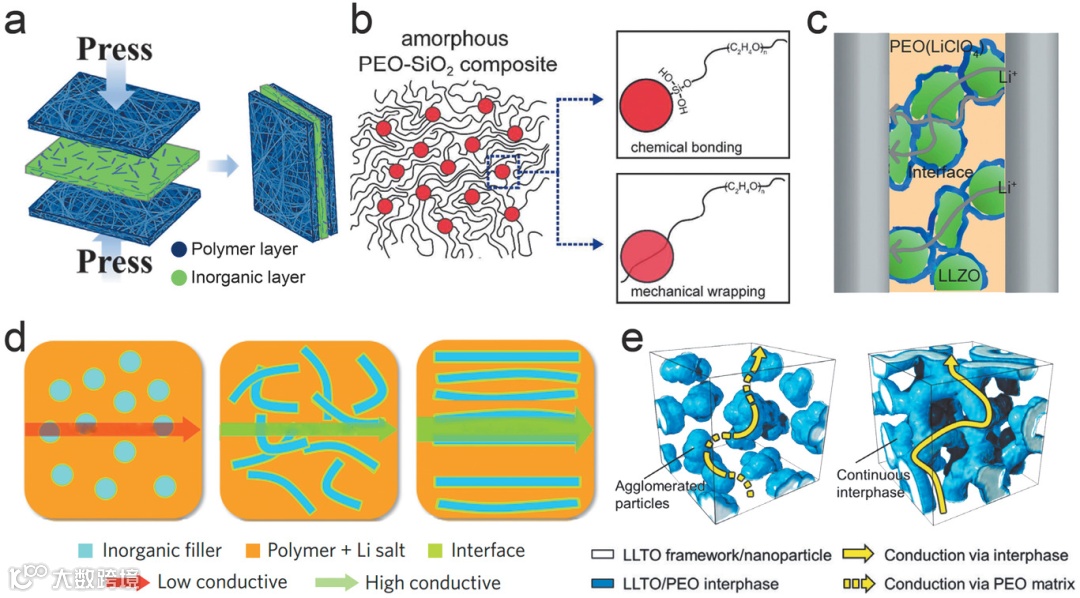
图3. 复合固态电解质
(a) Illustration of polymer/inorganic/polymer sandwiched structure.
(b) Schematic of interaction mechanisms between PEO chain and SiO2. Two possible interaction mechanisms are shown.
(c) Li+ transport pathways within the composite solid electrolyte.
(d) Li+ conduction pathways in composite polymer electrolytes with nanoparticles, random nanowires and aligned nanowires.
(e) Schematic representation of possible conduction mechanism in composite electrolytes with agglomerated nanoparticles and 3D continuous framework.
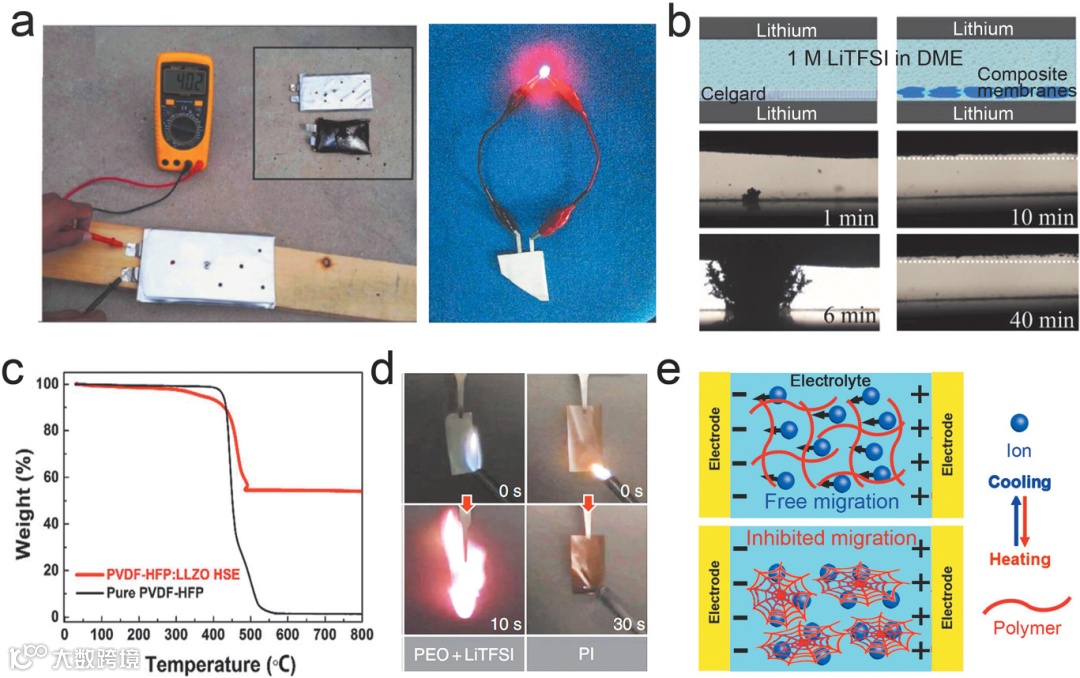
图4. 储能装置的安全性
(a) Impact of external factors on safety. The lift photograph indicates the pouch-type cells with solid electrolyte and liquid electrolyte after nail penetration test. The right photograph indicates solid-state, soft-package lithium batteries to power a red LED after being cut.
(b) Optical images of dendrite growth in symmetric Li-Li cell with Gelgard (left) and composite membrane (right).
(c) Thermogravimetric analysis of the PVDF-HFP and LLZO composite electrolyte and the pure PVDF-HFP electrolyte.
(d) Photographs of flame test on a PEO/LiTFSI film and a PI film.
(e) Schematic diagram of the working mechanism of the thermoresponsive polymer solid electrolyte.
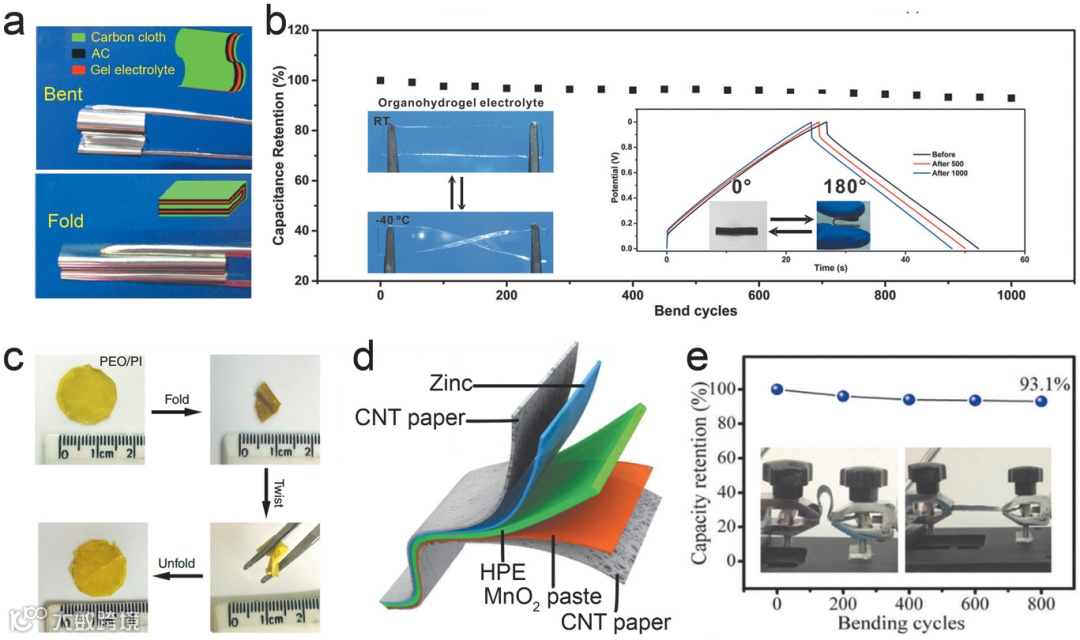
图5. 储能装置的灵活性
(a) Schematic diagram of fabricated supercapacitor with PHA gel film and its flexible behavior.
(b) Photograph of the PVA organohydrogel electrolyte under twisting at −40 °C and the cycling stability of the supercapacitor with PVA organohydrogel electrolyte under a 180° bending angle.
(c) Photographs of PI/PEO/LiTFSI electrolyte under folding, twisting and unfolding.
(d) Schematic illustration of the flexible zinc-ion battery.
(e) Capacity retention of the flexible zinc-ion battery under different bending cycles.
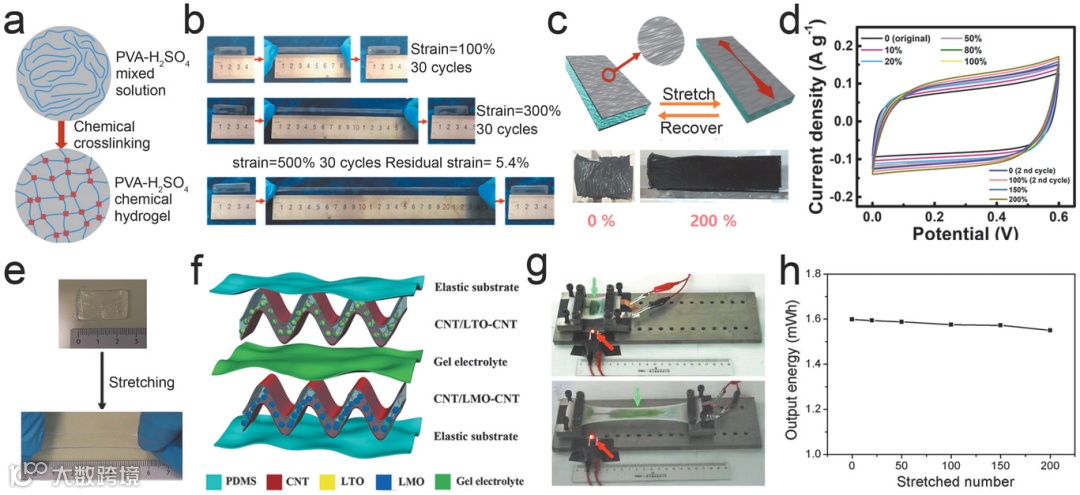
图6. 储能装置的可拉伸性
(a) Schematic of PVA-H2SO4 blended solution and chemical hydrogel.
(b) Recovery performance of Agar/HPAAm hydrogel under different stretching conditions.
(c) Schematic and photographs of supercapacitor with Agar/HPAAm hydrogel at the states of stretched and recovered.
(d) CV curves for Agar/HPAAm hydrogel-based supercapacitor at different strains.
(e) Photographs of the stretchability test of PAM-WiS hydrogel electrolyte.
(f) Schematic illustration of the stretchable lithium-ion battery.
(g) Stretchable lithium‐ion battery lighting up an LED before and after stretching by 400%.
(h) Dependence of the output energy on stretching cycles.
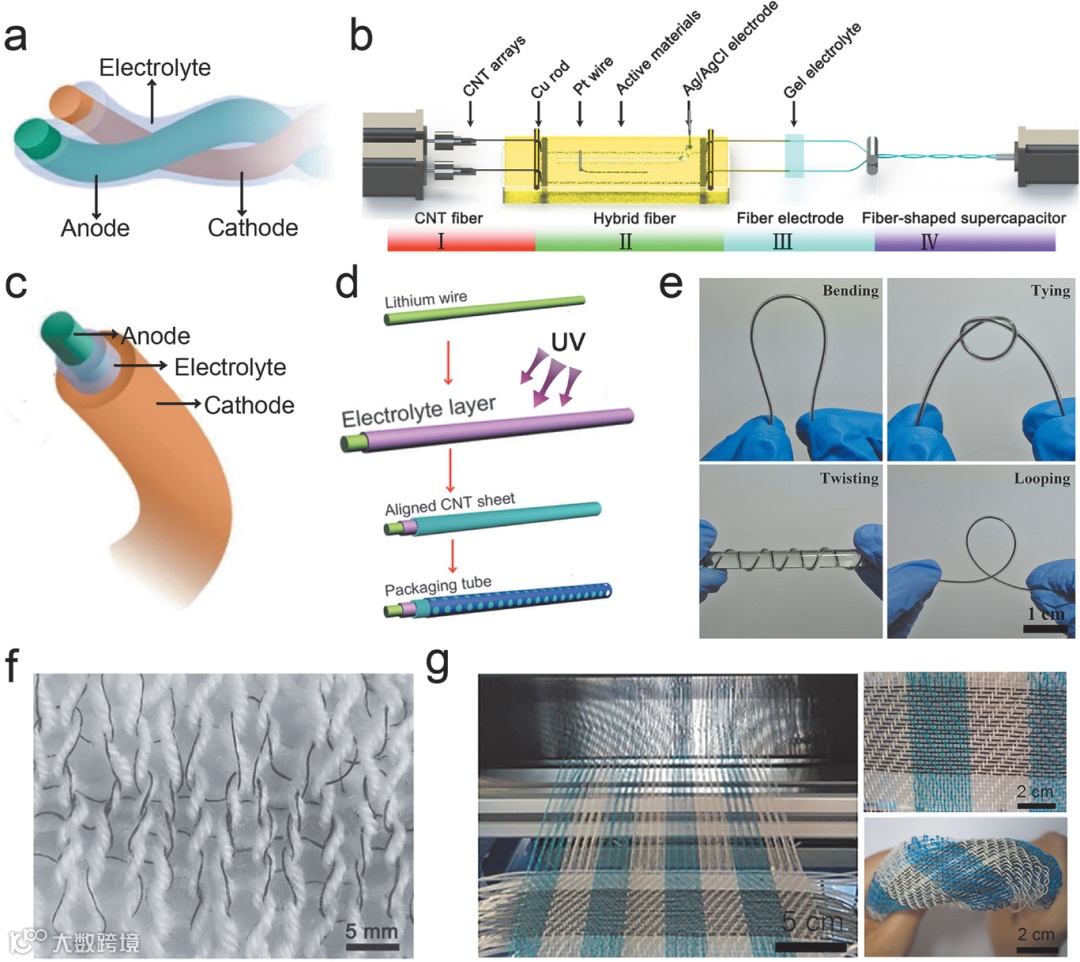
图7. 储能装置的可穿戴性
(a) Schematic illustration of twisted structure.
(b) Schematic illustration of the continuous fabrication process of fiber-shaped supercapacitors. (c) Schematic illustration of coaxial structure.
(d) Schematic illustration of the fabrication of the fiber-shaped lithium-air battery.
(e) Photographs of the fiber-shaped battery under various deformations.
(f) fiber-shaped supercapacitors being woven into flexible textiles.
(g) The progress of fiber‐shaped batteries being woven into a textile and the textile before and after twisting.
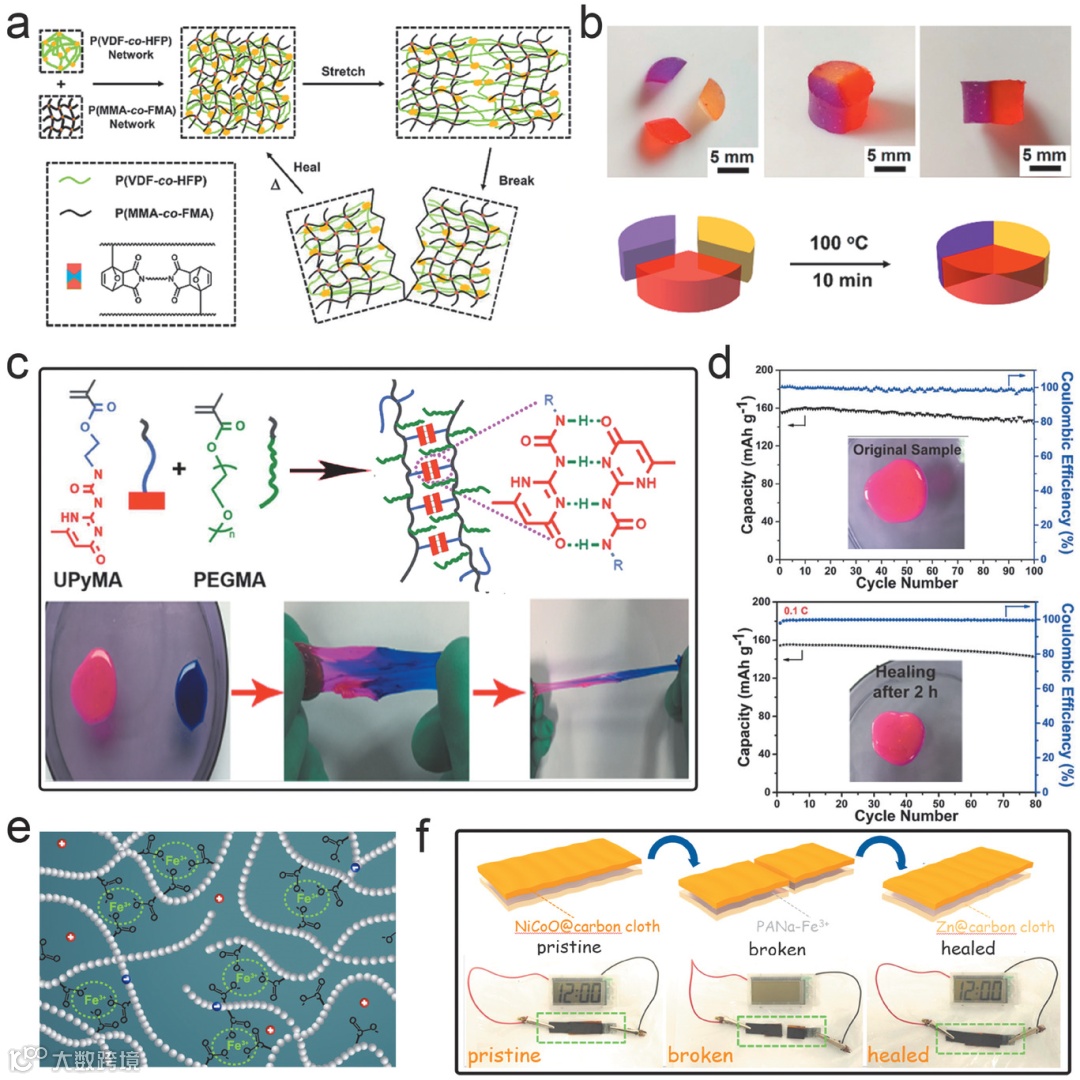
图8. 储能装置的自愈性
(a) Schematic illustrations of the composition of the P(FMA-co-MMA)/P(VDF-co-HFP) double network structure and its self-healing process.
(b) Three fan-shaped P(FMA-co-MMA)/P(VDF-co-HFP) gel polymer electrolytes.
(c) Schematic illustration of the synthesis and self-healing mechanism of the brush-like UPyMA-PEGMA copolymer, and optical images of the self-healing process under ambient conditions.
(d) Cycling performance of the LFP||Li cell at 0.1C with UPyMA-PEGMA gel polymer electrolyte (top) and healed UPyMA-PEGMA gel polymer electrolyte (bottom). The inset images show the as-fabricated and healed sample.
(e) Schematic diagram of self-healability PANa-Fe3+ hydrogel.
(f) Photographs of the self‐healing aqueous battery based on PANa-Fe3+ hydrogel powering a clock before cutting (left), after cutting (middle), and after self-healing (right).
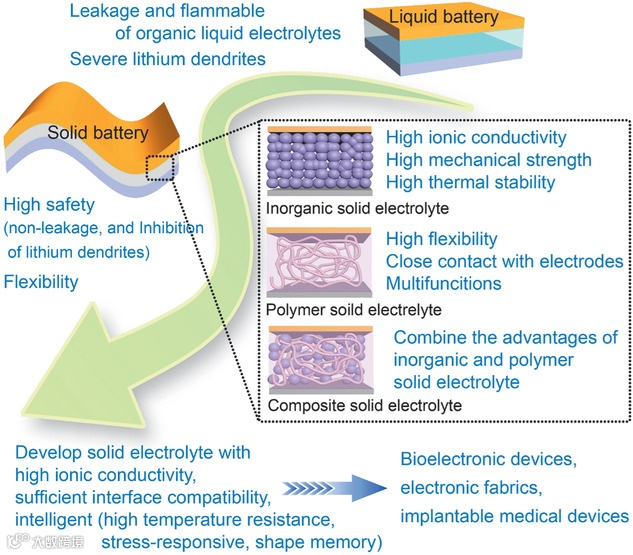
图9. 固态电解质概述及未来发展方向
文章链接

https://onlinelibrary.wiley.com/doi/full/10.1002/adfm.202000077
老师介绍
张晔 副教授
张晔,先后在郑州大学材料科学与工程学院和复旦大学先进材料实验室获得学士和博士学位,随后加入美国哈佛大学从事博士后研究工作,2019年加入南京大学现代工程与应用科学学院任副教授。主要从事新型材料和电子器件的开发,在国际上率先提出并发展了一系列新型纤维状储能器件。共发表SCI论文50余篇,其中以第一、共一或通讯作者发表论文15篇,包括1篇Nature Reviews Materials、8篇Angewandte Chemie International Edition和1篇Advanced Materials。研究成果两次被Nature以研究亮点进行专题报道。授权发明专利7项,其中2项实现了技术转让。因其研究成果,张晔获得了国际纯粹与应用化学联合会IUPAC-SOLVAY青年化学家奖(全球共5人),美国材料研究学会优秀博士生金奖(全球共8人)、日内瓦国际发明金奖等10多项国内外学术荣誉。

【版权声明】
1) 本文仅代表原作者观点,不代表本平台立场,请批判性阅读。
2) 本文内容若存在版权问题,请联系我们及时处理。
3) 如作者对该文章有误解误读,请联系我们进行修改,欢迎各位老师进行批评指正。
4) 本文版权归科学材料站公众号所有,翻版必究。
投稿或兼职作者请联系contact@scimaterials.cn