


Version of record online: 17 April 2020
中科院化学所
导 读
催化反应中总体反应速率取决于产物附着和反应物脱离的传质速度。所以催化剂表面的动态状态会显著影响催化过程。在催化反应中分子扩散作为一种主要的扩散机制,它被认为是一个缓慢的过程,抑制了反应物与多相催化剂之间的快速接触,从而降低了催化转化效率。
在此本文报告了一种策略可以打破这样的停滞层,以促进物质运输到催化剂表面,作者将Pd纳米管(NCs)封装在柔性金属有机框架(MOF)纳米片中作为氢化反应的催化剂。可变形的柔性MOF可以增强Pd纳米管上的物质传输,进而提高了催化剂的性能。
作者结合数值模拟证实:在受流体剪切力驱动下,含可变形MOF体系对染料的吸附和催化转化率与不含可变形MOF体系相比,分别提高了5倍和3倍。随着MOF纳米片长宽比的增大,催化效率呈现火山型增长趋势,当长宽比为2:1时催化效率达到最大。这项工作为基于多相催化反应机理设计催化剂提供了典范。
背景简介
1.多相催化机制
多相催化在许多工业产品是中一种经济有效和可持续的途径。催化材料与特定反应物的反应机理、化学热力学、相互作用等已被广泛研究。在多相催化体系中,催化反应发生在表面,通常涉及固相催化和液相反应物进行分子吸附、反应和解吸循环。反应物迅速与表面相互作用,产物迅速从催化表面分离。
2.催化效率低的原因
催化效率对催化剂表面附近区域的状态特别敏感,该区域受传质控制。根据“无滑移边界条件”,物质传输速率随距催化剂表面的距离呈线性下降趋势,最终变为零(图1a)。因此,沿催化剂表面的分子滞流边界层有点像绝缘层,阻碍了催化转化效率的提高,其中由于分子扩散速度慢,化学反应的消耗受到传质的限制。
3. 从柔性MOF纳米材料中受到启发探索新的催化剂
从柔性MOF纳米材料中受到启发,作者考虑该材料是否在流动流体系统中能实现更大的变形性,探索在原子/分子水平上合理设计催化剂的界面扰动-性能关系,这可能打破分子沿催化剂表面的滞流边界层,最终提高了催化转化效率。
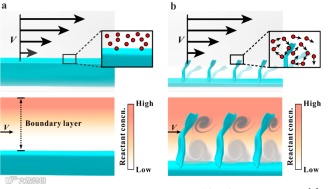
图1 传质速率与催化剂表面距离的关系
【文章介绍】
近日,中科院化学所王铁教授课题组在国际知名期刊Journal of the American Chemical Society (2018 IF: 14.695)上发表题为“Deformable Metal-Organic Framework Nanosheets for Heterogeneous Catalytic Reactions”的研究。Chuanhui Huang和 Zhihong Guo为本文共同第一作者。
作者通过数值模拟和原位测量验证了MOF纳米片的变形性和提高的物质输运性能。与传统的不可变形型Pd-NCs@MOF膜相比,可变形的Pd-NCs@MOF-NAF膜对染料的吸附和加氢反应的转化率有了显著提高。这种多用途策略适用于纳米MOF-NAF薄膜的可控、高效、经济合成和应用,为柔性低维纳米催化剂的大规模工业应用提供了一种途径。
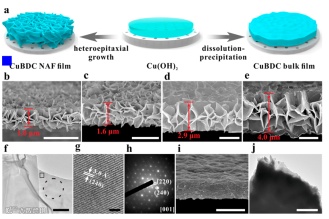
图2 MOFs NAF膜的合成过程及SEM/TEM图
(a) Schematic overview of the preparation of the MOF NAF film and the bulk-type film.
(b−e) Cross-sectional scanning electron microscope (SEM) images of the as-synthesized MOF NAF-0.5, NAF-1, NAF-2, and NAF-3 products.
(f) Transmission electron microscope (TEM) images of the MOF nanosheet from the NAF-2
product.
(g) High-resolution TEM image of the black square shown in (f).
(h) Selected-area electron diffraction pattern (black dashedcircle in (f)).
(i) Cross-sectional SEM image of the as-synthesized bulk-type MOF film. (j) TEM images of the bulk-type MOF film. Thediameter and pore size of the nylon-66 membrane were 47.0 mm and
0.22 μm, respectively. Scale bars represent 2 μm for (b−e), 500 nmfor (f), 5 nm for (g), 2 μm for (i), and 500 nm for (j).
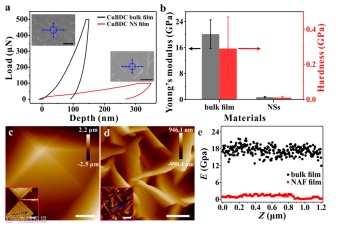
图3 MOFs NAF膜的机械性能
Typical load−displacement nanoindentation curves for different MOF film structures. The insets are scanning-electronmicroscope images of the surfaces of the bulk-type MOF and nanosheet films on Si and SiO2 substrates, respectively; the blue crosshair represents the test site.
(b) The Young’s modulus and hardness of different MOF structures.
(c) Atomic force microscopy (AFM) height channel visualizing the surface of the nanosheetassembled frame (NAF) film. The inset shows the corresponding Derjaguin−Mueller−Toporov (DMT) Young’s modulus map.
(d)AFM height channel visualizing the surface of the bulk-type MOF film. The inset shows the corresponding DMT Young’s modulus map.
(e) Profile analysis of the Young’s modulus map along the blue dashed line in (c) and (d). Scale bars represent 1 μm for the inset in (a) and 500 nm for (c,d) and their insets.
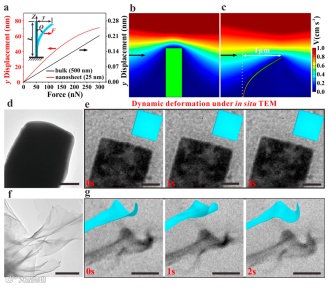
图4 原位TEM图
(a) Relationship between the applied force and the lateral deflection distance (x displacement) determined by field-emission microscopy using the nonlinear mode in the COMSOL Multiphysics
5.4 software. The inset shows the geometrical parameters of the curved nanosheet, which depicts the deflection (δ) when the force (F) from the distributed load caused by the flow was applied.
(b,c) Flow field around the bulk MOF and a single MOF nanosheet, wherein the arrow indicates the flow direction. The deformation of the nanosheet (E = 0.2 GPa) was 1.0 μm at 1.0 cm s−1 velocity.
(d) Transmission electron microscopy (TEM) image of the bulk MOF crystal.
(e) In situ TEM images showing the shape-invariant property of the bulk MOF crystal (from 0 to 1 and 2 s).
(f) TEM image of the edge of the MOF nanosheet-assembled frame (NAF) film.
(g) In situ TEM was used to observe the dynamic deformation of the nanosheets at the edge of the NAF film in the fluid. The TEM images show the transformable property of the MOF nanosheets, thatis, the outside edge of the nanosheets constantly twisting its shape to accommodate fluid changes (from 0 to 1 and 2 s). Scale bars represent 500 nm for (d,e), 500 nm for (f), and 400 nm for (g).
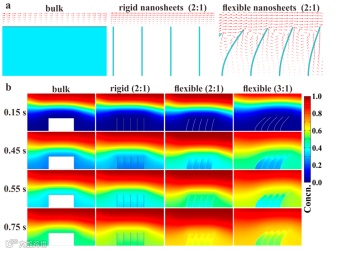
图5 流体-结构相互作用的数值模拟
(a) Velocity vectors and (b) concentration fields evolving with time.The numbers in brackets represent the ratio between the height and spacing of the nanosheets. Only the flexible nanosheets generated vortices and thus induced downward convection, which resulted in enhanced transport of reactants.
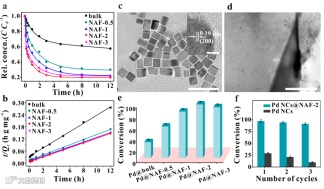
图6 吸附与催化性能
(a) Rates of adsorption of phenol red dye by different metal−organic framework (MOF) film samples.
(b) Pseudo-second-order plots of the adsorption by different MOF films as a function of adsorption time.
(c) Transmission electron microscopy (TEM) image of the Pd nanocubes (NCs) and high-resolution TEM image of the Pd NCs (inset).
(d) TEM image of the Pd NCs@NAF composites.
(e) Hydrogenation conversions for various alkenes catalyzed by the Pd NCs@MOF composites.
(f) Recyclability of the Pd NCs@NAF composites and Pd NCs for the hydrogenation of 1-hexene. Scale bars represent 50 nm for (c) and 2nm for its inset, and 500 nm for (d). Error bars represent the standard deviation of three replicate samples.
文章链接:
https://pubs.acs.org/doi/10.1021/jacs.0c02272
老师简介:
王铁,中科院化学所研究员,博士生导师
2013年起在中国科学院化学研究所任研究员,博士生导师,中国科学院大学兼职教授,北京大兴研究员理事,国仟医疗投资有限公司联合创始人,山东烟台市国家经济技术开发区副区长。获国家基金委杰出青年基金、优秀青年基金,科技部中青年领军人才、中科院创新交叉团队负责人,并获得了中国分析测试协会科学技术奖一等奖(第一完成人)。应邀担任《Journal of Analytical & Molecular Techniques》编委、《Rare Metals》编委、《高等学校化学学报》青年编委和《化学进展》青年编委等。发表了一系列科研成果。在Science, Chem. Soc. Rev., J. Am. Chem. Soc., Adv. Mater., Angew. Chem., Nat. Commun., Anal. Chem.等核心杂志发表论文共80余篇,他引2600多次。
研究方向:
1. 功能纳米材料自组装行为的机理以及应用研究
2. 有机、无机杂化纳米材料的结构构建、功能开发及分析检测应用研究
3. 功能化纳米材料及其组装体在呼出气疾病标志物检测和活体分析化学中的应用
4. 生命流动体系中痕量目标物的捕获与分析检测
版权声明:
1) 本文仅代表原作者观点,不代表本平台立场,请批判性阅读。
2) 本文内容若存在版权问题,请联系我们及时处理。
3) 如作者对该文章有误解误读,请联系我们进行修改,欢迎各位老师进行批评指正。
4) 本文版权归科学材料站公众号所有,翻版必究。

投稿请联系contact@scimaterials.cn