


Published: 21 April 2020
1
导读
纳米催化剂和单原子催化剂是两种不同的催化剂,但都是多相催化的关键。然而,理论研究表明,在CO氧化的过程中,Au纳米颗粒/团簇会释放出Au单原子,随后共同催化氧化。然而,目前还没有报道过共催化的实验证据或是单原子催化剂多相催化过程的直接观察结果。本文利用高时空分辨率的原位透射电子显微镜对纳米多孔Au催化甲烷裂解的动力学过程进行了监测。研究表明,在一定条件下,纳米多孔Au和Au单原子的多相催化过程不是独立的,而是动态共催化的。
2
关键词
催化机理,多相催化,Au单原子,多孔Au,共催化
3
背景简介
1. 共催化概念的提出
多相催化是化工、能源、环保等行业及其相关基础研究的关键过程,如加氢、CO氧化、CH4活化利用等。纳米催化剂和单原子催化剂是目前发展最快的两类重要的多相催化剂。这两类化合物都表现出了优异的性能和互补功能,其催化过程和机理通常被认为是不同的,
然而最近的两项工作通过理论计算表明,在Au纳米粒子/团簇催化的CO氧化过程中,Au单原子(SAs)能从纳米颗粒/团簇中脱离,SAs和纳米颗粒/团簇共同催化CO氧化。这些结果给我们提供了一个启示,即纳米催化剂的非均相催化过程与SACs之间的鸿沟可以通过共催化来弥合。
2. 共催化研究存在的问题
到目前为止,还没有实验证据表明在纳米催化剂的多相催化过程中会出现SACs。同时,尽管金属SAs在全固相催化中催化碳纳米结构生长的动力学过程已经得到了证明,但没有对SACs的任何多相催化过程的直接观察的报道。因此,在任何由纳米催化剂和SACs引发的多相催化过程中,是否存在共催化仍是一个未知数。
3. 甲烷裂解的研究现状
在多相催化反应中,甲烷(CH4)裂解是制备纳米碳和最环保的能源载体氢气(H2)的绿色技术,这对于缓解与CH4排放相关的环境挑战也很重要。同时,Au纳米催化剂及其衍生的催化剂对CH4的活化和利用也表现出良好的催化活性。纳米多孔Au(NPG)作为一种具有三维双连续多孔结构的新型金纳米催化剂,在多相催化方面表现出了优异的性能。其独特的结构具有比表面积大、密度低、渗透性好等优点,有利于催化反应的非均相化。
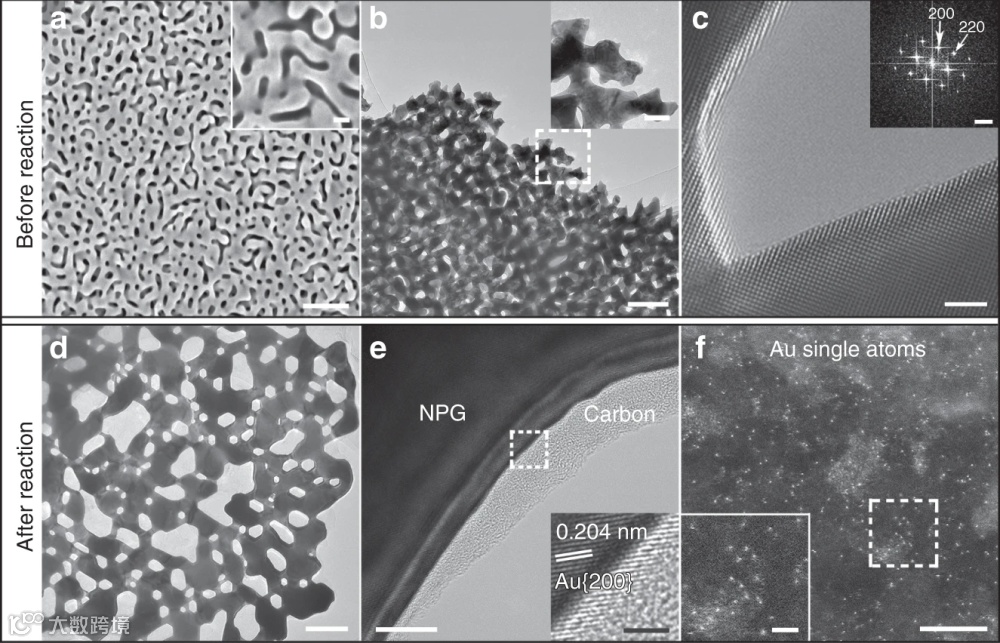
图1. 异位催化CH4热解反应前后NPG的表征
4
核心内容
近日,云南大学的胡广志教授、天津理工大学的罗俊教授和丁轶教授等人在国际知名期刊Nature Communication(2018 IF:11.878)上发表发表题为“Dynamic co-catalysis of Au single atoms and nanoporous Au for methane pyrolysis”一文。Wei Xi为本文的第一作者。
作者利用纳米多孔Au(NPG)催化CH4热解,并用高时空分辨率的常规和原位透射电镜(TEM)表征其动态催化过程。表征结果表明,表面的部分NPG连续分解,并释放出Au-SAs。Au-SAs和NPG共催化CH4热解生成非晶碳和H2。此外,在Au-SAs的催化过程中,一些SAs动态地聚集成Au纳米粒子,随后纳米粒子又动态地重新分解成SAs。
作者通过理论计算证实了纳米颗粒和SAs共同催化CH4的热解。并证明了在一定的多相催化条件下,SAs被纳米催化剂释放,然后参与最初由纳米催化剂引发的催化反应。该研究结果有助于弥合纳米催化剂催化过程与SACs之间的鸿沟,为催化剂的设计提供新的启示。
5
本文亮点
表征了纳米多孔Au动态催化CH4裂解过程
通过理论计算证明了纳米颗粒和SAs共催化CH4裂解
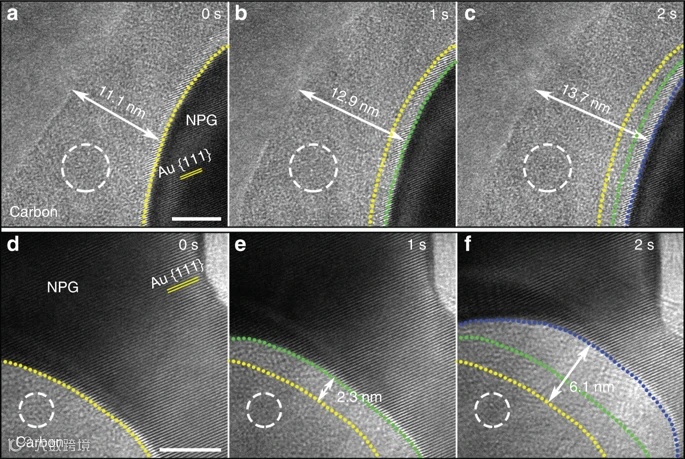
图2在NPG上催化CH4裂解反应的原位动力学过程
a-c) HRTEM images at three different moments during the reaction on a surface region with positive curvature. The images have the same scale bar. The moment in a is defined as 0 s.. The yellow, the green, and the blue dashed lines indicate the positions of the surface at 0, 1, and 2 s, respectively. The white dashed circles denote the positions of a randomly selected carbon region, and the arrows indicate the thickness of the amorphous carbon at 0, 1, and 2 s.
d-f)have the same meanings as a-c but are for a surface region with negative curvature. The arrows indicate the reduction of the NPG ligament at 0, 1, and 2 s.
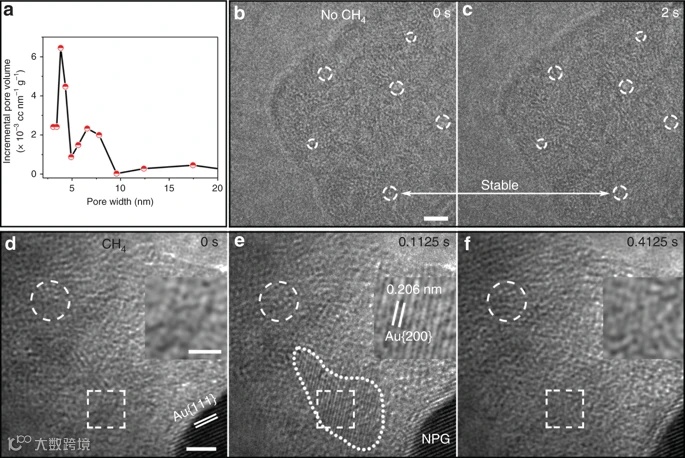
图3:非晶碳层的表征及Au-SAs的原位动态催化过程。
a Size distribution of nanopores in the amorphous carbon layers produced by the ex situ CH4 pyrolysis reaction.
b, c) HRTEM images of an amorphous carbon layer at two different moments after the layer was produced and the CH4 flow was stopped with the other conditions of
the in situ CH4 pyrolysis reaction unchanged. The two images have the same scale bar.
d–f) HRTEM images of an amorphous carbon layer at three different moments during the reaction with all the conditions unchanged. The moments in b and d are defined as 0 s. The white dashed circles in b and c denote the positions of six randomly selected carbon zones at 0 and 2 s, which are typical unchanged regions, and the ones in d–f indicate the positions of a randomly selected carbon zone at 0, 0.1125, and 0.4125 s, which is a typical changed region. The boxes in d–f indicate the positions of a nanoparticle that temporarily formed and disappeared. The insets in d–f are the close-up views of the boxed regions in d–f, respectively. The dashed closed curve in e indicates the boundary of a temporarily formed crystal nanoparticle. Scale bars: b 2 nm; d 2 nm; the inset of d 1 nm.
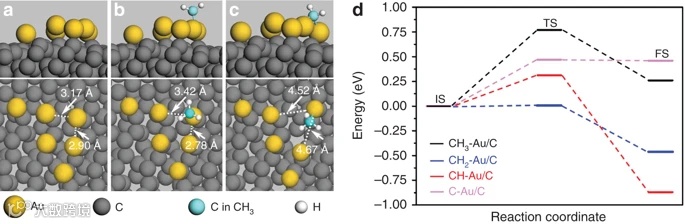
图4:DFT计算的非晶碳上金团簇的构型演化
a) DFT-relaxed atomic configuration of a pure Au cluster consisting of six Au atoms on amorphous carbon, which is denoted as Au/C. The top and the bottom panels are the side and the top views of the configuration, respectively.
b, c) DFT-relaxed atomic configurations of the IS (b) and the FS (c) of CH3-Au/C. CH3–Au/C, CH2–Au/C, CH–Au/C and C–Au/C denote the configurations of the Au cluster, respectively, with the presence of CH3*, CH2*, CH* and C*, which are the intermediates and the carbon product of the CH4 pyrolysis. IS, TS and FS are the initial, the transition and the final states, respectively. The dashed lines pointed by the white arrows in a–c denote the interatomic distances.
d) Activation energies of the configuration evolutions of the Au cluster, in which the black, blue, red, and pink lines represent the corresponding IS, TS, FS and activation energy of the Au cluster evolution under the adsorption of CH3, CH2, CH, and C, respectively.
原文链接:
https://www.nature.com/articles/s41467-020-15806-8
老师简介:
胡广志 云南大学 博士生导师
2004、2007和 2010年先后获得安徽师范大学化学专业学士、分析化学硕士和中国科学院兰州化学物理研究所理学博士学位;2010年9月-2014年11月 瑞典于默奥大学物理系博士后,2014年12月-2018年11月 中国科学院新疆理化技术研究所研究员;2018年12月至今,在云南大学工作,博士生导师。
研究方向:纳米化学传感与催化材料。
罗俊 天津理工大学 博士生导师
2001和2006年分获清华大学学士和博士学位;2006-2007年在英国Warwick大学化学系从事博士后研究;2007-2011年在英国牛津大学材料系从事研究工作;2011-2015年在清华大学材料学院和北京电镜中心工作,副教授;2015年至今在天津理工大学材料学院和新能源材料与低碳技术研究院暨电镜中心工作,教授、博士生导师、研究院副主任和电镜中心主任。
研究方向:低维纳米材料(纳米颗粒、纳米线/管/框/片、二维材料)的电子显微分析以及基于电子显微分析结果的先进能源材料设计、制备和器件应用。
丁轶 天津理工大学 博士生导师
1975年4月出生,师从中国科学院院士李亚栋、钱逸泰,在中国科学技术大学化学系获得学士和硕士学位,随后在美国约翰霍普金斯大学材料科学与工程系师从Jonah Erlebacher教授获得博士学位。2005年至2014年11月受聘山东大学泰山学者特聘教授,2015年1月至今在天津理工大学津理工大学新能源材料与低碳技术研究院工作,天津市特聘教授,博士生导师,兼任天津市先进多孔功能材料重点实验室主任。
研究方向:纳米多孔金属材料的设计、合成及其在能源和资源领域中的应用。