


Version of record online: 24 April 2020
Helmholtz Institute Ulm
导 读
本文研究了联苯钠(Na BP)作为钠-海水电池(Na-SWB)负极液的应用。研究发现Na-BP负极液的显著电子和离子导电性使得钠在充电时沉积的过电位较低,从而允许在整个Na-SWB中以高容量保持80个循环。并通过在金属负极上形成均匀的表面层来抑制气体的析出和枝晶的生长。
背景简介
1. 研究钠基电池的必要性
2. 联苯钠的优异表现
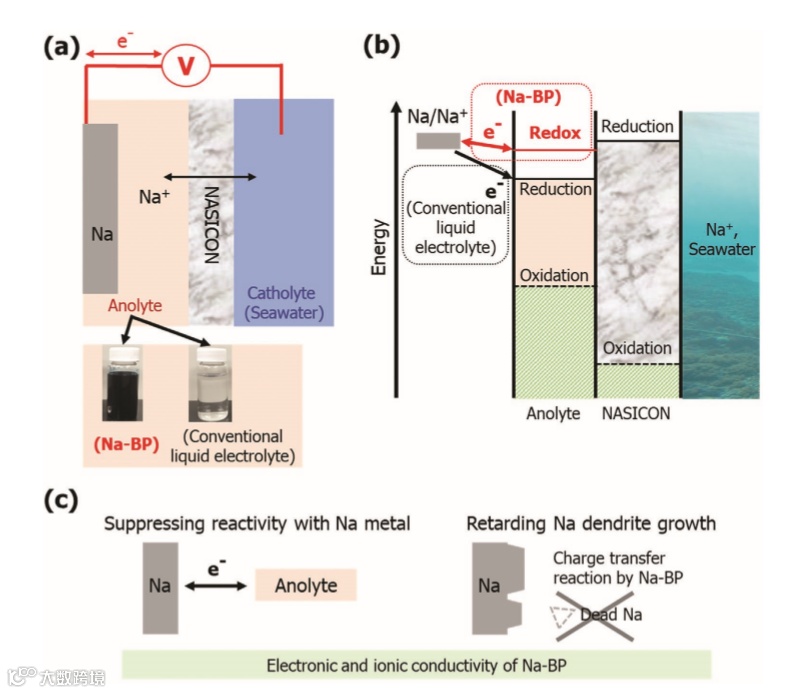
图1. 联苯钠使用示意图。
文章介绍
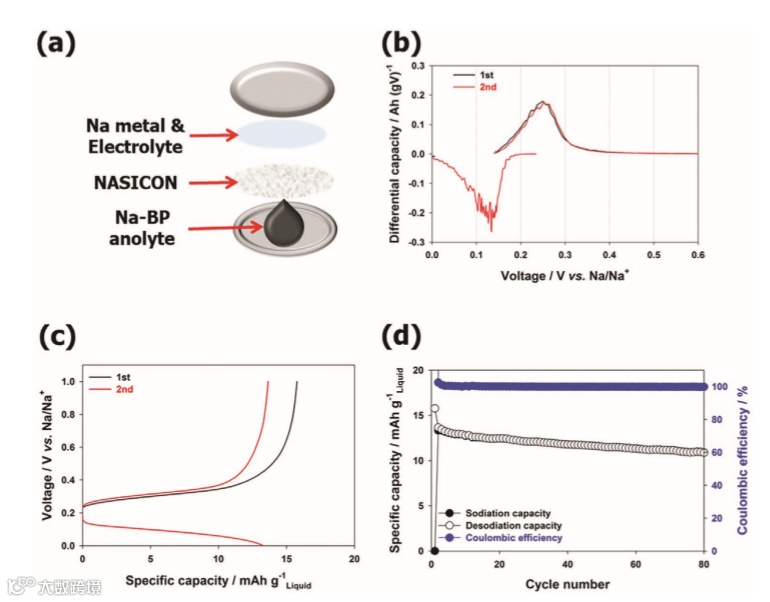
图2. 电化学性能
a)Schematic illustration of the cell setup for the electrochemical characterization of Na-BP as liquid active material in half-cell configuration with a sodium metal counter electrode and a layer of NASICON as solid electrolyte to physically separate the two electrodes.
b) Plot of the differential capacity (dQ/dV) as a function of the cell voltage when applying a current density of 0.25 mA cm−2.
c) Dis-/charge profiles for the 1st and 2nd cycle when subjecting such half-cells to a current density of 0.5 mA cm−2 (cut-off potentials: 0.0 and 1.0 V vs Na/Na+) and
d) the plot of the specific capacity versus cycle number for 80 cycles
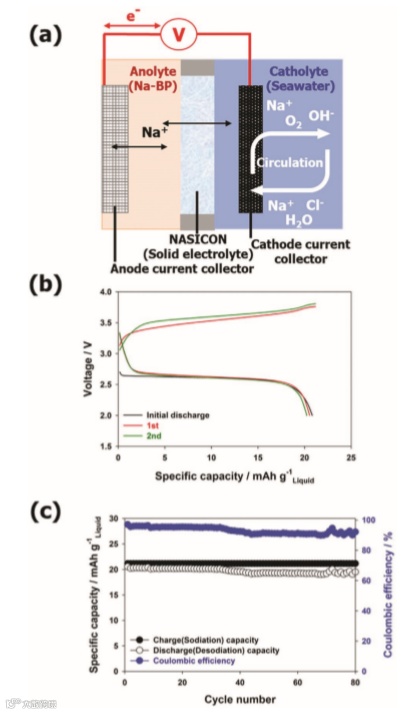
图3. 电池循环性能
a) Schematic illustration of the cell setup for seawater-battery full-cells employing the Na-BP solution as anolyte and seawater as catholyte. The electrodes are physically separated by a NASICON solid electrolyte layer and nickel foam and carbon felt are serving as current collector for the anode and cathode, respectively.
b) Dis-/charge profiles of the initial discharge (in black) as well as the 1st (in red) and 2nd (in green) galvanostatic cycle, applying a current density of 0.5 mA cm−2.
c) Plot of the specific capacity for the anode based on the total weight of the Na-BP solution versus the cycle number for the continuous galvanostatic cycling
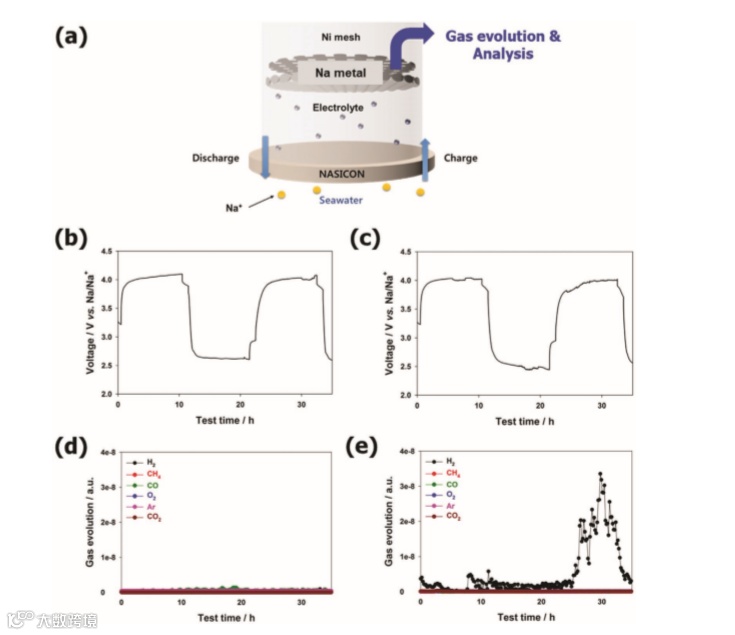
图4. 原位DEMS分析
a) Schematic illustration of the cell setup for the DEMS analysis.
b,c) The corresponding voltage profiles for the Na-BP and NaOTF comprising cells, respectively. d,e) The gas evolution occurring for the Na-BP and NaOTF containing cells,
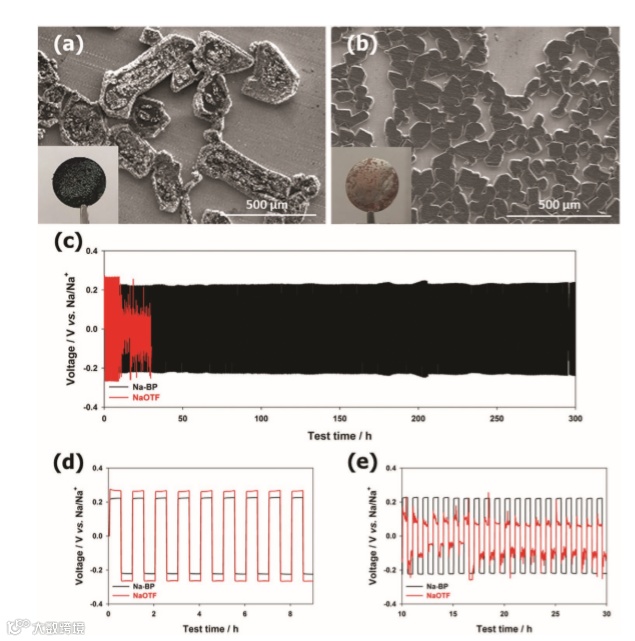
图5.电极形貌与循环
a) the Na-BP-based anolyte or
b) 1 m NaOTF in TEGDME as electrolyte (current density: 0.25 mA cm−2; plating time: 6 h) with photographs of the corresponding electrodes as inset.
c) Sodium stripping/plating experiments for symmetric Na|anolyte /electrolyte| NASICON|anolyte /electrolyte |Na cells employing either Na-BP in DEGDME (in black) or 1 m NaOTF in TEGDME (in red) at a current density of 1 mA cm−2 with a stripped/plated capacity of 0.5 mAh cm−2 for each step. d,e) Magnification of the
(d) initial and
(e) following stripping/plating cycles upon the first 30 h of the experiment
文章链接
https://onlinelibrary.wiley.com/doi/10.1002/adfm.202001249
老师简介
Kim, Young-Sik,韩国人,现就职于韩国科技信息部门高级研究员,博士,韩国海洋大学退休教授,主要从事金属焊接专业,研究领域包括:新材料的新焊接技术,堆焊过程的表面提高技术。Kim, Yun-Hae,教授(博士学位),韩国国籍,就职于韩国海洋国立大学航海设备工程学院,专门从事焊接,复合材料,新材料的研究,其研究领域包括三个方面:一、有利于环境发展的技术;二、在复合结构中新的制造方法的发展;三、复合材料在航海设备中的应用。
Stefano Passerini目前是赫尔姆霍兹研究所乌尔姆,卡尔斯鲁厄理工学院的主任。从事电化学和材料化学研究。他们目前的项目包括进一步开发锂离子电池、锂金属固态电池和后锂化学,如钠、钾、镁、钙和锌。担任Journal of Power Sources主编。

【版权声明】
1) 本文仅代表原作者观点,不代表本平台立场,请批判性阅读。
2) 本文内容若存在版权问题,请联系我们及时处理。
3) 如作者对该文章有误解误读,请联系我们进行修改,欢迎各位老师进行批评指正。
4) 本文版权归科学材料站公众号所有,翻版必究。
投稿请联系contact@scimaterials.cn