


关注我们
华南师范大学
导读
关键词
锂金属电池;碳酸乙烯基亚乙酯;不易燃;循环寿命长;实用规模
背景简介
石墨基锂离子电池(LIB)为信息技术的革命性发展提供了关键动力,而其能量密度和滥用情况下的潜在安全隐患却无法满足要求苛刻的应用,例如要求高能量和高安全性的电动汽车。锂金属电池(LMB)被认为是LIB的最有希望的替代品,因为锂金属负极具有很高的理论比容量(3860 mAh g-1)还原电位低(相对于标准氢电极为-3.04 V)。但在锂负极的实际应用中,安全性和循环寿命方面的挑战提高了。除了锂树枝状晶体对电池寿命的有害影响外,它们的高表面积与有机电解质的高可燃性相结合会导致比锂电池更为严重的危害。
-
用无机,聚合物或复合固态电解质(SSE)代替液体电解质, -
在表面上人工构造保护涂层锂负极, -
通过增加电解质中盐的浓度改变相间化学。 -
使用碳酸盐或碳酸盐电解质均可实现锂金属可逆性的某些改进,
但安全性仍存在很大隐患。无机SSE具有很高的机械强度,可以消除锂枝晶,而其低或不燃性被认为是有价值的优点。然而,最近的研究表明,即使是最稠密的SSE,由于其高电导率也无法完全阻止Li枝晶的生长。更重要的是,理想的方法应同时解决安全风险和电极/电解质不兼容问题,由于各种原因,到目前为止,SSE尚无法实现。
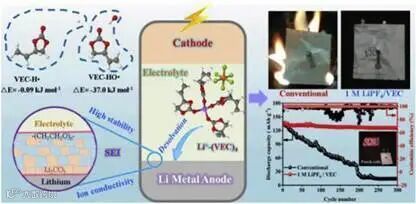
图1. 图片概要
文章介绍
在这项工作中,作者展示了一种新型电解质,一种溶解在碳酸乙烯基亚乙酯(VEC)单一溶剂中的1 M六氟磷酸锂(LiPF6)。与FEC相比,VEC较便宜,约为FEC的一半,但是基于VEC的电解质具有更好的阻燃性,并且使锂金属负极的循环寿命比基于FEC的电解质更长。理论计算与物理和电化学特性相结合表明,VEC基电解质的高阻燃性归因于VEC与氢和氢氧根自由基的强结合,而锂金属负极的长循环寿命归因于易去溶剂化VEC中的锂离子和离子传导性但非常稳定的界面相,主要由底部的无机Li2CO3和顶部的有机–(CH2-CH2O)2-物种组成,来源于VEC的还原。它具有对锂金属的高安全性和高稳定性的独特性能,并且可以给阻碍锂金属电池发展的问题提供新的策略。
文章亮点
新型的LiPF6 / VEC电解质可实现高度安全的Cyclabe锂金属电池。
VEC具有很高的阻燃性,因为VEC与氢和氢氧根自由基紧密结合,可确保高度安全的电池。
通过VEC还原,建立了由底部的无机Li2CO3和顶部的有机–(CH2-CH2O)2-独特相间化学。
可逆相间化学反应以及在VEC中轻松去除锂离子,确保了电池的高循环性。
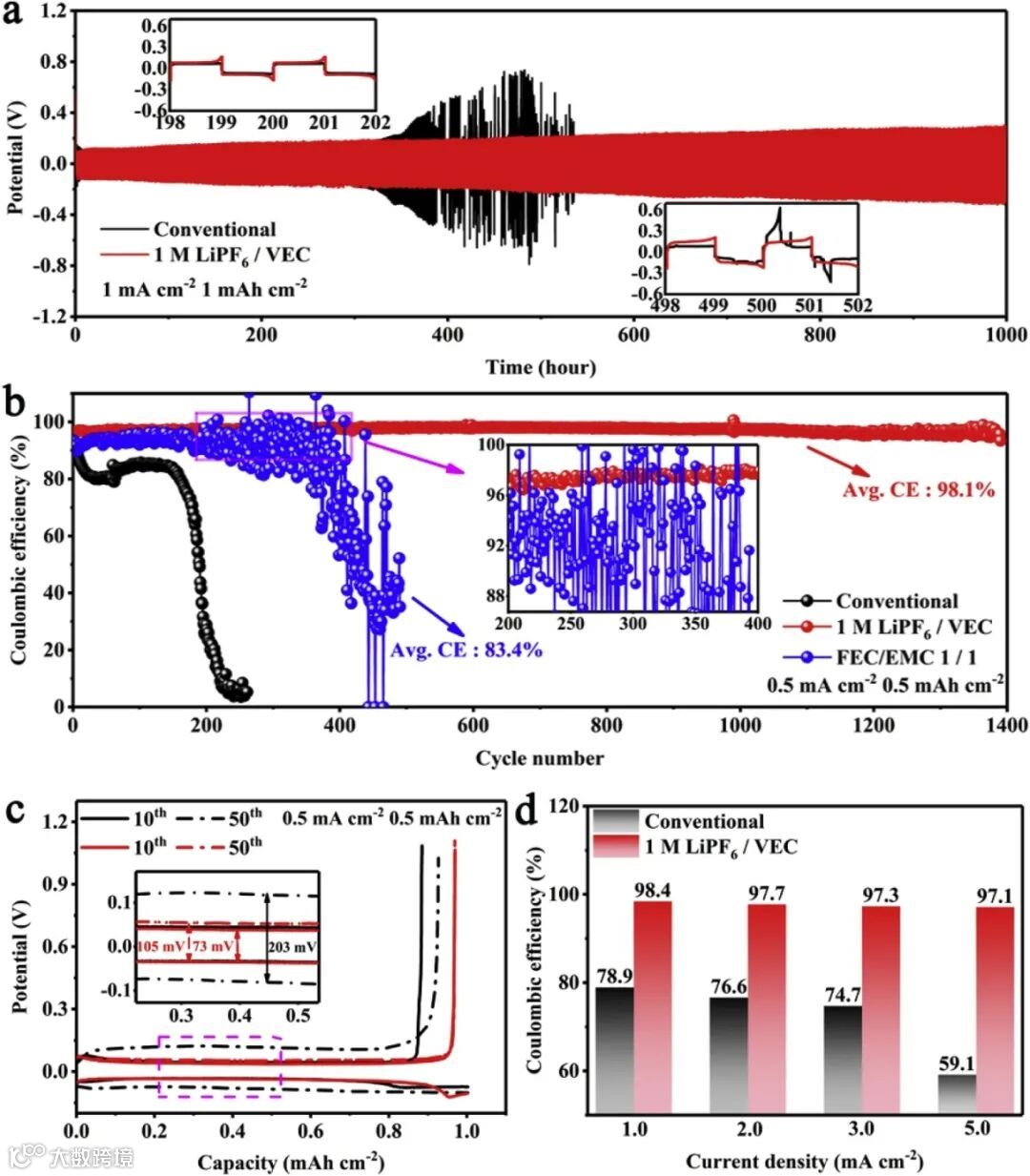
图2. Li//Li和Li//Cu电池的各类电性能
(a) The voltage profiles in Li//Li symmetrical cells,
(b) the average Coulombic efficiency in Li//Cu cells,
(c) polarization curves of plating/stripping process in Li//Cu cells,
(d) the average Coulombic efficiency of Li//Cu cells at current densities of 1.0, 2.0, 3.0 and 5.0 mA cm−2.
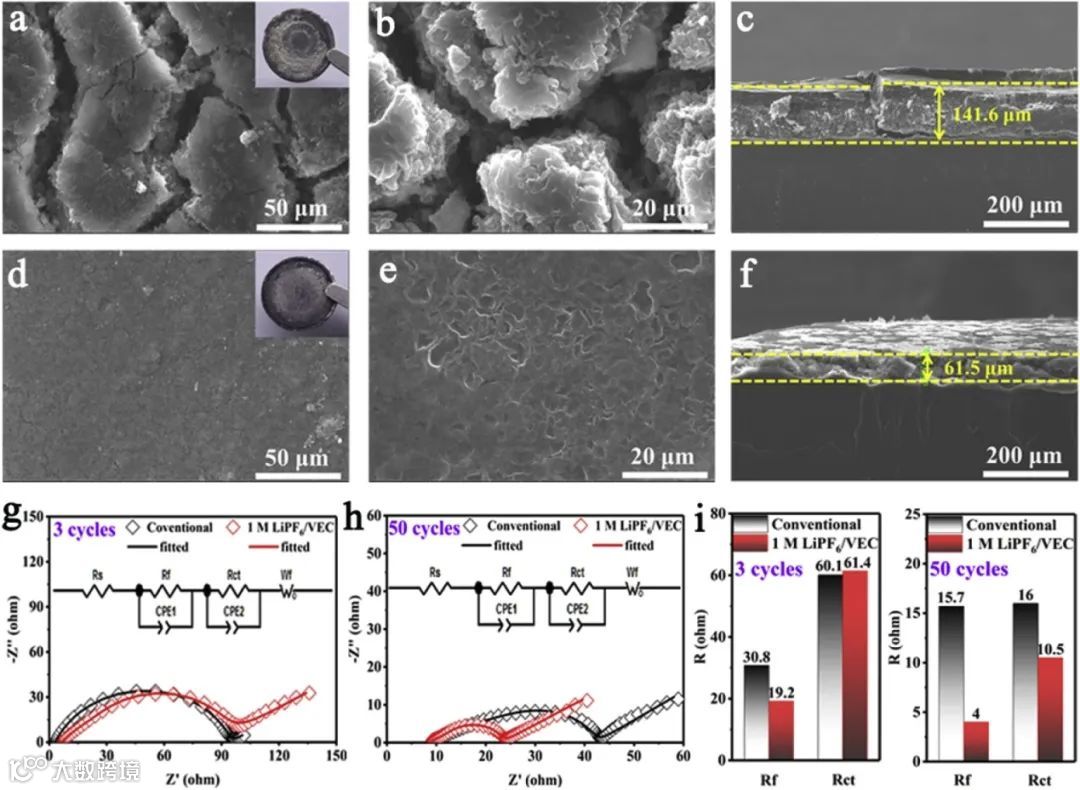
图3. 常规电解液和VEC电解液电池形貌及电性能
Top-view and cross-sectional view SEM images of Li metal anode after 20 cycles in (a–c) conventional electrolyte and (d–f) 1 M LiPF6/VEC electrolytes at 2.0 mA cm−2 with a Li capacity of 4.0 mAh cm−2.
The electrochemical impedance spectra at 2.0 mA cm−2, 4.0 mAh cm−2 after (g) 3, (h) 50 cycles for Li//Li cells using conventional electrolyte and 1 M LiPF6/VEC electrolyte. (i) Obtained interface film (Rf) and charge transfer (Rct) resistance by fitting.
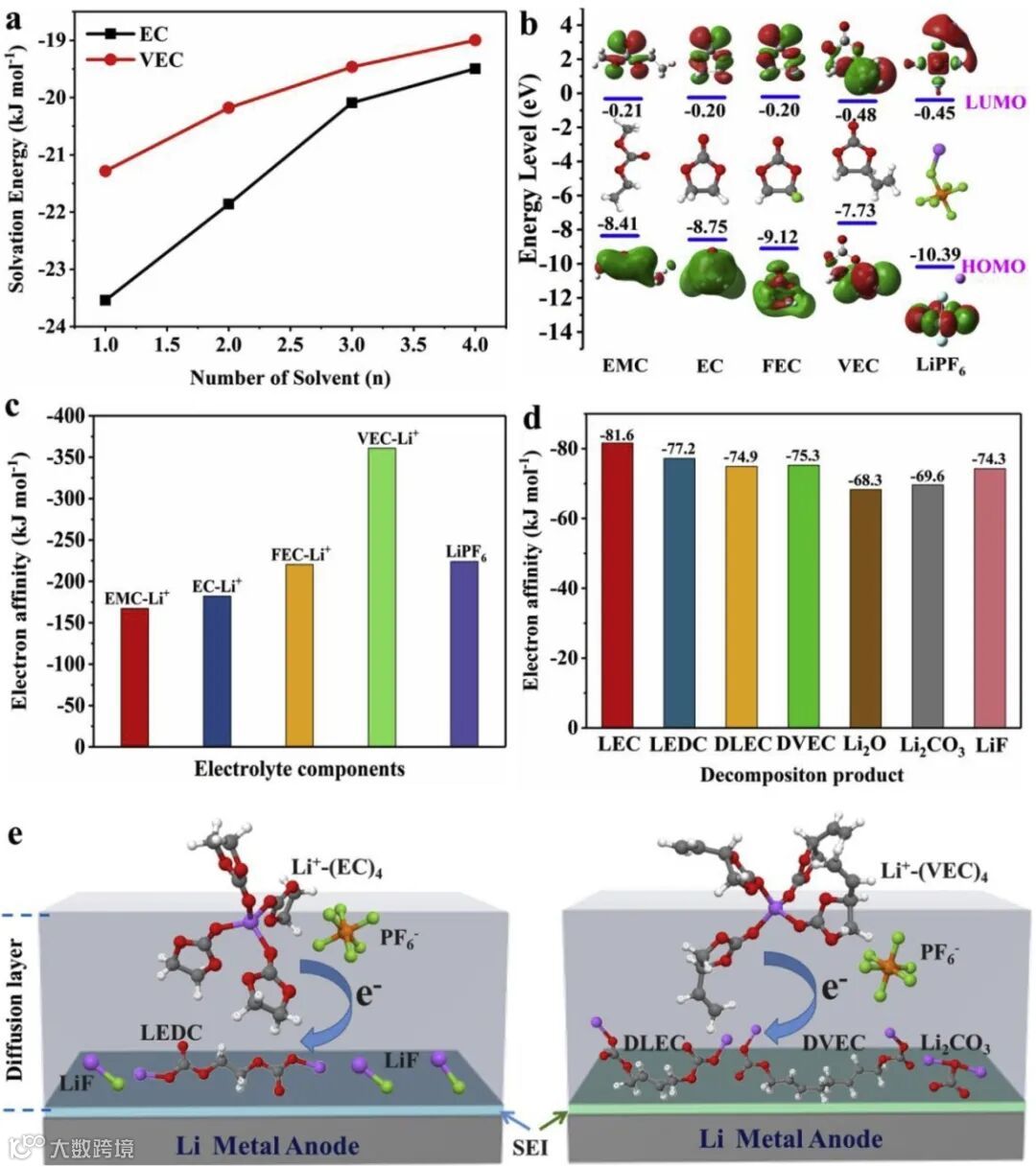
图4. EC和VEC电解质能量图谱
(a) Solvation energy of solvent molecules with Li+ in EC and VEC electrolytes.
(b) The HOMO/LUMO energy (eV) of electrolyte components (EMC, EC, FEC, VEC, and LiPF6).
The electron affinity energies (EAE, kJ mol−1) of (c) electrolyte components with Li+ and (d) their decomposition products (e) Schematics description of solvation sheath of Li+ and the main interphase chemistry derived from the conventional and VEC-based electrolytes.
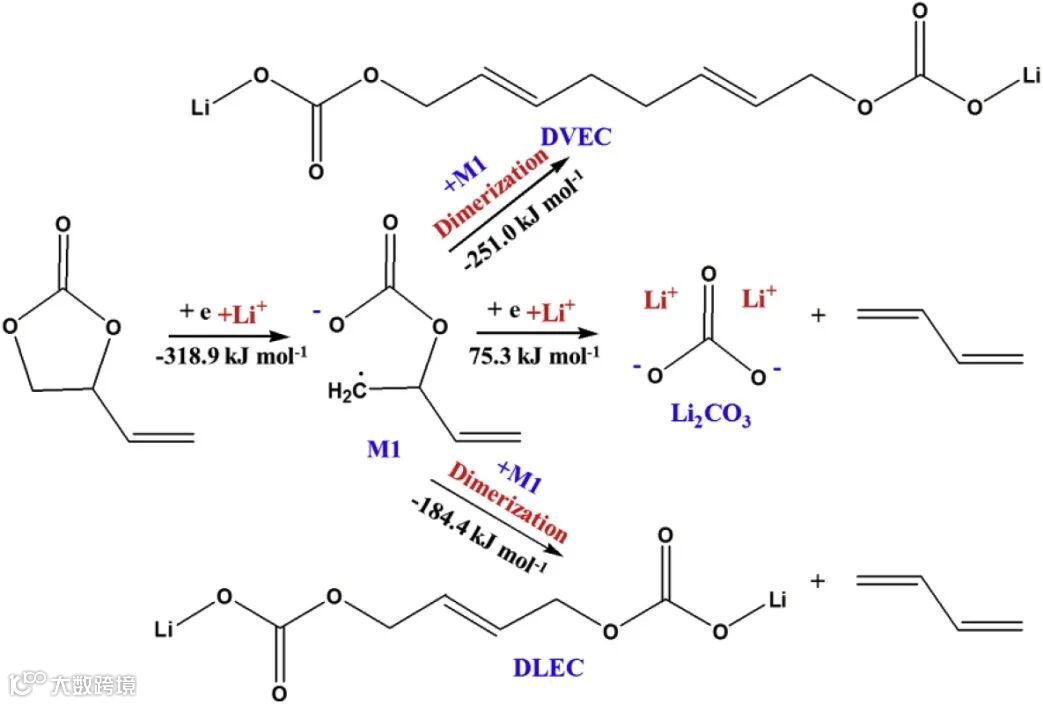
图5. LiPF6 / VEC电解液中相形成的机理
Mechanism of interphase Formation in the 1 M LiPF6/VEC electrolyte.
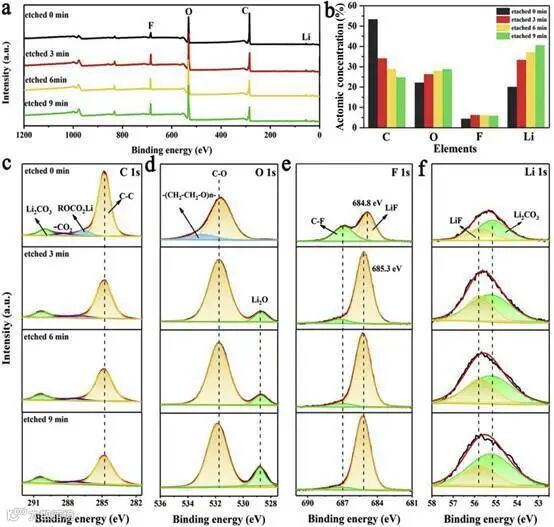
图6. LiPF6 / VEC电解液中锂金属XPS光谱图
(a) XPS survey spectra of lithium metal in 1 M LiPF6/VEC electrolyte at various argon (Ar+) sputtering depths in the interphases on Li electrodes, collected by disassembling Li//Li cells after 10 cycles at a current density of 2 mA cm−2 with a capacity of 2 mA cm−2.
(b) Corresponding relative atomic concentrations from XPS spectra; XPS profiles of (c) C 1s, (d) O 1s, (e) F 1s, and (g) Li 1s.
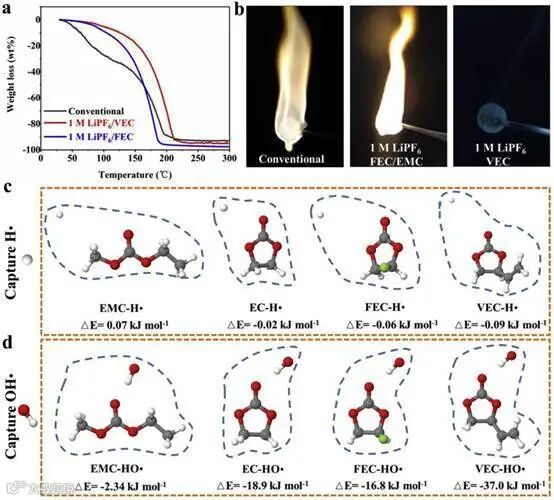
图7.常规电解液和LiPF6 / VEC电解液的热重测试和阻燃测试
(a) Weight loss of conventional electrolyte, 1 M LiPF6/VEC electrolyte, and 1 M LiPF6/FEC electrolyte in the thermogravimetric test.
(b) flame-retarding testing: the conventional electrolyte, 1 M LiPF6/FEC-EMC and 1 M LiPF6/VEC.
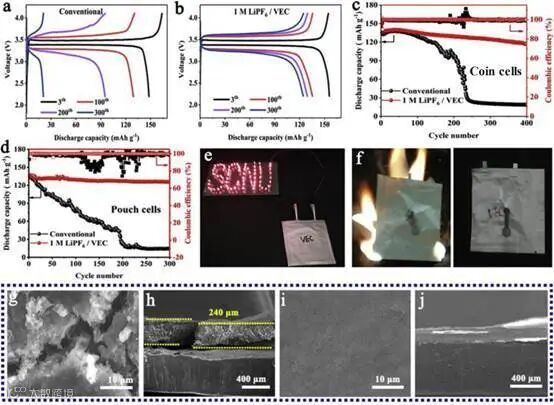
图8.常规电解液和LiPF6 / VEC电解液电池的对比功能测试
Charge/discharge curves of Li//LFP cells at the 3rd, 100th, 200th and 300th cycles in (a) conventional electrolyte and (b) 1 M LiPF6/VEC.
(c) Cycling stability of Li//LFP coin cells at 0.2 C for the initial three cycles and at 1 C for the subsequent cycles between 2.2 and 4.1 V (vs Li/Li+).
(d) Cycling stability of Li//LFP pouch cells at 0.5 C cycles between 2.2 and 4.1 V (vs Li/Li+).
(e) The lit “SCNU” typeface by a string of 77 light emitting diodes (LEDs).
(f) Nail penetration test for pouch cells (Li//LFP) after 100 cycles using conventional electrolyte (1.0 M LiPF6/EC:EMC = 1:1) (left) and 1 M LiPF6/VEC (right). The fully charged cells are vertically punctured from their central position with a steel needle of 2 mm diameter.
Cross-section and top-view SEM images of Li metal anode in Li//LFP coin cells after 250 cycles using (g, h) conventional electrolytes, (i, j) 1 M LiPF6/VEC.
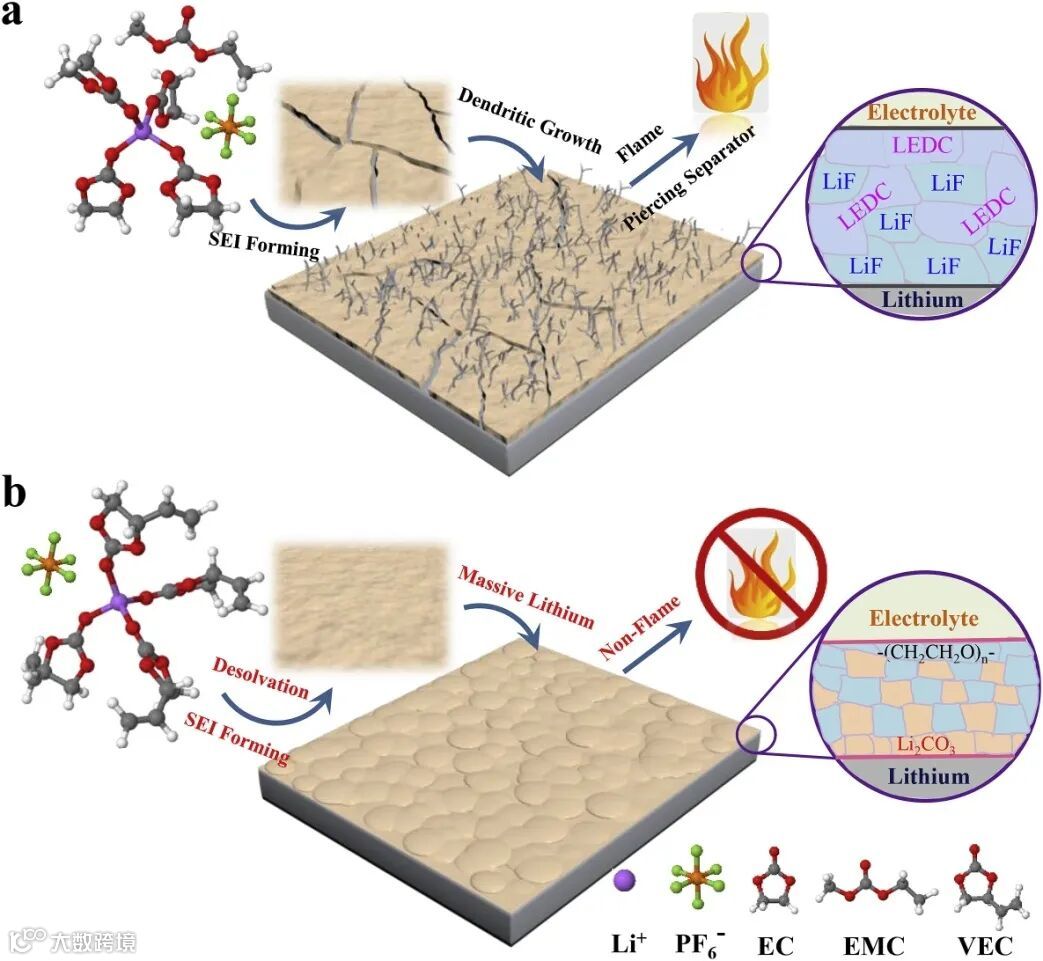
图9.传统电解质中的失效锂负极和LiPF6 / VEC电解质中受保护的锂负极示意图。
Schematic illustration on (a) the failure lithium anode in conventional electrolyte and (b) the protected lithium anode in 1 M LiPF6/VEC electrolyte.
文章链接:
Highly safe and cyclable Li-metal batteries with vinylethylene carbonate electrolyte
https://www.sciencedirect.com/science/article/abs/pii/S2211285520304171#!
老师简介:
李伟善,博士,教授
华南师范大学教授、华南理工大学兼职博士生导师。担任“电化学储能材料与技术教育部工程研究中心”负责人、广东省高水平大学建设“化学与环境学科群”项目负责人。Elservier高被引学者, 享受国务院政府特殊津贴。以第一完成人获得多项成果奖励,包括广东省科学技术奖(发明奖)一等奖(2012),广东省科学技术奖(科技进步奖)一等奖(2007)等奖项。
资料来源:https://mp.weixin.qq.com/s/dHO6po4UgM5GA3b1xEjCsQ
版权声明:
1) 本文仅代表原作者观点,不代表本平台立场,请批判性阅读。
2) 本文内容若存在版权问题,请联系我们及时处理。
3) 如作者对该文章有误解误读,请联系我们进行修改,欢迎各位老师进行批评指正。
4) 本文版权归科学材料站公众号所有,翻版必究。

投稿请联系contact@scimaterials.cn