


关注我们
导读
复合电极的微观结构决定了锂离子电池中单个电池颗粒的充放电方式。在实验中如何直观观察和理解电池颗粒与导电基体的电化学结合是一个前沿性的挑战。
在此,美国能源部SLAC国家加速器实验室的刘宜晋和Piero Pianetta博士,普渡大学机械工程学院的赵克杰,弗吉尼亚理工大学化学系的 Feng Lin等人将复杂的机器学习算法与X射线断层扫描数据结合起来用于研究电池电极微结构的演变。该工作发表在国际知名期刊Nature Communication上,Zhisen Jiang, Jizhou Li, and Yang Yang为文章共同第一作者。
本文采用多尺度实验方法、机器学习辅助统计分析和实验辅助数学建模的独特组合来解决这个问题。结果表明,颗粒的脱离程度与充电速率成正相关,较小的颗粒在从碳/粘合剂基体上的脱离方面表现出更高的不确定性。随后研究者进一步探讨了利用重构电子密度作为电荷状态的可行性和局限性。本研究的发现凸显了以统计可信度精确量化电池电极微结构演变性质的重要性,这是最大限度地利用活性颗粒提高电池容量的关键。
关键词
电池 复合材料 成像技术
背景简介
1. 锂离子电池研究现状
锂离子电池被认为是新型储能技术的重大突破,其对现代社会产生了深远的影响。锂离子电池的能量存储和释放涉及锂和电子在两个电极之间通过电子导电碳和离子导电电解质的网络传输。这种电子和锂离子(锂离子)的传输是由充电过程中的外加电势和放电过程中电池中的热力学下坡反应驱动的。理想的复合电极应提供一个机械稳定的框架,以实现最佳的电子和锂离子传导路径,这需要通过系统的电极尺度研究来精细控制电极微观结构。然而,目前在电极层面上的基础实验研究相对较少,这主要是由于在复杂多的颗粒电极中缺乏具有空间分辨率和统计相关性的颗粒行为的可靠实验测量。
2. 研究思路
要深入了解电极微观结构在调节电池性能方面的作用,就需要借助先进的表征方法。许多电极降解机制与电极中不同组分的空间排列直接相关,这些组分包括碳基体、空隙、粘合剂和活性颗粒。因此,复合电极的多尺度可视化变得至关重要,并且最好具有足够的空间分辨率和组分敏感性来分辨不同的成分。
3. 研究挑战
然而,具有期望的代表性、精度、可靠性和效率的复合电极的微观结构表征是非平凡的。X射线断层扫描(X-ray tomography)已被广泛应用于多种不同实验模式下的复合电极三维(3D)断层成像。例如,X射线微纳层析成像技术被用来跟踪电极材料在电极水平和颗粒尺度的运行条件下的动态演化。结合同步辐射X射线的能量可调性,还可以绘制出锂离子电池的二维/三维成分和荷电状态(SoC)异质性,为锂离子电池的局部化学提供有价值的信息。
由于低Z元素(如C和F)的弱吸收特性,基于样品引起的X射线衰减的传统对比机制明显受到电极中碳/结合畴(CBD)分辨能力的限制。建模方法或其他成像技术(例如聚焦离子束和扫描电子显微镜)已被用于评估CBD在复合电极中的作用。然而,对颗粒对其局部微结构的电化学响应的理解,在很大程度上仍停留在描述和推测的层面上。具有纳米成分和化学敏感性的复合电极微观结构的实验重建是这一领域的前沿挑战。
核心内容
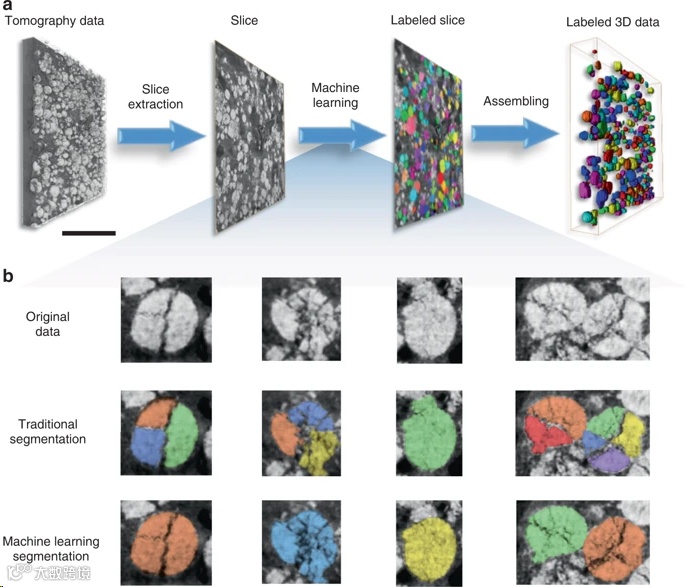
利用定量X射线相衬纳米断层扫描技术,观察到了NMC活性颗粒与CBD的分离。并建立了数值模型以计算部分分离的颗粒表面上电导率的空间异质性。为了通过更好的统计数据进行量化,研究者们还开发了一种机器学习模型,该模型可以自动识别和分割650多个NMC颗粒。统计分析表明,快速循环的颗粒与CBD的分离更严重,而较小的颗粒CBD的分离的不确定性更高。随后研究者进一步探讨了利用重构电子密度作为电荷状态的可行性和局限性。
该工作为研究复合电极微观结构与性能之间复杂关系背后的基本机理提供了新的思路,并凸显了平衡电荷扩散动力学对于两种载流子(锂离子和电子)的最佳电池性能的重要性。这样的标准对于指导具有快速充电能力的下一代锂离子电池的设计特别重要。
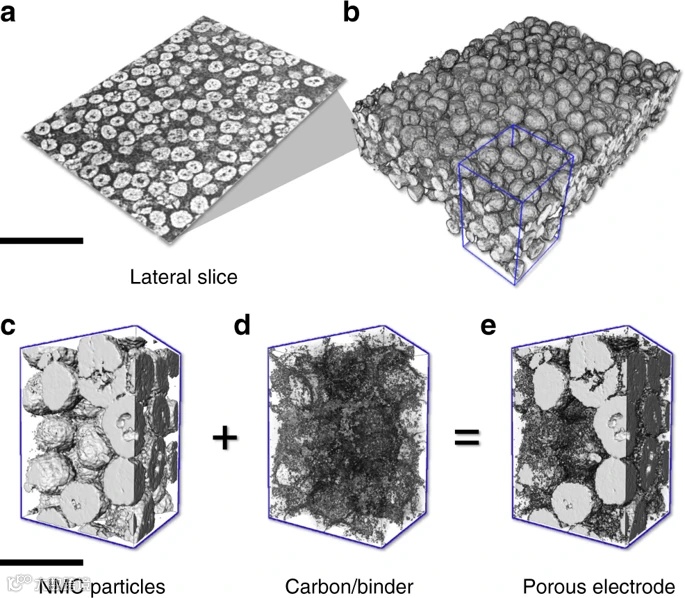
图1. 复合电池正极的3D微观结构
a, b An overview of a relatively large area on the electrode, which covers hundreds of NMC particles, with the central lateral virtual slice displayed in (a).
c–e A smaller region of interest (the region highlighted by the blue box in (b)) with the active NMC particles (c) and the inactive carbon/binder domains (d) rendered separately and jointly (e). The scale bars in (a) and (c) are 60 and 20 μm, respectively.
文章链接:
Machine-learning-revealed statistics of the particle-carbon/binder detachment in lithium-ion battery cathodes
https://www.nature.com/articles/s41467-020-16233-5
导师简介:
Yijin Liu
LEAD SCIENTIST, SLAC NATIONAL ACCELERATOR LABORATORY
With over 10 years of experience in cutting-edge synchrotron techniques, Liu has explored the applications of x-ray microscopy, spectroscopy, and scattering in a broad range of scientific disciplines. Liu group’s major effort has been devoted to the developments and applications of nanoscale x-ray spectro-microscopy since the early 2010s. In more recent years, with a focus on the microscopic study of battery materials and the associated scientific data/information mining methodology, his work has attracted worldwide attention and has opened vast scientific opportunities well beyond the battery science.
信息来源:https://profiles.stanford.edu/yijin-liu
林锋
Dr. Feng Lin holds a Bachelor’s degree in Materials Science and Engineering from Tianjin University (advised by Xi-Wen Du), and an MSc degree and a PhD degree in Materials Science from Colorado School of Mines (co-advised by Ryan Richards of CSM, and Chaiwat Engtrakul and Anne Dillon of National Renewable Energy Lab). Feng joined Virginia Tech after working for QuantumScape Corporation as a Senior Member of Technical Staff and Lawrence Berkeley National Lab as a postdoctoral fellow (advised by Marca Doeff). Prof. Lin’s expertise includes energy materials for batteries, smart windows and catalysis, as well as advanced analytical techniques for the operando characterization of these energy devices at various length scales. His research activities at Virginia Tech focus primarily on electrochemical energy systems, including rechargeable batteries, smart windows, and catalysts for chemicals and renewable fuels.
信息来源:https://thelinlabatvt.weebly.com/team.html
赵克杰
赵克杰博士于2014年加入普渡大学机械工程系。他于2012年获得哈佛大学工程科学博士学位,分别于2005年和2008年获得西安交通大学的学士和硕士学位。于2012 - 2014年在麻省理工学院担任博士后助理。研究领域集中在结合实验和多尺度模拟方法研究能源材料的化学力学性能,并致力于高温陶瓷和有机半导体分子和聚合物的原子模拟。
Dr. Kejie Zhao joins the faculty of mechanical engineering at Purdue University in 2014. He received his Ph.D degree in Engineering Science in 2012 from Harvard, and obtained his bachelor’s and master’s degrees from Xi’an Jiaotong University in 2005 and 2008, respectively. He worked as a postdoctoral associate at MIT in 2012-14. The research theme of his group focuses on the chemomechanics of energy materials using experimentation and multi-scale modeling approaches. He is also working on electrochromic glasses and organic semiconductor molecules. He is a recipient of the Extreme Mechanics Letters Young Investigator Award, 3M Non-tenured Faculty Award, Energy Storage Materials Young Scientist Award, and NSF CAREER Award for his research and multiple teaching awards at Purdue University.
信息来源:https://engineering.purdue.edu/kjzhao/

版权声明:
1) 本文仅代表原作者观点,不代表本平台立场,请批判性阅读。
2) 本文内容若存在版权问题,请联系我们及时处理。
3) 如作者对该文章有误解误读,请联系我们进行修改,欢迎各位老师进行批评指正。
4) 本文版权归科学材料站公众号所有,翻版必究。
投稿请联系contact@scimaterials.cn