


First published: 04 May 2020
西北太平洋国家实验室、美国马里兰大学
关键词
石榴石电解质, 界面化学. 锂枝晶, 固体电解质, 界面相, 固态电池
导读
背景简介
近年来,由于H+/Li+交换和球团矿表面LiOH/Li2CO3钝化层的形成,水分被认为是导致GSE与Li金属正极电阻大的主要原因同时,其固有的差异(如离子导电性、剪切模量、电子导电性等)。晶界结构和SSEs内部晶粒之间的相互作用控制了界面处锂枝晶的形核。从而为石榴石基固态锂金属电池(SSLBs)提供了坚固的锂/GSEs界面,以磷酸氧基锂(LIPON)的成功为参考是必要的。均匀溅射LIPON膜通过动态界面稳定化过程实现高效锂正极,形成纳米级的、锂离子导电的、电子绝缘的界面相。另一方面,LIPON的均匀表面薄膜实现了锂的均匀溶解/沉积,从而降低了界面电阻,避免了枝晶状锂成核的局部热点的形成。
3. 本文的设计思路
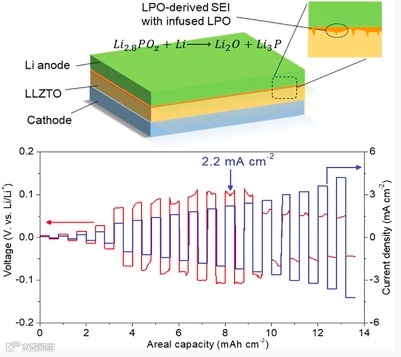
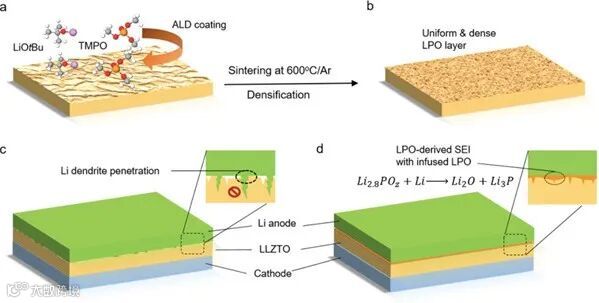
作者首先讲述了通过原子层沉积(ALD)在GSE上涂覆一薄层固体电解质Li3PO4(LPO),然后进行简单的退火处理。制备的LPO注入LLZTO(LPO@LLZTO)对Li阳极具有可忽略的界面电阻(≈1Ωcm2),对水分具有良好的稳定性。在室温下,LPO@LLZTO的临界电流密度(CCD)达到了创纪录的2.2mAcm-2,是原始GSEs的5倍(约0.4mAcm-2)。基于LPO@LLZTO的新化学性质,设计了一种以LiFePO4为负极的锂金属正极在室温下工作的固体电池,研究了一种新型的GSE基复合材料的制备方法。
文章介绍
1)平坦的LPO顶层使其与Li正极共形接触,导致Li剥离/电镀均匀;
2)注入LPO在填充表面缺陷的同时,提高了互连晶界结构的机械强度和Li离子导电性;
3)注入LPO后,材料的力学性能得到明显改善Li2O,Li3P富SEI的形成具有可忽略的电子传导和高锂离子传导的特性。
文章亮点
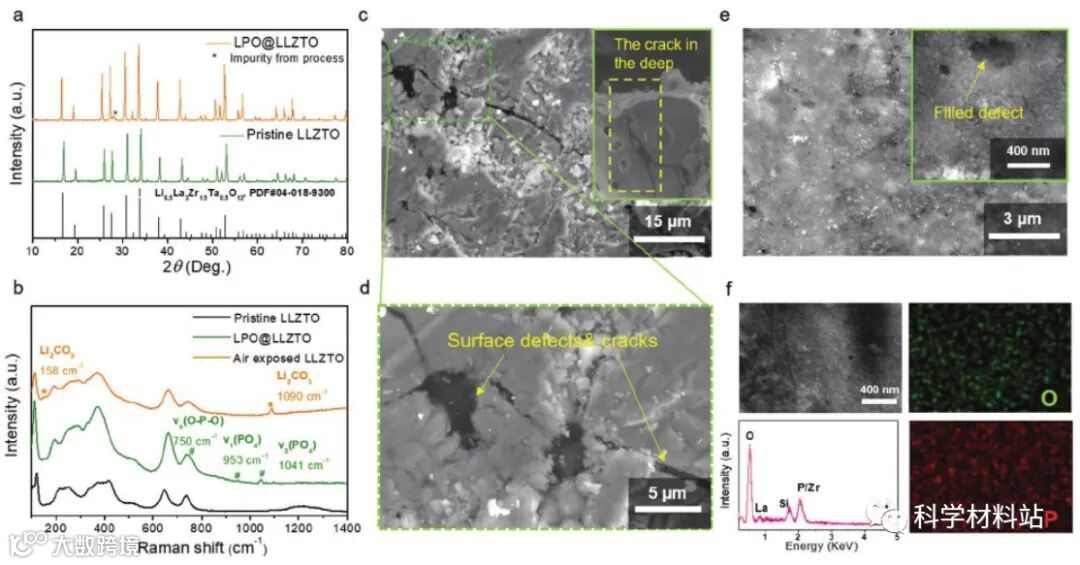
图三: LPO @ LLZTO石榴石电解质的表征。
a) XRD pattern comparison of the as‐prepared pristine LLZTO, LPO@LLZTO, and standard Li6.5La3Zr1.5Ta0.5O12 with pure cubic garnet phase.
b) Raman spectra of pristine LLZTO, LPO@LLZTO, and LLZTO after exposure to air for 1 month.
c) SEM image for the top view of pristine and polished LLZTO pellet; the inset image shows the crack stretches inside of LLZTO pellet.
d) The enlarged view of surface defects and cracks existing on the LLZTO pellet of (c).
e) SEM image for the top view of LPO@LLZTO pellet, the inset image showing the enlarged view of filled surface defect by LPO infusion.
f) The EDS mapping of O, P elements showing the uniform coating of LPO on LPO@LLZTO.
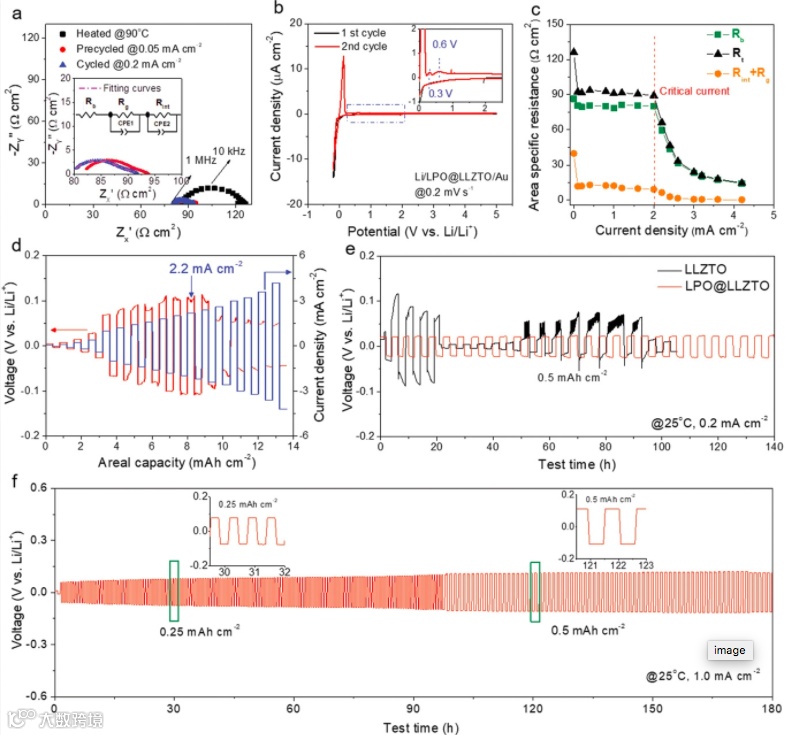
图四: 制备的LLZTO沉淀在25°C下的电化学表征。
a) Representative EIS spectra of Li/LPO@LLZTO/Li cells before cycling (heat‐treated at 90 °C for overnight) and after cycling at 0.05 and 0.2 mA cm−2.
b) First two cyclic voltammetry curves of Li/LPO@LLZTO/Au cell at a scanning rate of 0.2 mV s−1 (−0.2 to 5.0 V).
c) Evolution of bulk resistance (Rb), total resistance (Rt), and interfacial resistance (Rint) + grain boundary resistance (Rg) from EIS spectra of Li/LPO@LLZTO/Li cells after cycling at step‐increased current densities.
d) Potential responses of Li/LPO@LLZTO/Li cells during the CCD measurement.
e) Comparison of d.c. cycling for symmetric cells of Li/LLZTO/Li and Li/LPO@LLZTO/Li at a current density of 0.2 mA cm−2 under areal capacity of 0.5 mAh cm−2.
f) Galvanostatic cycling of Li/LPO@LLZTO/Li cell with a current density of 1.0 mA cm−2; the cell was precycled at 0.05 mA cm−2.
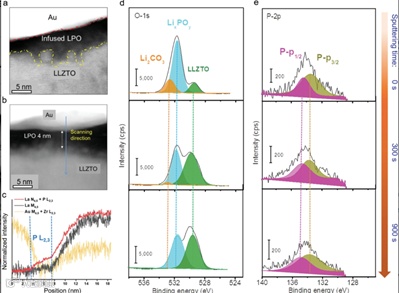
图五: LLZTO球团晶界上LPO层和注入LPO的表征。
a) Typical dark‐filed cross‐section TEM image at the interface of LPO@LLZTO with the Au coating layer.
b) TEM‐HAADF image of LPO@LLZTO interface for EELS line scan analysis; the thickness of the infused LPO layer is <5 nm after sintering.
c) Compositional line scan profiles for La‐M4,5 + P‐L2,3 edge, La‐M4,5 edge, and Au‐M4,5 + Zr‐L2,3 edge along the scanned line probed in EELS mode; the P distribution can be observed by comparing the evolution of La‐M4,5 edge due to overlapping of P‐L2,3 edge and La‐M4,5 signals.
d,e) XPS depth profiles of O 1s (d) and P 2p (e); the XPS signal after long time of Ar+ sputtering indicates the presence of LPO inside LLZTO pellet. CPS: counts per second.
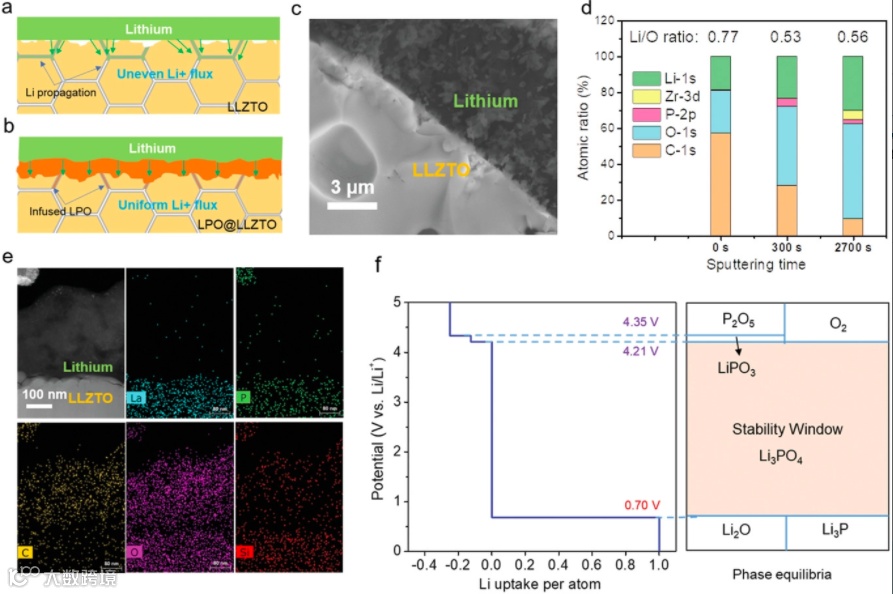
图六: 坚固耐用的锂离子导电Li / LPO @ LLZTO接口的界面化学插图。
a) Schematics of lithium dendrite propagation.
b) proposed mechanisms at the interface of Li/LLZTO. c) SEM image of Li/LPO@LLZTO interface cycled at 1.0 mA cm−2 with an areal capacity of 0.5 mAh cm−2.
d) Composition of cycled Li/LPO@LLZTO interface after various durations of Ar+ sputtering.
e) STEM‐EDS mappings of La, P, C, O, and Si elements on FIB‐cut cycled Li/LPO@LLZTO interface.
f) First‐principles calculation results of the voltage profile and phase equilibria of LPO solid electrolyte upon lithiation and delithiation.
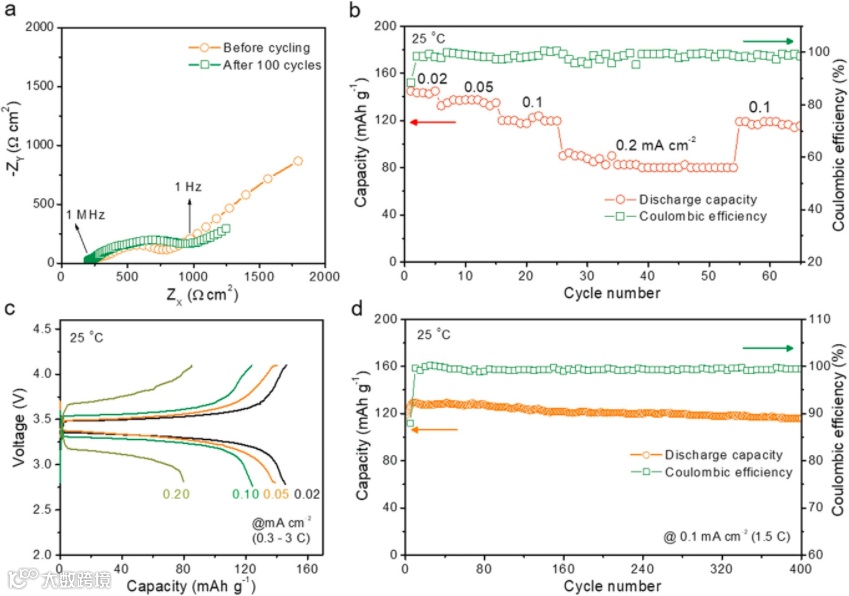
图七: 通过与LiFePO4负极配对来测试固态电池的电化学性能。
a) Nyquist spectra of solid cell before and after 100 cycles with constant current density of 0.1 mA cm−2.
b) Rate capability of Li/LPO@LLZTO/LiFePO4 solid cell at different current densities, increasing from 0.02 to 0.20 mA cm−2 (0.3C–3C, 1C = 140 mA g−1).
c) Corresponding electrochemical charge/discharge curves of solid cell at different current densities.
d) Cycling performance of Li/LPO@LLZTO/LiFePO4 solid cell at 0.1 mA cm−2 (1.5C). The areal capacity of LiFePO4 composite cathode is ≈1.0 mg cm−2.
文章链接:
https://onlinelibrary.wiley.com/doi/10.1002/adma.202000030
版权声明:
1) 本文仅代表原作者观点,不代表本平台立场,请批判性阅读。
2) 本文内容若存在版权问题,请联系我们及时处理。
3) 如作者对该文章有误解误读,请联系我们进行修改,欢迎各位老师进行批评指正。
4) 本文版权归科学材料站公众号所有,翻版必究。

投稿请联系contact@scimaterials.cn