


关注我们
Available online:7 May 2020
Florida State University
导读
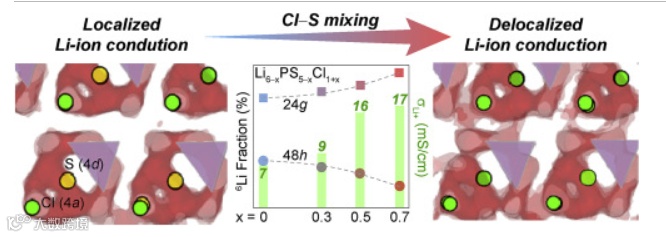
结果表明,当x=0.7(Li5.3PS4.3Cl1.7)时,在25℃时,锂离子输运活化能降低,电导率增加到17 mS/cm。这项工作不仅报道了Cl-argyrotes的离子电导率,而且为负离子无序诱导的离子输运提供了新的见解,在快速离子导体和混合负离子功能材料的开发中具有广泛的应用前景。
关键词
固态锂离子电池,菱形导体,6Li→7Li示踪剂交换,离子传输途径,阴离子紊乱
背景简介
1. 固体电解质介绍
高导电固体电解质中,2008年报道的argyrodites(Li6PS5X,X = Cl,Br,and I)由于Li+迁移率异常高,可达到10-2 S/cm的离子导电率。在过去的十年中,所报道的辉绿岩(Li6PS5X)的电导率可达数mS/cm。泥晶石的离子导电性受缺陷和无序的影响很大。在完全有序结构中,卤化物X-离子占据空间群的4a位(0,0,0),而自由S2-占据4d位(0.25,0.25,0.75)。对于X = Cl和Br,自由的S2–(4d)和X–可以交换,导致明显的无序,而这种交换很少发生在X = I。此外,X的化学性质也影响Li6PS5X结构在48h和24g位置的锂离子分布,这对离子传导有很大的影响。
2. Li6PS5Cl的无序化方法
Wolfgang的小组引入Ge取代Li6PS5I(Li6+xGexP1-xI)中的P来扩展晶格,从而增强了s和I之间的无序性,从而使室温下的电导率显著增加到18 mS/cm。然而,通用电气的成本和稳定性可能会限制其实际应用。由于S和Cl/Br之间的无序比S/I明显得多,在Li6PS5Cl或Li6PS5Br体系中,不掺杂Ge就有可能达到高导电性。先前的计算结果已经预测Li6PS5Cl的离子电导率可以超过10 mS/cm。在Li6PS5Cl中,4d处的Cl是影响Li+跃迁速率和离子电导率的重要因素。最近报道了贫锂的Li5.5PS4.5Cl1.5,由于S/Cl无序增加和Li骨架离子相互作用减弱,其电导率高达9.4 mS/cm(烧结时为12 mS/cm)。
文章介绍
作者采用实验与计算相结合的方法,进一步加深了对结构-离子-传导关联的基本认识。通过对Cl占有率、24g和48h位点Li占有率、离子迁移率和Li离子迁移途径的定量分析,了解这些因素对离子传导的影响,Li5.3PS4.3Cl1.7的离子传导率为17 mS/cm,活化能为0.22 eV。
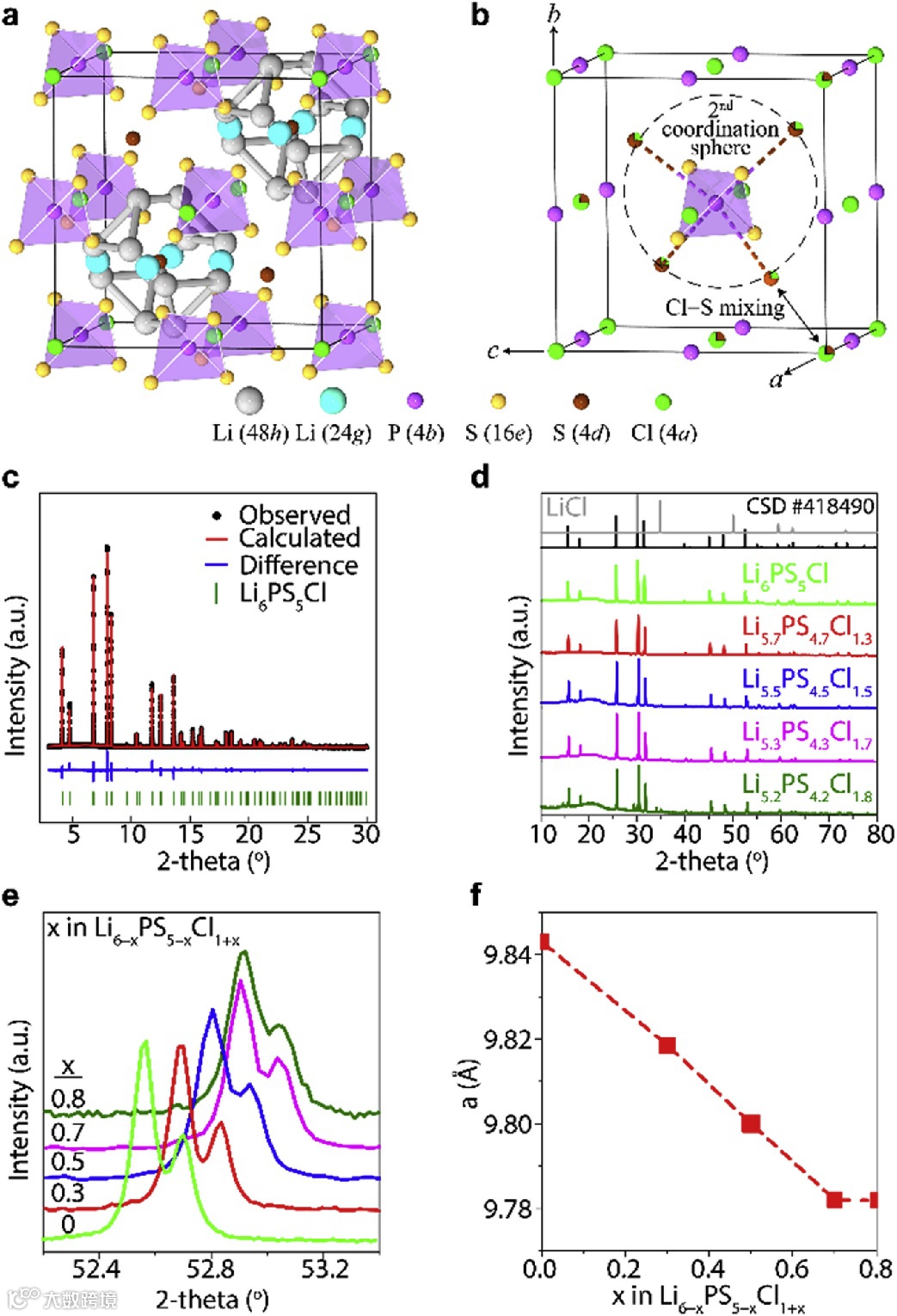
图1.结构表征
(a) Crystal structure of cubic Li6PS5Cl (F4(—)3m) with ordered packing of Cl (Wyckoff 4a) and S (Wyckoff 4d).
(b) Site disorder induced by S2−/Cl− mixing between Cl (Wyckoff 4a) and S (Wyckoff 4d).
(c) Rietveld refinement of high-resolution XRD of Li6PS5Cl.
(d) PXRD (powder x-ray diffraction) patterns of Li6−xPS5−xCl1+x, x = 0, 0.3, 0.5, 0.7, and 0.8.
(e) Change in Bragg diffraction peaks at 52.5° and 52.7° as a function of x in Li6−xPS5−xCl1+x.
(f) The lattice parameters are obtained from refinement of PXRD patterns in (d) as a function of x in Li6−xPS5−xCl1+x.
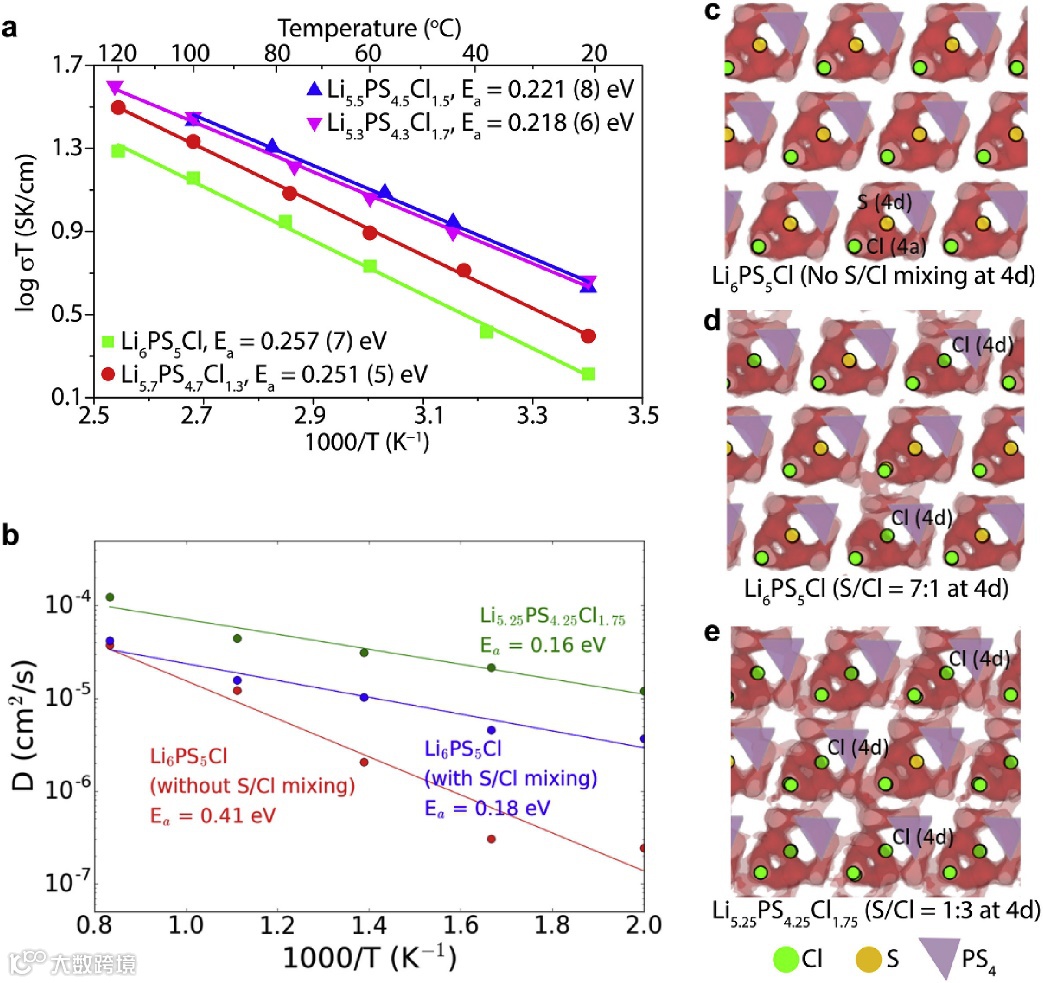
图2. 实验测量和AIMD计算说明了4d位置S2- / Cl-混合对离子扩散和传导的影响
Experimental measurements and AIMD calculations illustrating the impacts of S2−/Cl− mixing at 4d sites on ion diffusion and conduction
(a) The Arrhenius plots of ionic conductivity as a function of temperature for Li6−xPS5−xCl1+x (x = 0, 0.3, 0.5, and 0.7) obtained from variable temperature impedance measurements.
(b) The Arrhenius plots of Li-ion diffusivity as a function of temperature for Li6PS5Cl (without S2−/Cl− mixing at 4d sites), Li6PS5Cl (S2−/Cl− mixing 7:1 at 4d), and Li5.25PS4.25Cl1.75 (S2−/Cl− mixing 1:3 at 4d) obtained from AIMD calculations.
(c–e) The Li-ion probability densities of Li6PS5Cl (without S2−/Cl− mixing at 4d sites), Li6PS5Cl (with S2−/Cl− mixing 7:1 at 4d sites), and Li5.25PS4.25Cl1.75 (S2−/Cl− mixing 1:3 at 4d sites). The probability densities of Li ions are obtained from AIMD simulations at 600 K with 100 ps, and the isosurfaces are plotted at isovalues of the mean value of the density. The Li atoms inside the Li(S/Cl)4 tetrahedrons (48h sites), P (4b sites) and S (16e sites) atoms in the PS4 tetrahedra are not shown for a clear view of the sites of interest.
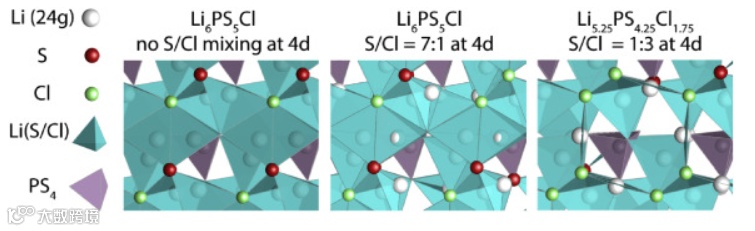
图3.晶体结构
Li occupancies at 24g and 48h sites in DFT optimized structures of Li6PS5Cl (without S2−/Cl− mixing), Li6PS5Cl (S2−/Cl− mixing 7:1 at 4d), and Li5.25PS4.25Cl1.75 (S2−/Cl− mixing 1:3 at 4d). Li at 48h sites is shown in Li(S/Cl)4 tetrahedra and Li at 24g sites is represented by white balls.
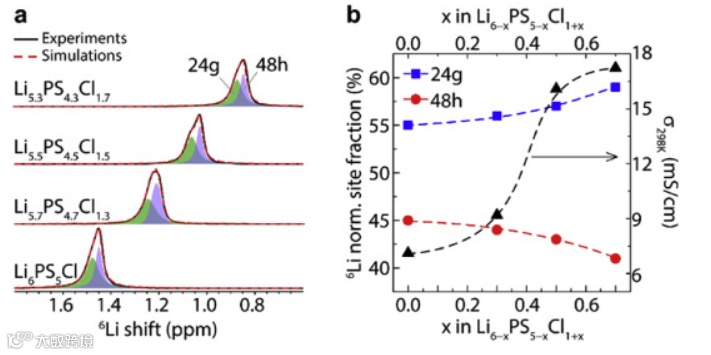
图4.6Li位置占有率电导率
Li site occupancy in Li6−xPS5−xCl1+x (x = 0, 0.3, 0.5, and 0.7) probed by solid-state 6Li NMR
(a) 6Li MAS NMR spectra,
(b) Normalized Li site fractions and ionic conductivity in Li6−xPS5−xCl1+x (x = 0, 0.3, 0.5, and 0.7).
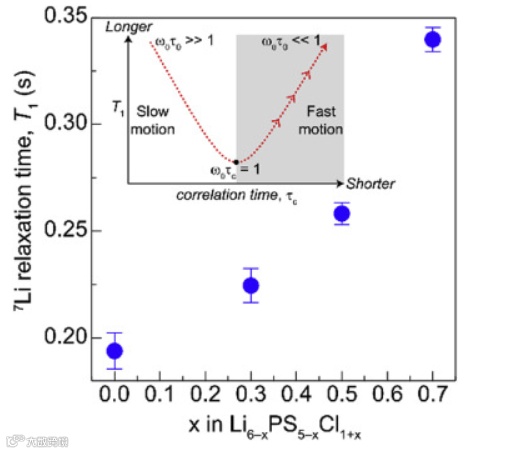
图5. 作为离子迁移率的指标的Li6-xPS5-xCl1 + x的7Li NMR T1弛豫时间
7Li NMR T1 relaxation time of Li6−xPS5−xCl1+x (x = 0, 0.3, 0.5, and 0.7) as an indicator of ion mobility.
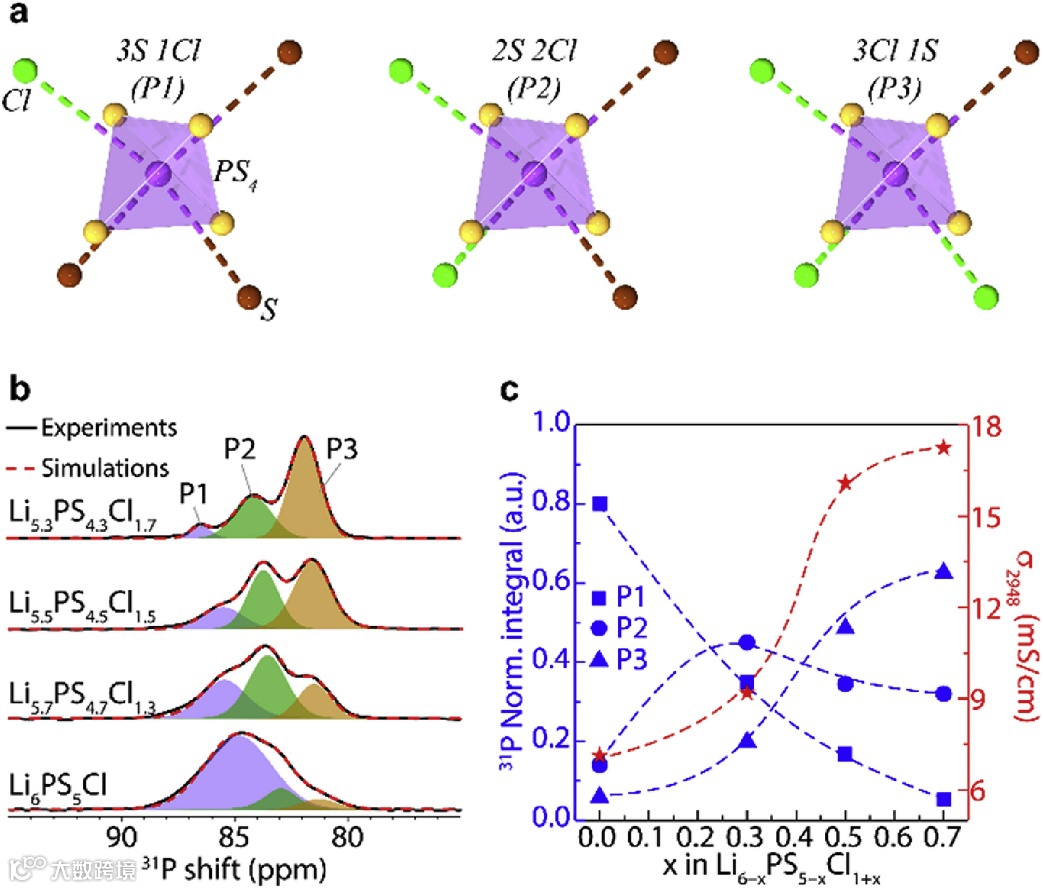
图6.环境、电导率
(a) The schematic of distinct P environments induced by different levels of S2−/Cl− mixing at 4d/4a site.
(b) 31P NMR spectra of Li6−xPS5−xCl1+x, x = 0, 0.3, 0.5, and 0.7.
(c) The correlation of ionic conductivity with the normalized P integral of P1, P2, and P3 NMR resonances as a function of Cl content.
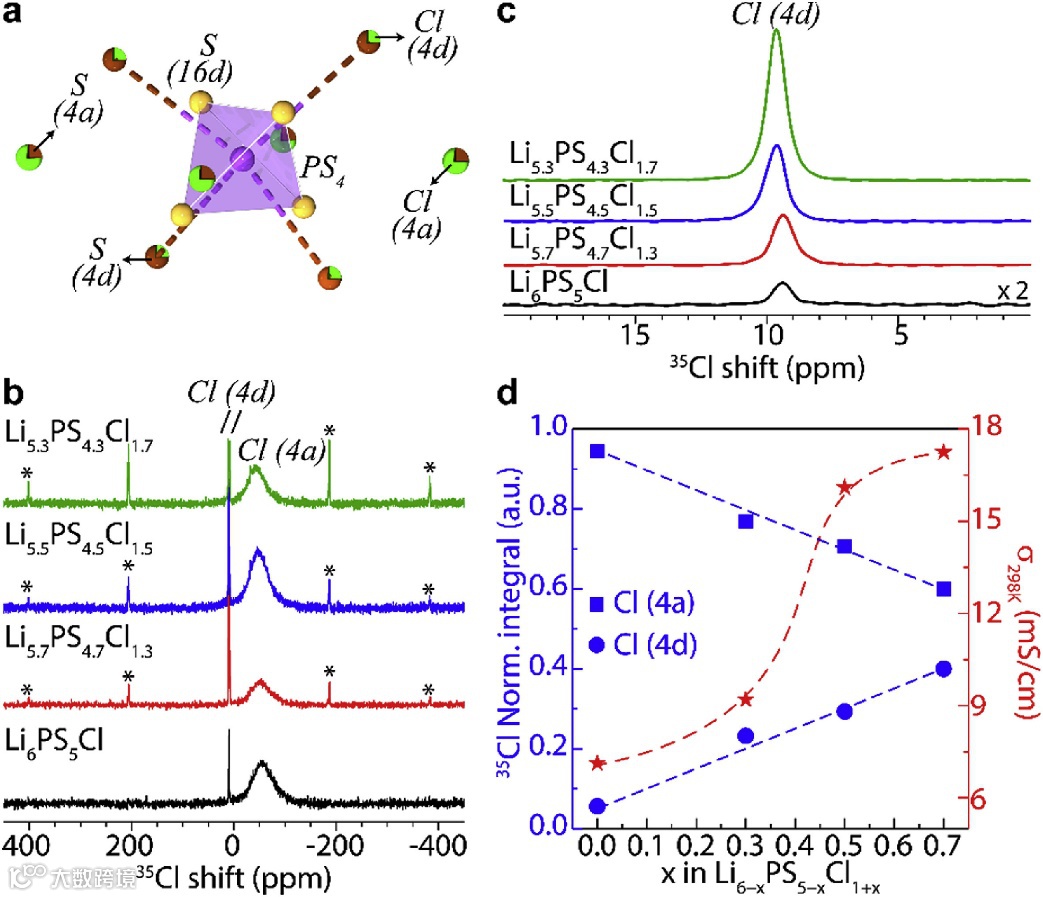
图7.S2- / Cl-在4d / 4a位置混合
(a-c) The schematic of S2−/Cl− mixing at 4d/4a sites. 35Cl NMR spectra showing Cl at 4a site and 4d site (* presents the side bands of 4d peak) in Li6−xPS5−xCl1+x, x = 0, 0.3, 0.5, and 0.7.
(d) The correlation of ionic conductivity with the normalized 35Cl NMR integral of 4a/4d sites as a function of Cl content.
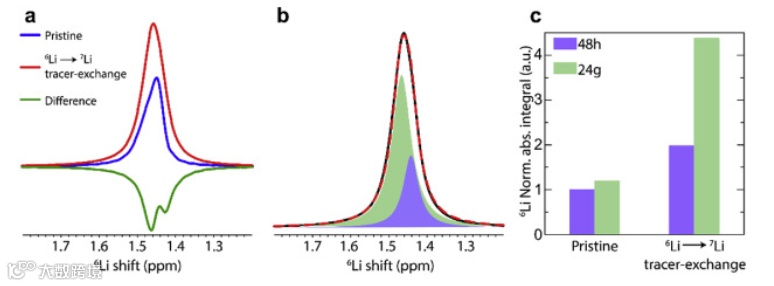
图8.离子传递路径
Detection of ion transport pathways in Li6PS5Cl with 6Li → 7Li tracer-exchange NMR. (a) 6Li NMR spectra before/after tracer exchange. The difference spectrum shows both Li sites are 6Li enriched.
(b) Simulation results of the 6Li NMR spectrum after 6Li → 7Li tracer-exchange.
(c) Comparisons of site fractions before/after 6Li → 7Li tracer-exchange. The 6Li absolute integrals are normalized based on the integral of Li (48h) in pristine Li6PS5Cl.
文章链接:
https://www.sciencedirect.com/science/article/abs/pii/S2405829720301707

版权声明:
1) 本文仅代表原作者观点,不代表本平台立场,请批判性阅读。
2) 本文内容若存在版权问题,请联系我们及时处理。
3) 如作者对该文章有误解误读,请联系我们进行修改,欢迎各位老师进行批评指正。
4) 本文版权归科学材料站公众号所有,翻版必究。
投稿请联系contact@scimaterials.cn