


关注我们
Published: 04 May 2020
南开大学
导读
背景简介
研究思路及挑战:
研究现状:
近年来,由于钒基化合物具有开放的骨架晶体结构且钒具有等多种氧化态,已发展成为水性锌离子电池(ZIBs)的正极材料。在放电过程中,Zn2+离子的插入和钒的还原同时发生。此外,钒基化合物也是一种活性氧化还原材料,在低价态时可以被氧氧化。因此,放电的钒基阴极在周围环境中会被氧气氧化,就像充电过程一样。从而实现了同时具有能量转换和存储功能的自充电开关。
文章介绍
本文开发了一种化学自充电的ZIBs水溶液系统,其中化学能量的收集、转换和存储集成在单个CaV6O16·3H2O(CaVO)正极中完成。该系统具有与常规ZIBs相似的双电极结构。它可以通过自发的氧化还原反应从周围环境中获取能量,然后将化学能转化为电能,储存在ZIBs中。因此,通过直接将CaVO正极暴露在空气中而无需任何外部电源,所得到的ZIB可以自我充电。该设计将为下一代自供电系统提供一个有前途的研究方向。
文章亮点
本文开发了一种兼具能量收集、转换、存储的化学自ZIBs。
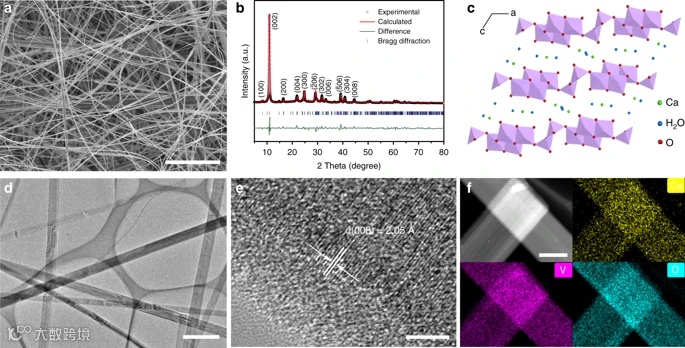
图1:CaVO纳米带的形貌和晶体结构
a. SEM image.
b. Rietveld refinement of the XRD pattern.
c. Crystal structure.
d. TEM image.
e. HRTEM image.
f. TEM elemental mapping images.
Scale bars: a 10 μm; d 1 μm; e 3 nm; and f 400 nm.
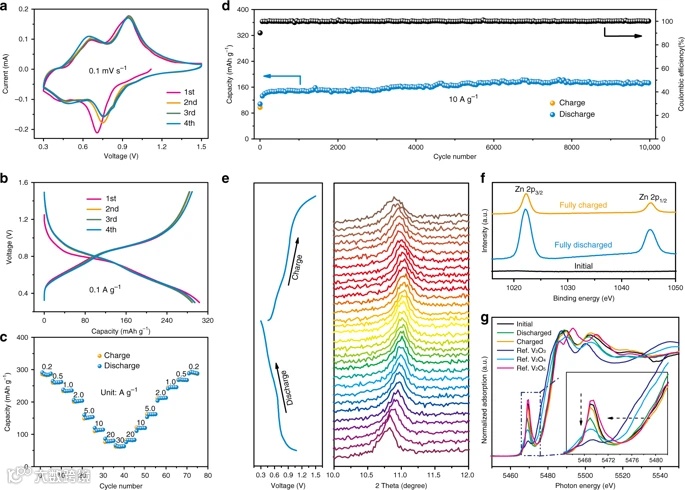
图2: Zn/CaVO电池的电化学性能及机理
a. CV curves at 0.1 mV s−1.
b. GCD curves at 0.1 A g−1.
c. Rate capability at various current densities.
d. Cycling performance at 10 A g−1.
e. In situ XRD patterns of (002) reflection and corresponding GCD curves at 0.2 A g−1 during the first cycle.
f. XPS spectra of Zn 2p at initial, fully discharged, and charged states.
g. V K-edge XANES curves at initial, fully discharged, and charged states with reference to the standard V2O3, VO2, and V2O5.
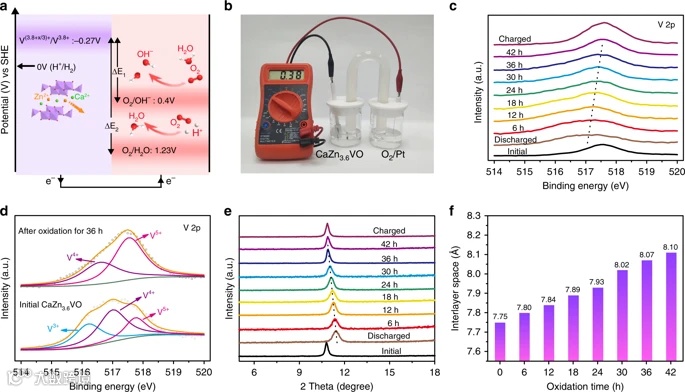
图3: CaZn3.6VO与O2的氧化还原反应机理
a. Energy level transition diagram of CaZn3.6VO and O2.
b. Optical image of the designed galvanic cell.
c. V 2p XPS spectra of the CaVO electrodes at different states and the CaZn3.6VO electrodes after being oxidized by O2 in 4 M Zn (CF3SO3)2 solution for different times.
d. Comparison of XPS spectra of V 2p before and after oxidation.
e-f. XRD patterns and calculational interlayer spacing of (002) plane of CaZn3.6VO electrodes after being oxidized by O2 for different times.
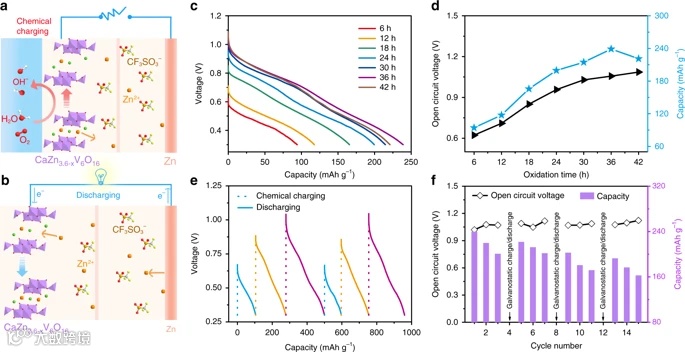
图4:Zn/CaZn3.6-xVO电池的化学充放电行为
a-b. Working mechanism of chemically self-charging ZIBs during a chemical charging (a) and galvanostatic discharging process (b).
c. The galvanostatic discharge curves of Zn/CaZn3.6−xVO batteries at 0.1 A g−1 after the CaZn3.6VO electrodes were oxidized for different times.
d. Effect of the oxidation time on OCV and discharge capacity of Zn/CaZn3.6−xVO batteries.
e. Voltage–time curves of the Zn/CaZn3.6−xVO batteries after being chemically charged to different states (dotted lines: chemical charging for different times. Solid lines: galvanostatic discharging at 0.1 A g−1).
f. Chemical charging/galvanostatic discharging cycling stability of the Zn/CaZn3.6−xVO battery in a voltage window from 0.3 to ~1.05 V.
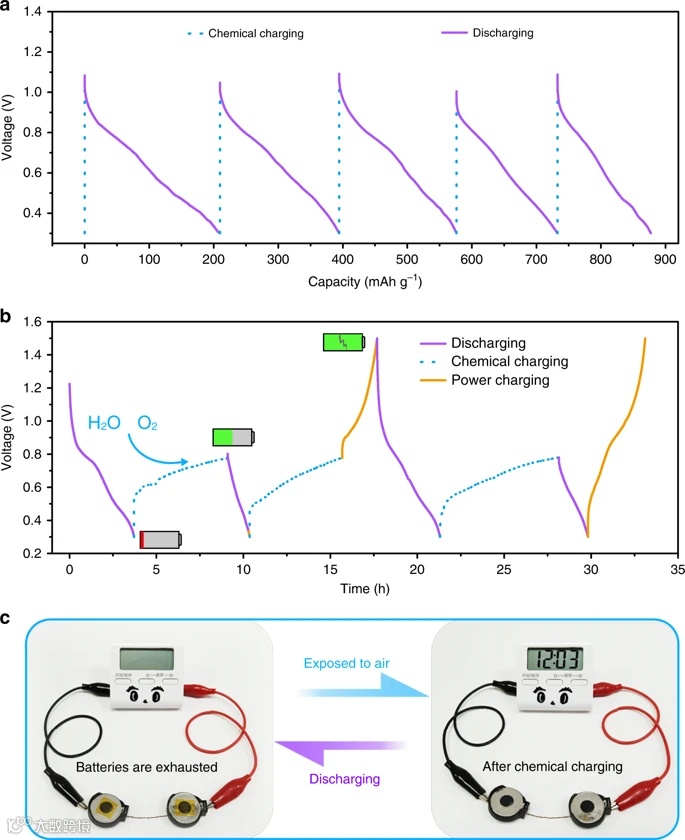
图5:“开放式”ZIBs在不同模式下的原位化学充电行为
a. Repeated chemical charging/galvanostatic discharging cycles of the ZIBs.
b. Charging/discharging behavior of the ZIBs at chemical or/and galvanostatic charging hybrid modes.
c. A timer powered by two self-charging ZIBs in series at (left) exhausted and (right) chemically charged states.
文章链接:
https://www.nature.com/articles/s41467-020-16039-5
老师简介:
陈军,无机化学家,中国科学院院士。
现任南开大学化学学院院长、先进能源材料化学教育部重点实验室主任。
研究领域:
1)纳米材料与能源化学
2)材料电化学与高能电池
3)氢能、太阳能等新能源与可再生能源.
牛志强,南开大学 化学学院教授,
于2010年在谢世信教授的指导下获得中国科学院物理研究所博士学位。在南洋理工大学材料科学与工程学院进行博士后研究(新加坡,联合指导老师:陈晓东教授)之后,他从2014 年开始以南开大学的一百名青年学术带头人的身份独立从事研究工作。国家优秀青年科学基金(2018)和天津市优秀青年科学基金(2018)。他发表了90余篇同行评审的期刊论文和3本书章节。他的研究兴趣包括纳米碳材料和先进的能量存储设备。
课题组主页:http://www.niu.nankai.edu.cn/
版权声明:
1) 本文仅代表原作者观点,不代表本平台立场,请批判性阅读。
2) 本文内容若存在版权问题,请联系我们及时处理。
3) 如作者对该文章有误解误读,请联系我们进行修改,欢迎各位老师进行批评指正。
4) 本文版权归科学材料站公众号所有,翻版必究。

投稿请联系contact@scimaterials.cn