First published: July 29, 2020
作者:李飞,屈江,李阳,王金辉,朱旻棽,刘丽香,段胜凯,李天明,Vineeth Kumar Bandari
通讯作者:黄明*,朱峰*,Oliver G. Schmidt*
单位:开姆尼茨工业大学,莱布尼茨半固体材料研究所(德累斯顿),蔚山科技大学,长春应用化学研究所,德累斯顿工业大学
便携式和可穿戴电子设备的最新发展促进了微、小型化的柔性能量存储设备的深入研究。微型超级电容器(MSC),是集成芯片、电子电路应用中最有希望的下一代电源设备之一。它们具有高功率密度(比电池高几个数量级),快速充电/放电速率(数秒内)和超长寿命(大于一万次循环)等理想特性。
更重要的是,平面插指型结构的微型超级电容器可以控制和缩短电子/离子扩散路径,并易于与其他小型电子设备集成在一起,例如微型传感器,摩擦电纳米发电机和钙钛矿太阳能电池。
传统微型器件的加工方法中存在光刻、烘烤、等离子体刻蚀、集流体沉积等步骤,操作复杂造价较高。因此简化制造工艺,制备能量密度高、循环稳定性好的柔性超级电容器仍然是当前的研究难点。
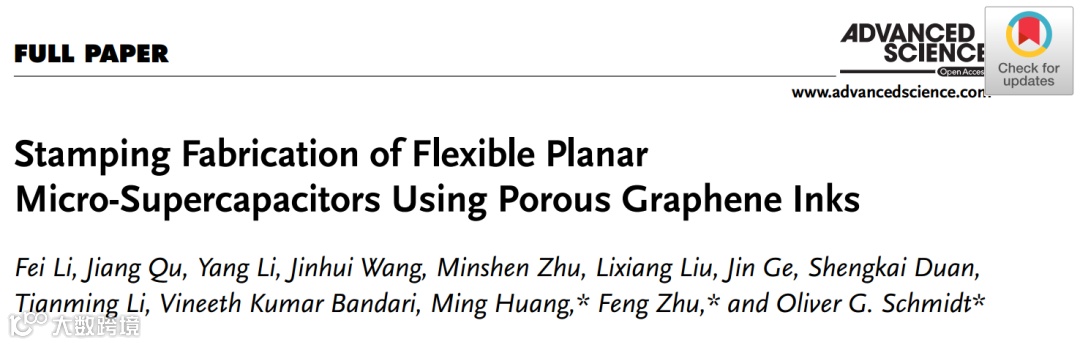
近日,德国开姆尼茨工业大学Oliver G. Schmidt院士、朱峰博士课题组和韩国蔚山科技大学黄明博士在国际顶级期刊Advanced Science (影响因子:15.84) 上发表题为“Stamping Fabrication of Flexible Planar Micro-Supercapacitors Using Porous Graphene Inks”的研究工作。
该工作用CVD方法合成六边形多孔石墨烯油墨,并通过印章压印的方式在不同的柔性基底(碳纤维素纸,绿叶,柔性PET膜)制备大批量可串并联的微型插指超级电容器。得益于多孔石墨烯材料极高的比表面积以及优异的电导率,此MSC显示出优异的面电容和能量密度。此外,此MSC具有良好的循环稳定性和机械柔韧性。我们的方法适用于其他柔性电子设备,并且可能为柔性电子设备的大规模工业制造开辟新的途径。
该文章共同第一作者为开姆尼茨工业大学博士研究生李飞和屈江,本文共同通讯作者是黄明博士、朱峰教授和Oliver G. Schmidt院士。
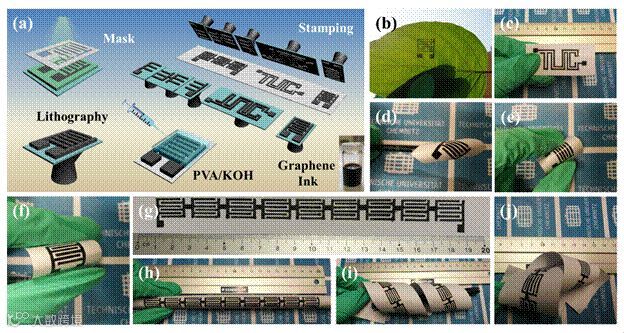
要点一:通过印章压印的方式在不同柔性基底上制备可串并联的柔性MSC器件
(b-c) 不同基底(树叶)和不同压印结构(TUC)的微型MSC的制备。
(d-f) 碳纤维素纸基底上插指型MSC在不同弯曲方向的柔性展示。
(g-j) 大量串联的插指型MSC在不同弯曲状态(平面、弯曲、螺旋、打结)下的柔性展示。
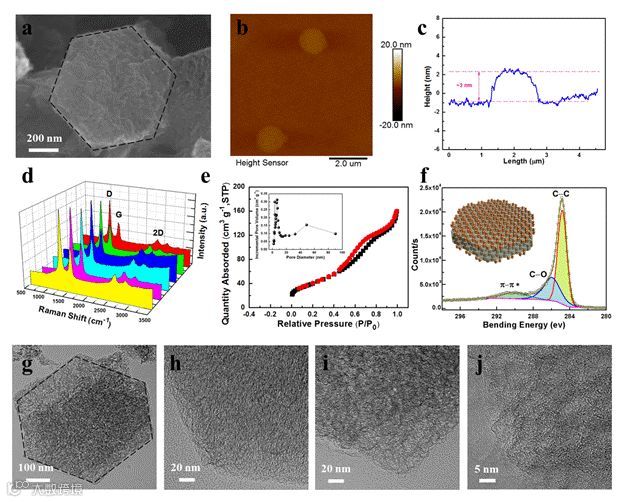
(b-c) AFM图像以及高度分布测试(~3nm)。
(d-f) Raman光谱,比表面积和孔结构测试(2326 m2 g−1),XPS光谱。
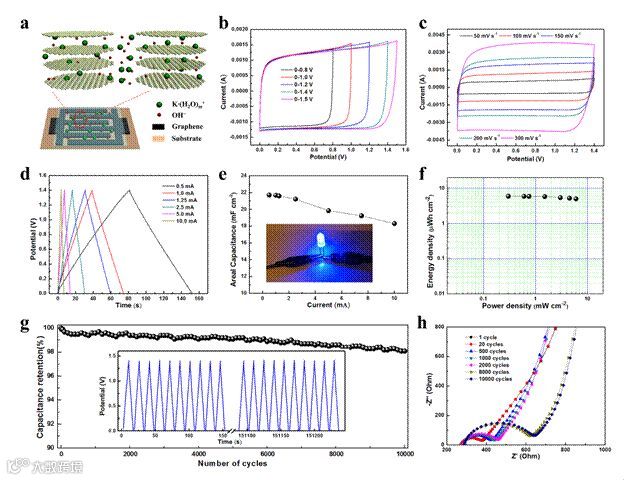
(b-c) 不同电位窗口(0-1.5 V)和不同扫描速度(50-300 mV s−1)下的伏安循环曲线测试。
(d-e) 不同电流下的充放电曲线以及倍率性能测试(21.7 mF cm−2 at 0.43 mA cm−2)。
(f) 能量密度和功率密度(5.9 µWh cm−2 at 0.3 mW cm−2, 5.0 µWh cm−2 at 6.0 mW cm−2)。
(g-h) 10000圈充放电循环稳定性测试(98.8% after 10 000 cycles)以及不同循环圈数下的阻抗测试。
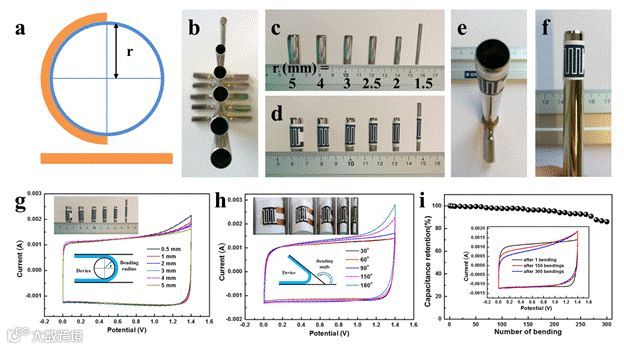
(a-f) 弯曲曲率示意图以及不同曲率模具和弯曲器件的光学照片展示。
(g) 不同弯曲曲率下的伏安循环曲线测试(0.5 mm ~ 5 mm)。
(h) 不同弯曲角度下的伏安循环曲线测试(30o ~ 180o)。
(f) 不同弯曲次数的弯曲循环稳定性测试(83.5% after 300 cycles)。
要点五:插指MSC串并联测试以及与太阳能电池、LED集成
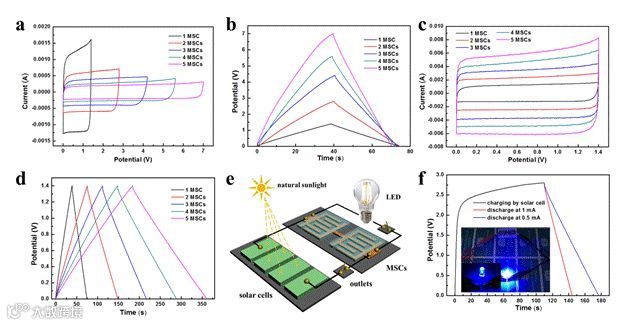
(a-b) 1到5个插指MSC器件串联的伏安循环和充放电测试。
(c-d) 1到5个插指MSC器件并联的伏安循环和充放电测试。
(e-f) 插指MSC与商用太阳能电池以及蓝色LED的集成示意图,光学照片以及充电(太阳能电池充电)放电(电化学工作站)曲线测试。
在此工作中,我们用CVD模板法制备的六边形多孔石墨烯作为油墨材料,用印章压印的方法大规模制备可串并联的插指型MSC。得益于多孔石墨烯极大的比表面积以及良好的电导率,MSC器件显示出极高的面积比电容(21.7 mF cm−2),面能量密度(5.0 µWh cm−2 at 6.0 mW cm−2)以及优异的循环稳定性(98.8% after 10 000 cycles)。
且压印的MSC器件具有极好的机械柔韧性,在不同弯曲状态下都显示良好的柔性和弯曲稳定性。压印方法重复性好、制备速度快,可大规模制备MSC器件,且易于通过串并联来获得可定制的电位窗口和面积电容。此外压印的MSC与其他电子器件如太阳能电池、LED集成简单。这项工作为促进未来便携式电子储能设备中先进电极材料的发展、性能提升以及柔性电子设备的大规模工业制造提供有效指引策略。
tamping Fabrication of Flexible Planar Micro-Supercapacitors Using Porous Graphene Inks
https://onlinelibrary.wiley.com/doi/full/10.1002/advs.202001561
Ming Huang received his Ph.D. in the School of Materials Science and Engineering at Ulsan National Institute of Science and Technology (UNIST) in 2018 under the supervision of Prof. Rodney S. Ruoff. He worked as a postdoctoral researcher (2018-2019) with Prof. Ruoff at the Center for Multidimensional Carbon Materials (CMCM), Institute for Basic Science (IBS). Currently, he is a research fellow at the School of Chemical and Biomedical Engineering in Nanyang Technological University. His research focuses on the preparation of single crystal metal foils and controllable growth of multilayer single crystal graphene films.
Feng Zhu received his Ph.D. in polymer chemistry and physics in 2009 from Changchun Institute of Applied Chemistry (CIAC), Chinese Academy of Sciences, China. Then, he worked as a postdoctoral researcher at the Institute for Solid State Research, Leibniz IFW Dresden, Germany, and Eindhoven University of Technology, the Netherlands. In 2014, he became a research group leader at Chemnitz University of Technology and the Institute for Integrative Nanosciences, Leibniz IFW Dresden, chaired by Prof. Oliver G. Schmidt. Since 2019, he is a full professor at CIAC. His research focuses on organic electronics and integrated micro-/nanodevices, and their applications in displays, sensorics, MEMS/NEMS, and energy storage/conversion.
Oliver G. Schmidt is a Director at the Leibniz IFW Dresden, Germany, and holds a full Professorship for Materials Systems for Nanoelectronics at Chemnitz University of Technology, Germany. In 2018, he received the Gottfried Wilhelm Leibniz Prize, and in the same year he was elected as a member of the German Academy of Science and Engineering (acatech). His interdisciplinary activities bridge across several research fields, ranging from nanophotonics and nanoelectronics to materials design and system engineering. His special interest lies with nanomembrane materials which can be strain engineered and employed in multifunctional devices both on and off the chip.
https://www.tu-chemnitz.de/etit/nano/index.php
https://www.ifw-dresden.de/ifw-institutes/iin/home
说明
🔹本文内容若存在版权问题,请联系我们及时处理。
🔹欢迎广大读者对本文进行转发宣传。
🔹《科学材料站》会不断提升自身水平,为读者分享更加优质的材料咨询,欢迎关注我们。
投稿请联系contact@scimaterials.cn
点击“在看”分享你的观点