大数跨境

EnSM:锂化的COF纳米片也能促进锂硫电池中锂离子的运输?

EnSM:锂化的COF纳米片也能促进锂硫电池中锂离子的运输? 科学材料站
2020-05-02
0
导读:本文作者开发了一种二维锂化共价有机骨架纳米片(Li-CON)层,该层在Li-CON的固有纳米孔中具有有序的锂化位点。由于低扩散势垒,这些锂化位点能显著促进锂离子的迁移。
Available online:29 April 2020
天津大学

导读

作为有效的改良方法,在隔膜上沉积改性层被广泛应用于抑制锂硫电池中多硫化物的穿梭,其中改性层部分牺牲了锂离子传输功能。到目前为止,同时实现锂离子的快速传输和多硫化物的阻隔仍然是一个热点和挑战性的问题。在此,作者开发了一种二维锂化共价有机骨架纳米片(Li-CON)层,该层在Li-CON的固有纳米孔中具有有序的锂化位点。由于低扩散势垒,这些锂化位点能显著促进锂离子的迁移。此外,由于三唑单元和锂化位点的协同作用,Li-CON促进了Li-S键断裂,形成了多硫化物快速转化动力学。因此,Li-CON改性分离器具有较高的锂离子导电率和迁移数,同时抑制了多硫化物的穿梭,降低了充电过电位,从而获得了优异的长周期、高倍率性能。


关键词

锂化共价有机骨架纳米片,改良分离器,锂离子传导,多硫化物捕集效应,锂硫电池

背景简介

1、锂硫电池优点及面临的挑战
锂硫电池(Li-S)作为最有前途的可充电池候选材料,以其2500Wh/kg能量密度和较低的性价比成为研究热点。此外,元素硫的环保、丰富、安全等特性使锂硫电池越来越普遍。然而,基于多电子转移氧化还原反应的硫正极会产生可溶的中间多硫化物,这些硫化物会通过分离器扩散并与锂负极反应,导致活性物质的不可逆损失,库仑效率低,循环性差。此外,硫物种的低导电性和离子导电性导致活性物质的高过电位和低利用率。因此,在正极侧捕获和再活化多硫化物并促进其转化反应是锂硫电池面临的严峻挑战。
2、隔板改性材料分类
1)具有物理排斥可溶性多硫化物特性的碳基涂层,如介孔碳、碳纳米管,碳纳米纤维和石墨烯;
2)用于化学吸附的与多硫化物有强相互作用的极性材料,包括导电聚合物、金属氧化物/硫化物、黑磷和金属有机框架(MOF);

3) 催化多硫化物转化的过渡金属基材料,如NiFe层状双氢氧化物、TiO2-Mxene、钴包覆的碳纳米片和ketjen black@铱复合材料。

3、选择CON的理由以及Li-CON效果
1) CON中含有大量吡啶氮有利于捕获多硫化物;
2)邻酚单元和三唑单元的O-H键和N-H键分别为锂的取代提供了活化位点;
3) CON的自剥落特性有利于在Celgard分离器上形成致密层。当Li-CON作为改性层应用在分离器上时,表现出如下的协同效应:
  • 三唑单元中的吡啶N作为吸附点,通过在Li-CON表面的偶极-偶极相互作用捕获多硫化物;

  • 锂化位点作为锂离子转移介质,可以调节锂离子的扩散。


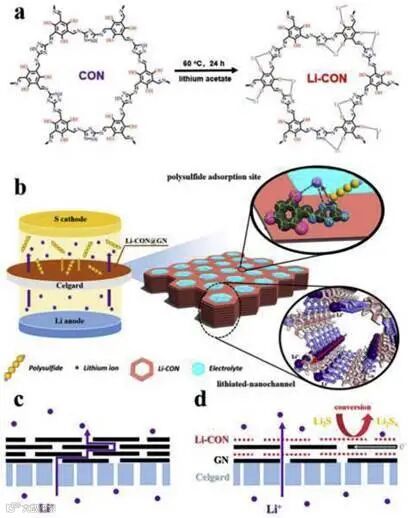
方案1. Li-CON与不同分离器的合成方法

文章介绍

近日,天津大学姜忠义教授,原续波教授等人在在国际知名期刊Energy Storage Materials上发表题为“Lithiation of covalent organic framework nanosheets facilitating lithium-ion transport in lithium-sulfur batteries”的文章。Yu Cao,Cheng Liu等人为本文共同第一作者。

作者选择1,3,5-三甲酰间苯三酚和3,5-二氨基-1,2,4-三唑来制备COF纳米片(标记为CON),并随后通过锂化方法对其进行处理,从而得到锂化共价有机骨架纳米片(Li-CON),其中含有丰富的酚类和三唑类单元,并在CON有序通道中成功引入了岩化位点。
一方面,由于活化能较低,锂化位点与相邻的三唑单元结合,促进了锂硫键的断裂。另一方面,垂直通道中的连续岩化位点可以将锂离子从锂盐(LiTFSI)和多硫化物离子中分离出来,并作为锂离子选择介质促进锂离子的传输。结合上述功能,Li-CON基于相邻三唑单元和岩化位点的内在周期性和有序排列发展出协同效应。因此,溶解在电解液中的多硫化物可以被有效地再利用,而不是在隔膜或负极中产生不可逆损失,并且锂离子在改性层中的快速迁移保证了电池内部良好的动力学效应。Li-CON改性隔膜的应用显著的改善了锂硫电池的循环稳定性和倍率性能。
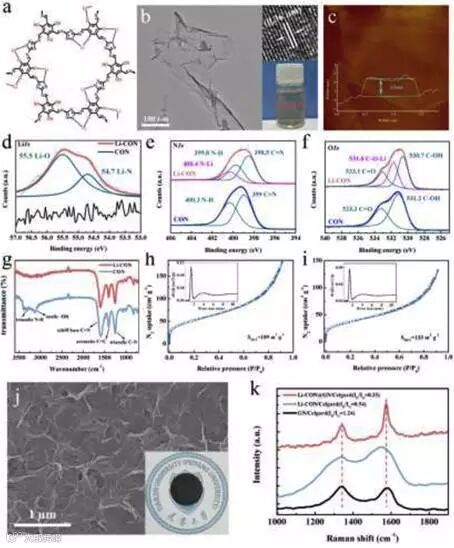
图1.Li-CON形貌与结构表征
(a) Schematic representation of the Li-CON.
(b) TEM and HRTEM image of the Li-CON and tyndall scattering effect in the aqueous solution of the Li-CON.
(c) AFM image of the Li-CON.
(d-f) Li 1s, N 1s, O 1s XPS spectra of the Li-CON and CON.
(g) FTIR spectra of the Li-CON and CON.
(h-i) N2 adsorption-desorption isotherms of the CON and Li-CON (insets: pore size distribution of the CON and Li-CON).
(j) SEM image of the Li-CON@GN/Celgard surface (inset: photograph of the Li-CON@GN/Celgard).
(k) Raman spectra of the Li-CON@GN/Celgard, Li-CON/Celgard and GN/Celgard separators.
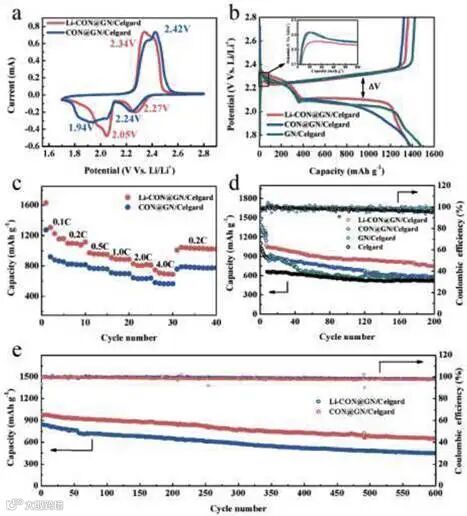
图2电化学性能分析
(a) CV curves of the Li-CON@GN and CON@GN cells.
(b) First galvanostatic discharge-charge curves of the Li-CON@GN, CON@GN and GN cells, respectively, at 0.1C.
(c) Rate performance of the Li-CON@GN and CON@GN cells.
(d) Cycling performance at 0.5 C of the Li-CON@GN, CON@GN, GN and pristine cells.
(e) Long-term cycling performance of the Li-CON@GN and CON@GN cells, respectively, at 1C.
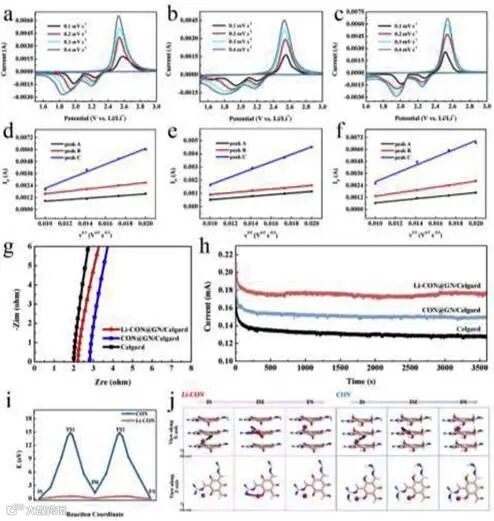
图3.不同条件下电化学性能比较
(a-f) CV curves at different scan rates and the corresponding linear fits of the peak current of the Li-S batteries with the Celgard, CON@GN/Celgard, and Li-CON@GN/Celgard separators.
(g) Impedance plots estimating lithium-ion conductivity of the Li-CON@GN/Celgard, CON@GN/Celgard and Celgard separators.
(h) I-t curves of symmetric batteries with different separators.
(i) Theoretical elucidation of Li+ migration behaviors in the nanopores of the Li-CON and CON.
(j) Schematic illustration of energy barriers for lithium-ion diffusion along with the nanochannels direction corresponding Fig. 4i. The initial, intermediate, transition, and final states are abbreviated as IS,IM,TS, and FS, respectively. The purple-colored balls represent lithium-ion. (For interpretation of the references to color in this figure legend, the reader is referred to the Web version of this article.)
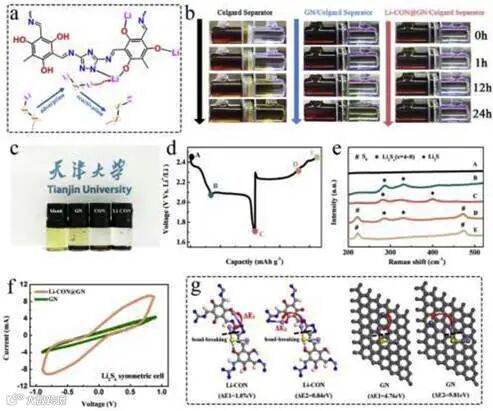
图4.转化机理与性能分析
(a) Schematic illustrations of the interaction mechanism between the Li-CON and polysulfides and conversion mechanism.
(b) H-type polysulfides permeation device with the Li-CON@GN/Celgard, GN/Celgard and Celgard separators.
(c) Visualized adsorption of Li2S8 by the Li-CON, CON and GN.
(d) First galvanostatic discharge-charge curves of lithium-sulfur batteries.
(e) Corresponding raman spectra of the Li-CON@GN/Celgard separators at five different potentials(A-E) in (d).
(f) CV curves of symmetric cells employing the Li-CON@GN and GN electrodes at a scanning rate of 10mVs1.
(g) The activation energy of reaction process from Li2S to Li+ and LiS- on the surface of the Li-CON and GN, respectively.

文章链接:
https://www.sciencedirect.com/science/article/abs/pii/S2405829720301574

老师简介:
姜忠义,天津大学教授,博士生导师
    天津化学化工协同创新中心“膜和膜过程”研究团队负责人,化学工艺国家重点学科负责人,化工绿色过程省部共建国家重点实验室培育基地主任,天津大学膜科学与技术研究中心主任。5种国内外期刊编委。
    主要研究领域为仿生与生物启发下的膜和膜过程、酶催化、光催化。

版权声明:
1) 本文仅代表原作者观点,不代表本平台立场,请批判性阅读。
2) 本文内容若存在版权问题,请联系我们及时处理。
3) 如作者对该文章有误解误读,请联系我们进行修改,欢迎各位老师进行批评指正。
4) 本文版权归科学材料站公众号所有,翻版必究。
投稿请联系contact@scimaterials.cn
【声明】内容源于网络
0
0
科学材料站
内容 0
粉丝 0
科学材料站
总阅读0
粉丝0
内容0