


Version of record online: 27 April 2020
新加坡国立大学
导读
海水淡化过程通常需要大量的能量来产生清洁的水,反之亦然。这种相互依存关系造成了这两种基本资源之间的紧张关系。本文报道了一种低碳技术,即水-氢联产系统,该系统能够同时实现稳定的淡水和清洁能源输出。这种水能耦合技术具有光谱和热管理的太阳能收集凝胶,用于光氧化和光热效应。通过这种方法水与能源的关系转变为一种协同纽带,提供了更好地满足预期需求的机会。
背景简介
1. 太阳能在海水净化的作用
然而,海水淡化过程往往需要大量的电能或热能消耗。发展节能的海水淡化技术对于可持续的淡水生产尤为重要,由于太阳能吸收材料纳米材料的发展,太阳能蒸发在海水淡水生产中具有很高的应用前景。这些光吸收材料能够有效地收集光并将光子转化为热能,这在很大程度上提高了太阳能蒸发效率。
同样,这种光热效应也被认为是通过将光催化剂的吸收范围扩大到光学带隙之外,以促进太阳能到化学能的转化,作为催化作用的增强策略。到目前为止,太阳驱动的光热现象证明了光氧化和光热有效地收集和利用太阳光谱来分别刺激淡水生产和清洁燃料生产。
2. 什么是太阳能吸收纳米材料
这些问题可以通过利用疏水微孔膜分离给水和收集的水蒸气来解决,水蒸气优先从光路冷凝。疏水膜为液相给水的通过提供了屏障。疏水膜两侧的温差产生蒸汽压梯度,导致蒸汽通量从膜的加热给水侧转移到冷冷凝侧。利用太阳能吸收体纳米材料实现热局部化概念,可以减少加热给水所需的能量输入,也可以增大跨膜的温度梯度,从而提高其效率。
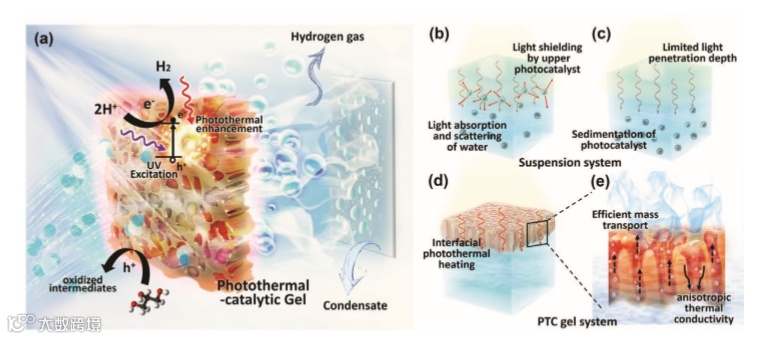
图1. 太阳能蒸发和制氢的PTC凝胶设计示意图。
文章介绍
使用PTC凝胶在一次太阳照射下实现了≈1.49kgm−2h−1的太阳蒸发率和≈3260μmolm−2h−1的氢气生成率。随后,HCS被用于首次用于并行海水淡化和氢能产生的整体原型设计。在自然光照下,它能在1d内收集约5000gm-2水和约4600μmolm-2氢。该系统具有利用低热和处理高含盐给水的优点,为解决水和能源生产之间的紧张关系提供了一个具有环境吸引力和具有可持续性的解决方案。
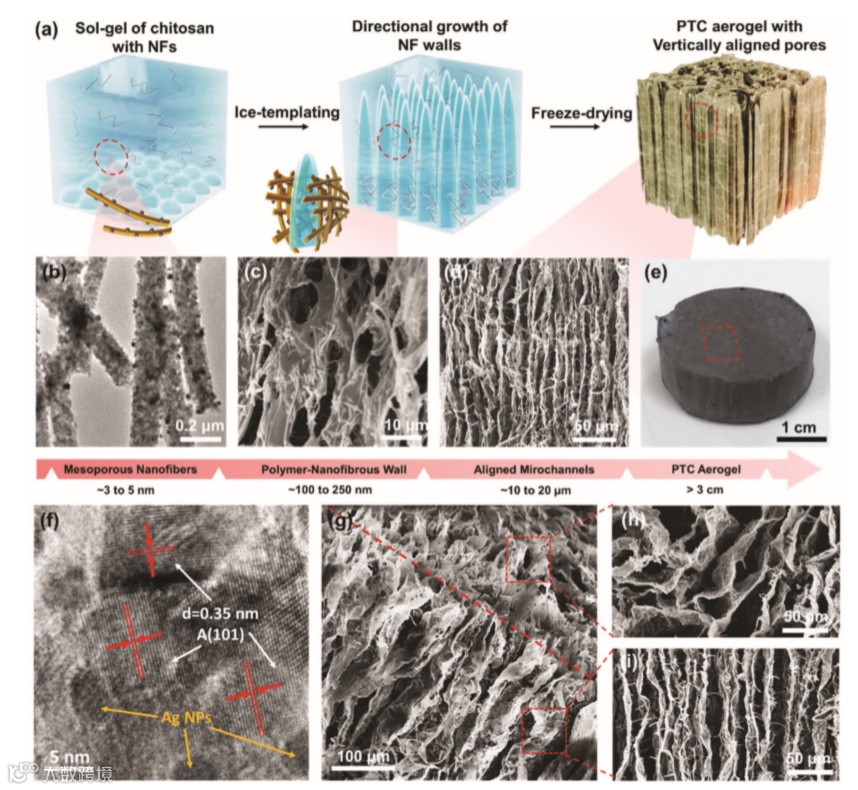
图2. PTC凝胶的合成工艺示意图及形貌结构图
a) Schematic diagram of the synthesis process of the PTC gel.
b) TEM image of TiO2/Ag NFs.
c-d) SEM images of the fibrous wall of PTC gel and its aligned microchannels.
e) Digital photo of the as-prepared PTC gel.
f) High-resolution TEM images of Ag nanoparticles within the crystalline porous TiO2 matrix.
g–i) SEM images of anisotropic microchannels in PTC gel
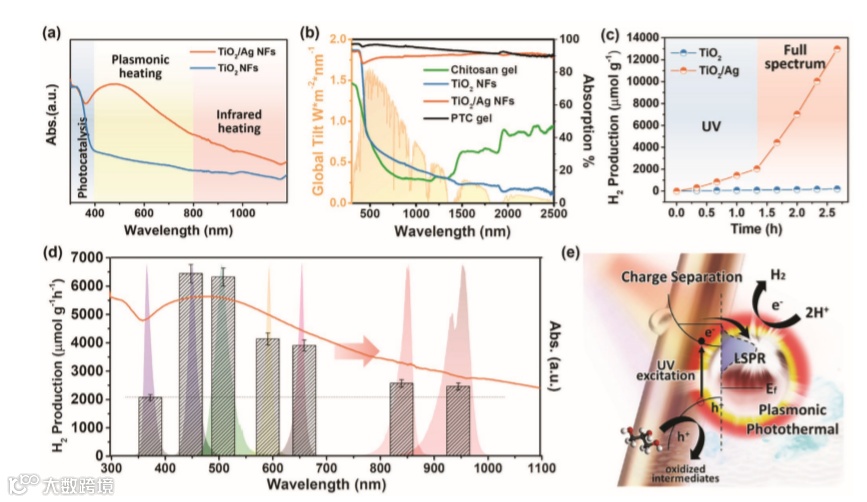
图3. TiO2-NFs和TiO2/Ag-NFs的吸收光谱及等离子体光热增强催化机理示意图
a) Absorption spectra of TiO2 NFs and TiO2/Ag NFs.
b) Calculated absorption spectra of TiO2 NFs, TiO2/Ag NFs, chitosan gel, PTC gel, and spectral solar irradiance (AM 1.5).
c) Hydrogen generation by TiO2 NFs and TiO2/Ag NFs in glycerol–water solution under both UV light and full spectrum irradiation.
d) The photocatalytic hydrogen generation rate of the TiO2/Ag NFs under different monochromatic light irradiation conditions, and its corresponding absorption spectrum.
e) Schematic diagram of the proposed mechanism of plasmonic photothermal enhanced catalysis
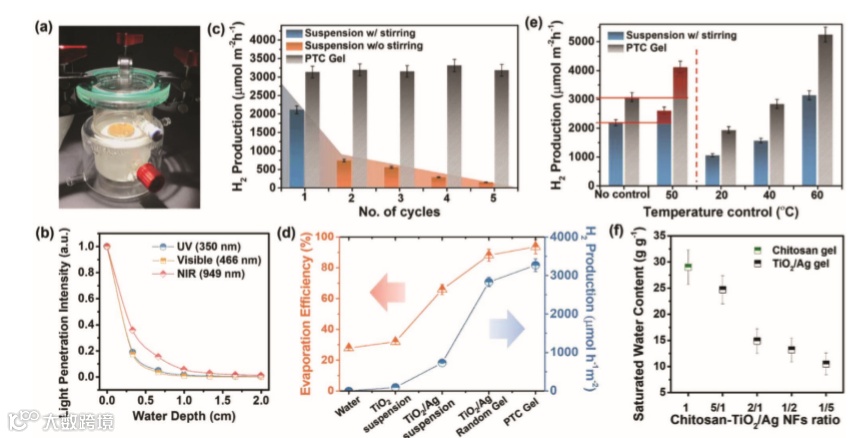
图4. 太阳蒸发效率和光催化制氢率的总结
a) The digital photo of the reactor used for photocatalytic hydrogen production under Xe lamp irradiation.
b) Light penetration intensity against water depth for selective wavelengths at 350, 466, and 949 nm.
c) Hydrogen production rate of suspension system with or without stirring and PTC gel for 5 two hour cycling test.
d) Summary of solar evaporation efficiency and photocatalytic hydrogen production rate of various systems.
e) Hydrogen production rate of suspension system with stirring and PTC gel for various temperature conditions.
f) Saturated water content in PTC gels with different composition ratios.
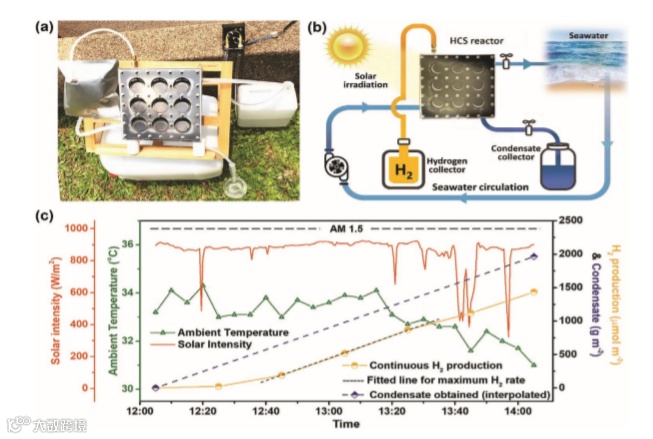
图5. 室外测试装置示意图
a) Digital photo of the set-up for outdoor testing.
b) Schematic diagram and
c) the measured results of the integral prototype for large-scale demonstration of concurrent photocatalysis and desalination of seawater under natural sunlight.
文章链接:
https://onlinelibrary.wiley.com/doi/10.1002/aenm.202000925
导师简介:
Ghim Wei Ho(何锦韦)博士,新加坡国立大学(NUS)电子与计算机工程系副教授,工程科学先导项目成员。她主要研究光子与热能转换的纳米材料在能源及环境可持续性方面的应用。何教授的本科和硕士毕业于新加坡国立大学。毕业后曾在特许半导体公司(CSM) 做过工程师,之后赴英国剑桥大学获得博士学位。在剑桥继续博士后研究后,她回到新加坡国立大学成为副教授。她曾获得了L’OREAL UNESCO 的女性科学家奖金,JCI 杰出青年 (TOYP) (科技)奖,以及杰出时代女性(科技)奖。她至今已发表文章150余篇, h-index 42。

版权声明:
1) 本文仅代表原作者观点,不代表本平台立场,请批判性阅读。
2) 本文内容若存在版权问题,请联系我们及时处理。
3) 如作者对该文章有误解误读,请联系我们进行修改,欢迎各位老师进行批评指正。
4) 本文版权归科学材料站公众号所有,翻版必究。
投稿请联系contact@scimaterials.cn