


Version of record online: 27 April 2020
Nanyang Technological University
导读
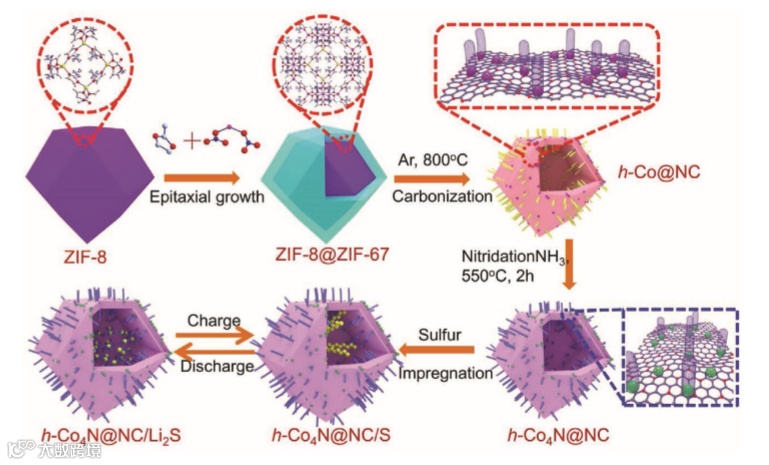
锂硫电池(Li-S)以其低廉的价格和高丰度被认为是一种很有应用前途的储能装置。然而,多硫化锂(LiPSs)的穿梭效应和缓慢的氧化还原转化导致硫利用率低、功率密度低、电极劣化快。通常这些挑战通过两种策略来解决:1)通过催化提高LiPS转化动力学;2)通过增强LiPS的捕获和吸附来减轻穿梭效应。这些改进是通过构建用氮化钴催化剂修饰的双层中空纳米笼来实现的。掺氮空心内碳壳不仅可以作为LiPSs的物理化学吸收剂,而且可以提高电极的导电性,从而显著抑制穿梭效应。
背景简介
1.锂硫电池的发展方向
文章介绍
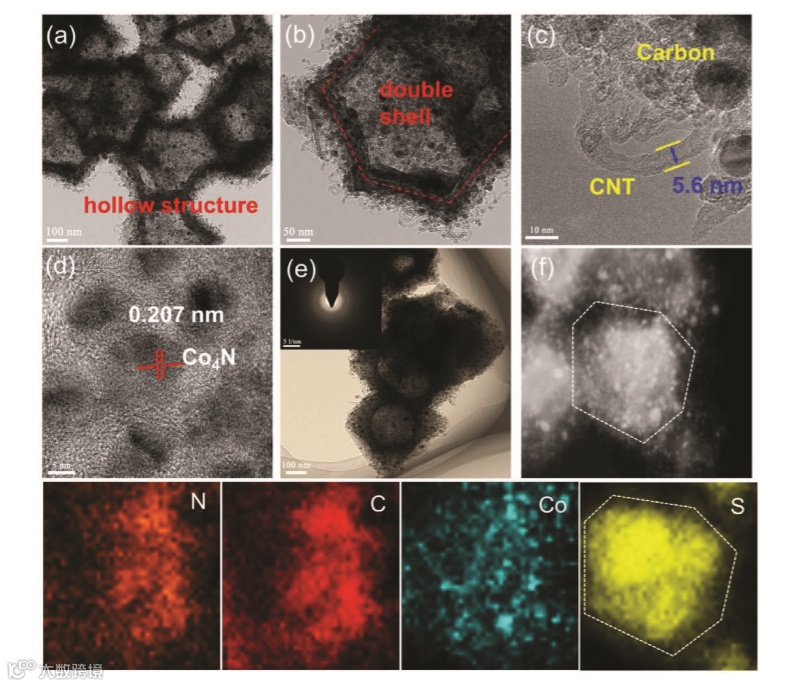
图2. h-Co4N@NC的形貌表征
a,b) TEM images of h-Co4N@NC.
c,d) Typical HRTEM images of h-Co4N@NC.
e) TEM image and SEAD pattern (inset) of h-Co4N@NC/S.
f) HRTEM image and EDX element mapping images of h-Co4N@NC/S. The shape of the particle is labeled with dotted polygons.
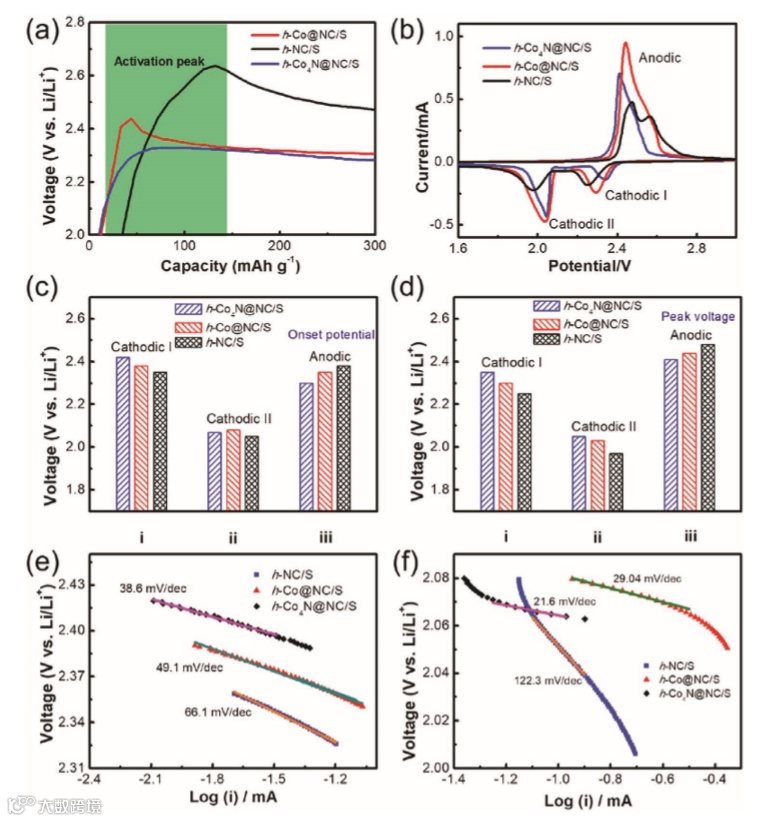
图3. h-Co4N@NC的电化学性能
a) First cycle charge voltage profiles of the h-NC/S, h-Co@NC/S, and h-Co4N@NC/S electrodes. b) The first CV curves of the h-NC/S, h-Co@ NC/S, and h-Co4N@NC/S electrodes.
c) Onset potential and
d) Peak voltage of the h-NC/S, h-Co@NC/S, and h-Co4N@NC/S electrodes from the first CV curves.
e,f) Tafel slopes of the h-NC/S, h-Co@NC/S, and h-Co4N@NC/S electrodes from the cathodic peaks of the first CV curves
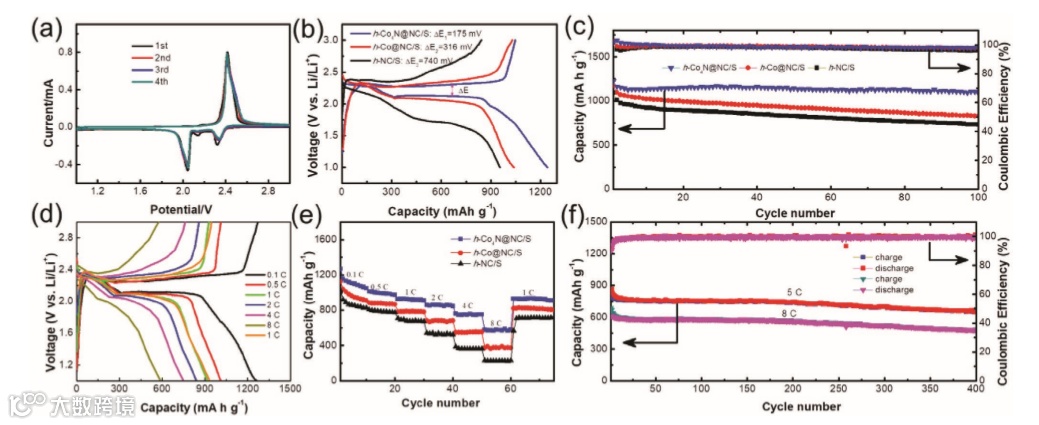
图4. 锂硫电池的电化学性能。
a) Cyclic voltammograms of h-Co4N@NC/S electrodes for the first four cycles at 0.2 mV s−1.
b) Representative charge-discharge voltage profiles.
c) Cycling at 0.1 C over 100 cycles of the h-NC/S, h-Co@NC/S, and h-Co4N@NC/S electrodes with sulfur loading of 1.5 mg cm−2.
d) Charge–discharge curves of the h-Co4N@NC/S composites at various current densities from 0.1 C to 8 C.
e) Rate performance of the composites.
f) Cycling performance of the h-Co4N@NC/S composite at high rates
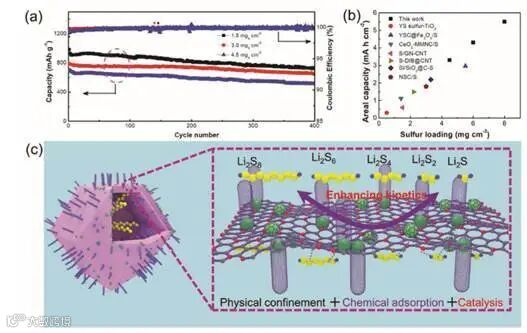
图5. 不同硫负荷下h-Co4N@NC/S复合材料的循环性能与结构示意图
a) Cycling performance of the h-Co4N@NC/S composite with different sulfur loading.
b) Areal capacity and sulfur weight comparisons of the h-Co4N@NC/S composites with the recent reports.
c) Schematic structure of the h-Co4N@NC/S composite
文章链接:
https://onlinelibrary.wiley.com/doi/10.1002/aenm.201904010
导师简介:
Hong Li, 博士在新加坡南洋理工大学获得学士和博士学位。毕业后获新加坡千年基金会博士后奖学金。2013年,他作为博士后加入斯坦福大学机械工程系,专注于催化能量转换/储存的二维材料工程(隶属于催化可持续能源中心)。他还与三星合作,为可穿戴设备开发健康监测生物传感器。Hong Li博士于2016年6月加入机械与航空航天工程学院,任助理教授,隶属于制造业产业工程集群。Hong Li的专长是开发用于能量转换和储存的电化学装置和催化剂。他目前的研究工作主要集中在通过电化学器件的设计和电催化剂的工程来实现能量转换。
版权声明:
1) 本文仅代表原作者观点,不代表本平台立场,请批判性阅读。
2) 本文内容若存在版权问题,请联系我们及时处理。
3) 如作者对该文章有误解误读,请联系我们进行修改,欢迎各位老师进行批评指正。
4) 本文版权归科学材料站公众号所有,翻版必究。

投稿请联系contact@scimaterials.cn