



Available online 4 May 2020
浙江大学
导读
尤其是,分层NCNT/NF支架在Li剥离/沉积过程中表现出低的过电位和高的库仑效率(在1 mA cm -2条件下循环200次平均为98.2%)。此外,通过注入熔融锂形成NCNT/NF/Li复合负极与LiFePO4(在2C下循环400次后容量保持率为94%)配合使用时,具有3 mAh cm-2的高比表面积容量和稳定的全电池性能,在3mA cm-2条件下拥有超过400 h 的超长寿命。这是由于NCNT/NF支架的合理设计,它结合了层次结构的优点以及富氮物质(吡啶N和吡咯N)对Li良好的亲和力。
关键词
锂金属负极,分层集电器,N掺杂CNTs/Ni泡沫支架,无枝晶负极
背景简介
1、锂金属负极实际应用的阻碍
1)锂沉积的不均匀性导致了枝晶的不可控制生长,进而导致短路和安全隐患;
2)无支撑的锂金属负极在Li剥离/沉积过程中大体积变化会导致电极内部压力波动和SEI膜突然破裂;
3)SEI突裂后,电解液与Li继续发生不可逆反应,连续消耗电解液,形成死锂,导致库仑效率低。
2、锂枝晶的解决办法
1)改善电解液的组成,探索有效的电解液添加剂,以制备稳定的SEI膜;
2)使用固体电解质抑制锂枝晶的生长;
3) 通过物理约束,构建具有良好柔韧性、良好离子/电子导电性和高杨氏模量的稳定人工SEI膜,以防止枝晶生长;
4)设计稳定的三维导电框架,以减轻Li枝晶引起的体积变化并减少其危害。
3、改善传统的金属基和碳基三维导电骨架的亲锂性的方法
1)在负极基底上引入Au、Ag、CuO、Co3O4等亲锂纳米粒子。通过调控这些亲锂纳米颗粒的形貌,可以进一步改善骨架与锂金属的接触性。但它涉及到贵金属或Li2O等副产物的使用;
2)在导电基体上构建具有毛细作用的三维互连材料;
3)通过氮(N)掺杂提高3D基体的亲锂性也越来越受到人们的关注。
文章介绍
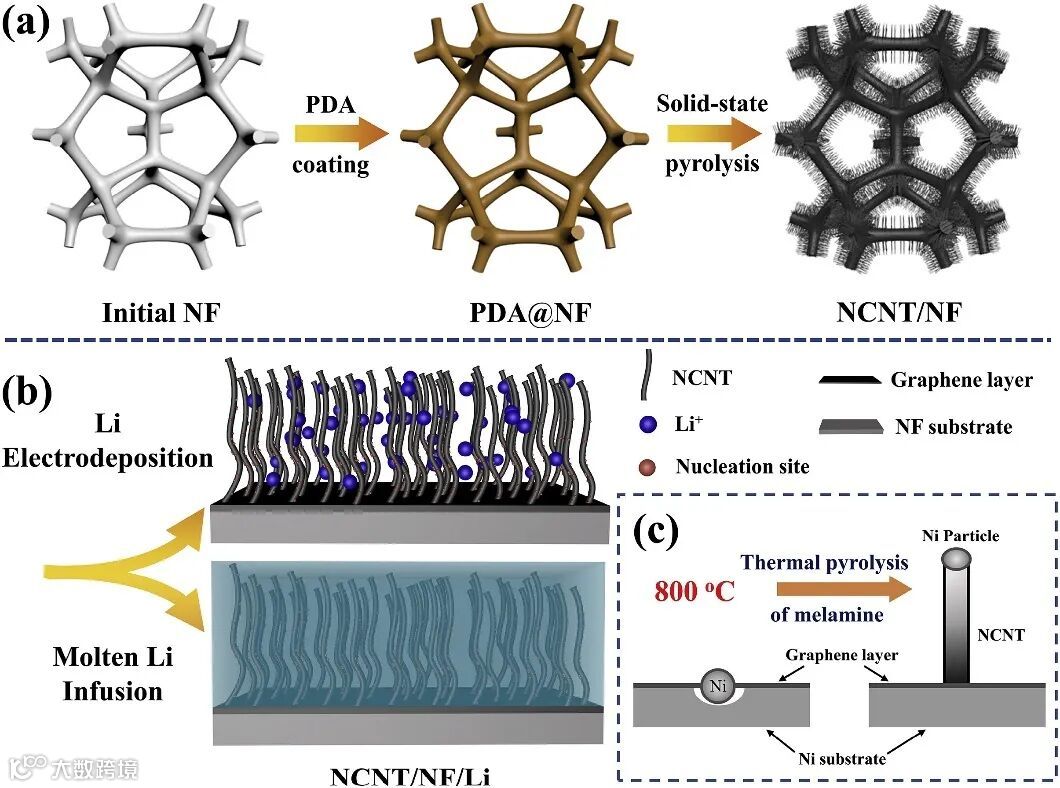
图1.合成路线
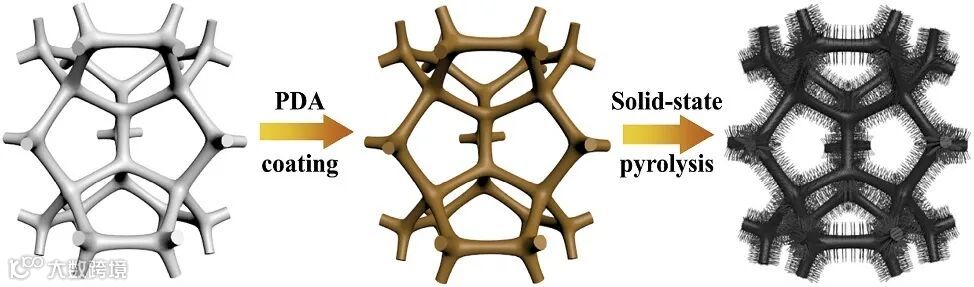
a) Schematic illustration of the fabrication procedures of the hierarchical N-doped CNTs/Ni Foam scaffold (denoted as NCNT/NF).
b) Schematic of direct Li deposition and molten Li infusion to construct composite Li metal anode.
c) Cross-sectional schematic diagram of the tip growth process of N-doped CNTs in the NCNT/NF scaffold.
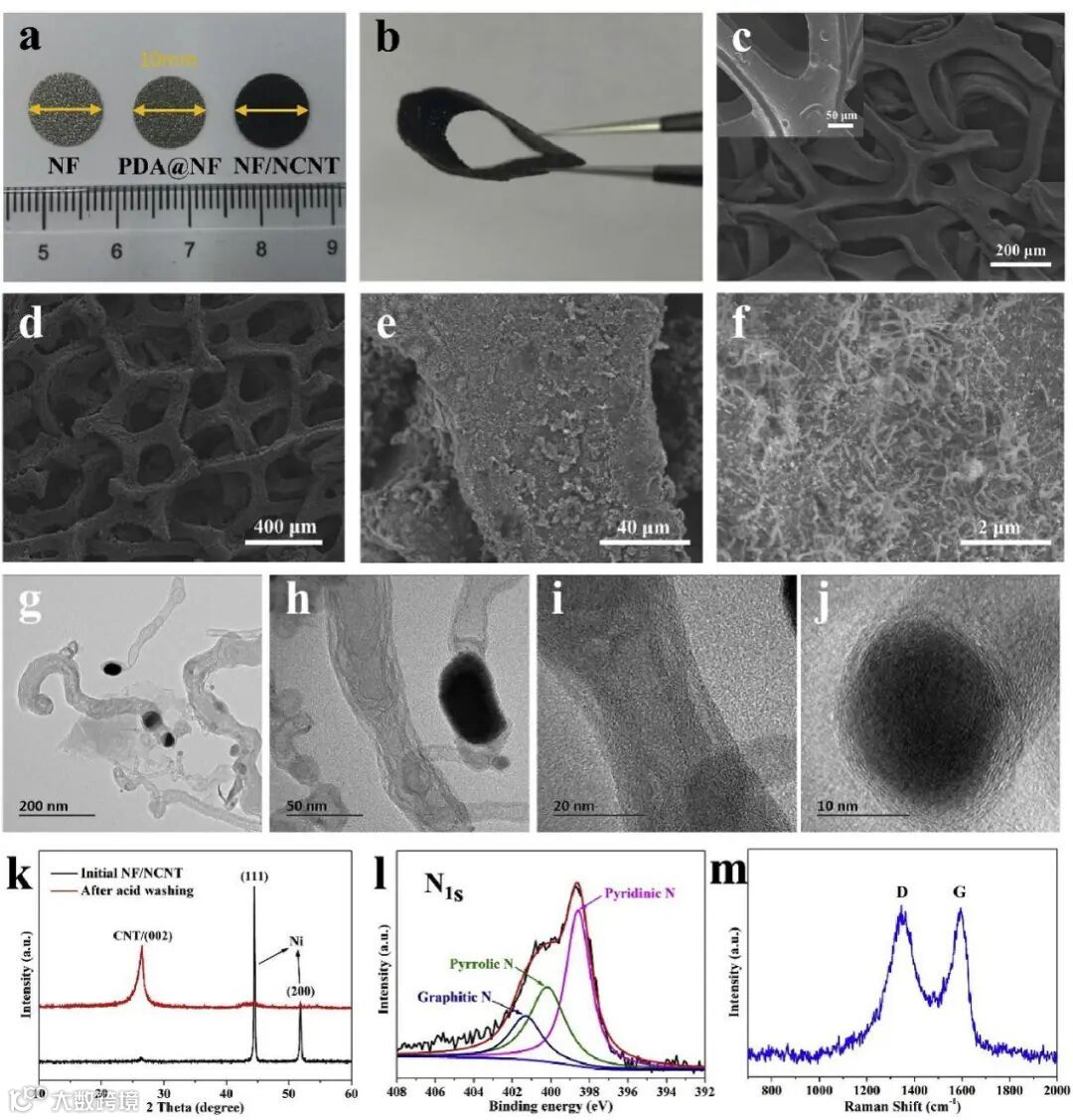
图2.结构与形貌特征
a) Digital photographs of pristine NF, NF coated with PDA layer (denoted as PDA@NF) and the hierarchical N-doped CNTs/Ni Foam scaffold (denoted as NCNT/NF).
b-f) A strip of NCNT/NF is bended by a pair of tweezers to show good flexibility. SEM images of pristine NF and NCNT/NF at different magnification.
g-i) TEM and HR-TEM images of NCNT/NF after acid washing to remove NF skeleton.
k) XRD patterns of NCNT/NF before and after acid washing.
l-m) High-resolution N1s XPS pattern and Raman spectrum of NCNT/NF after acid washing.
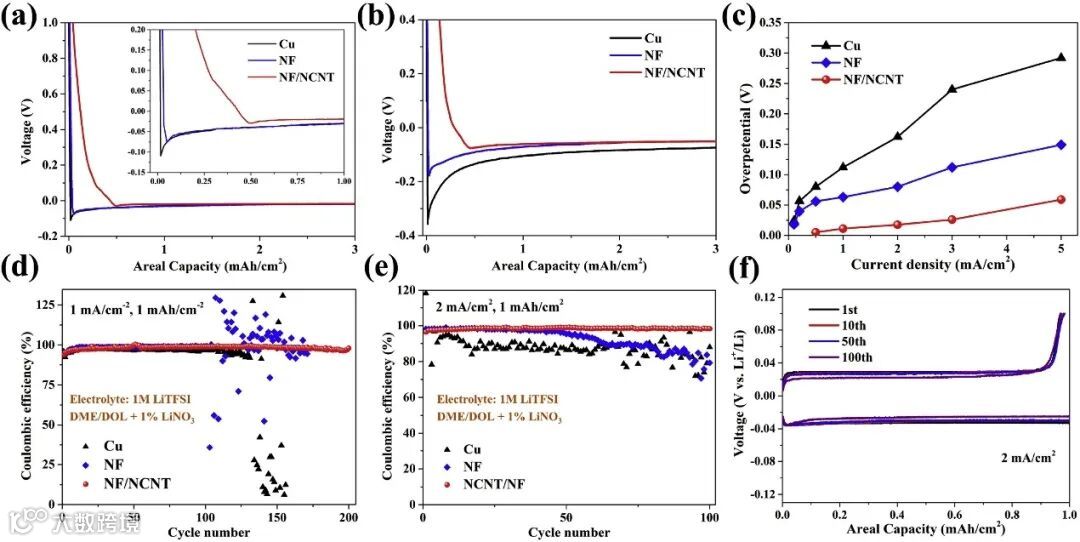
图3.电化学性能
a-b)Voltage profiles of galvanostatic Li deposition on NCNT/NF, NF and Cu foil substrates in ether-based electrolyte at a current density of 1mAcm−2 and 3mAcm−2 with total areal capacity of 3mAh cm−2.
c-e) Li nucleation overpotential on NCNT/NF, NF and Cu foil substrates at various current density in ether-based electrolyte. Comparison of CE of Li plating/stripping cycles on NCNT/NF, NF and Cu foil substrates with fixed areal capacity of 1mAh cm−2 at a current density of 1mAcm−2 and 2mAcm−2.
f) Voltage profiles for Li metal plating/stripping cycles on NCNT/NF, NF and Cu foil substrates at a current density of 2mAcm−2 with an areal capacity of 1mAh cm−2.
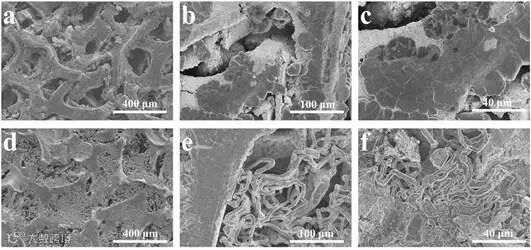
图4.循环后形貌
a-f) SEM images of the NCNT/NF and NF after plating 5mAh cm−2 at 1mAcm−2 at different magnification.
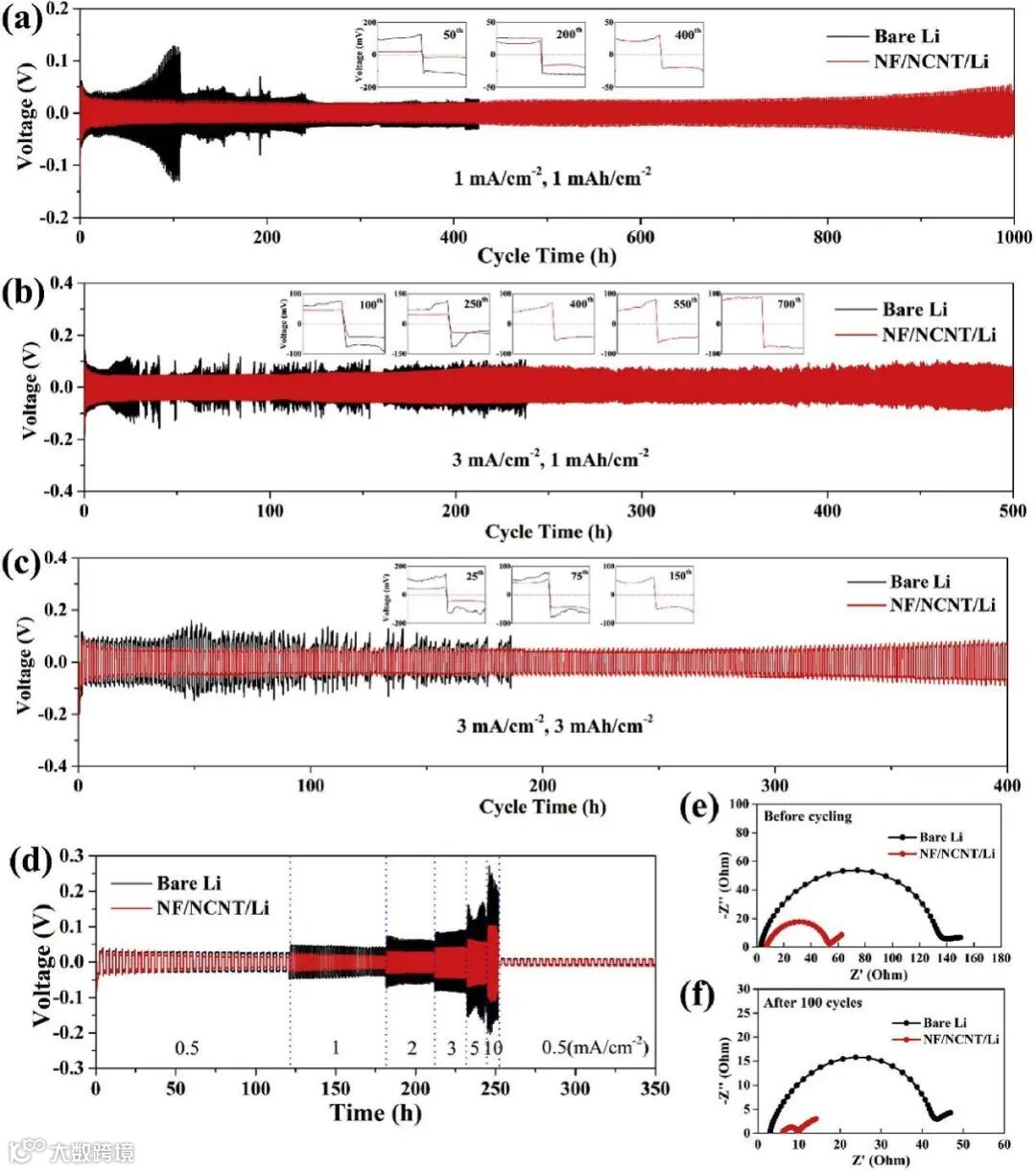
图5.不同条件下电化学性能
The electrochemical performance of bare Li and NCNT/NF/Li in symmetrical cells at various current density and areal capacity:
a) 1mAcm−2 at 1mAh cm−2
b) 3mAcm−2 at 1mAh cm−2
c) 3mAcm−2 at 3mAh cm−2.
d-f) Rate performance at various of current density of bare Li and NCNT/NF/Li in symmetrical cells. The Nyquist plots of bare Li and NCNT/NF/Li in symmetrical cells before cycling and after 100 cycles.
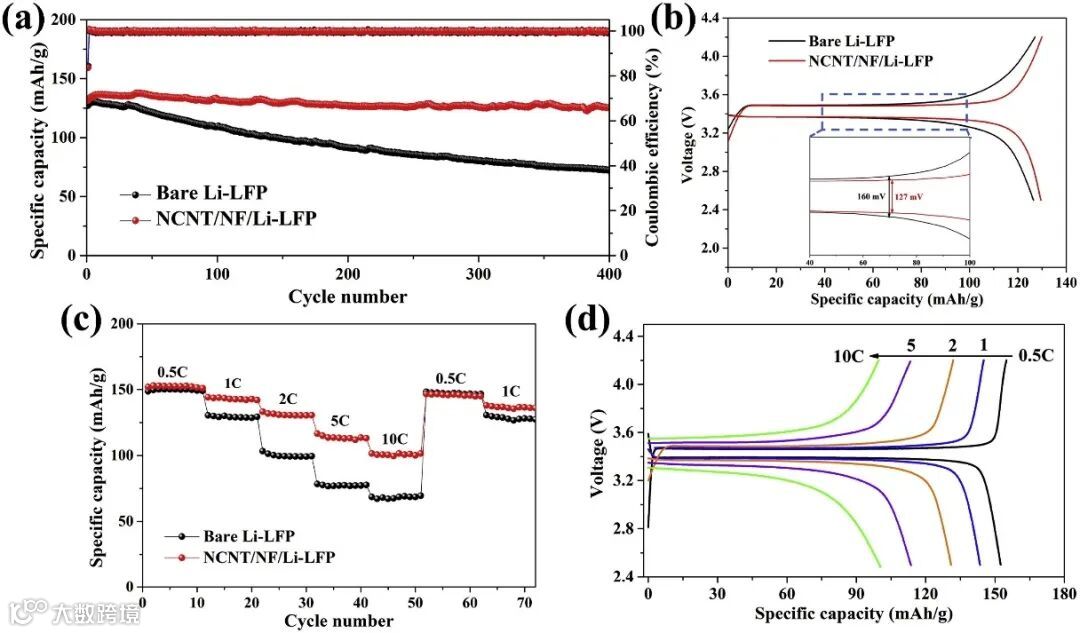
图6.循环性能对比
a-b) The Cycling performance and charge/discharge curves of Bare Li-LFP and NCNT/NF/Li-LFP at the rate of 2C.
c-d) Rate performance and charge/discharge curves of NCNT/NF/Li-LFP at various rate of 0.5, 1, 2, 5, 10 C.
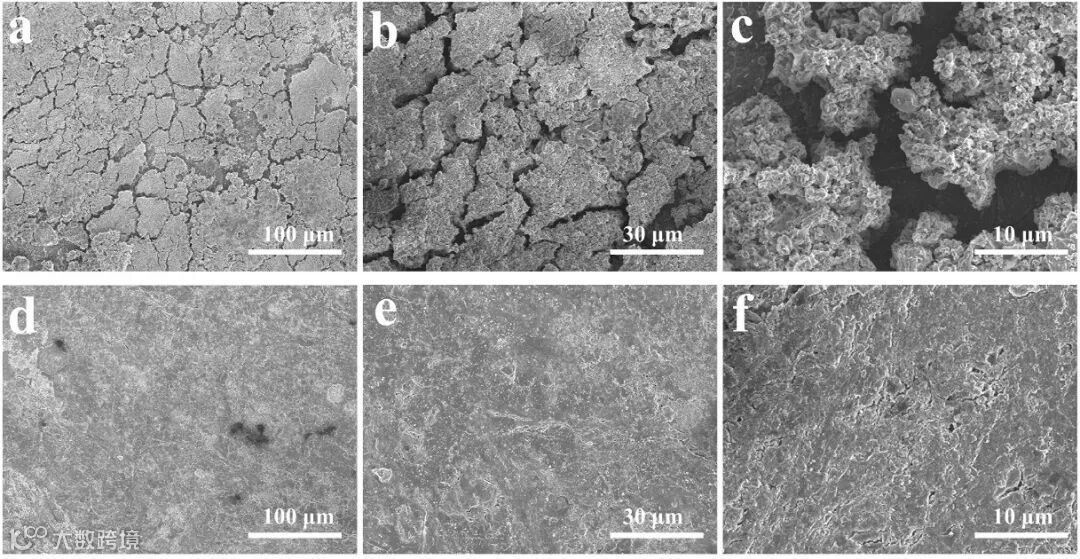
图7.形貌对比
a-f)SEM images at different magnification of bare Li and NCNT/NF/Li after 400 galvanostatic charge/discharge cycles coupled with LFP cathode at 2C rate.
文章链接:
https://www.sciencedirect.com/science/article/abs/pii/S2405829720301483
导师简介:
韩伟强,教授,博士生导师。浙江大学材料学院求是讲席教授。2012年9月前在美国布鲁克海文国家实验室纳米中心研究员。随后任中国科学院宁波工程技术研究院新能源所所长。2015年10月到浙大材料学院工作。研究微纳低维材料、锂离子电池和催化剂。在Nature、Science等杂志发表论文超过160篇。他人引用次数过万。作为第一作者工作1997年发表在Science,2002年被引用102次而成为中国当年单篇论文被引用次数最多的论文,这个工作被中科院院士和工程院院士评为1998年度中国十大科技新闻之一。参加世界上首个纳米马达的研究工作,2003年被评为年度十大世界科技新闻之首。入选2014-2018年爱思唯尔中国高被引学者。获Battelle2007年发明家奖入选。
主要研究方向为能源材料,微纳材料。
版权声明:
1) 本文仅代表原作者观点,不代表本平台立场,请批判性阅读。
2) 本文内容若存在版权问题,请联系我们及时处理。
3) 如作者对该文章有误解误读,请联系我们进行修改,欢迎各位老师进行批评指正。
4) 本文版权归科学材料站公众号所有,翻版必究。

投稿请联系contact@scimaterials.cn