


Published: 04 May 2020
导读
作为未来的储能技术,超高能量密度锂氧电池受到了广泛的关注。开发有效的电催化剂及探究其在循环过程中的工作机理对锂氧电池至关重要。本文采用聚合物包埋的方法制备了钴单原子电催化剂。单原子催化剂的孤立部分能有效地调节活性位点的分布,形成微米级的花状Li2O2,并通过单电子途径促进Li2O2的分解。钴单原子电池具有较高的往返效率(86.2%)和长期稳定性(218天),优于市售5 %Pt/C催化剂。单原子与载体之间的协同作用赋予了催化剂优异的稳定性和耐久性。这些研究结果为设计锂氧电池高效催化剂提供了新的思路,也大大拓展了今后的研究范围。
关键词
电池 电催化 电化学 锂氧电池
背景简介
Li-O2电池的研究意义
典型的非水性锂氧电池由锂金属阳极、锂离子导电电解液和多孔氧阴极组成。在放电过程中,O2优先还原,然后与Li+结合形成Li2O2(氧还原反应,ORR)。随后,在充电过程中,Li2O2转化为Li和O2(析氧反应,OER)。电催化剂能有效地提高ORR和OER的动力学性能,进一步提高电池的循环效率,这对于储能设备而言至关重要。
Li-O2电池的研究难题
研究表明,LiO2中间产物在电解液中的溶解度决定了Li2O2的沉积行为。然而,通过增强的溶剂化介导途径重新充电后Li2O2的有效分解机理却鲜为人知,这对电池的往返效率和循环寿命造成了很大的阻碍。采用有效的电催化剂来详细讨论放电时O2还原为Li2O2的机理以及充电时的逆过程将是设计Li-O2电池高往返效率的另一种方法。
单原子催化剂
非均相单原子催化剂(SACs)是指在载体上具有原子分散的活性金属位点。这种材料的特殊电子结构和最大化的原子利用率,与传统的纳米或亚纳米材料有很大的不同。此外,SACs中活性位点的单原子性质以及由此产生的低配位环境和增强的金属-载体相互作用都在许多非均相反应中(如二氧化碳还原、析氢反应和光催化反应)提供了强大的催化性能。因此,探讨SACs在锂氧电池中的电化学和催化机理是非常重要的。
文章介绍
在放电过程中,均匀的原子位是Li2O2等孤立纳米片生长的成核点,并有利于随后的充电分解。在充电过程中,SACs通过一个电子过程促进Li2O2的分解,在电解液中形成更多的LiO2中间产物。得益于这些优点,这些N-HP-Co SACs表现出相对较低的过电位、较高的比容量和较高的倍率能力。此外,借助SACs可以有效地消耗其副产物,并显示出出色的循环稳定性。
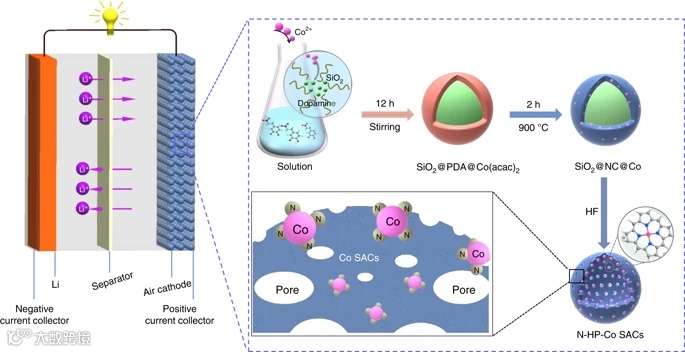
图1. N-HP-Co SACs合成的示意图
文章亮点
本文首次将单原子催化剂应用于并锂氧电池阴极催化剂,成功地调节了Li-O2电池的沉积/分解途径。
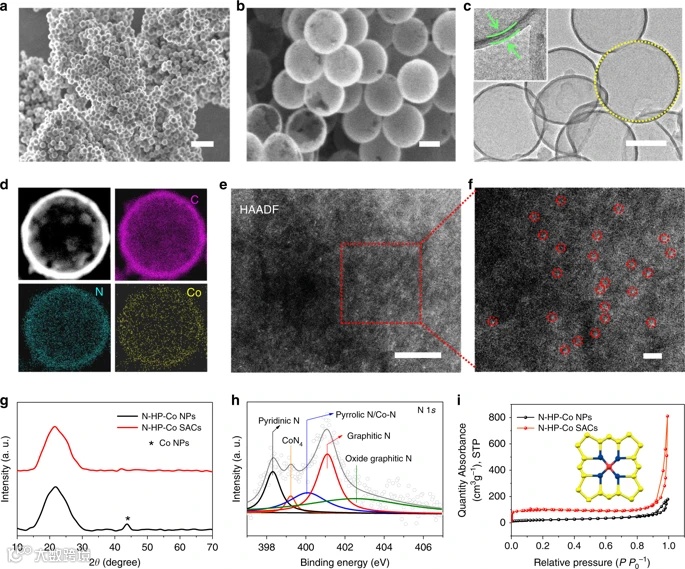
图2:N-HP-Co SACs的表征
a-b. SEM images of N-HP-Co SACs, 1 μm in (a), 200 nm in (b);
c. TEM image of N-HP-Co SACs.
d. HAADF-STEM image, 50 nm in (d); and the corresponding elemental maps.
e. HAADF-STEM image, 5 nm in (e),
f. enlarged image of N-HP-Co SACs, 2 nm in (f);
g. PXRD graphs of N-HP-Co NPs and Co-SACs.
h. High-resolution N 1s XPS spectra of N-HP-Co SACs.
i. N2 adsorption-desorption isotherms of N-HP-Co NPs and Co SACs at 77 K. BET: 80.5 cm3 g−1 with N-HP-Co NPs; 312.3 cm3 g−1 with N-HP-Co SACs.
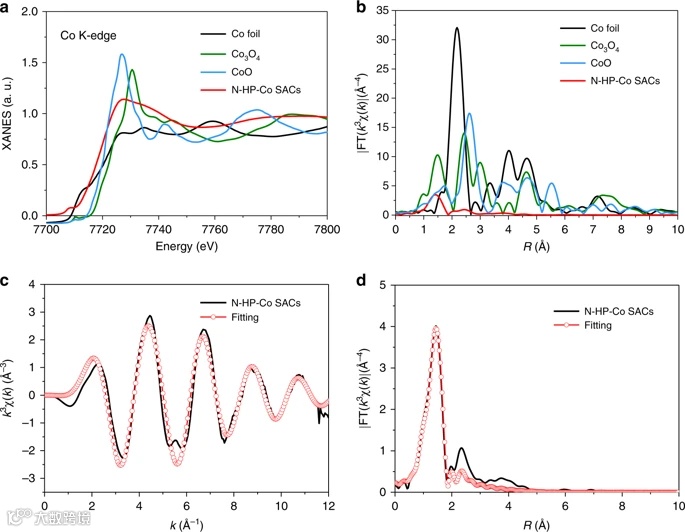
图3:原子结构分析
a-b. XANES spectra (a) and Fourier transform of the Co K-edge (b) of N-HP-Co SACs Co3O4, CoO, and Co foil.
c-d. The corresponding EXAFS fitting curves of N-HP-Co SACs at the k space and R space, respectively.
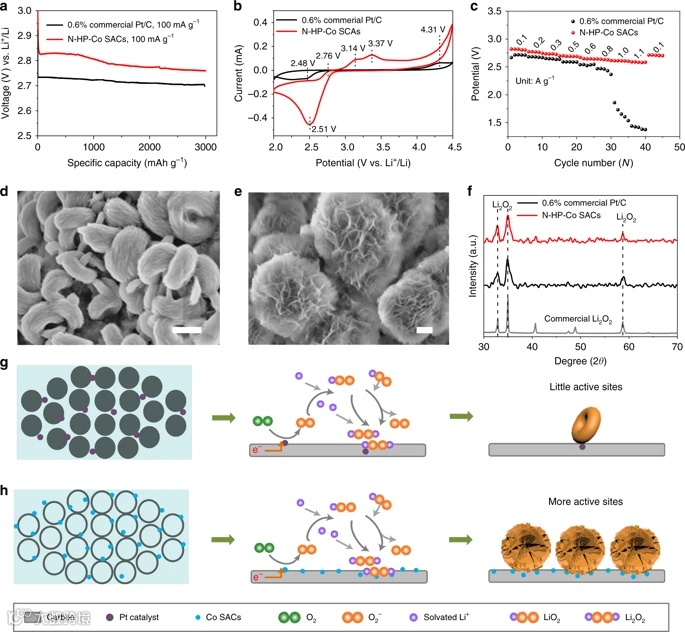
图4:放电性能和放电产物的特性
a. First discharge curves with 0.6% commercial Pt/C and N-HP-Co SACs at a current density of 100 mA g−1 with a limiting specific capacity of 3000 mAh g−1.
b. CV curves.
c. Full range rate performances of Li-O2 batteries at different current densities.
d-e. FESEM images of the discharged cathodes with (d), 0.6% commercial Pt/C and (e) N-HP-Co SACs at a current density of 100 mA g−1 with a limiting specific capacity of 3000 mAh g−1, 500 nm in (d, e);
f. The corresponding XRD patterns. The standard spectra for Li2O2 are also shown for reference. g-h. Discharge mechanism of 0.6% commercial Pt/C (g) and N-HP Co SACs (h) in the Li-O2 batteries.
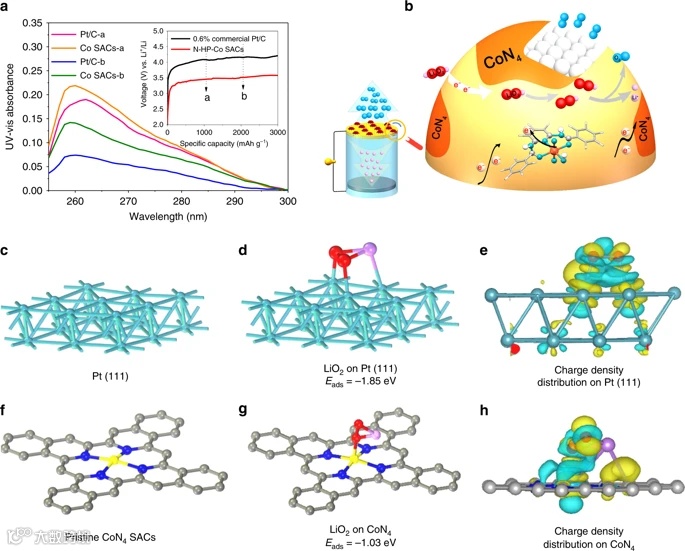
图5:充电特性
a. UV-vis spectra of DMSO-extracted superoxide products from the 0.6% commercial Pt/C and N-HP-Co SAC cathodes at different charging states (a. state a, charge to 1000 mAh g−1; b. state b, charge to 2000 mAh g−1). The inset of a shows the corresponding charge potential profiles of the Li-O2 cells using 0.6% commercial Pt/C and N-HP-Co SACs at a current density of 100 mA g−1.
b. Schematic illustration showing the charge mechanisms of the N-HP-Co SAC-catalysed Li-O2 batteries.
c-d. Pristine and top views of the optimized structures with the corresponding binding energy of LiO2 on Pt (111); f, g optimized structure and the corresponding binding energy of LiO2 on CoN4; and
e-h. corresponding charge density distribution. Colour code: platinum (green), carbon (grey), CoN4 (blue), and LiO2 (red).
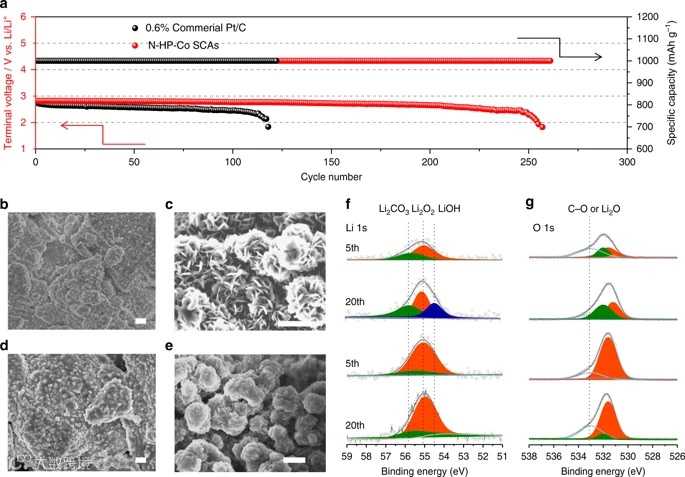
图6:由N-HP-Co SACs组成的Li-O2电池的循环稳定性
a. Voltage versus cycle number on the discharge terminal of the Li-O2 cells with commercial Pt/C and N-HP-Co SACs.
b-e. FESEM images of the discharged cathode with the 0.6% commercial Pt/C catalyst (b) and the N-HP-Co SAC catalyst (c) at a current density of 200 mA g−1 after the 5th cycle and the cathode with the 0.6% commercial Pt/C catalyst (d) and the N-HP-Co SAC catalyst (e) after the 20th cycle. One micrometer in b, d; 500 nm in c, e;
f-g. XPS spectra of the discharged cathodes with 0.6% commercial Pt/C and N-HP-Co SACs: Li 1s (f) and O 1s (g) after the 5th and 20th cycles.
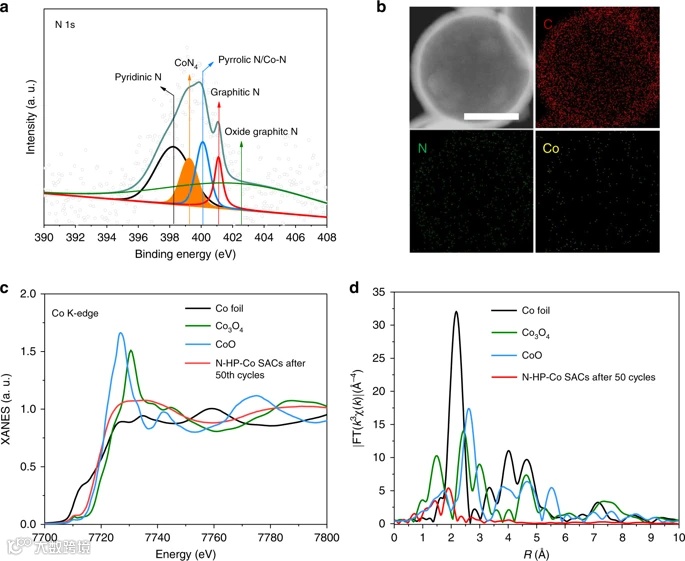
图7:N-HP-Co SACs的循环稳定性
a N 1s XPS spectra for N-HP-Co SACs after 50 galvanostatic cycles.
b HAADF-STEM images and the corresponding EDX elemental maps after 50 galvanostatic cycles, 200 nm in b.
c-d XANES spectra and Fourier transform of the Co K-edge of N-HP-Co SACs, Co3O4, CoO, and Co foil.
文章链接:
https://www.nature.com/articles/s41467-020-15712-z#Sec14
导师简介:
徐吉静,吉林大学教授,博士生导师,学术带头人
研究领域:无机新能源材料的纳微结构设计、制备及储能机理研究:
(1) 锂(钠、钾)离子电池关键材料及器件
(2) 锂-空气电池等新型化学电源
(3) 多功能电催化材料

版权声明:
1) 本文仅代表原作者观点,不代表本平台立场,请批判性阅读。
2) 本文内容若存在版权问题,请联系我们及时处理。
3) 如作者对该文章有误解误读,请联系我们进行修改,欢迎各位老师进行批评指正。
4) 本文版权归科学材料站公众号所有,翻版必究。
投稿请联系contact@scimaterials.cn