


Version of record online: 20 April 2020
University of Wollongong
【导读】
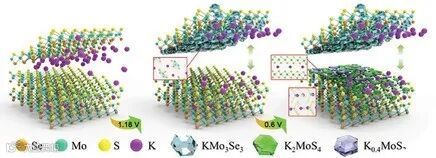
本文作者采用在2d Mos1.5Se0.5纳米片中引入层间阴离子配体的方法,巩固了层间带隙,优化了钾离子电池的电子结构。这种结构结合了两种具有高导电性和与钾离子亲和力的阴离子配体的互补优势。钾离子扩散速率也被优化的低势垒离子扩散路径所加速,形成了除K0.4MoS2/K2MoS4之外的高度可逆的KMo3Se3晶体,提供了具有优异循环稳定性的增强钾储存性能。
【背景简介】
1.钾离子电池的特点
钾离子电池(KIBs)以其固有的高经济性和潜在的高能量密度等优点,越来越受到人们的关注。由于钾的标准还原电位较低(-2.93v vs标准氢电位,E0),接近锂的标准还原电位(-3.04v vs E0),因此被认为是大型储能系统中最具竞争力的候选电池之一。
基于最初的分子动力学模拟,已经证明K+的扩散系数比Li+的扩散系数大约3倍。同时,K+在碳酸丙烯酯(PC)电解质中具有较高的离子迁移率和离子导电性。然而,由于钾(1.38Å)与锂(0.68Å)、钠(0.97Å)和钙(1.18Å)相比,其原子半径最大,因此设计具有高度可逆和可供长期K+插入和提取能力的合适材料是相当困难的。
2.目前钾离子电池电极材料的挑战
在全球学术研究的基础上,已经为KIB探索并设计了各种电极材料。如过渡金属氧化物、碳基材料和聚阴离子基材料,由于其独特性的优势,所有这些材料都显示出潜在的更高性能。由于二维材料具有层间距大、可逆转换效率高等优点,因此受到了人们的广泛关注,并通过形貌控制和物理结构控制,设计出了各种优化其性能的策略。
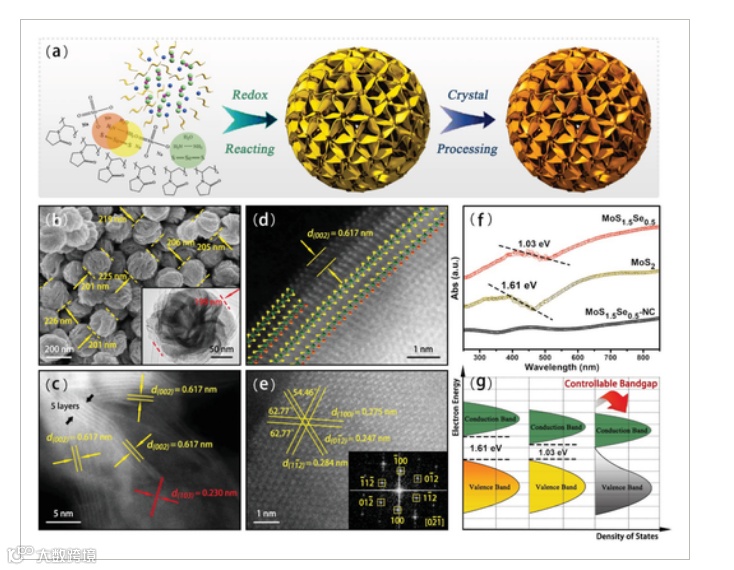
图1. MoS1.5Se0.5-NC的制备示意图
a) Schematic illustration of the preparation of MoS1.5Se0.5-NC;
b) Basic SEM image with inset TEM image of the as-produced MoS1.5Se0.5-NC;
c–e) HRTEM images showing different crystal facets with DFT-abbreviated structure in
d) and the corresponding FFT pattern inset in (e);
f) UV–vis absorption spectra presenting different energy bands from the MoS1.5Se0.5, MoS2, and carbon coated MoS1.5Se0.5, respectively;
g) Controllable bandgap from the MoS1.5Se0.5, MoS2, and carbon coated MoS1.5Se0.5.
【文章介绍】
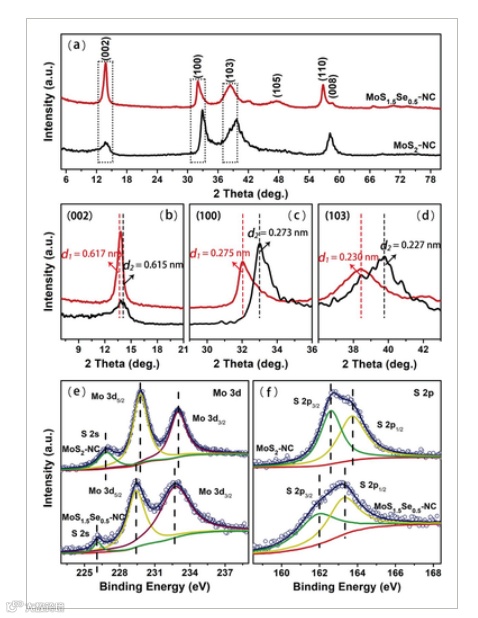
图2. MoS1.5Se0.5-NC的结构表征
a–d) XRD patterns of MoS1.5Se0.5-NC and MoS2-NC composites;
e) Mo 3d and
f) S 2p XPS spectra of the as-prepared MoS1.5Se0.5-NC and MoS2-NC.
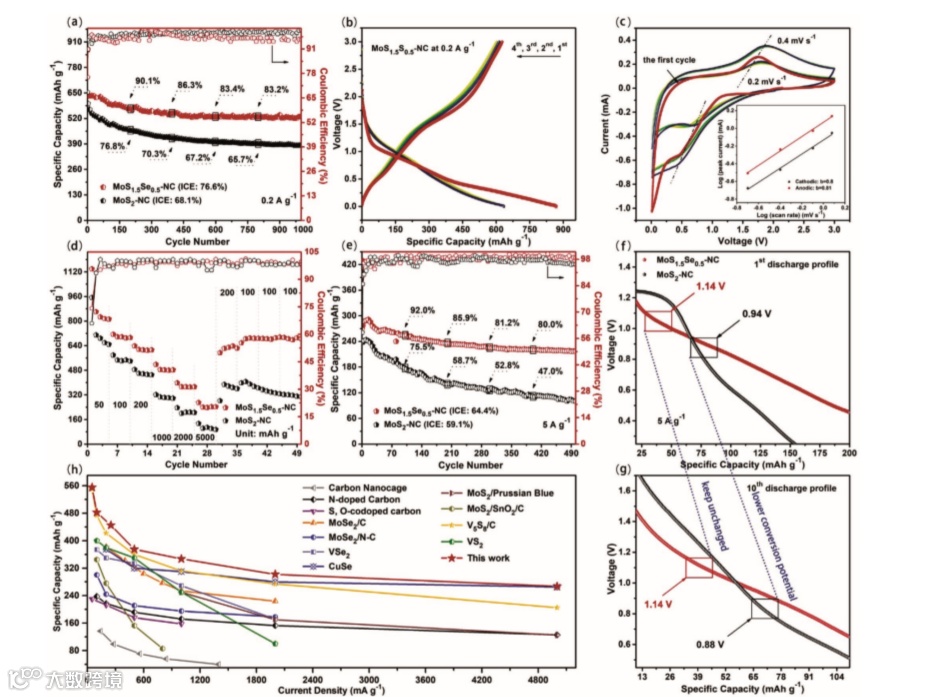
图3. MoS1.5Se0.5-NC的电化学性能
a) Long-term cycling stability under 0.2 A g−1 with the corresponding coulombic efficiency shown on the right y-axis.
b) The 1st, 2nd, and 3rd charge/discharge curves of MoS1.5Se0.5-NC at 0.2 A g−1 for KIBs.
c) Cyclic voltammograms of MoS1.5Se0.5-NC at scanning rates of 0.2 and 0.4 mV s−1 with the plots of log (scan rate) versus log (peak current) calculated from CV curves inset.
d) Rate performance under various current densities from 50 mA g−1 to 5 A g−1 with the corresponding coulombic efficiency shown on the right line.
e) Cycling performance at 5 A g−1 with the corresponding coulombic efficiency shown on the right y-axis.
f,g) Comparison from galvanostatically discharge–charge profiles of 1st and 10th at 5A g−1 between MoS1.5Se0.5-NC and MoS2-NC. h) Electrochemical performances of reported electrode materials for potassium-ion batteries.
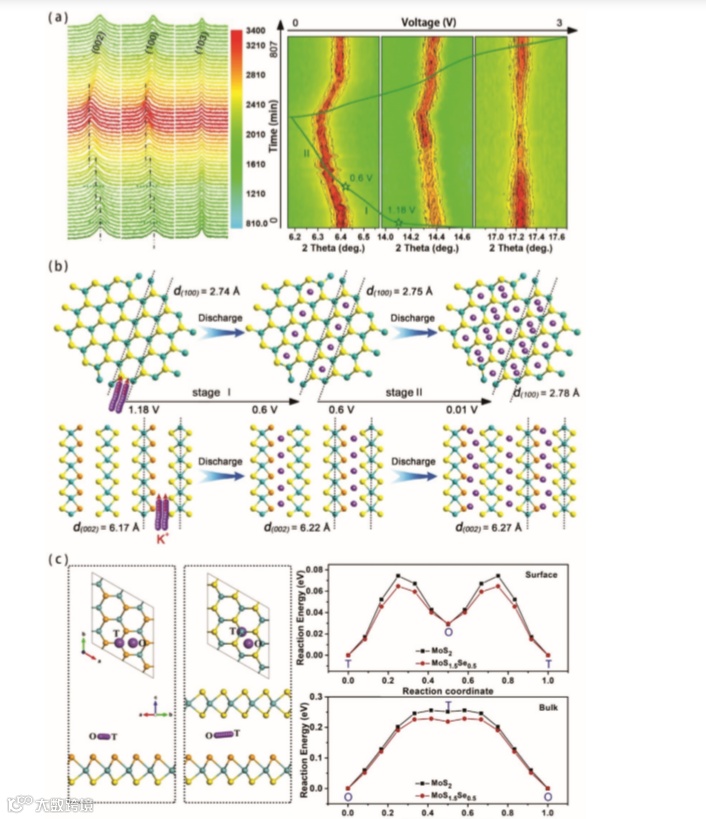
图4. 原位同步辐射XRD和理论计算
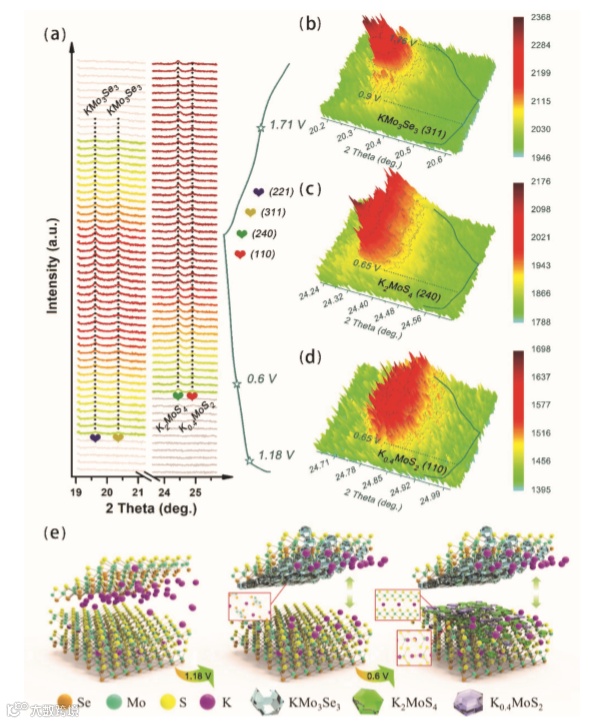
图5. 合金化过程示意图
a) In operando synchrotron XRD data with superimposed voltage profiles shown for selected 2θ ranges.
b–d) Contour plots of the operando data for each main phase.
e) Schematic diagrams of the alloying reaction process.
文章链接:
https://onlinelibrary.wiley.com/doi/10.1002/aenm.201904162
版权声明:
1) 本文仅代表原作者观点,不代表本平台立场,请批判性阅读。
2) 本文内容若存在版权问题,请联系我们及时处理。
3) 如作者对该文章有误解误读,请联系我们进行修改,欢迎各位老师进行批评指正。
4) 本文版权归科学材料站公众号所有,翻版必究。

投稿或兼职作者请联系contact@scimaterials.cn