


关注我们
First published: 04 May 2020
苏州大学、浙江大学
关键词
3D打印, 生物启发材料, 电催化电极, 石墨烯, 力学性能
导读
背景简介
1. 3D打印石墨烯电极研究的意义
对先进能源、环境、电子技术和器件的需求日益增长,对高性能电极提出了迫切的要求。为此,三维电极因其高比表面积和高负载能力而备受关注。特别是新兴的三维石墨烯材料,由于其高导电性的显著优势,作为高性能电极具有巨大的潜力,优异的热稳定性和化学稳定性,良好的生物相容性,以及丰富的功能位点(如吸收和/或活化位点)。
最近,基于挤压的三维打印技术被认为是快速、大规模生产具有分层多孔结构的三维石墨烯材料的一种有希望的方法,如宏卡福具有微孔,赋予快速的质量和/或电荷和离子传输速率。
2. 3D打印石墨烯电极的优势及挑战
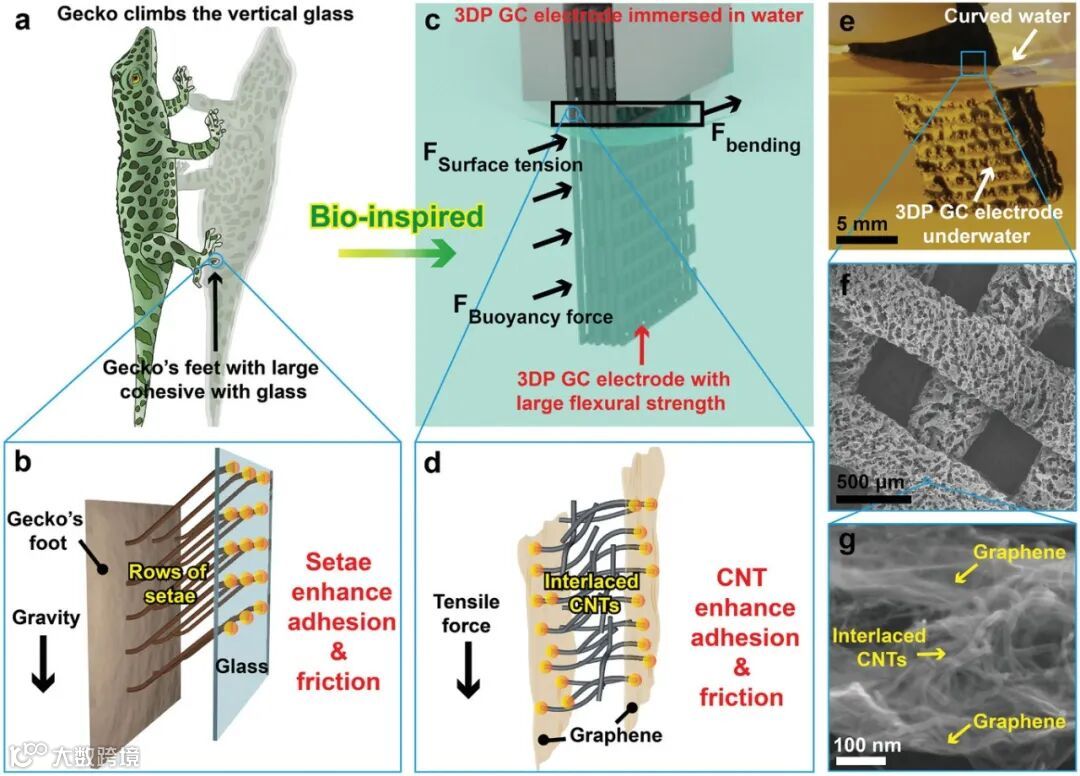
但是, 传统的3D打印石墨烯电极弯曲强度差,在表面张力和水浮力引起的弯曲力作用下,极易断裂,这正是3D打印石墨烯电极在许多应用中需要承受的常见应力情况。因此,在实际应用中,对具有高抗弯强度、能承受复杂应力环境的3D打印石墨烯电极的需求仍然十分迫切。
3. 本文材料设计灵感
文章介绍
作者已经通过基于挤压的3D打印方法打印了机械坚固的3DP GC电极。实验和模拟结果均表明,石墨烯/碳纳米管复合材料纳米结构的弯曲强度显著提高。3DP-GC电极同时满足高弯曲强度、高导电性和多层多孔结构的要求。原位生长NiFeP-NA后,3DP-GC/NiFeP电极在30ma cm-2电流密度下,电池电压为1.58v,正极和负极均具有良好的循环稳定性。
这种仿生三维打印的一维纳米材料增强二维纳米材料的方法是非常有希望的,以制造各种三维结构材料具有较高的力学性能。更重要的是,3DP气相色谱材料在各种能量转换/储存、环境和电子应用领域具有巨大的潜力,在这些领域中,对机械性能和层次多孔结构的需求非常迫切。
文章亮点
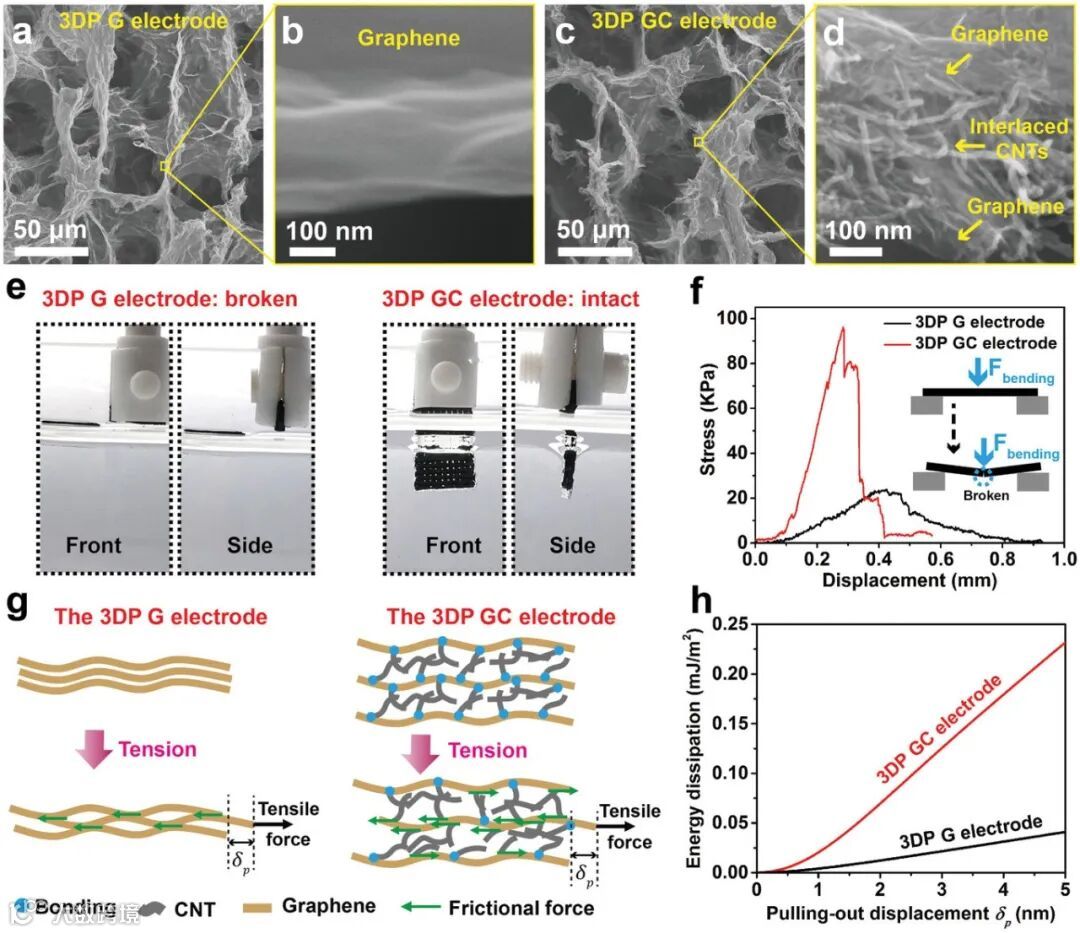
图二: 比较3DP G和3DP GC电极的结构和机械性能。
a–d) SEM images of 3DP‐G (a,b) and 3DP‐GC (c,d) electrodes.
e) Optical images of 3DP G (left) and 3DP GC (right) electrodes in 1 m KOH aqueous electrolyte.
f) Flexural stress as a function of roller displacement (bending deflection) for 3DP G and 3DP GC electrodes. The inset illustration presents the method of bending test.
g) Envisioned molecular‐level deformation mechanisms of the 3DP G and GC electrodes.
h) Calculated energy dissipation as a function of the pulling‐out displacement of a graphene nanosheet from 3DP G and GC electrodes.
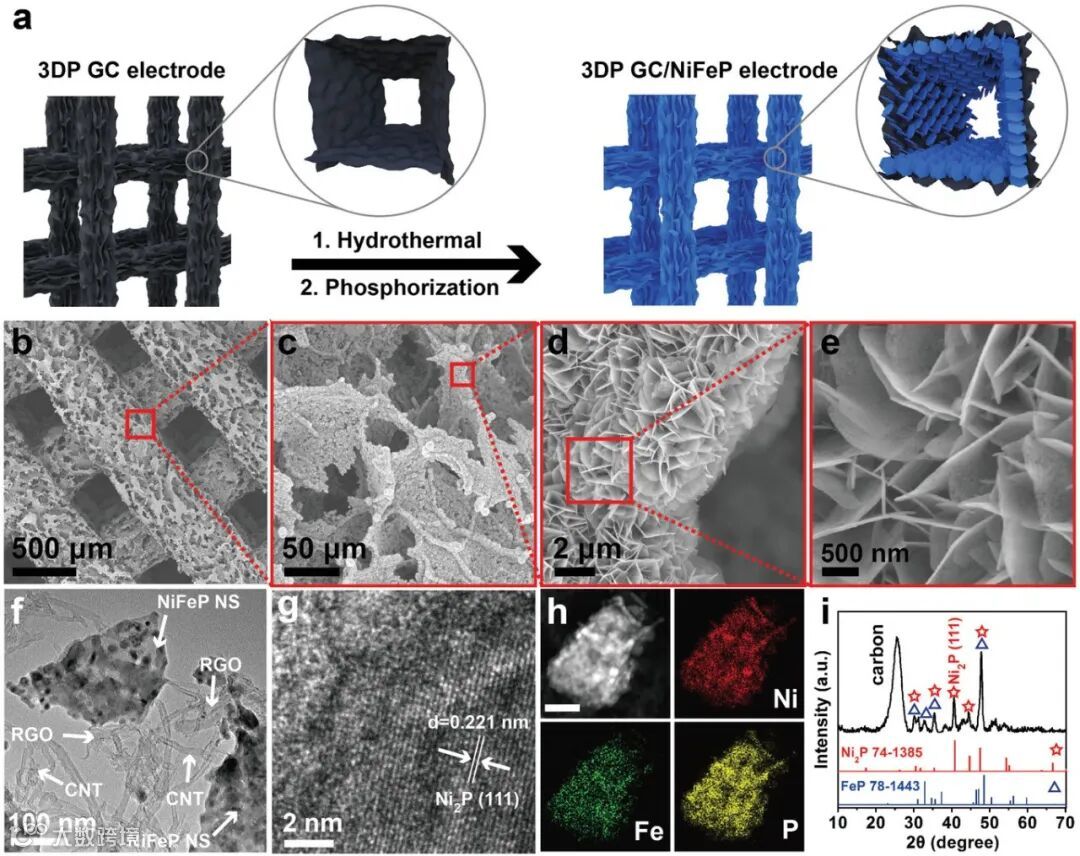
图三: 3DP GC / NiFeP电极的形态和成分表征。
a) Schematic diagram of the preparation process of NiFeP nanosheet arrays on 3DP GC electrode.
b–e) SEM images of 3DP GC/NiFeP electrode.
f) TEM image of NiFeP nanosheets combined together with CNT and RGO.
g) HRTEM image of a NiFeP nanosheet.
h) HAADF‐STEM images of a NiFeP nanosheet and corresponding elemental mapping images of nickel, iron, and phosphorus. Scale bar: 100 nm.
i) XRD pattern of 3DP GC/NiFeP electrode.
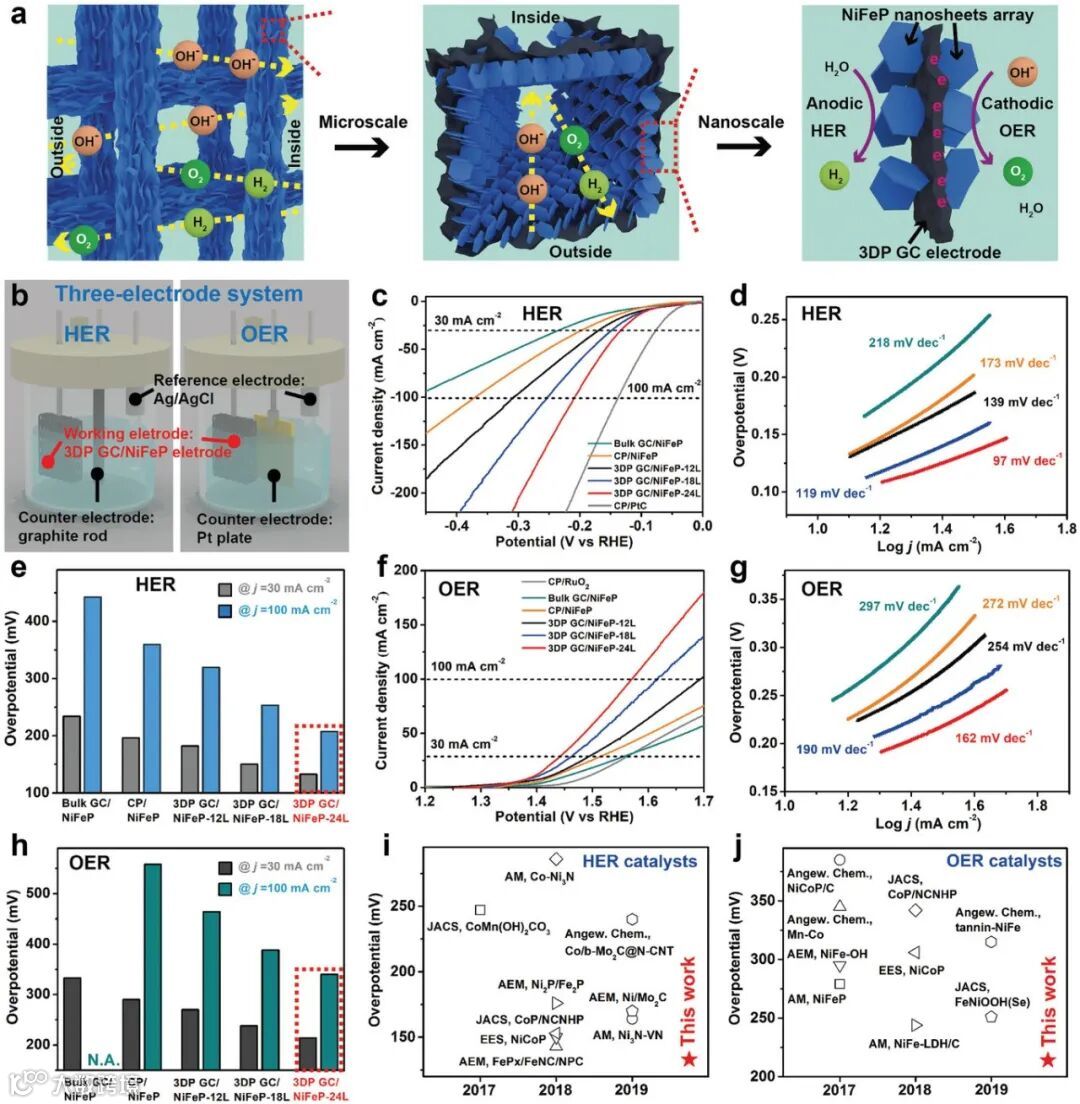
图四: 3DP GC/NiFeP电极用于HER和OER。
a) Schematic diagram of the hierarchical porous structure of 3DP GC/NiFeP electrode facilitated ion and gas transport for both anode (HER) and cathode (OER) of water splitting.
b) Schematic diagram of the three‐electrode system.
c) HER polarization curves.
d,e) corresponding Tafel plots (d), and overpotentials at current densities of 30 and 100 mA cm−2 (e) for 3DP GC/NiFeP electrodes with 12, 18, and 24 layers, bulk GC/NiFeP, and carbon paper (CP)/NiFeP electrodes.
f) OER polarization curves.
g,h) corresponding Tafel plots (g) and overpotentials at current densities of 30 and 100 mA cm−2 (h) for 3DP GC/NiFeP electrodes with 12, 18, and 24 layers, bulk GC/NiFeP, and CP/NiFeP electrodes.
i,j) Comparisons of overpotentials at a current density of 30 mA cm−2 for 3DP GC/NiFeP‐24L with other HER catalysts[23-31] (i) and with other OER catalysts[26, 27, 32-38] (j) in the literature.
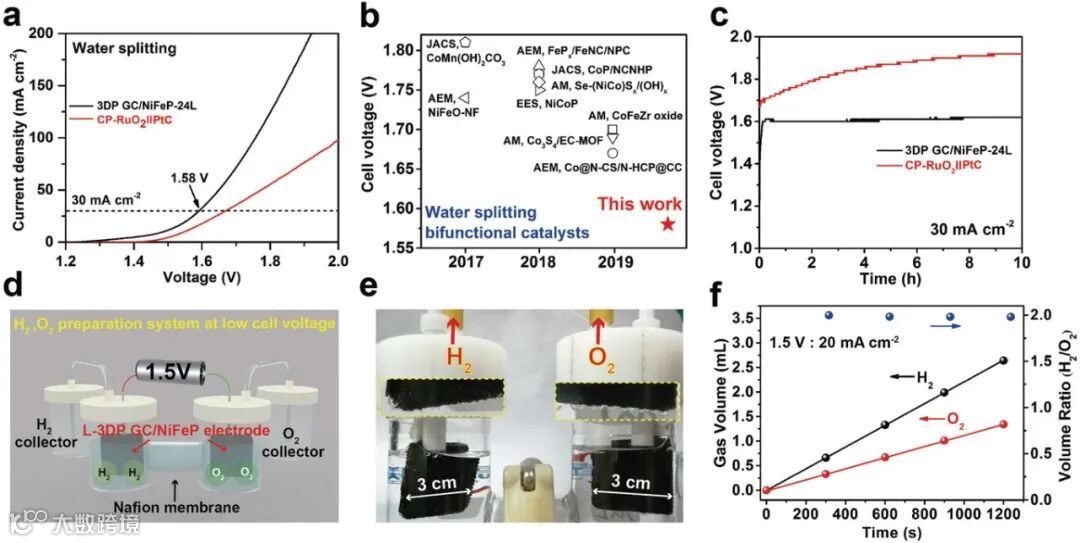
图五: 3DP GC / NiFeP电极用于水分解
a) Two‐electrode polarization curve of 3DP GC/NiFeP‐24L electrodes (1 × 1 cm2) for water splitting.
b) Comparison of cell voltage at a current density of 30 mA cm−2 of 3DP GC/NiFeP‐24L electrodes and bifunctional catalysts for water splitting in related reports in the literature.[23, 24, 26, 27, 39-43]
c) Chronopotentiometric curve of 3DP GC/NiFeP‐24L electrodes for two‐electrode water splitting at 30 mA cm−2.
d) Schematic diagram of the H‐type two‐electrode water splitting system together with H2 and O2 collector using L‐3DP GC/NiFeP electrodes (3 × 3 cm2).
e) Photograph of H‐type two‐electrode water splitting system and gas volume measurement by drainage.
f) H2 and O2 evolution catalyzed by the L‐3DP GC/NiFeP electrodes (3 × 3 cm2).
文章链接:
https://onlinelibrary.wiley.com/doi/10.1002/adma.201908201
老师简介:
江林, 苏州大学功能纳米与软物质研究院教授,博士生导师
目前已经在Acc. Chem. Res.,Energy Environ. Sci., Adv. Mater.,ACS Nano, Adv. Funct. Mater.等国内外学术刊物上发表论文90余篇,论文总引用4200余次,多篇论文作为期刊的封面文章,或被Material Views China,X-MOL等媒体亮点报道。已获授权发明专利5项;撰写国际专著两部(章);担任Chem. Rev.、 Acc. Chem. Res.、Adv. Mater.、Adv. Funct. Mater.等20余个期刊的独立审稿人。获国家优秀青年科学基金资助,江苏省杰出青年科学基金资助,主持国家重点研发计划-政府间国际合作项目1项,国家自然科学基金面上项目1项,江苏省自然科学基金青年项目1项。
研究集中于功能纳米材料的可控组装、性能调控以及应用探索。通过对空间静电势能与纳米粒子之间静电相互作用的协同调控,实现了对纳米粒子组装体系的功能化与固定化,为纳米粒子的精准组装与功能化奠定了理论和实验基础,探索在光电转换、催化、太阳能电池、燃料电池等方面的应用。
http://funsom.suda.edu.cn/7f/a2/c2735a32674/page.htm
梁志强, 苏州大学,功能纳米与软物质研究院,讲师、副教授
在Adv. Mater., Energy Environ. Sci., Adv. Funct. Mater., ACS nano, Small, J. Mater. Chem. A, Appl. Phys. Lett., Plasmonic, Springer等材料、化学领域的国际权威期刊发表论文/著40余篇,其中2篇被标为高被引论文,单篇他引最高240余次;担任ACS Nano、Nanoscale、Journal of Materials Chemistry A、Journal of Materials Chemistry C等期刊审稿人。在功能纳米材料的制备和应用方面申请发明专利多项
主要研究方向:
3D打印功能纳米材料(石墨烯、碳纳米管、氮化硼、金属氧化物和聚合物等)及其应用;
(2) 金属纳米粒子的制备及其表面等离激元增强太阳能电池性能;
ZnO基航天器热控涂层复合颜料制备与性能。
http://nano.suda.edu.cn/00/b4/c5717a131252/page.htm
贾铮, 浙江大学航空航天学院工程力学系, 博士生导师
迄今为止在国际SCI期刊上已发表论文30余篇,其中作为第一作者或通讯作者在国际刊物上发表论文20余篇,总被引1600余次,H指数15。获2019年Extreme Mechanics Letters Young Investigator Award等奖励。学术兼职方面,担任力学国际网络论坛iMechanica的journal club栏目的编委(2020年),并为ACS Applied Materials & Interfaces, Nature Scientific Reports, International Journal of Solids and Structures,Extreme Mechanics Letters等十余个SCI学术期刊担任审稿人。在软材料与结构的力学与设计领域,本研究组建立了新型水凝胶材料的本构模型并研究了其变形、失稳、断裂等现象,设计了可变形仿生结构及平面内可拉伸柔性结构等软体器件。在储能材料力学领域,揭示了锂离子电池硅负极在锂化与去锂化过程中的应力产生以及力学-电化学耦合机理,研究了衬底结构对锂金属薄膜电极延展性的影响,成功合作开发了多种锂离子电池及钠离子电池的新型负极结构。
研究方向为能源材料力学(Mechanics of Energy Materials)和软物质与软机器力学(Mechanics of Soft Materials and Soft Robotics) 。
https://person.zju.edu.cn/zhengjia
版权声明:
1) 本文仅代表原作者观点,不代表本平台立场,请批判性阅读。
2) 本文内容若存在版权问题,请联系我们及时处理。
3) 如作者对该文章有误解误读,请联系我们进行修改,欢迎各位老师进行批评指正。
4) 本文版权归科学材料站公众号所有,翻版必究。

投稿请联系contact@scimaterials.cn