


关注我们
Available online 11 May 2020
导读
关键词
自供电传感器;压电透射;微孔弹性体;有机太阳能电池;
可穿戴传感器;压力传感器
背景简介
1. 一些应用于可穿戴传感器的压传感器
此外,基于摩擦电的压力传感器具有多种材料,这些材料具有不同的摩擦电极性和表面形态(例如,微型金字塔,微孔,纳米孔/纳米线),也成功演示了动态检测。
2. 现有压力传感器的缺陷
然而,基于压电的压力传感器和基于摩擦电的压力传感器都只能检测动态压力变化,并且由于产生类似脉冲的电压而导致响应快速衰减,因此缺乏静态压力检测的能力。此外,两个传感器的压力传感性能均显示出较差的分辨率,并且对相同压力的响应不一致。
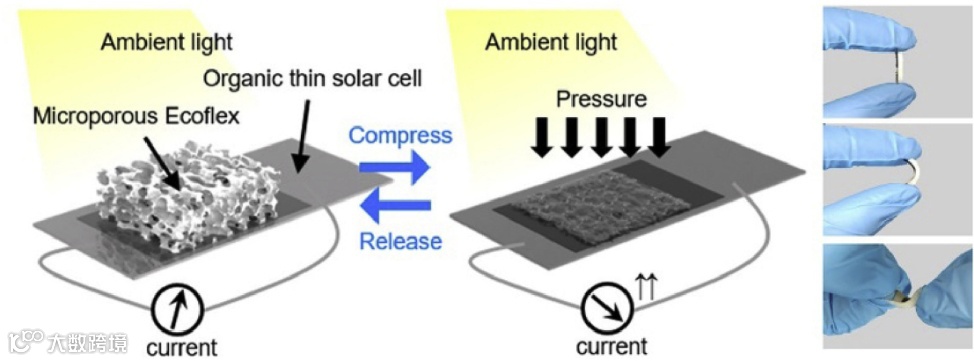
图1. 图片概要
文章介绍
另外,通过最小化固体弹性体(SE)的粘弹性,可大大提高PTME的弹性,从而使传感器响应完全立即恢复。关于PTME的光学特性,PTME显示出由OSC产生的电流(ΔI/ I0)的相对变化与压力之间的线性响应。通过这些特性,PTSPS表现出了很高的性能,灵敏度为0.101 / kPa,线性度为R2 = 0.995,并且对高达100 kPa的压力具有快速且可逆的响应。
最后,对于实际应用,展示了可以检测用于操纵假肢机器人手指的人的手指的弯曲/伸展的手指运动传感器和能够连续监视风速和风向的风检测传感器。
文章亮点
• 作为所提出的传感器的实际应用,已经证明了用于操纵假肢机器人手指的人的手指的弯曲/伸展的检测以及用于连续监测风速和风向的风检测。
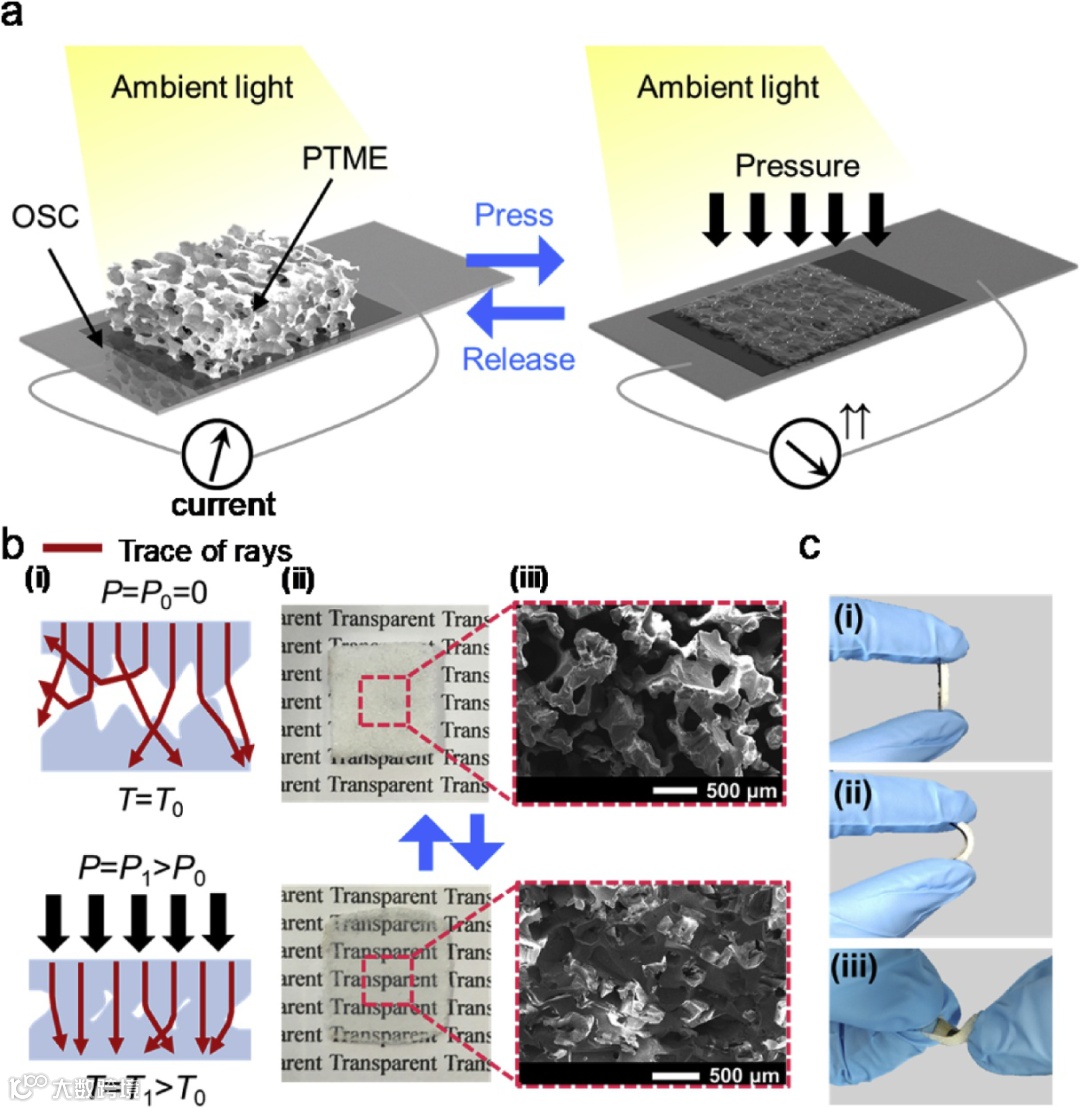
图2.基于压电透射率的自供电压力传感器
Proposed piezo-transmittance based self-powered pressure sensor:
(a) Schematic representation of the PTSPS.
(b) Optical properties of the PTME under compression. (i) Low amount of light transmission through the PTME (T = T0) due to light scattering under the uncompressed state (P=P0=0) and higher amount of light transmission through the PTME (T = T1>T0) under the compressed state (P=P1>P0). (ii) Photographs of the change in transparency of the PTME before compression (top photograph) and after compression (bottom photograph). (iii) SEM images showing the pore-closing behavior of the PTME before compression (top image) and after compression (bottom image).
(c) Optical images of the PTSPS showing its capability of (ii) bending and (iii) twisting.
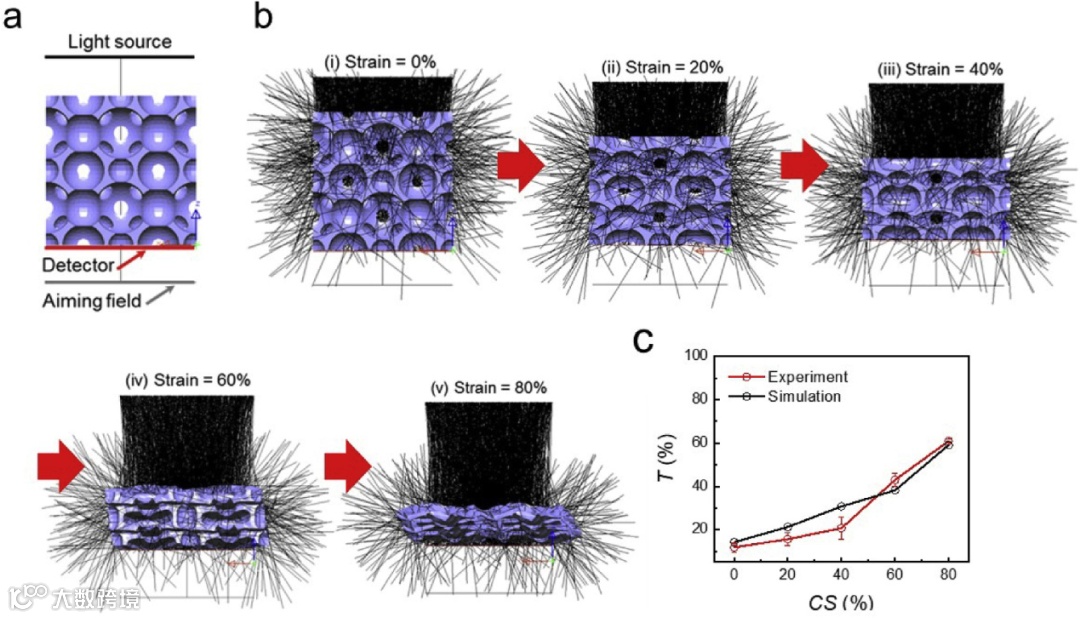
图3.PTME光学仿真结果
Ray-tracing optical simulation results for the prediction of light transmission changes of the PTME by compressive strain:
(a) Schematic illustration of the simulation model in similarity to the actual experimental set up.
(b) Results of the simulation, showing the light paths transmitted through the PTME.
(c) Transmittance versus compressive strain curves of the experimental data and simulation results. The transmittance of the PTME gradually increases with increasing compressive strain; the graph shows a reasonable agreement between the experimental and simulation results.
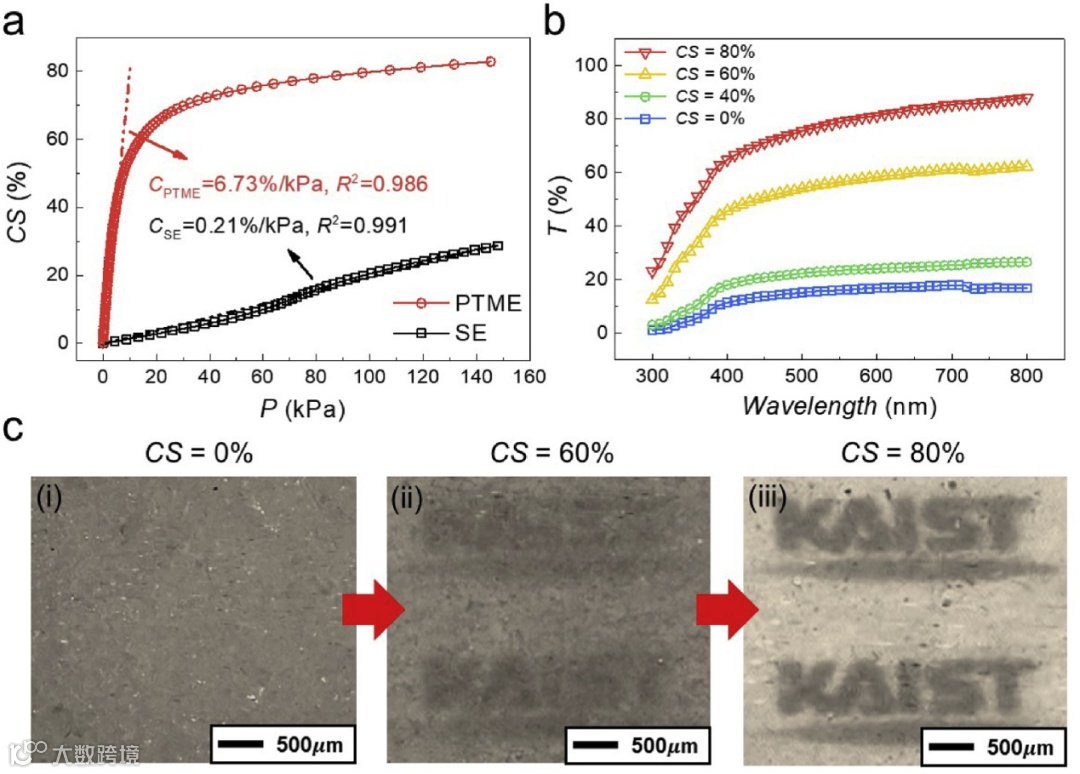
图4. PTME的机械性能和光学性能
Mechanical and optical characteristics of the PTME:
(a) Compressive behavior of the PTME and SE. The compressibility of the PTME was 6.73%/kPa (R2 = 0.986) while that of the SE was 0.21%/kPa (R2 = 0.991).
(b) The transmittance of the PTME over the range of visible light under various compressive strain.
(c) The piezo-transmittance property of the PTME was visually captured by a CCD camera. The closure of pores occurs uniformly throughout the whole surface of the PTME, and the transparent area fraction of the PTME, which can be determined by the clarity of the institution logo (KAIST) under the PTME.
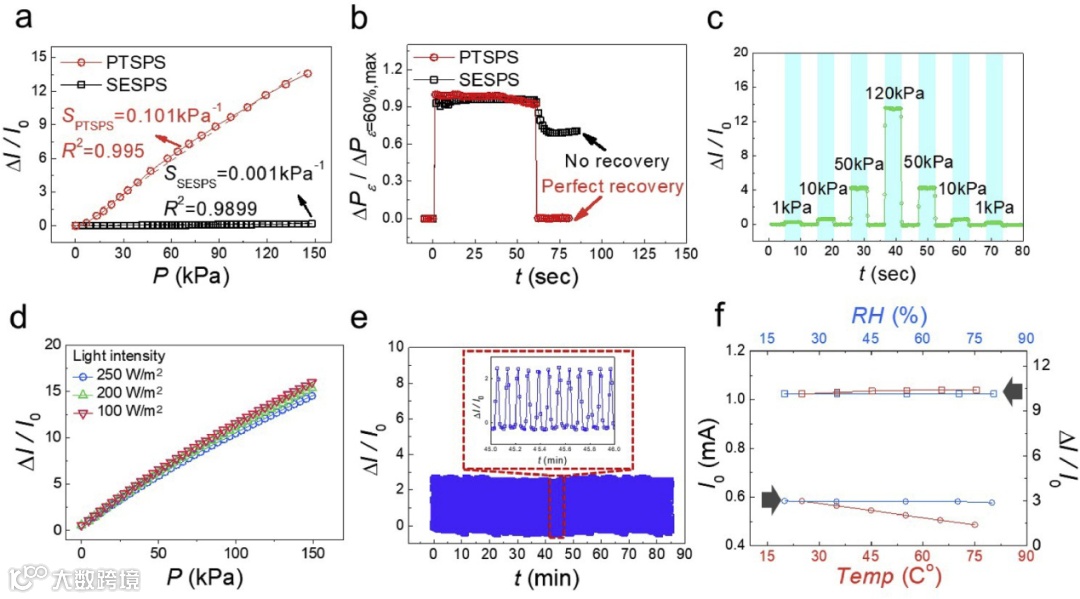
图5. PTSPS动静态压感性能测试
Static and dynamic pressure sensing performances of the PTSPS:
(a) the relative change of current versus pressure of the PTSPS compared to the SESPS.
(b) Recoverability performances of the PTSPS compared to the SESPS.
(c) Dynamic responses of the PTSPS to various pressure ranging from 1 kPa to 100 kPa.
(d) The relative change of current versus pressure of the PTSPS under the various light intensities of 100 W/m2, 200 W/m2, and 250 W/m2.
(e) Long-term electromechanical stability of the PTSPS over 5000 cycles of a repeated compression/release test with a compressive strain of 70%.
(f) Initial current and the relative change of current of the PTSPS under different temperature and humidity conditions.
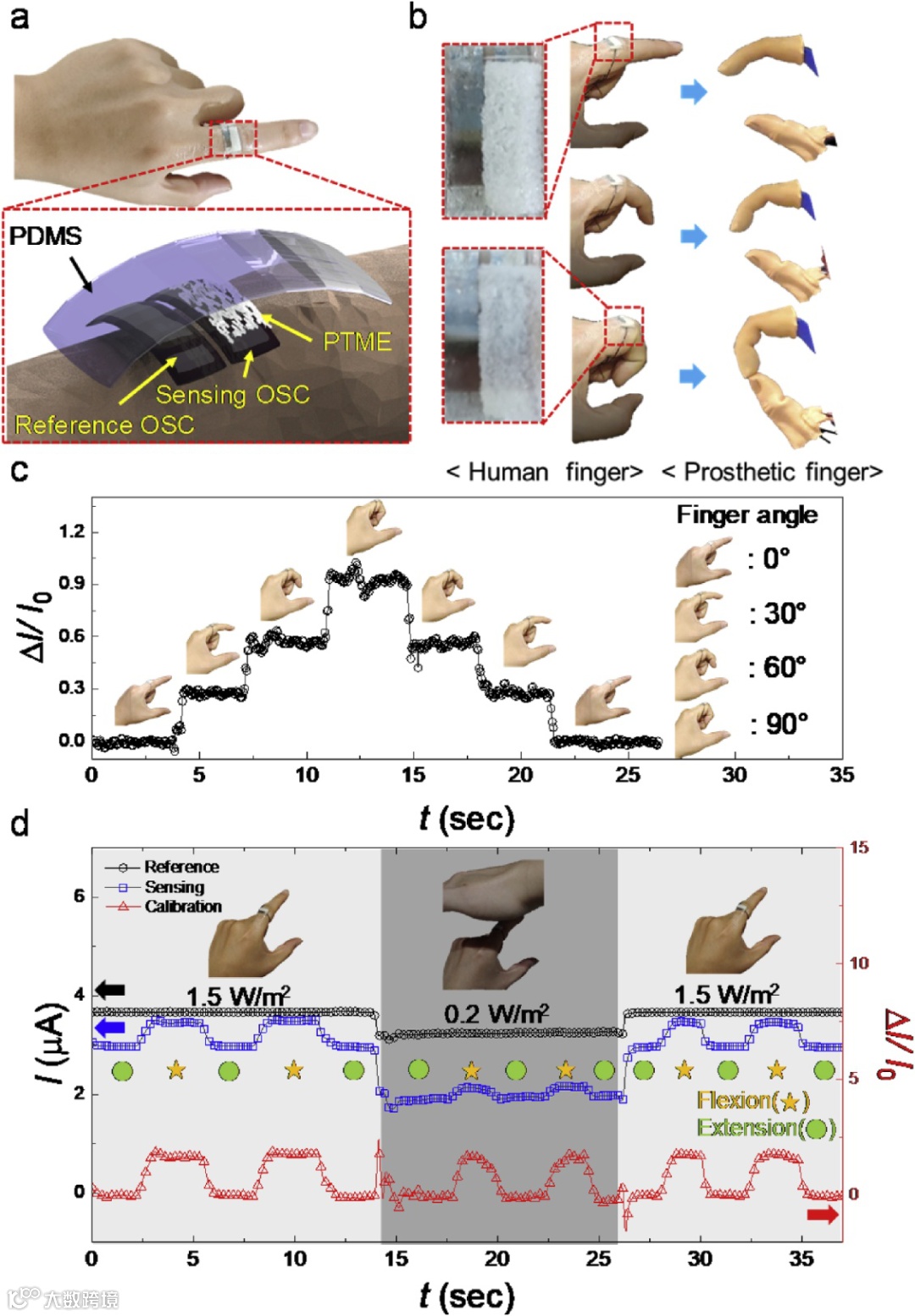
图6.PTSPS进行的手指运动感应以控制假肢机器人手指演示
Demonstration of the finger motion sensing by PTSPS for control of the prosthetic robot finger:
(a) Photographic image of the finger motion sensor on the finger based on the PTME and OSC and 3D model of detailed components of the finger motion sensor.
(b) Photographic images of controlling the prosthetic robot finger using the sensor on the human finger.
(c) The sensor response over the finger angle of 0° – 90°.
(d) The sensor responses of the sensing OSC and reference OSC and the calibrated response with repeated flexion/extension motions of human finger under different light intensities. The amount of current generated by the sensing OSC and reference OSC were decreased with the decrease of illumination intensity. However, the calibrated relative change of current shows similar tendency regardless of the light intensity as shown in the red line with a triangle marker. (For interpretation of the references to color in this figure legend, the reader is referred to the Web version of this article.)
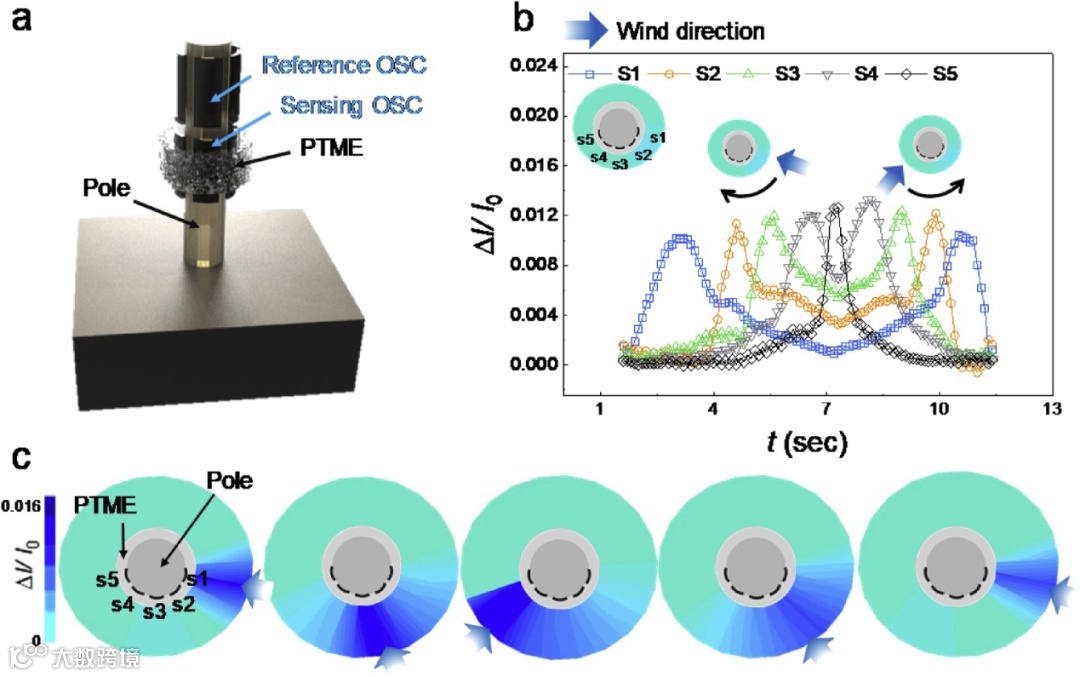
图7. PTSPS风速传感测试
Demonstration of the wind detection sensing by an array of PTSPS:
(a) 3D schematic depicting the components of the wind detection sensor. The five sensing OSCs covered by the PTMC and five reference OSCs were attached on the pole for detecting the wind speed and direction under different light intensities.
(b) The relative change of current on each sensor when the wind was blowing in the direction from S1 to S5 continuously and then back in the direction to S1.
(c) 2D color mapping of the intensity change of each sensor in polar coordinates. The change in the signal of each sensor is represented by the darkness level of blue color. (For interpretation of the references to color in this figure legend, the reader is referred to the Web version of this article.)
文章链接:
Wearable self-powered pressure sensor by integration of piezo-transmittance microporous elastomer with organic solar cell
https://www.sciencedirect.com/science/article/abs/pii/S2211285520303062
导师简介:
Inkyu Park,博士,教授
Inkyu Park分别从KAIST(1998),UIUC(2003)和UC Berkeley(2007),获得了理学学士,硕士学位和博士学位,全部涉及机械工程。自2009年以来,他一直在韩国科学技术院的机械工程系任教,目前是KAIST的讲座教授。研究兴趣是纳米制造,智能传感器,基于纳米材料的传感器以及柔性和可穿戴电子产品。在MEMS / NANO工程领域,他发表了100多篇国际期刊文章(SCI收录)和130篇国际会议论文。曾获得IEEE NANO最佳论文奖(2010年)和HP开放创新研究奖(2009-2012年)。
资料来源:https://www.sciencedirect.com/science/article/abs/pii/S2211285520303062

版权声明:
1) 本文仅代表原作者观点,不代表本平台立场,请批判性阅读。
2) 本文内容若存在版权问题,请联系我们及时处理。
3) 如作者对该文章有误解误读,请联系我们进行修改,欢迎各位老师进行批评指正。
4) 本文版权归科学材料站公众号所有,翻版必究。
投稿请联系contact@scimaterials.cn