
大数跨境

中南大学孙伟&葛鹏课题组EnSM:矿物材料在储能领域中的发展及挑战

中南大学孙伟&葛鹏课题组EnSM:矿物材料在储能领域中的发展及挑战 科学材料站
2021-12-06
1
导读:本文详细介绍了矿物材料在电极、隔板、电解液和金属保护等方面的重要应用。

文 章 信 息

第一作者:曾子豪
通讯作者:葛鹏
单位:中南大学

研 究 背 景

双碳目标下,清洁能源的高效储存便成为了绿色社会发展的关键。新能源体系作为关键的能源转存系统,引起了人们广泛的关注。矿物作为国家的重要战略资源,一直面临着利用率低、附加值不足等现象。若是将矿物材料有效地运用于新能源体系,不仅可以缓解由于化学合成所带来的环境污染,对于矿物材料附加值的增加也是至关重要。

文 章 简 介

基于此,中南大学葛鹏副教授在Energy Storage Materials(影响因子:17.78)上发表题为“Natural Mineral Compounds in Energy-Storage Systems: Development, Challenges, Prospects”的综述性论文。
可持续清洁能源面临着间歇性、不可持续性等问题,进一步开发完善现有的新能源体系势在必行。在双碳目标下,全链条考虑新能源体系的搭建过程中的碳减排问题,电池系统中的材料较多的来源于复杂的化学反应过程,往往伴随着系列碳污染。
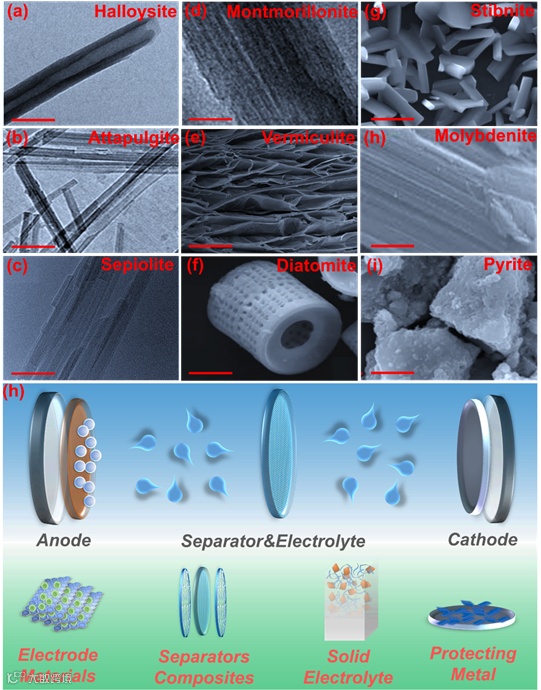
天然矿物材料资源丰富,在结构、吸附能力、活性位点等多个方面具有显著的优点,引起了人们的广泛关注。一维结构(埃洛石、凹凸棒石、海泡石)、二维结构(蒙脱石、蛭石、辉钼矿)和三维结构(硅藻土、黄铁矿)的矿物化合物已经在许多领域得到了实际的应用。针对锂离子电池、锂硫电池、固态电池等方面的储能应用,本文详细介绍了矿物材料在电极、隔板、电解液和金属保护等方面的重要应用。
然而,单纯的矿物材料由于导电性差,活性物质不足,难以满足储能系统的需求。因此,系列的改性手段应用得到了开发,例如矿相的演化(从硅酸盐矿物到硅),表界面结构调控等该工作旨在总结不同结构矿物化合物的特性,同时为在储能系统中探索矿物基材料方向提供指导。 

要 点 解 析

要点一:矿物材料结构图及储能应用区域
Figure.1 TEM and SEM images: Halloysite (a), Attapulgite (b), Sepiolite (c), montmorillonite (d), Vermiculite (e), Diatomite (f), Stibnite (g), Molybdenite (h), Pyrite (i), the components of the full-cell and exploring targets (h).

要点二:矿物材料在电极材料中的应用
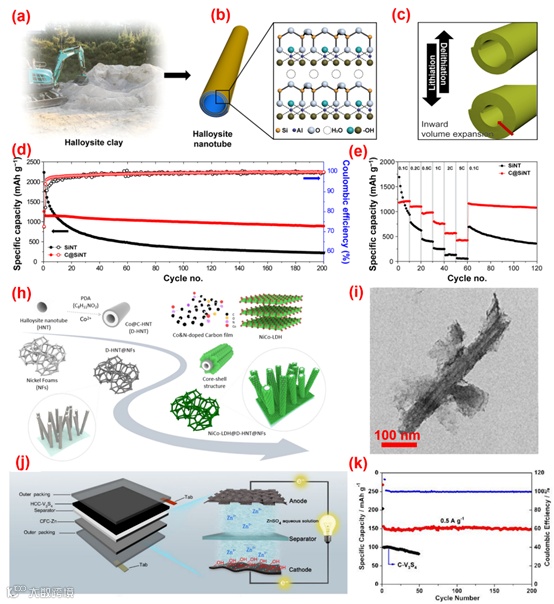
Figure.2 For nano-sized Si@carbon: The large-scale production of rich-resources HNTs (a), the interior lattice structure (b), the alleviated volume swelling (c), the cycling stability at 0.2 A g-1 (d), rate performances (e); For 3D NiCo-LDH arrays@HNTs: the mechanism of preparing process (h), their TEM images (i); For V3S4@carbon substrate: Schematic of flexible Zn-ions cell with V3S4@carbon substrate (j), their ions-storage capabilities at 0.5 A g-1 (k). 

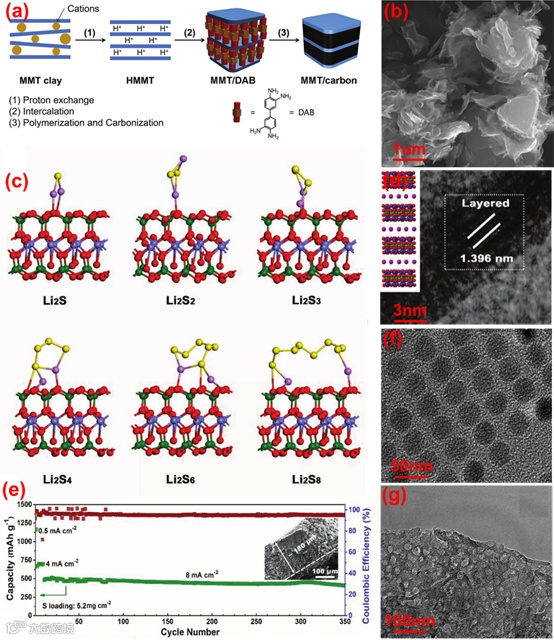
Figure.3 For carbon nanosheets@MMT interlayers: the fabrication process (a), SEM images (b); For Li-doped MMT@S: DFT calculations about the adsorption analysis of LI-MMT with various polysulfide (c), TEM images (d), the long-term cycling stabilities (e); For TEM images of porous graphene flakes from the as-templated MMT: the as-resulted samples Fe3O4@OA nanoparticles (f), the prepared graphene flakes (g).

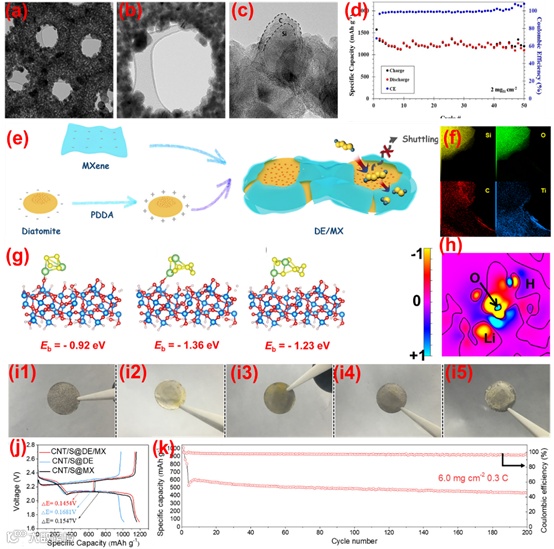
Figure.4 For nano-size Si particles@carbon: TEM and HRTEM images (a-c), the cycling stability (d); For diatomite@S@Mxene: The preparation process and the controlling of LiPSs (e), Mapping images (f), the adsorptions behaviors of LiPSs with diatomite(g), 2D charge-transfer mapping between Li2S4 and diatomite (h), the discharge/charge platforms (j) and long-term cycling behaviors (k); For diatomite@S@MgO: the photographs about series of the as-resulted samples (i

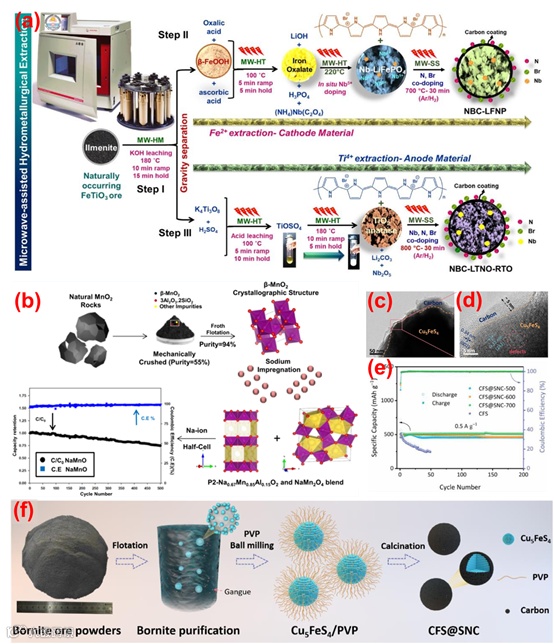
Figure.5 For LiFePO4 and Li4Ti5O12 anodes from ilmenite (FeTiO3): Schematic illustration of various different conditions for the as-resulted samples (a); For P2-Na0.67Mn0.85Al0.15O2 cathodes from natural pyrolusite (β-MnO2): the preparing process, lattice structures and cycling stability (b); For Cu5FeS4 anodes from chalcopyrite: TEM and HRTEM images (c, d), the cycling properties at 0.5 A g-1 (e), the corresponding formation mechanism.

要点三:矿物材料对于电极隔膜性能改善研究
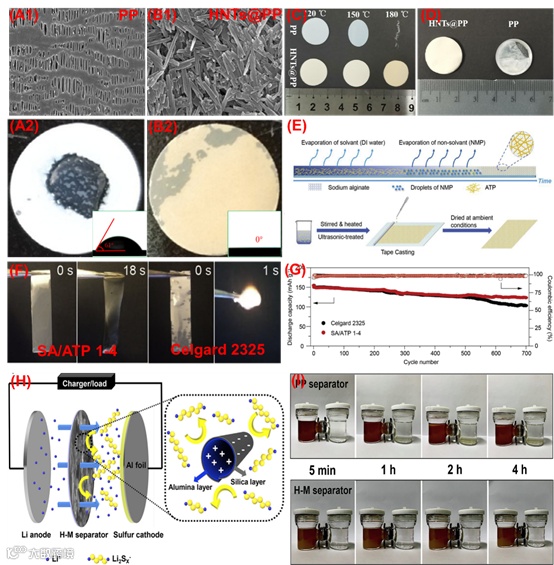
Figure.6 For PP and HNTs@PP: SEM images, the digital photo about electrolyte wetting and contacting angle of PP(A), HNTs@PP (B), their properties of thermal shrinkaging (C), the photo images after open-circuit voltages (D); For sodium alginate/attapulgite separators: the simple-mechanism about phase-inversion method and the preparing process (E), their relative combustion test (F), the long-term cycling properties for LiFePO4 vs. Li battery (G); For HNTs-modulated separator: the mechanism of HNTs in electrolyte about the capturing of polysulfide (H), their testing of polysulfide shuttling in electrolyte (I).    

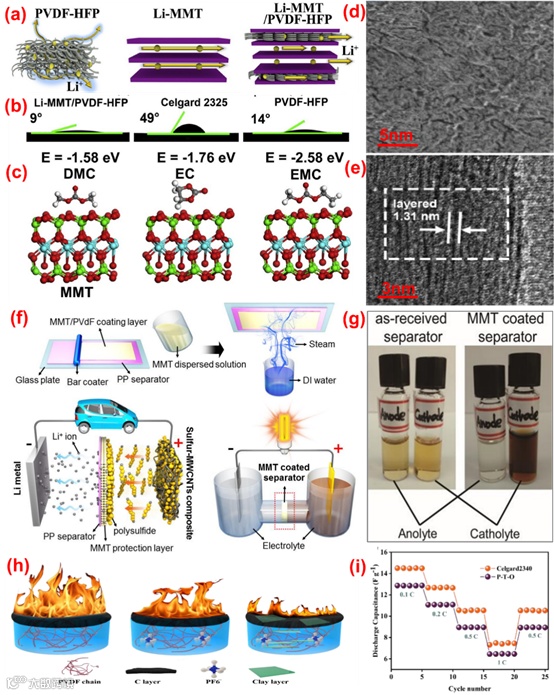
Figure.7  For Li-MMT@PVDF@HFP separators: the simple explaining about the as-designed structures (a), their contact angle (b), the DFT analysis between MMT and electrolyte components (c), TEM images (d, e); For MMT@PVDF@PP in Li-S systems: the fabricating process and capturing mechanism (f), the trapping properties of polysulfide in electrolyte (g); For gel membranes with MMT: the flame-retardant mechanism (h), the electrochemical properties (i).

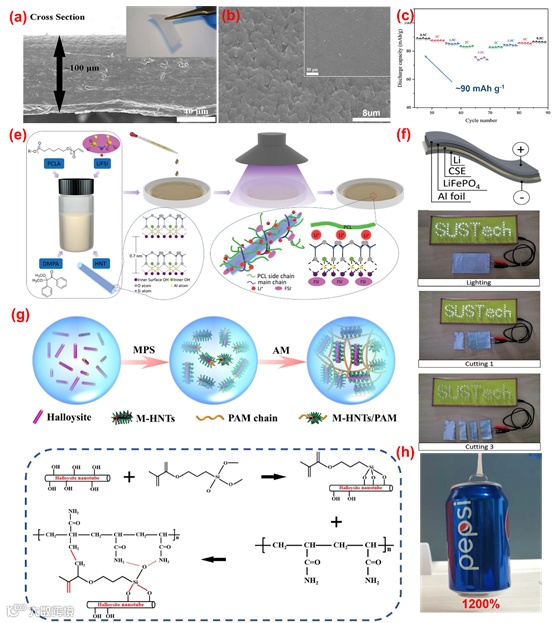
Figure.8 For HNTs@PVDF in CPEs for solid-state LIBs: SEM images of the composites polymer-electrolyte (a, b), their rate properties for Li vs. LiMn2O4 (c);180 For in-situ pohotopolymerized composites in LIBs: schematic illustration of the preparing process (e), the constructing of flexible anodes and safety testing(f);181 For HNTs nanotubes-crosslinked anodes in ZIBs: the relative preparing mechanism (g) and the tensile testing (h).183

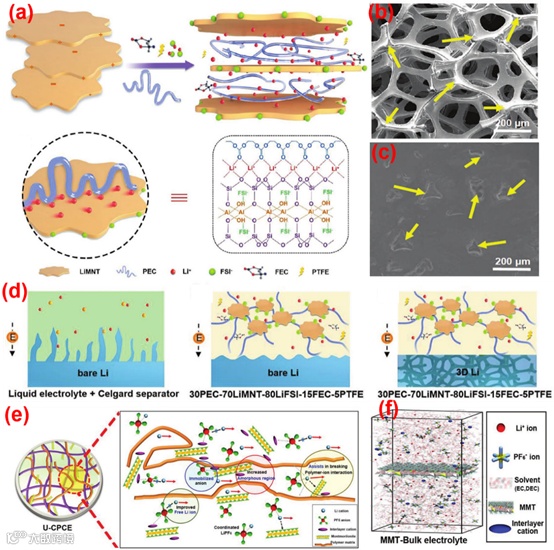
Figure.9 For PEC@Li-MMTs in solid-state LIBs: the mechanisms about the improved ions-moving rates (a), SEM images for Ni foams (b) and Li-Ni composites (c), the illustration mechanism about the Li-ions depositions (d); For ETPTA@PVdF-HFP@MMTs in LIBs: the mechanism about ions-moving and relative affecting factors (e) and the molecular-dynamics simulation about composite electrolyte (f).    

要点五:矿物材料在金属电极性能改善研究
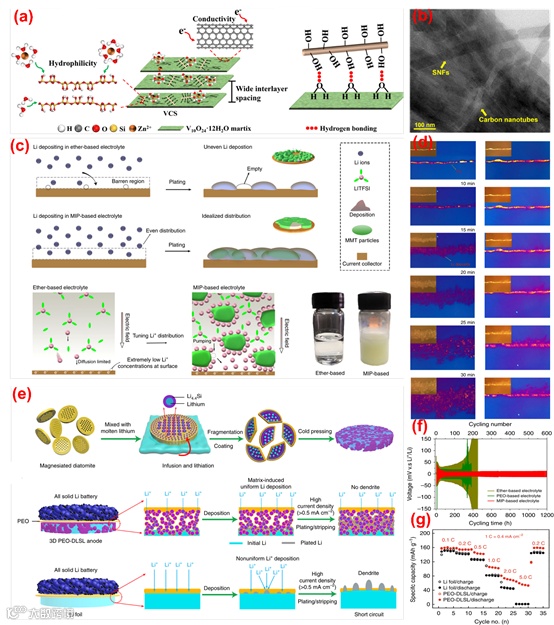
Figure.10 For HNTs@V-based samples: schematic illustration of the preparing process of HNTs coating V-based samples (a), TEM images (b); For MMTs coating Li-metals: the designing mechanisms, the contacting between electrolyte and MMTs (c), the optical images about Li-metal deposits (d), Charge/Discharge curves about Li||Li cells at 1.0 mA cm-2; For diatomite coating Li-metals: schematic illustrations of the designing architectures and the formation mechanism of Li-dendrites (e) and the relative rate properties (g).

总 结

综上所述,本文介绍了不同种类的天然矿物在储能领域的详细应用,包括锂离子电池、锌离子电池、锂硫电池、固态电池、锂金属电池等系统。根据矿物材料应用的不同位置,将其具体应用分为电极材料、隔板、固体电解质和电极保护。由于矿物结构的独特性,本文从微纳结构、孔隙度和电化学性能等方面对不同组分上的优势进行了讨论和总结。
在此,需要注意的是,对于电极而言,矿物是离子存储行为的主要活性材料。但是,对于其他材料,矿物总是作为添加剂的角色,利用矿物的特性,如孔隙度,吸热和无毒性能开展具体应用,本文期望对于矿物材料在未来的储能系统中够开展高效有力的应用。

文 章 链 接

Natural Mineral Compounds in Energy-Storage Systems: Development, Challenges,Prospects
https://www.sciencedirect.com/science/article/pii/S2405829721005687

通 讯 作 者 简 介


孙伟 教授 博士生导师
资源加工与生物工程学院院长。长江学者特聘教授,教育部新世纪优秀人才,湖南省121新世纪人才,湖南省531工程人才。中国矿物加工理事会秘书长,湖南省稀有金属冶金及材料制备重点实验室副主任、中国有色金属学会理事、江西省钨产业、稀土产业技术创新战略联盟副理事长,中国化学学会会员。


葛鹏 博士 副教授 硕士生导师
主要从事新能源材料设计合成,矿物材料高效资源化利用,矿物化学法衍生新能源材料等研究,近五年发表SCI论文近60篇,其中以通讯作者/第一作者在Advanced Materials、Advanced Energy Materials、Nano Energy、Advanced Functional Materials、Advanced Science等刊物上发表论文30余篇
课题组网页:
https://hyh.csu.edu.cn/list_textpic.jsp?urltype=tree.TreeTempUrl&wbtreeid=1019


添加官方微信 进群交流

SCI二氧化碳互助群

SCI催化材料交流群

SCI钠离子电池交流群

SCI离子交换膜经验交流群

SCI燃料电池交流群

SCI超级电容器交流群

SCI水系锌电池交流群

SCI水电解互助群

SCI气体扩散层经验交流群

备注【姓名-机构-研究方向】

说明

🔹本文内容若存在版权问题,请联系我们及时处理。

🔹欢迎广大读者对本文进行转发宣传。

🔹《科学材料站》会不断提升自身水平,为读者分享更加优质的材料咨询,欢迎关注我们。

投稿请联系contact@scimaterials.cn

致谢

感谢本文作者对该报道的大力支持。

点分享

点赞支持

点在看

【声明】内容源于网络
0
0
科学材料站
内容 0
粉丝 0
科学材料站
总阅读0
粉丝0
内容0