




文 章 信 息
Atomically Dispersed Fe–N3C Sites Induce Asymmetric Electron Structures to Afford Superior Oxygen Reduction Activity
第一作者:佟苗苗
通讯作者:王蕾,付宏刚
通讯单位:黑龙江大学
研 究 背 景
文 章 简 介
本 文 要 点
(1)首先通过理论计算预测Fe–NxCy(x=0~4,y=4–x)的结构稳定性,然后通过控制Fe掺杂的ZIF-8的热解温度可控合成非对称结构的Fe/Zn–NC–950催化剂。XAFS、XPS与球差电镜(AC HAADF-STEM)分析表明Fe/Zn–NC–950催化剂的配位结构为Fe–N3C、Zn–N4。证明成功合成双金属单原子分散催化剂。
(2)同时催化剂Fe–N3C/Zn–N4构型在碱性条件下显示出更好的ORR活性,其起始电位(E1/2)为0.99V、半波电位(E1/2)为0.91 V,具有优异的长期稳定性(10000 次CV循环后性能无衰减),性能优于Pt/C和大部分非贵金属催化剂。
(3)利用理论计算(DFT)研究了非对称的Fe–N3C结构对ORR的催化机制的影响。Fe–N3C中Fe的价态高于对称的Fe–N4,可以增强电子的离域性。此外,ZIF-8衍生的剩余Zn单原子会将其d轨道电子给予Fe原子,Fe–N3C和Zn–N4之间的协同作用,调节Fe的d带中心。使得O2分子吸附在富电子的Fe活性位点上,在ORR过程中逐渐转化为含氧中间体最终转化为OH–,降低ORR动力学和活性的反应能垒。该工作对设计高效的ORR催化剂的发展具有重要的指导意义。
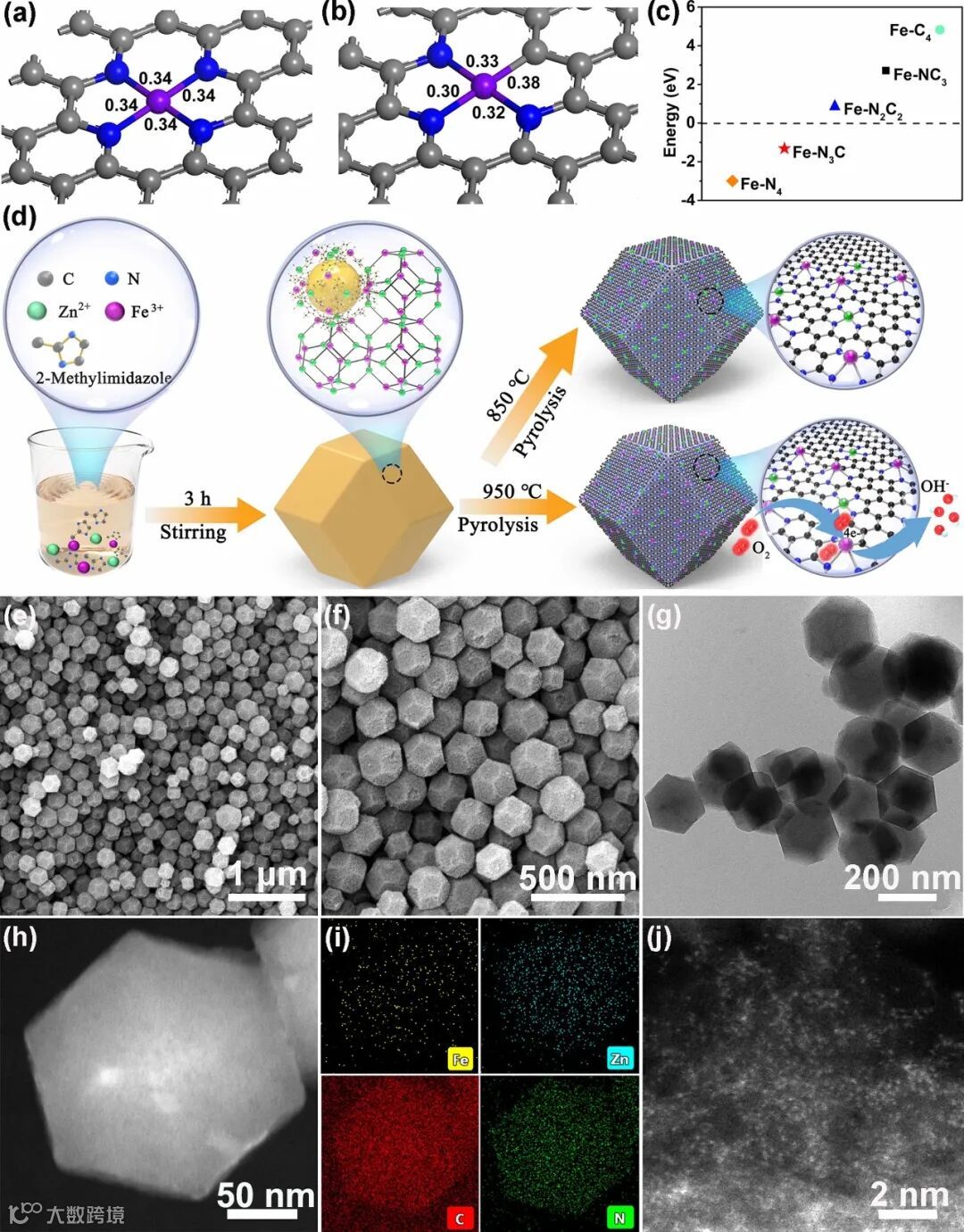
Figure 1. Bond order of (a) Fe–N4 and (b) Fe–N3C. (c) The energy of formation for the five configurations of Fe–N4, Fe–N3C, Fe–N2C2 Fe–NC3 and Fe–C4. (d) Schematic illustration for the preparation of Fe/Zn–NC–950. (e, f) SEM, (g) TEM, (h) HAADF-STEM images and (i) corresponding EDX element mappings of Fe, Zn, C and N for Fe/Zn–NC–950. (j) AC HAADF-STEM image of Fe/Zn–NC–950 shows the atomically dispersed state.
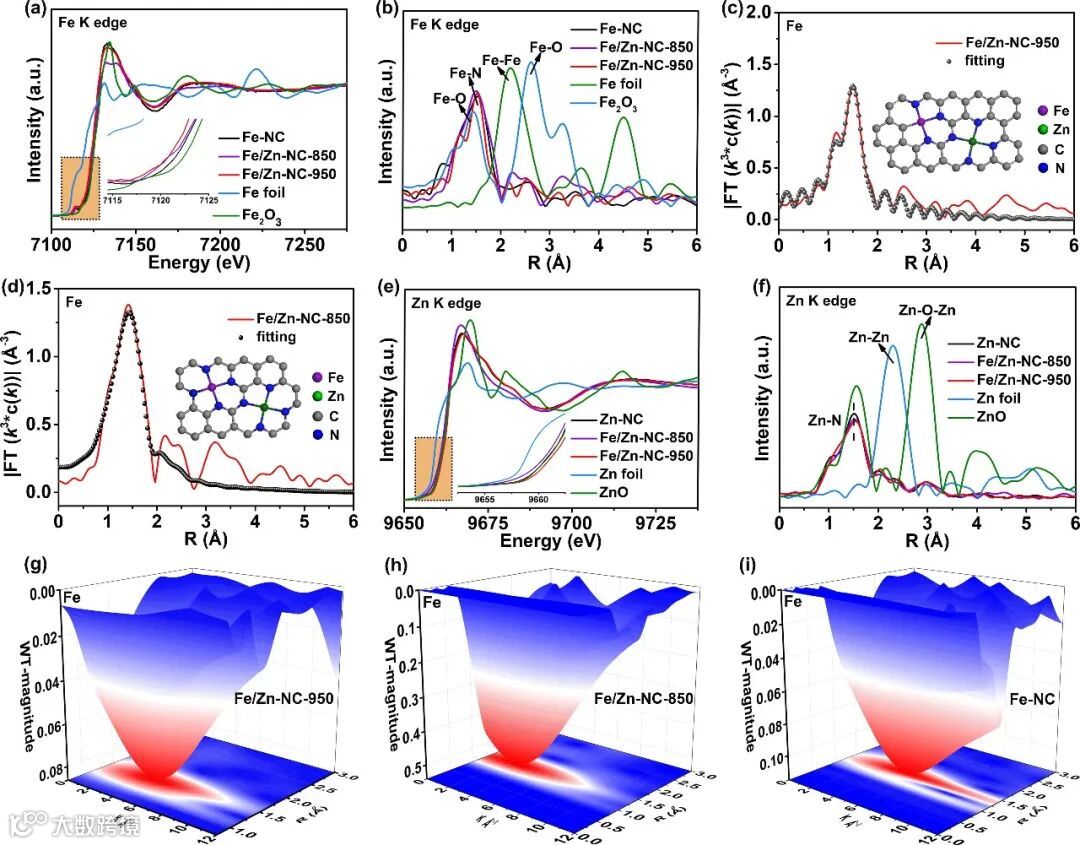
Figure 2. (a) Normalized Fe K-edge XANES and (b) FT-EXAFS spectra of Fe/Zn–NC–850, Fe/Zn–NC–950, Fe–NC, Fe foil, FeO and Fe2O3. (c) FT-EXAFS fitting curves of Fe K-edge for Fe/Zn–NC–950 (inset: structural model of Fe–N3C). (d) FT-EXAFS fitting curves of Fe K-edge for Fe/Zn–NC–850 (inset: structural model of Fe–N4). (e) Normalized Zn K-edge XANES and (f) FT-EXAFS spectra of Fe/Zn–NC–850, Fe/Zn–NC–950, Zn–NC, Zn foil and ZnO. (g-i) WT contour plots of Fe K-edge at R space for Fe/Zn–NC–950, Fe K-edge at R space for Fe/Zn–NC–850, Fe K-edge at R space for Fe–NC.
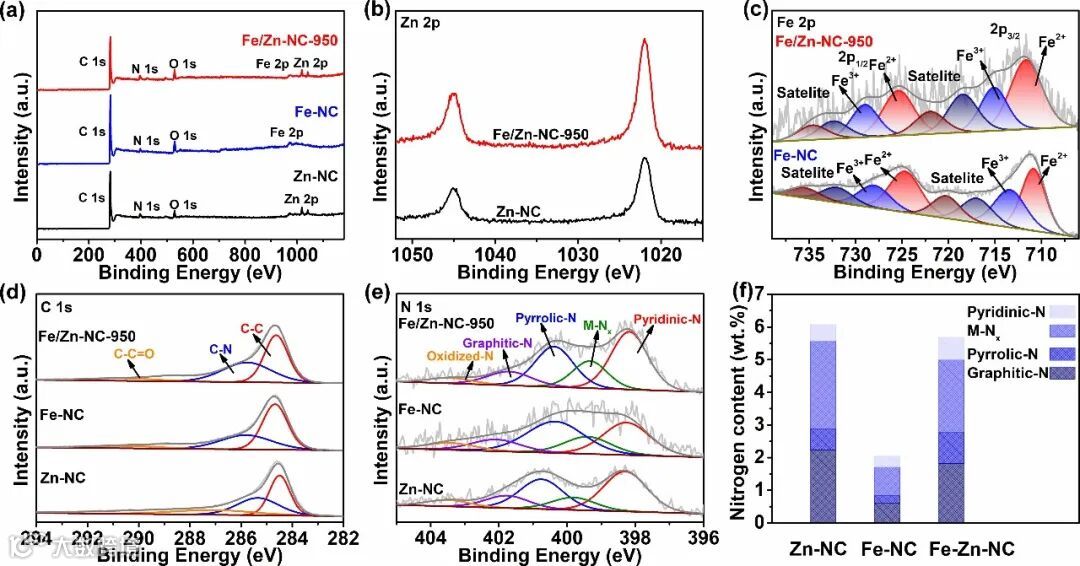
Figure 3. (a) Wide-scan, (b) Zn 2p, (c) Fe 2p, (d) C 1s, (e) N 1s XPS spectra and (f) different N dopant contents diagrams of Zn–NC, Fe–NC and Fe/Zn–NC–950.
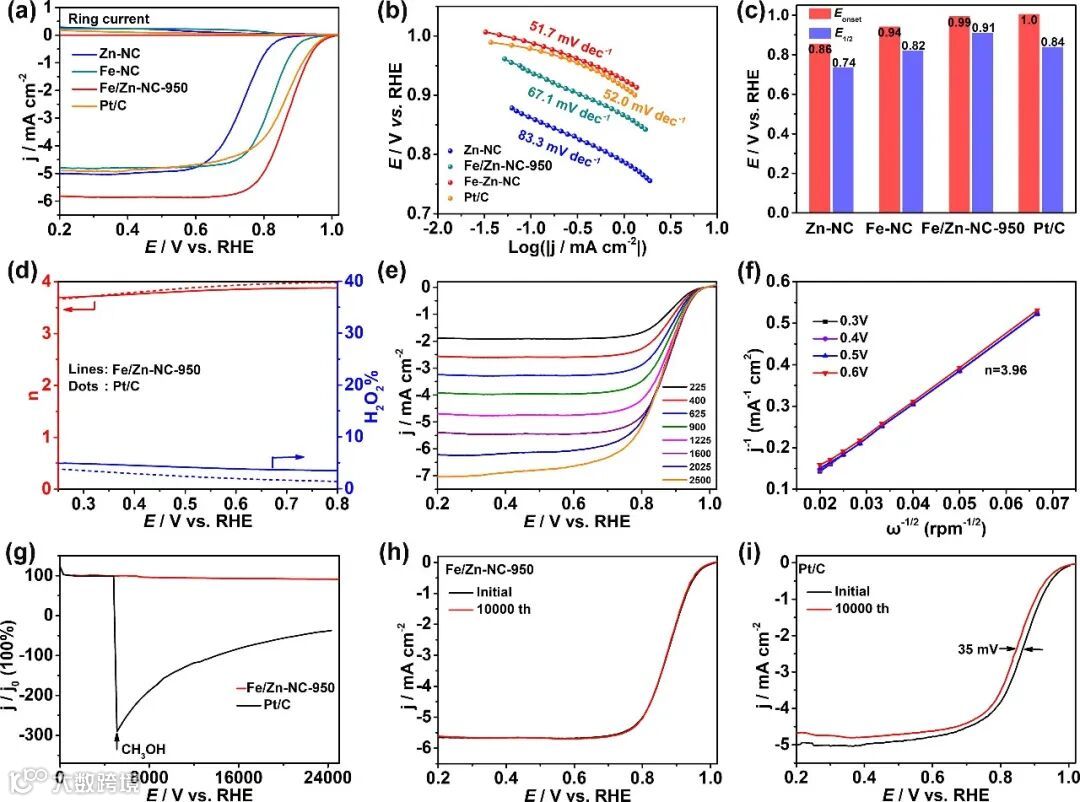
Figure 4. (a) ORR polarization curves, (b) corresponding Tafel curves, (c) Eonset and E1/2 values of different catalysts tested in O2-saturated 0.1 M KOH electrolyte with a scanning rate of 5 mV s–1 at 1600 rpm. (d) H2O2 yield and electron transfer number of Fe/Zn–NC–950 (lines) and Pt/C (dots). (e) ORR polarization curves of Fe/Zn–NC–950 at different rotation rates and (f) corresponding Koutecky–Levich (K–L) plots. (g) Chronoamperometric curves of Fe/Zn–NC–950 and Pt/C tested at 0.75 V (vs. RHE) after introducing 1.0 M methanol. Stability test of (h) Fe/Zn–NC–950 and (i) Pt/C.
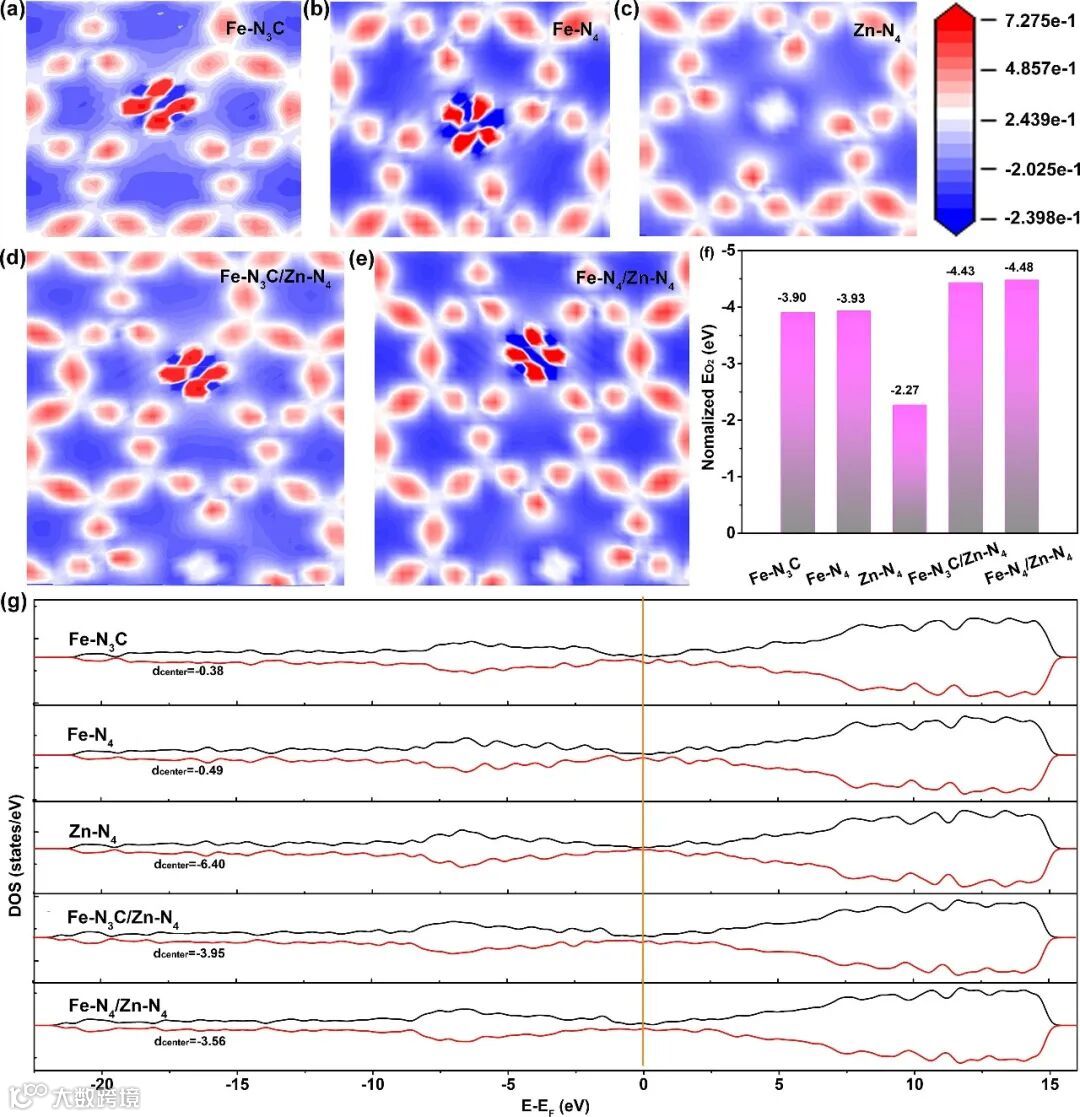
Figure 5. Calculated charge density differences of (a) Fe–N3C, (b) Fe–N4, (c) Zn–N4 (d) Fe–N3C/Zn–N4 and (e) Fe–N4/Zn–N4. The blue and red areas respectively represent charge density increase and decrease, in which the larger values represent the increased electron density. (f) O2 absorption energy values on the Fe cantered structures in Fe–N3C, Fe–N4, Fe–N3C/Zn–N4 and Fe–N4/Zn–N4 models, Zn cantered structures in Zn–N4 model. (g) Density of states (DOS) of Fe–N3C, Zn–N4 and Fe–N3C/Zn–N4, Fe–N4 and Fe–N4/Zn–N4 models.
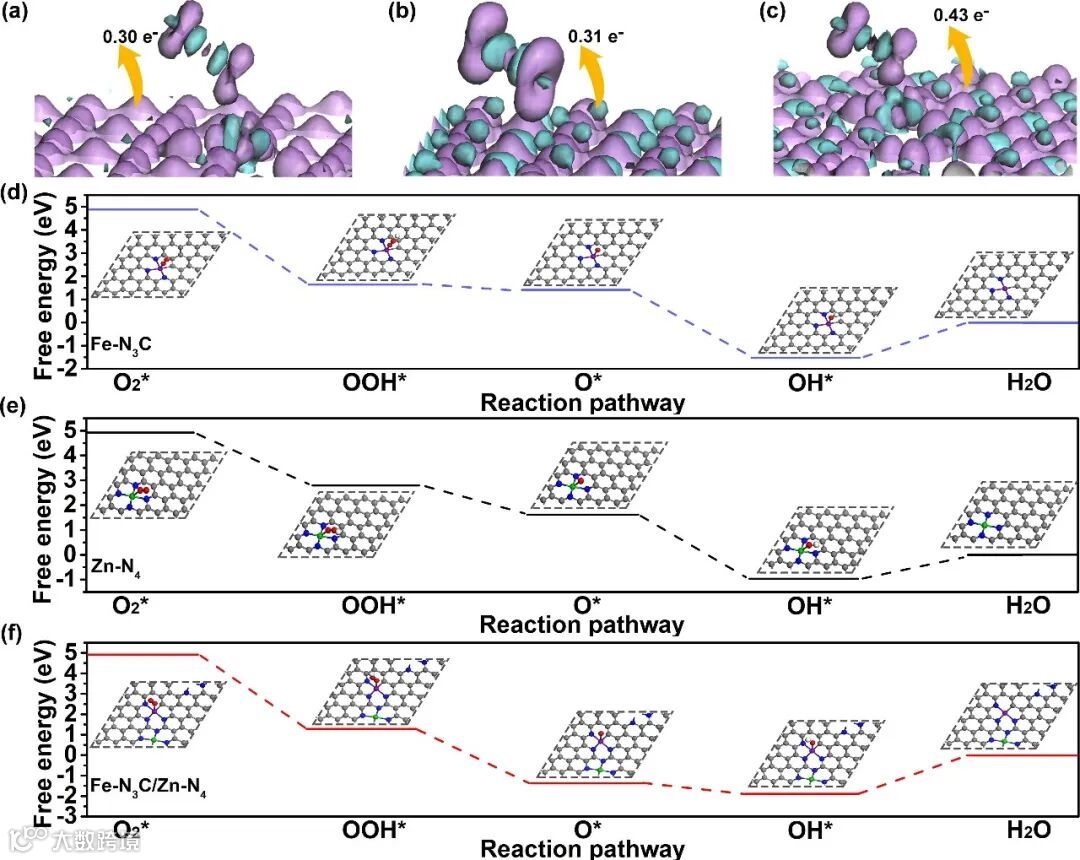
Figure 6. Calculated Bader charge transfer of (a) Zn–N4, (b) Fe–N3C and (c) Fe–N3C/Zn–N4 models (purple and blue areas respectively rep-resent charge density increase and decrease; larger values represent increased electron density). Free energy diagrams for ORR processes on the three models of (d) Fe–N3C, (e) Zn–N4 and (f) Fe–N3C/Zn–N4 at the equilibrium potentials of U=0 V under pH=14.
总 结
文 章 链 接
Atomically Dispersed Fe–N3C Sites Induce Asymmetric Electron Structures to Afford Superior Oxygen Reduction Activity. Small, 2022, e202201255. https://doi.org/10.1002/smll.202201255
通 讯 作 者 简 介
王蕾 研究员
现为黑龙江省优秀青年基金、黑龙江省英才计划、中国博士后科学基金特别资助获得者。主要从事二维石墨烯基碳材料的合成及应用研究。发展了以生物质为原料的“基团配位组装析碳法”制备石墨烯材料的方法,并实现了生物质石墨烯材料的产业化生产及应用;制备了过渡金属碳基复合材料,探究其在金属-空气电池、燃料电池等能源器件中的应用,并利用理论计算结合原位技术阐明反应机制。在Angew. Chem. Int. Ed.、Adv. Mater.、Adv. Sci.、Small等国际学术期刊发表研究论文50余篇,有3篇论文进入ESI Top 1%高被引用论文,1篇论文进入ESI Top 0.1%热点论文。授权中国发明专利20余项,国际发明专利3项。主持国家自然科学基金及省部级项目10余项,获黑龙江省技术发明奖一等奖1项。
付宏刚 教授
黑龙江大学功能无机材料化学教育部重点实验室主任。教育部长江学者奖励计划特聘教授,首批“国家万人计划”百千万工程领军人才,新世纪百千万人才工程国家级人选。英国皇家化学会会士,教育部科技委员会化学化工学部委员。2018-2021连续3年入选科睿唯安全球高被引科学家。主持及承担国家自然科学基金重点项目、科技部重点研发计划项目等国家级项目20余项。主要从事光催化和电催化领域的材料设计合成、结构调控,在材料尺寸,晶相,缺陷的选择性控制合成及其在光催化、电催化制氢,有机物合成以及ORR,OER等催化反应过程中的活性和稳定性,反应机制等方面开展工作。作为通讯作者在J. Am. Chem. Soc.、Angew. Chem. Int. Ed.、Adv. Mater.、Chem. Soc. Rev.、Energy. Environ. Sci.等期刊发表研究论文300余篇,被引用24000余次,H因子83,有50余篇论文进入ESI Top 1%高被引用论文,4篇论文进入ESI Top 0.1%热点论文。获省科学技术奖一等奖3项,获授权发明专利30余项。
第 一 作 者 简 介
佟苗苗 博士研究生
2018年毕业于黑龙江大学,获硕士学位。现为哈尔滨工程大学博士研究生,师从付宏刚教授。主要研究方向为先进的单原子ORR催化剂的设计合成。目前以第一作者身份在Angew. Chem. Int. Ed.、Small Methods、ACS Sustainable Chem. Eng.等高水平学术期刊上发表多篇论文。


添加官方微信 进群交流
SCI二氧化碳互助群
SCI催化材料交流群
SCI钠离子电池交流群
SCI离子交换膜经验交流群
SCI燃料电池交流群
SCI超级电容器交流群
SCI水系锌电池交流群
SCI水电解互助群
SCI气体扩散层经验交流群
备注【姓名-机构-研究方向】
投稿请联系contact@scimaterials.cn
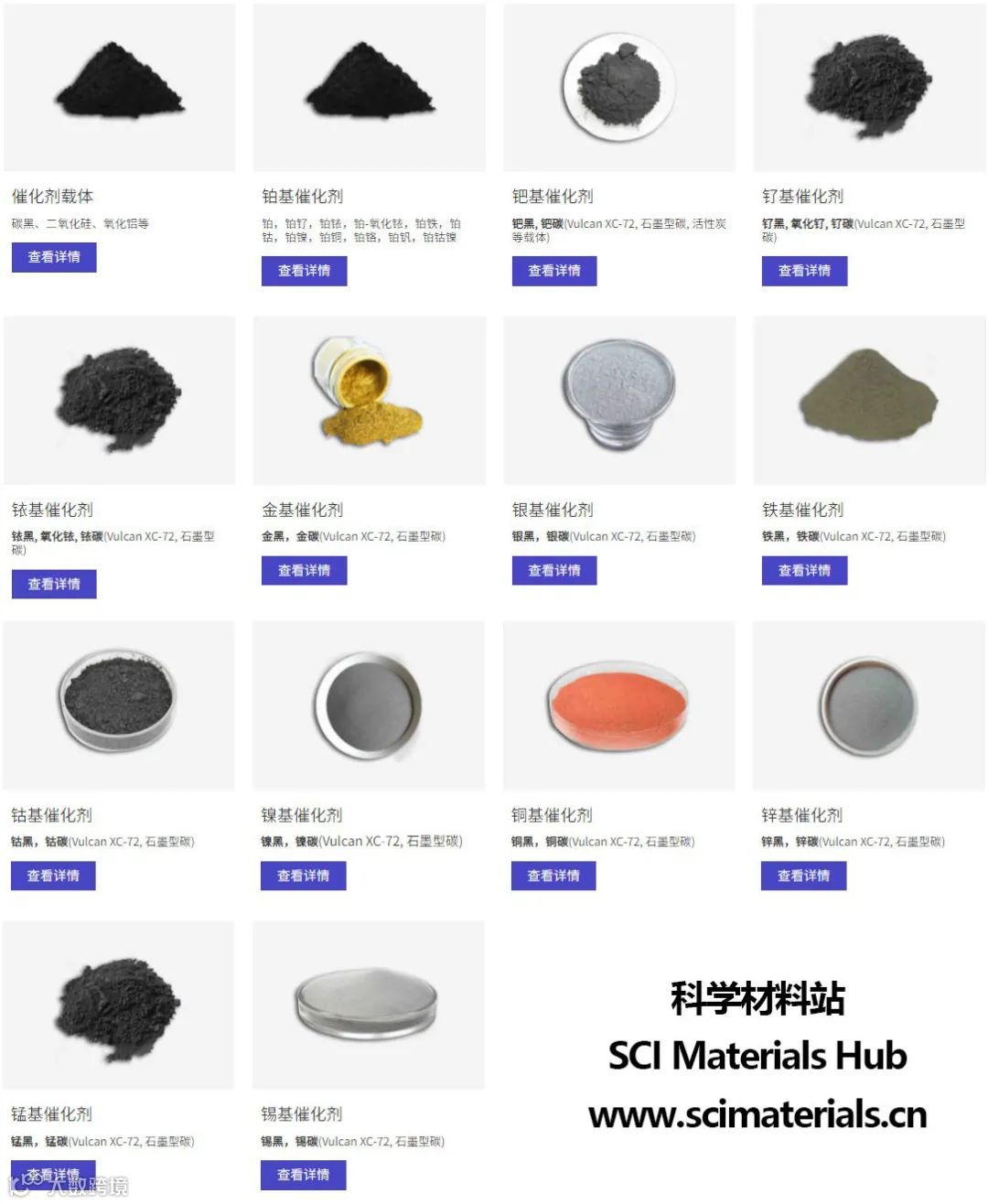
了解更多催化剂材料,点击"阅读原文"

点分享

点赞支持

点在看