




文 章 信 息
通过一种持续释放的多功能电解液添加剂去自修复正极电解液界面以稳定高镍正极
第一作者:邹跃
通讯作者:乔羽*,鲍骏*,孙世刚*
单位:中国科学技术大学国家同步辐射实验室,厦门大学化学化工学院
研 究 背 景
公共交通车辆通过用电力供能来取代传统的化石燃料,这有利于各国早日实现碳中和。遗憾的是,如今电动汽车的发展受制于行驶里程和使用寿命的限制。为了解决这一问题,提高高镍正极LiNixCoyMnzO2 (NCM)的Ni可促使更多的Ni2+参与氧化还原过程(Ni2+Ni4+),从而能提升电池的能量密度。不过随之而来的是,正极材料的循环稳定性显著下降,这主要是因为随着Ni含量提升,加剧了以下挑战:1. 增大的Li+/Ni2+混排;2. 各向应力应变摧毁正极的层状结构,这会引起循环后期的颗粒破损;3. 过渡金属离子溶出和电解液在高电压下的分解。以上挑战目前有很多改性手段:包覆,掺杂,电解液改性等,其中电解液添加剂作为一种最为简单且有效的方法被广泛应用。
文 章 简 介
近日,厦门大学孙世刚院士/乔羽教授团队与中国科学技术大学鲍骏研究员合作,在国际知名期刊Chemical Engineering Journal上发表题为“Self-repaired cathode electrolyte interphase to stabilize the high-nickel cathode interface by a sustained–release multifunctional electrolyte additive”的研究论文。该文章提出了通过引入N,N-二甲基,4-氟苯磺酸胺电解液添加剂(FBSN)去显著提升NCM90||Li电池的循环稳定性。NCM90正极材料在加有FBSN的电解液中1C循环200圈后的容量保持率为90.2%,高于基准电解液的70.0%。根据实验结果表明FBSN添加剂对于NCM正极的提升作用主要源于两点:1. 抑制了经常发生在正极表面的EC脱氢反应;2. 在NCM90正极表面形成了致密、刚性(富含LiF和苯环骨架)、高离子电导的物质(富S和富N基成分)和可自主修复的CEI。
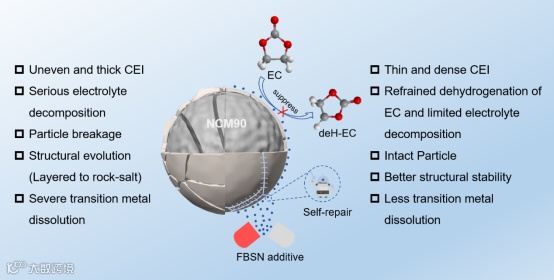
图1. FBSN电解液添加剂改性NCM90正极的机理示意图。
本 文 要 点
要点一:FBSN电解液添加剂提升NCM90正极的循环稳定性
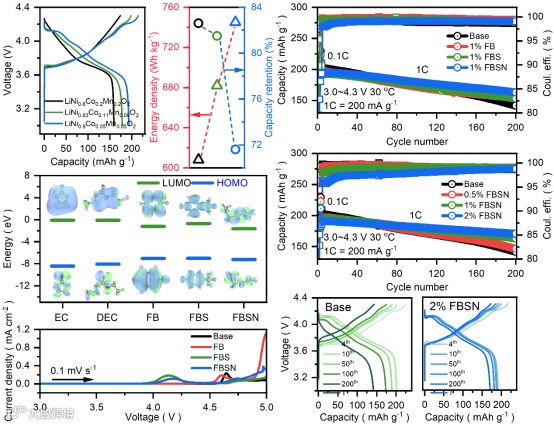
Fig. 1. (a, b) The galvanostatic charge/discharge curves and corresponding energy density at 1C and capacity retention after 200 cycles for different high-nickel cathode (LiNi0.6Co0.2Mn0.2O2,LiNi0.83Co0.11Mn0.06O2,LiNi0.9Co0.05Mn0.05O2). (c) The HOMO and LUMO energy levels for EC, DEC, FB, FBS, FBSN acquired by theoretical calculation. The structural formula of EC, DEC, FB, FBS, FBSN are inset in (c). (d) LSV curves of Base electrolyte and electrolyte with FB/FBS/FBSN with a sweeping rate of 0.1 mV s−1. (e) Cycling performance of different electrolyte formulations (Base/1% FB/1% FBS/1% FBSN) between 3.0 and 4.3 V at 1C. (f) Cycling stability between 3.0 and 4.3 V at 1C in electrolyte with selected addition amount of FBSN. (g) The charging and discharging curves in Base and 2 % FBSN-added electrolyte, in accordance with (f).
要点二:漫反射傅里叶变换红外光谱(DFIRT)研究FBSN电解液添加剂抑制高镍正极表面EC脱氢反应
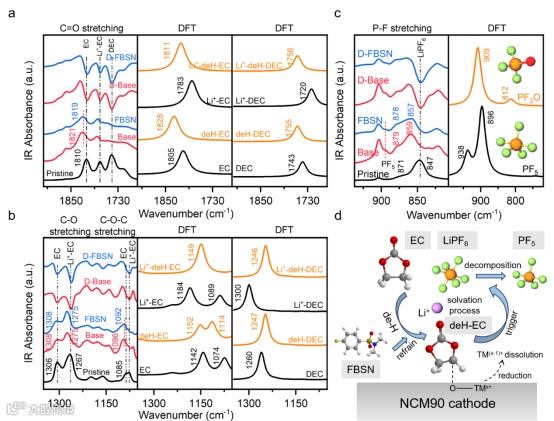
Fig. 2. (a-c) FT-IR measurements on pristine electrolyte and the NCM90 cathode charged to 4.3 V in Base and 2 % FBSN-containing electrolyte. To demonstrate the IR shift, the corresponding derivative spectra are shown at the top (named as D-Base and D-FBSN). DFT-simulated spectra of EC/DEC, dehydrogenated EC/DEC (deH-EC/DEC), Li+-coordinated dehydrogenated EC/DEC (Li+-EC/DEC) and Li+-coordinated dehydrogenated EC/DEC (Li+-deH-EC/DEC) are provided on the left side. Beyond that, the spectra of lithium salt LiPF6 decomposition products (PF3O and PF5) are also calculated by DFT. (d) Proposed working mechanism of FBSN additive: refraining the generation of dehydrogenated EC (deH-EC).
要点三:FBSN电解液添加剂可持续修复NCM90正极表面
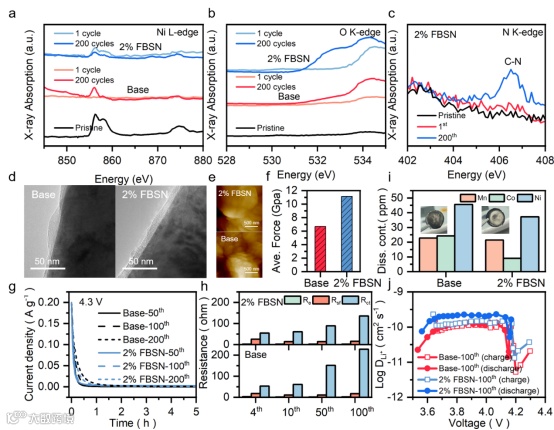
Fig. 3. Characterization of the pristine and cycled NCM90 cathode surface by soft-XAS: (a) Ni-L-edge, (b) O K-edge and (c) N K-edge. (d, e) TEM and AFM images of the NCM90 cathode cycled in Base and 2 % FBSN electrolyte. (f) The average Young’s modulus acquired from (e). (g) Leakage current tests after 50, 100, 200 cycles at a constant voltage of 4.3 V for NCM90 electrodes in Base and 2 % FBSN electrolyte. (h) The electrochemical impedance values (Re, Rsf, Rct) of NCM90||Li cells with different electrolyte at selected cycles. (i) Quantitative analysis of the transition metals (Ni/Co/Mn) deposited on the lithium metal anode in the electrolyte with and without FBSN additive. In addition, digital images of the lithium metal anode after 200 cycles are displayed in the inset. (j) The Li+ diffusion coefficient of NCM90 electrodes in different electrolytes after 100 cycles.
要点四:FBSN电解液添加剂在NCM90表面构建薄且致密的CEI层,富含LiF以及一些高离子电导的物质(S-rich和N-rich成分)
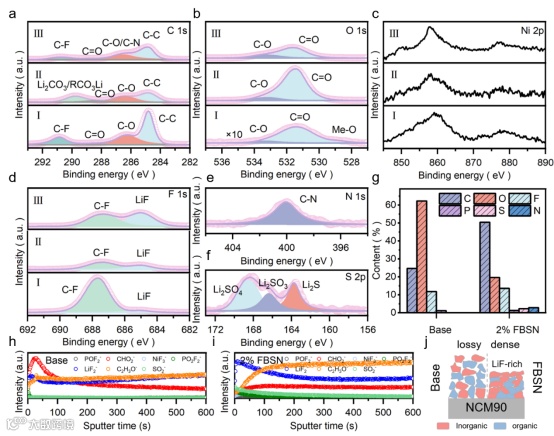
Fig. 4. XPS spectra of (Ⅰ) pristine NCM90 electrode and NCM90 electrodes after 200 cycles in (Ⅱ) Base and (Ⅲ) FBSN electrolyte: (a) C 1 s spectra, (b) O 1 s spectra, (c) Ni 2p spectra, (d) F 1 s spectra, (e) N 1 s spectra, (f) S 2p spectra. (g) element percentage on NCM90 surface in Base and 2 % FBSN electrolyte after 200 cycles. (h, i) TOF-SIMS sputtering depth profiles of the CEI species (organic: CHO2–/C2H3O–, inorganic: POF2-/NiF3-/ POF2-/LiF2-/SO2-) on the NCM90 surface with different electrolyte after 200 cycles. (j) Schematic diagram of the CEI composition and components distribution on NCM90 surface before and after introducing FBSN additive.
要点五:FBSN电解液添加剂参与构建的高质量CEI层保护NCM90正极界面,从而保持正极颗粒的完整性以及减缓层状结构向盐岩相的转变
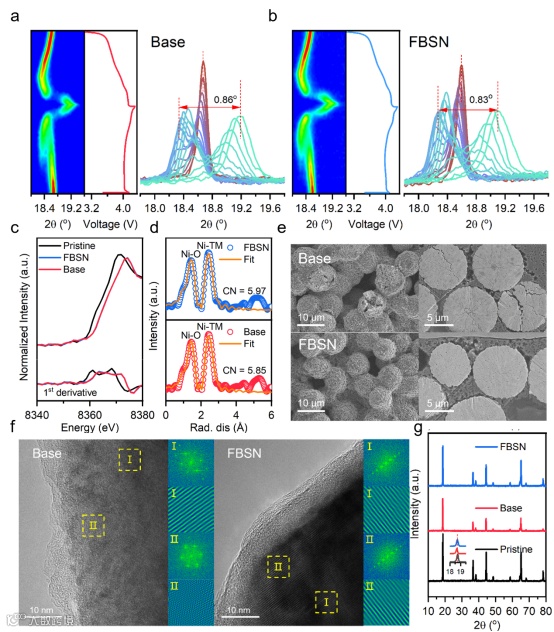
Fig. 5. (a, b) In situ XRD patterns of the NCM90 cathode in Base and FBSN-containing electrolyte at the first cycle with a current density of 40 mA g−1. (c) Ni K-edge (XANES region) of the pristine and full-charged (4.3 V) NCM90 electrodes. The 1st derivative spectra of the electrodes are shown on the bottom. (d) Ni K-edge EXAFS spectra and the fitted results of NCM90 electrodes in Base and FBSN electrolyte. (e) SEM images of the NCM90 electrodes after 200 cycles in Base and FBSN electrolyte. (f) TEM images of NCM90 electrodes after 200 cycles in Base and FBSN electrolyte. The corresponding FFT and IFFT images of the selected region Ⅰ/Ⅱ (yellow squares) are shown on the right. (g) XRD patterns of pristine and cycled NCM90 electrodes in Base and FBSN electrolyte.
致谢
感谢合肥国家同步辐射实验室XMCD线站和上海同步辐射(BL16U1)分别提供了软X射线吸收谱(Soft-XAS)和硬X射线吸收谱(Hard-XAS)测试支持。
文 章 链 接
“Self-repaired cathode electrolyte interphase to stabilize the high-nickel cathode interface by a sustained-release multifunctional electrolyte additive”
https://doi.org/10.1016/j.cej.2024.151153
通 讯 作 者 简 介
孙世刚,中国科学院院士,教授、博士生导师。获国家自然科学奖二等奖、教育部自然科学奖一等奖、中法化学讲座奖、中国电化学贡献奖、中国光谱成就奖、国际车用锂电池协会终身成就奖、国际电化学学会Brian Conway物理电化学奖章等科技奖项;获国家级教学成果奖、首届全国教材建设先进个人奖、第四届杰出教学奖、国家级教学名师、全国模范教师、全国优秀科技工作者和全国先进工作者等荣誉。担任J Electroanal Chem、Func Mater Lett、ACS Energy Lett、Electrochem Energy Rev、National Sci Rev、J Solid State Electrochem、JMCA、《应用化学》、《物理化学学报》、《结构化学》等学术期刊编委或顾问编委,国际电化学会会刊Electrochimica Acta、《光谱学与光谱分析》、《化学学报》和《化学教育》副主编、中国化学会电化学专业委员会会刊《电化学》主编。
曾主持国家基金委重大科研仪器设备研制专项、“界面电化学”创新研究群体(3+3+3延续资助)、中科院学部“高端电子制造电子电镀”科学与技术前沿论坛,以及中科院学部咨询评议项目“我国电子电镀基础与工业的现状和发展”等项目。现任厦门大学自然科学学部主任、中国化学会第二届监事会监事长、中国化工学会电子化学品专业委员会副主任、高端电子化学品国家工程研究中心(重组)科技领军专家。
鲍骏,中国科学技术大学国家同步辐射实验室研究员、博士生导师。中国化学会高级会员,中国科学院十五五重大科技基础设施战略规划咨询专家组成员,中国材料与试验团体标准委员会高通量制备分技术委员会主任委员。主要从事同步辐射实验技术和能源催化等领域研究。发展了一系列基于同步辐射和自由电子激光的原位实验方法及材料基因组学技术,如同步辐射红外显微谱学催化剂高通量筛选系统、红外自由电子激光时空域分辨原位谱学表征方法等,并对用户开放。迄今,已在Nature. Comm., J. Am. Chem. Soc., Angew. Chem. Int. Ed., ACS Catal.等期刊发表论文150多篇,受邀请参与撰写英文专著2部,获授权发明专利12项。主持承担基金委、科技部、中科院、教育部等多项课题研究,部分成果实现技术转让。
乔羽, 教授 博士生导师,厦门大学化学化工学院 / 固体表面物理化学国家重点实验室,中国福建能源材料科学与技术创新实验室(嘉庚创新实验室)。研究内容:二次电池相关新型储能体系(富锂、高镍等高电压正极材料中阴离子氧化还原机理,电极电解液表界面电化学过程及相关溶剂化构型改性研究,二次电池产气精细分析等);电化学原位谱学表征(电化学原位气相质谱色谱联用、Raman、红外等)。学术成果:2017年以来,以第一作者和通讯作者身份在Nature Energy (2篇), Nature Catalysis, Nature Sustainability, Joule (7篇), J. Am. Chem. Soc. (2 篇), Angew. Chem. (7篇), Adv. Mater. (10篇), Energy Environ. Sci. (4篇), Adv. Energy Mater. (5篇)等科研期刊发表学术论文50余篇。获奖情况:国家海外高层次青年引进人才计划、福建省杰青、闽江特聘教授等。
课 题 组 招 聘
招聘博士后(锂钠离子电池正极结构方向优先),待遇:基础薪金30-35W/年(税前),其他另算。在站博士后除独立科研外,指导相关方向学生进行科研,以共同通讯作者身份署名。联系方式:yuqiao@xmu.edu.cn。

添加官方微信 进群交流
SCI二氧化碳互助群
SCI催化材料交流群
SCI钠离子电池交流群
SCI离子交换膜经验交流群
SCI燃料电池交流群
SCI超级电容器交流群
SCI水系锌电池交流群
SCI水电解互助群
SCI气体扩散层经验交流群
备注【姓名-机构-研究方向】
投稿请联系contact@scimaterials.cn

点分享

点赞支持

点在看