




文 章 信 息
极化超薄BN诱导的动态电子相互作用增强酸性析氧性能
通讯作者:彭生杰*
单位:南京航空航天大学
研 究 背 景
随着质子交换膜(PEM)水电解技术的大规模部署,开发稳定的高活性氧析出反应(OER)电催化剂成为当务之急。在实际应用中,RuO2被认为是酸性介质中最具成本效益的OER催化剂。然而,在高氧化电位下,由于晶格氧的参与,RuO2会被氧化为高价的RuO4,从而使金属脱离晶格而不能形成共价结构,转化为可溶性金属阳离子。此外,单一的RuO2催化剂质量活性也较差。因此,提高RuO2催化剂的稳定性和活性对于工业化电解水产氢具有重要意义。
文 章 简 介
传统的修饰策略通常提供一个供电子层,通过电荷补充来保持电荷转移能力。然而,这种方法往往是单向的,可能不能保证对晶格氧氧化的抑制。因此,需要一个空间分离的双锚点载体,它可以作为电荷供体和受体来稳定氧。为了解决这一挑战,六方氮化硼(BN)成为一个可能的候选者。与石墨不同,BN结构中的B和N原子分别作为缺电子中心和富电子中心,产生一个极化的B-N键。极性载体的引入促进了RuO2电子的再分配,导致了锚定位点上的局部损失或积累,并促进了Ru和BN之间的双向电荷转移。此外,BN具有优异的高电位稳定性和耐酸腐蚀性,这是界面稳定性的关键。然而,BN仍然面临着弱电子相互作用的挑战,阻碍了快速定向电子转移的实现。在这种情况下,原子薄的缺陷BN纳米片(BNNS)提供了更独特的性能优势。B/N缺陷位点表现出强的路易斯酸和碱位点性质,并且被合理地定位在一个分子中而不被中和。这一特性非常适合于均相催化中电子供给-接收协同的催化微区域。此外,原子薄的纳米片允许在垂直于暴露平面的方向上进行快速的电子隧穿,作为一个额外的电荷传输路径。总之,有缺陷的BNNS与RuO2复合,形成了更稳定的键合结构,并表现出更高的催化活性。
本 文 要 点
要点一:晶格匹配界面的精确构建
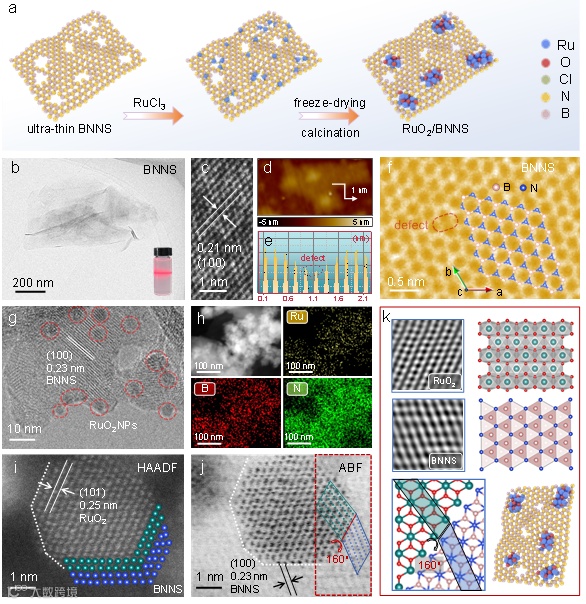
Figure 1. Catalyst design and structured characterization. (a) Schematic illustration of the preparation process of RuO2/BNNS. (b-c) The TEM and high-resolution TEM images of BNNS (inset in b: Photograph of BNNS suspension with Tyndall effect). (d) AFM images and the corresponding height profiles of a flat BNNS. (e) Intensity profiles along the image c. (f) Atomic resolution STEM image of BNNS with vacancies (as indicated by the dotted box) and structure analysis images. (g-h) The TEM image and corresponding element mapping images of synthesized RuO2/BNNS. (i-j) High angle annular dark field (HAADF) and annular bright field (ABF) STEM images of RuO2/BNNS. The colored balls represent the RuO2/BNNS connections at the interface with similar angles. (k) The corresponding inverse fast Fourier transform (IFFT) images and atomic structure of RuO2 (top) and BNNS (middle) in RuO2/BNNS, respectively. The atomic model of RuO2/BNNS with lattice-matched interfaces (bottom).
要点二:酸性析氧反应活性的增强
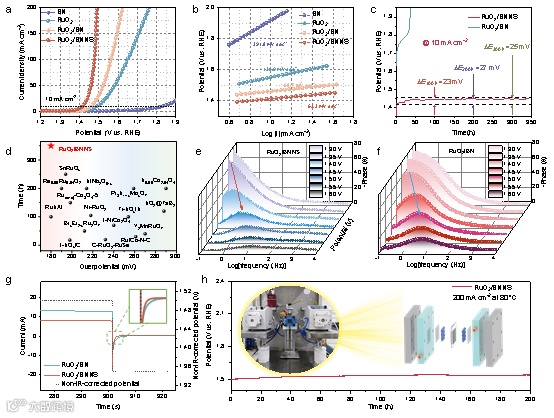
Figure 2. Electrocatalytic acidic OER performance. (a) linear sweep voltammetry (LSV) of BN, RuO2, RuO2/BN, and RuO2/BNNS recorded at a scan rate of 5 mV s−1 in 0.5 M H2SO4 solution with iR correction, and (b) the relevant Tafel slopes. (c) Chronopotentiometric curves of RuO2/BN, and RuO2/BNNS. (d) Comparison of OER activity using the reported electrocatalysts. Bode plots at the potential range of (e) RuO2/BNNS, and (f) RuO2/BN from 1.30 to 1.60 V (vs. RHE). (g) Pulse voltammetry protocol curves. (h) PEM device performance (200 mA cm-2) using commercial Pt/C and RuO2/BNNS as catalysts in the PEM electrolyser. A schematic of PEM electrolyte is shown in the inset, in which the anode and cathode sides are separated by a Nafion membrane.
要点三:新颖的电子相互作用抑制催化剂溶解
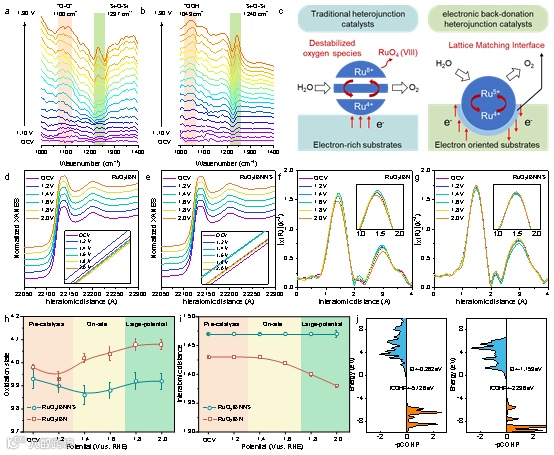
Figure 4. Investigating the structure evolution during OER. In-situ FTIR spectra of (a) RuO2/BN and (b) RuO2/BNNS in the range of 1000−1400 cm−1 at different applied potentials. (c) Schematic illustration of charge compensation and chemical oxidation on the different interfaces. Operando XAFS for Ru K-edge of (d) RuO2/BN and (e) RuO2/BNNS. The inset demonstrates a detailed view of the absorbing edge, respectively. Operando EXAFS of (f) RuO2/BN and (g) RuO2/BNNS with applied bias rise from 1.2 to 2.0 V versus RHE. (h) The valence states of RuO2RuO2/BN and RuO2/BNNS fitted by Ru K-edge absorption energy at different potentials. (i) Summary of the Ru–O interatomic distance of RuO2/BN and RuO2/BNNS at various potentials. (j) Crystal orbital Hamilton population (COHP) analysis and the corresponding integrated crystal orbital Hamiltonian population (ICOHP) values of RuO2/BN and RuO2/BNNS.
文 章 链 接
Polarized Ultrathin BN Induced Dynamic Electron Interactions for Enhancing Acidic Oxygen Evolution
https://doi.org/10.1002/anie.202402018
通 讯 作 者 简 介
彭生杰教授简介:南京航空航天大学教授,博士生导师,入选国家青年人才,江苏省特聘教授、江苏省“双创人才计划”、江苏省“六大人才高峰”高层次人才、南航首批“长空学者”,主持完成江苏省杰出青年基金获得者、国家自然基金面上项目、中央高校基本科研业务费和南京留学人员科技创新项目。2010年于南开大学取得博士学位,导师陈军院士。随后分别加入南洋理工大学Prof. Yan Qingyu和新加坡国立大学Prof. Seeram Ramakrishna(英国工程院院士)课题组进行博士后研究。近十年来,一直从事微纳米结构及新型功能材料的设计、合成及其电化学储能与催化研究,取得了一系列创新性科研成果。共发表论文200余篇,被引用1.4万余次,H-index63。出版学术专著三部。申请中国发明/授权专利30项。

添加官方微信 进群交流
SCI二氧化碳互助群
SCI催化材料交流群
SCI钠离子电池交流群
SCI离子交换膜经验交流群
SCI燃料电池交流群
SCI超级电容器交流群
SCI水系锌电池交流群
SCI水电解互助群
SCI气体扩散层经验交流群
备注【姓名-机构-研究方向】
投稿请联系contact@scimaterials.cn

点分享

点赞支持

点在看