




文 章 信 息
双功能COF构建协同界面促进硫转化和Li+动力学
第一作者:安琪
通讯作者:郭洪*
单位:云南大学、西南联合研究生院
研 究 背 景
锂硫(Li-S)电池以其较高的理论比容量和成本效益而脱颖而出。然而,Li-S电池的实际应用受到诸如穿梭效应、氧化还原动力学迟缓和枝晶生长等问题的阻碍。本文设计了一种具有氰基和聚硫链双官能团活性位点的共价有机骨架(COF)作为协同功能界面,同时解决了枝晶和穿梭效应问题。结合原位技术和理论计算,可以证明COF-CN-S独特的化学结构能够实现以下功能:(1)COF-CN-S具有丰富的离子跳跃位点(氰基),可以显著增强Li+的传输能力;(2)通过调控多硫阴离子和Li+的动态行为,能够起到选择性离子筛的作用,从而抑制穿梭效应和枝晶生长;(3) COF-CN-S作为氧化还原介质,能有效控制多硫化物的电化学行为,增强其转化动力学。基于以上优势,COF-CN-S赋予了Li-S电池优异的性能。本工作强调了界面修饰的重要性,并为Li-S领域有机材料的合理设计提供了新的见解。
文 章 简 介
近日,云南大学郭洪教授团队在国际知名期刊Advanced Materials上发表题为 “Constructing Cooperative Interface via Bi-Functional COF for Facilitating the Sulfur Conversion and Li+ Dynamics”的研究型论文。该论文通过后修饰策略实现了COF官能团的调整,以提高其在Li-S领域的电化学活性。COF-CN-S功能协同界面可以作为氧化还原介质,实现对硫阴极和锂阳极的双重保护。值得注意的是,一方面,COF-CN-S中的氰基可以排斥多硫化物阴离子,聚硫链可以与多硫化物发生可逆反应,精确控制了多硫化物的氧化还原行为。另一方面,COF-CN-S可以促进Li+的传输,有效抑制锂枝晶。因此,COF-CN-S改性的电池具有优异的电化学性能。该研究为提高硫氧化还原反应和锂离子动力学提供了新的策略,并为功能COF材料在储能系统中的应用提供了广阔的前景。
本 文 要 点
要点一:双功能COF的设计和协同界面的构筑
合成后修饰可以实现COF官能团的定制和改变,以获得多功能COF材料。利用合成后的硫化反应制备了具有强极性氰基和聚硫链的不对称COF (COF-CN-S)。COF-CN-S由于其可逆的氧化还原能力、独特的电学性能和极性氰基基团,是Li-S电池中功能协同材料的候选者。相应的物相表征也证明了目标产物被成功合成了。
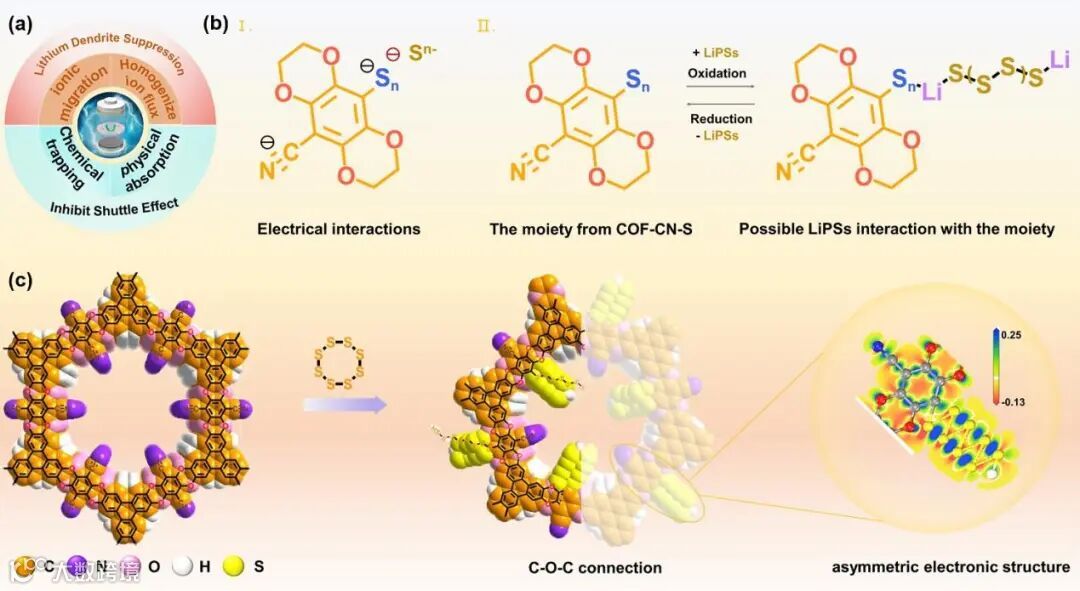
Figure 1. a) practical application of COF-CN-S in Li−S chemistry. b) Schematic illustration of the possible chemical bonding between COF-CN-S and lithium polysulfides. c)Schematic illustration of the preparation process of COF-CN-S material.
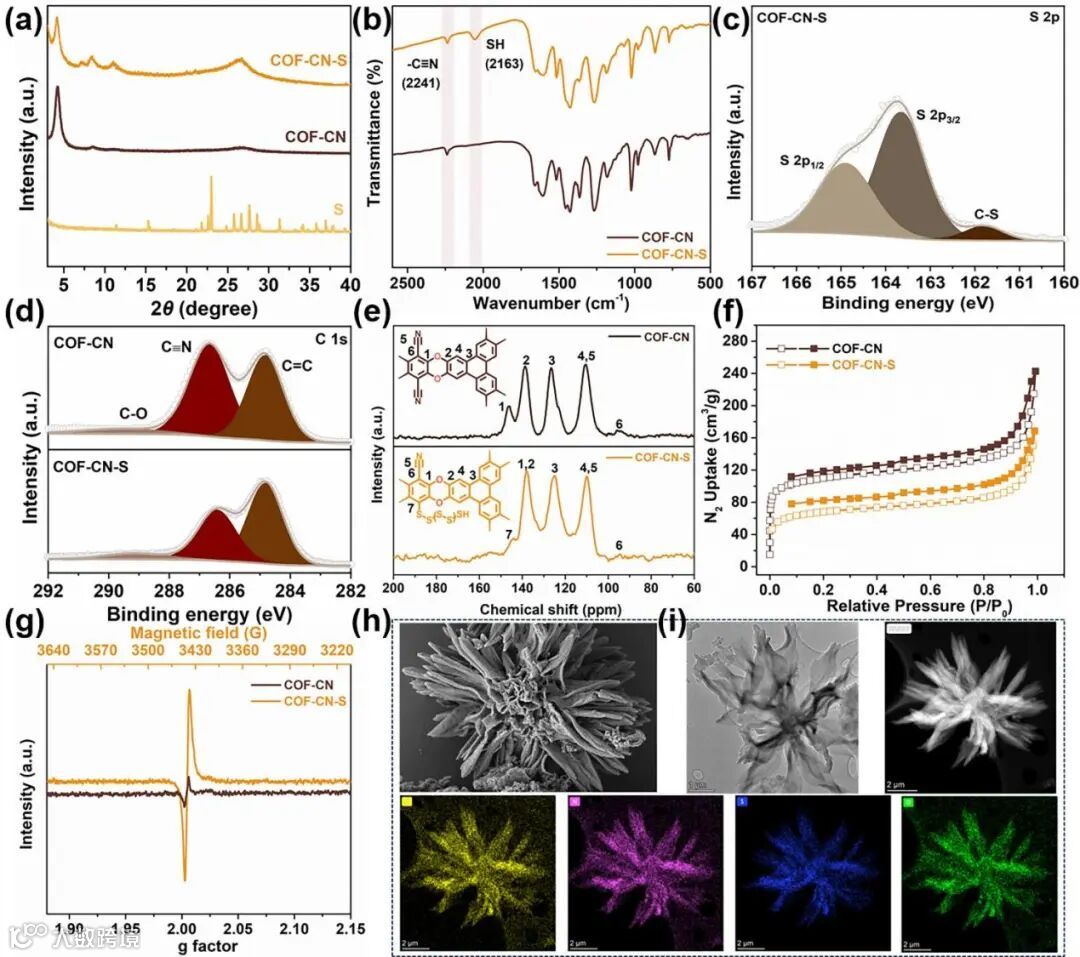
Figure 2. a) X-ray diffraction (XRD) patterns. b) FTIR spectra. High-resolution XPS spectra of S 2p c) and C 1s d). e) solid-state 13C NMR spectrum of COF-CN and COF-CN-S. f) Nitrogen adsorption–desorption isotherms of COF-CN and COF-CN-S. g) EPR spectra of COF-CN-S and COF-CN. h) SEM images of COF-CN-S. i) TEM image, High-angle annular dark-field scanning transmission electron microscopy (HAADF-STEM) and energy-dispersive X-ray spectroscopy (EDS) analysis mapping of COF-CN-S.
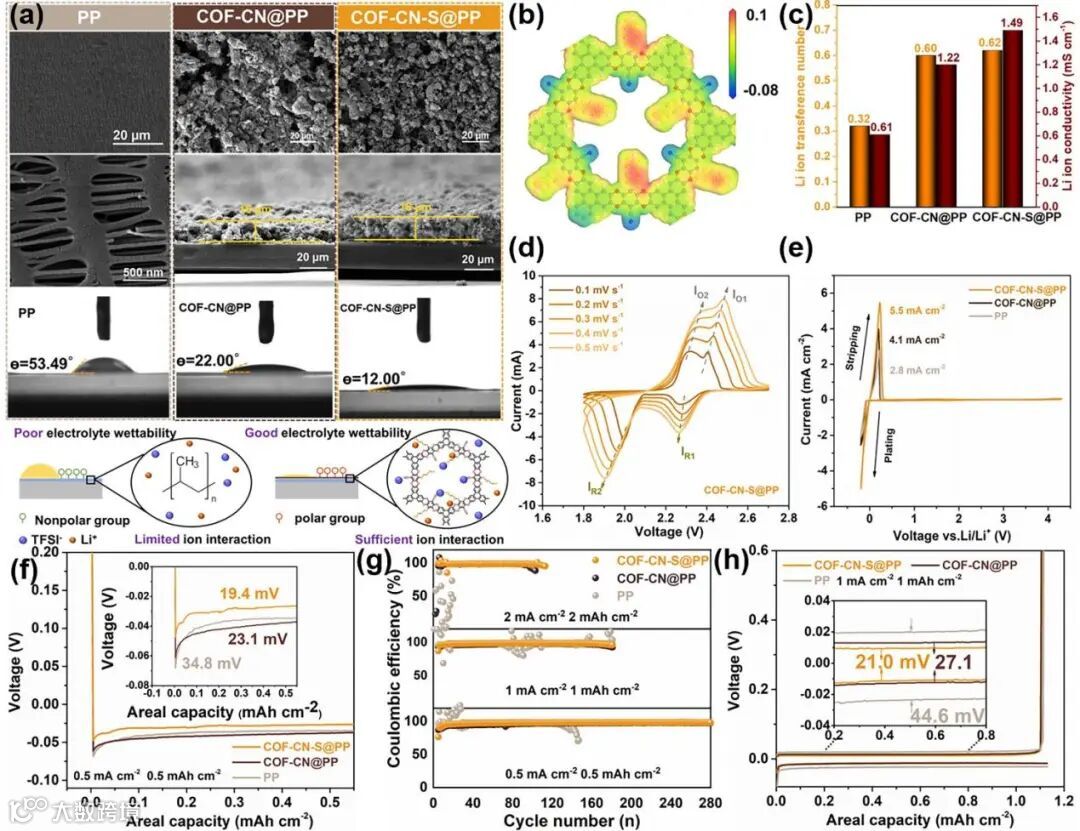
Figure 3. a) SEM image, cross-section SEM image, and contact angle test of separators. b) Electrostatic potential distributions of COF-CN-S. c) Li-ion conductivity and Li-ion transference number of PP, COF-CN@PP, and COF-CN-S@PP separators. d) CV profiles at different scan rates with COF-CN-S. e) CV curves of PP, COF-CN@PP, and COF-CN-S@PP separator. f) The nucleation overpotentials of COF-CN-S@PP, COF-CN@PP, and PP separator. g) CE of Li-Cu cells. h) Voltage profiles at 1.0 mA cm−2 for 1.0 mA h cm−2 for Li-Cu cell.
要点二:优异的电化学性能以及对锂枝晶和穿梭效应的成功抑制
COF-CN-S材料改性的电池均表现出了出色的电化学性能。Li|COF-CN-S@PP|Li电池表现出了稳定的循环性能。此外通过原位光学显微镜技术证实了COF-CN-S能够有效的抑制锂枝晶生长。理论计算充分说明了COF-CN-S能有效地促进整个多硫化物转化过程。
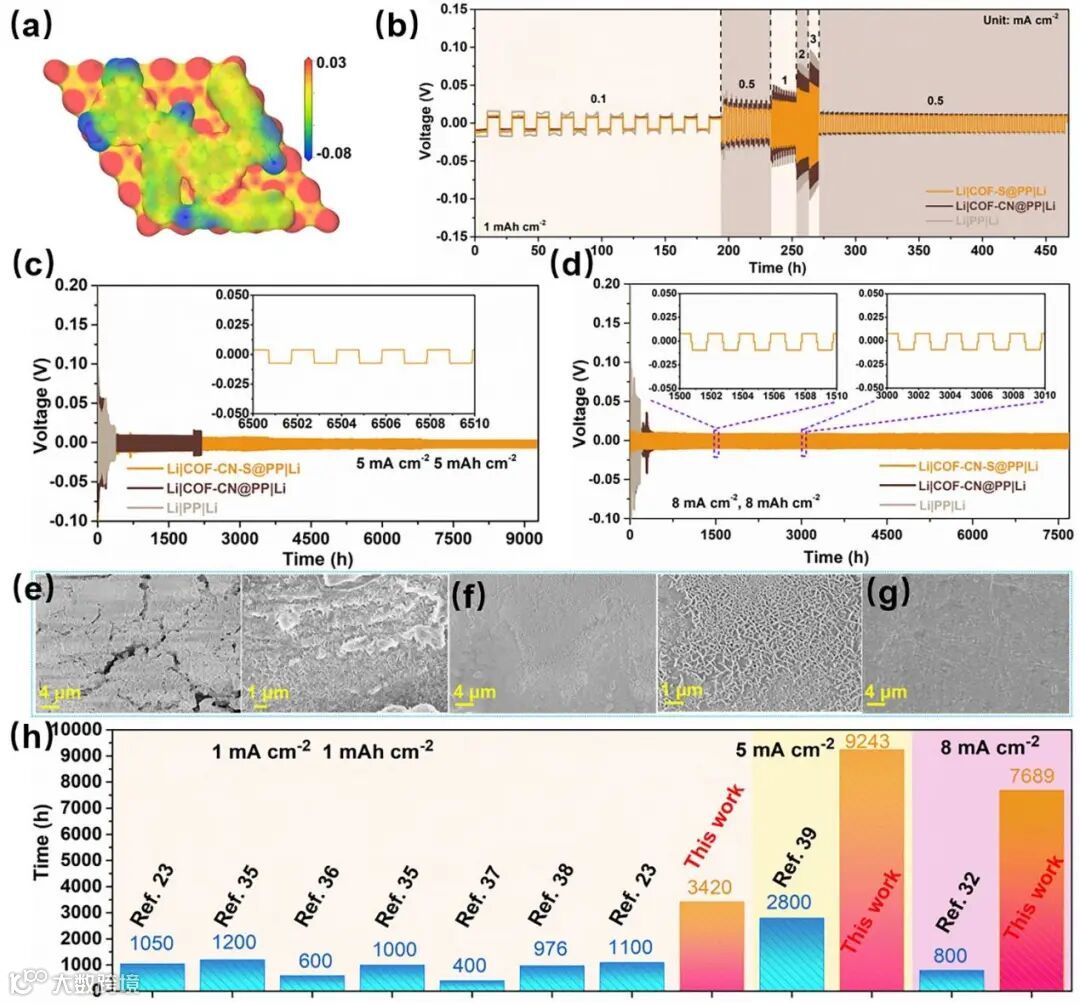
Figure 4. a) Distribution of electrostatic potential on the interface of Li (111) surface and COF-CN-S. b) Rate performance. Voltage-time profiles of Li plating/stripping processes in Li| |Li cells with PP, COF-CN@PP, and COF-CN-S@PP separators at 5 mA cm−2 for 5 mA h cm−2 c), at 8 mA cm−2 for 8 mA h cm−2 d). SEM images of cycled Li-PP e), Li-COF-CN f), and Li-COF-CN-S g) at 5 mA cm−2 with an areal capacity of 5 mAh cm−2 after 500 cycles. h) Comparison of cycling stability of the Li|COF|Li cell in this work with those of other recently reported results in symmetrical Li||separator||Li cells.
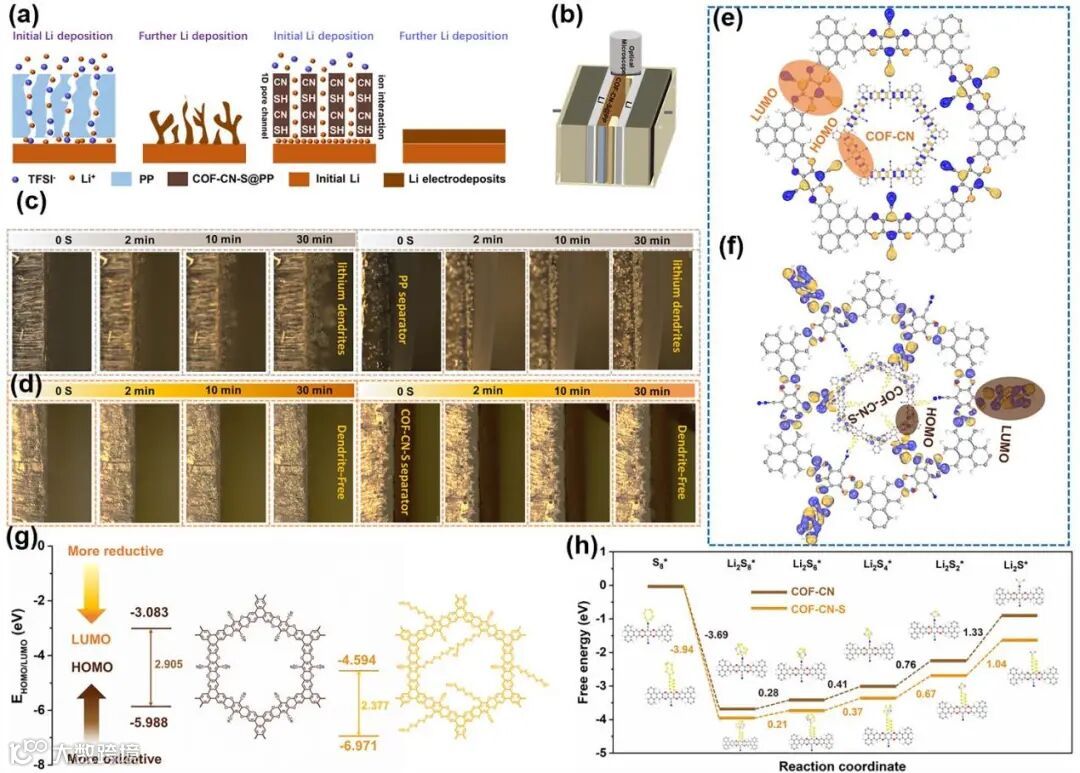
Figure 5. a) Schematic illustration of cycled Li behaviors with PP and COF-CN-S@PP separator. b-d) In situ optical microscopy observations of Li|PP|Li and Li|COF-CN-S@PP|Li batteries during the Li plating/stripping process at 1 mA cm−2 with 0.5 mAh cm−2. e-g) LUMO and HOMO of COF-CN and COF-CN-S. h) Energy profiles for the discharging process from S8 to Li2S on COF-CN and COF-CN-S substrates (insets: the optimized adsorption structures of intermediates).
要点三:原位表征技术揭示电化学反应机理
锂硫电池表现出优异的容量释放和循环稳定性。此外,通过原位拉曼、原位红外以及XPS测试,全面详细地说明了COF与多硫化物的相互作用并解释了作用机理。其中COF-CN-S的S-H基团可以化学捕获LiPSs,从而有效抑制穿梭效应及促进转化。
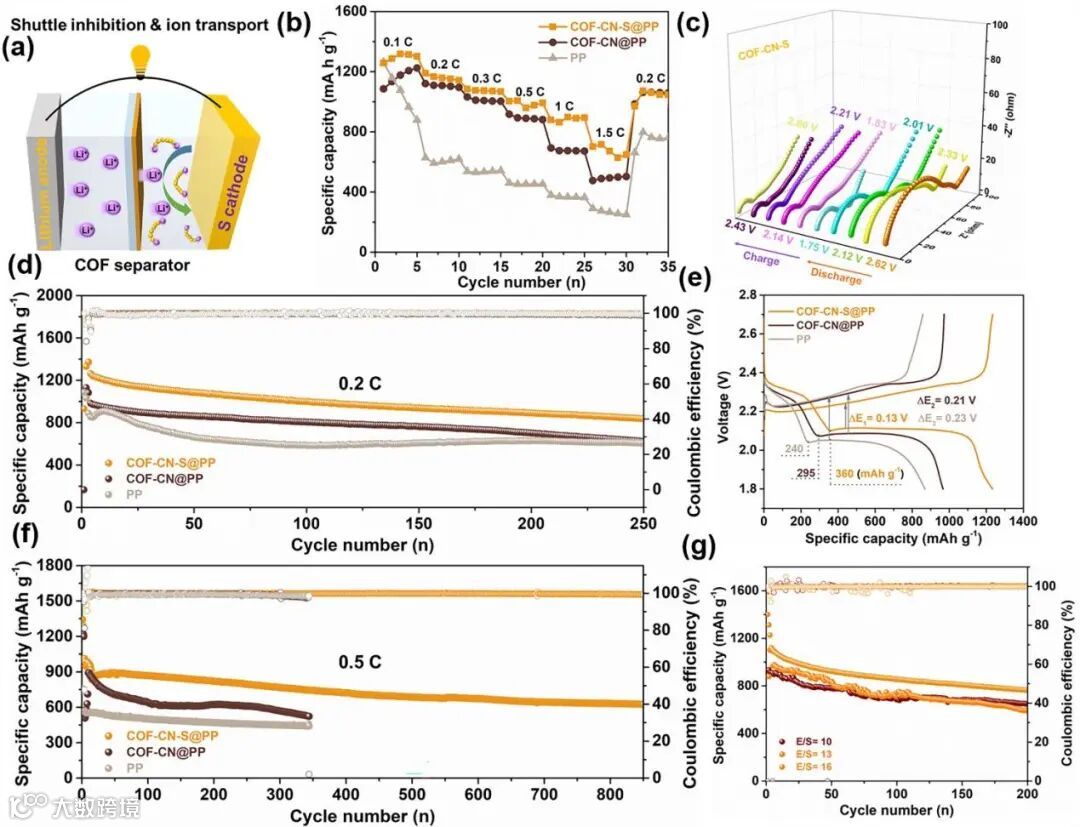
Figure 6. a) Schematic diagram of the Li−S battery with COF separators allowing the fast Li+ transport and blocking polysulfide. b) Rate capabilities. c) ex-situ EIS spectra of the COF-CN-S modified battery at different depths of charge and discharge. d) The long-term cycling performances of Li-S batteries at 0.2 C. e) The charge-discharge voltage profile at the current of 0.2 C. f) The long-term cycling performances of Li-S batteries at 0.5 C. g) Cycle performance for COF-CN-S-equipped batteries of different electrolyte amounts at 0.2 C.
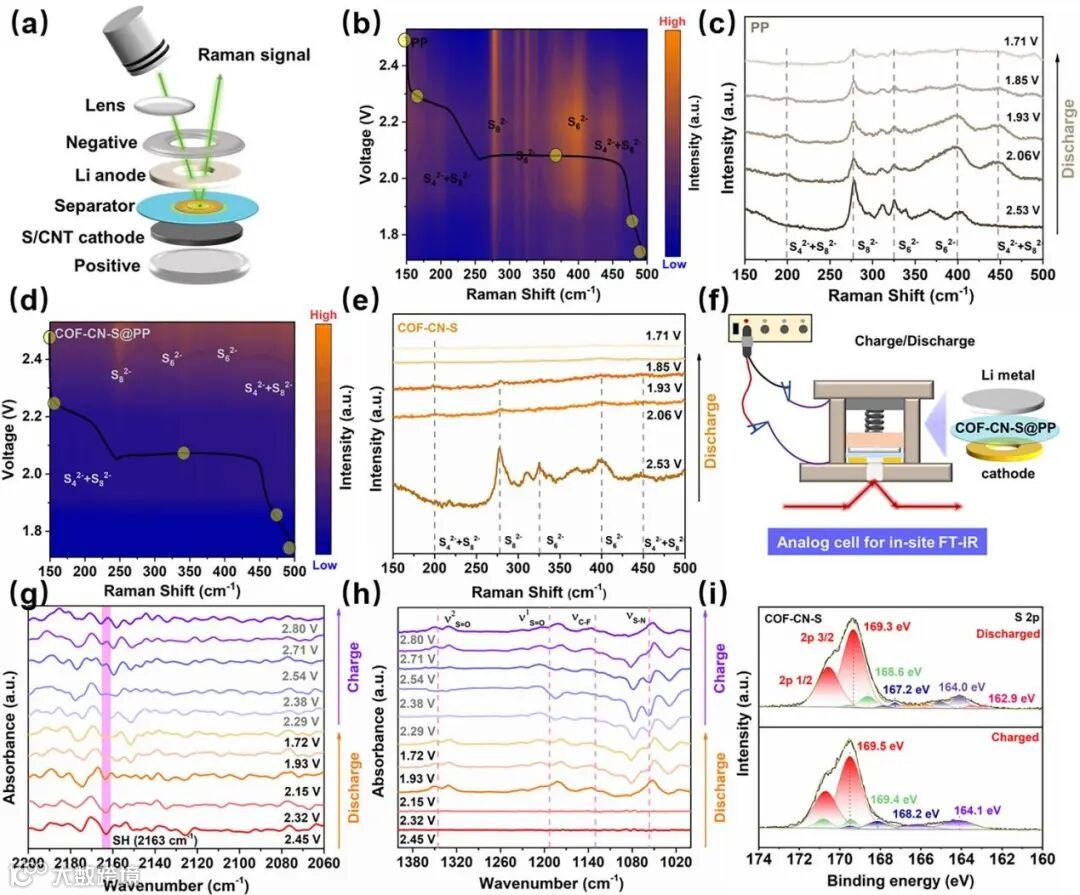
Figure 7. a) Schematic illustration of in situ Raman detection. Raman spectra at 0.10 C of the discharge process and Raman signals of the batteries at different voltage states with b,c) PP and d,e) COF-CN-S@PP separators, respectively. f) Schematic of in-situ FT-IR spectro-electrochemical cell. g,h) FT-IR spectral of COF-CN-S-modified battery at the current of 0.1C. i) XPS spectra of S 2p at a discharged state (upper) and charge state (below), respectively.
文 章 链 接
Constructing Cooperative Interface via Bi-Functional COF for Facilitating the Sulfur Conversion and Li+ Dynamics
https://onlinelibrary.wiley.com/doi/10.1002/adma.202305818
通 讯 作 者 简 介
郭洪,云南大学教授,博士生导师,博士后合作导师, 享受云南省政府津贴的专家学者,云南大学东陆学者,中国硅酸盐学会固态离子学分会理事(CSSI),国际能源与电化学科学研究院(IAOEES理事,国际电化学会(ISE)会员。主持973计划课题、国家自然科学基金、云南省重大科技专项、云南省及教育部重点项目等20余项省部级及以上课题。主要从事电化学储能及环境催化研究。以第一作者及通讯作者在Adv. Mater.,Angew Chem. Int. Edit., Mater. Today, Adv. Energy Mater., ACS Energy Lett.等学术期刊发表论文150余篇,引用超过7000次。申请及授权30余项中国发明专利。
第 一 作 者 简 介
安琪,云南大学材料科学与工程专业博士研究生,目前主要从事锂金属电池方向的研究。
课 题 组 招 聘
云南大学郭洪教授课题组常年招收二次电池关键技术及光、电催化方向师资(科研)博士后及优秀青年学者。
联系邮箱:guohong@ynu.edu.cn
添加官方微信 进群交流
SCI二氧化碳互助群
SCI催化材料交流群
SCI钠离子电池交流群
SCI离子交换膜经验交流群
SCI燃料电池交流群
SCI超级电容器交流群
SCI水系锌电池交流群
SCI水电解互助群
SCI气体扩散层经验交流群
备注【姓名-机构-研究方向】
投稿请联系contact@scimaterials.cn

点分享

点赞支持

点在看