




文 章 信 息
基于晶粒工程实现具有高开路电压的高效硫化锑薄膜太阳能电池
第一作者:刘新年、蔡志远
通讯作者:周儒、陈涛、Robert Hoye
单位:合肥工业大学、中国科学技术大学、牛津大学
研 究 背 景
锑基硫属化合物是一类富有前景的新型光伏材料,其具有环境友好、储量丰富、稳定性优异、组分简单、光吸收系数高(104~105 cm-1)以及带隙可调(1.10~1.70 eV)等理想特性。特别是,硫化锑(Sb2S3)禁带宽度约为1.70 eV,十分适合用于室内光伏器件以及硅基叠层太阳能电池;同时,低熔点(约500°C)和高饱和蒸气压使其可以实现低温制备柔性轻型器件,为低功耗物联网终端传感器供能。根据单结太阳能电池Shockley–Queisser极限理论,具有1.70 eV带隙光伏材料的最高性能参数是:开路电压(Voc)为1.402 V,短路电流密度(Jsc)为22.46 mA/cm2,填充因子(FF)为91%,在一个太阳光照下(AM1.5G)的光电转换效率为28.64%。然而,目前Sb2S3太阳能电池的效率记录仍远远落后于此理论效率,其主要原因是器件Voc较低。在过去十年中,Sb2S3太阳能电池的Voc基本保持在550-750 mV之间,Voc损失超过900 mV,这显著高于其他具有类似带隙的光吸收材料体系(如CH3NH3PbI3、GaAs、CdTe等)。因此,亟需探索有效策略以提升Sb2S3太阳能电池器件的开路电压。研究表明Sb2S3太阳能电池较大的Voc损失主要源自器件内部的界面和体相缺陷。对于多晶半导体光电器件来说,晶界显著影响其薄膜光电特性,进而影响光伏器件性能。这是由于晶界处存在大量悬挂键,会增加电荷非辐射复合,且晶界会造成载流子散射,从而阻碍载流子输运。由于薄膜微观结构在很大程度上取决于初始成核和生长过程,因此,合理设计和调控Sb2S3的成核和生长过程十分重要。然而,由于溶液环境或气相系统中涉及复杂的反应过程,使薄膜生长过程调控较为困难。调控晶粒尺寸和晶界网络以制备大晶粒Sb2S3吸收层薄膜仍然具有较大挑战性。
文 章 简 介
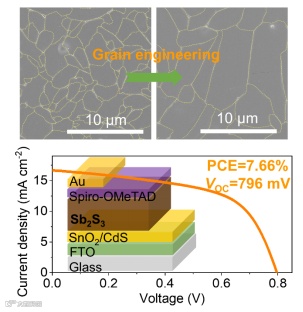
近日,合肥工业大学周儒课题组与中国科学技术大学陈涛、牛津大学Robert Hoye 课题组合作,在学术期刊Advanced Materials上发表题为“Grain engineering of Sb2S3 thin films to enable efficient planar solar cells with high open-circuit voltage”的研究论文。该文章针对Sb2S3薄膜太阳能电池中Voc损失较大的问题,通过薄膜晶粒尺寸调控实现器件Voc提升,获得高效Sb2S3薄膜太阳能电池。在本工作中,作者通过在Sb2S3沉积前驱溶液中加入适量的镧系离子Ce3+,使Sb2S3薄膜晶界密度大幅下降,从1068±40 nm μm-2(最大晶粒约为5 μm)显著降低至327±23 nm μm-2(最大晶粒>15 μm)。通过系统的材料结构、薄膜形貌和光电特性表征并辅以计算,揭示了Sb2S3薄膜晶粒尺寸增加和器件光伏性能改善的潜在机制。研究表明:晶界密度降低的关键因素之一是在CdS/Sb2S3界面处形成了超薄Ce2S3层,这会降低Sb2S3层与衬底之间的界面能并增加粘附功,进而促进Sb2S3薄膜在衬底上的异质成核及其侧向生长。通过降低晶界密度以及CdS/Sb2S3异质界面处的非辐射复合,改善异质结处的载流子传输性能,获得高效Sb2S3薄膜太阳能电池,光电转换效率为7.66%,开路电压达796 mV,这是目前Sb2S3光伏器件中的开路电压最大值。本研究提供了一种通过调节原位化学环境实现Sb2S3吸收层薄膜成核和生长调控的有效策略,该策略可以广泛应用于其他薄膜材料体系。
本 文 要 点
要点一:制备大晶粒尺寸Sb2S3薄膜
通过在Sb2S3薄膜沉积前驱溶液中添加镧系离子Ce3+能够实现有效晶粒尺寸调控,从而制备具有超低密度晶界网络的大晶粒Sb2S3吸收层薄膜。系统表征揭示:在CdS/Sb2S3界面形成超薄Ce2S3,可以调控成核和生长过程。对照组Sb2S3薄膜晶粒尺寸约为2.5-5.0 μm,通过引入一定量Ce3+到前驱体溶液中能够将薄膜晶粒尺寸显著提升至超过15 μm。Sb2S3薄膜表面的晶界密度则从对照组样品的1068±40 nm μm-2大幅下降至327±23 nm μm-2。FIB-TEM表征证实这些大晶粒确实为单晶晶粒。
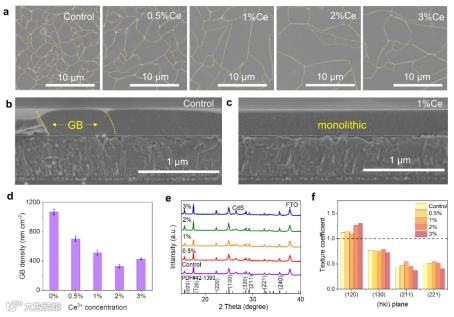
Figure 1. (a) Top-view scanning electron microscopy (SEM) images of Sb2S3 thin films prepared without (i.e., control) and with the addition of Ce(CH3COO)3 salt, with molar ratios of Ce3+/Sb3+ = 0.5%, 1%, 2% and 3%. The hydrothermal deposition time was 180 min in all cases. The grain boundaries (GBs) are highlighted to show more clearly the changes in the GB density. (b, c) Cross-sectional SEM images of the control Sb2S3 and 1%Ce-Sb2S3 films. (d) The dependence of the GB density on the Ce3+ concentration in the precursor solution. Three samples were measured to determine the mean GB density values shown, and the error bars represent the standard deviation. (e) X-ray diffraction (XRD) patterns of the control Sb2S3 film and Ce-Sb2S3 films prepared with different Ce3+ concentrations. (f) Texture coefficients of the (120), (130), (211) and (221) peaks, which dominate the diffraction patterns of the Sb2S3 films.
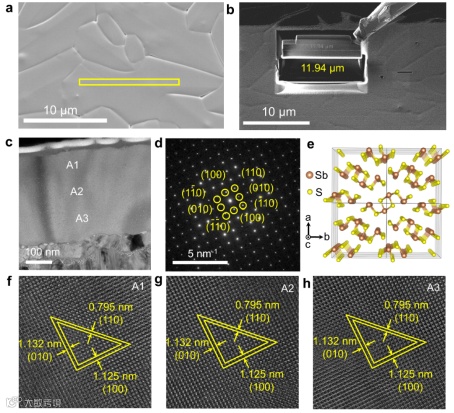
Figure 2. (a, b) SEM images of the 1%Ce-Sb2S3 film used for making samples for transmission electron microscopy (TEM) characterization, and corresponding process of obtaining the lamella using a focused ion beam. (c) Cross-sectional TEM image of 1%Ce-Sb2S3 sample deposited on FTO/SnO2/CdS substrate. (d) Selected area electron diffraction (SAED) pattern from Sb2S3 crystals, with diffraction spots indexed. (e) Illustration of the crystal structure of Sb2S3, viewed from the [001] direction. (f-h) High-resolution (HR) TEM measurements performed at points A1, A2 and A3 (see part c), and the corresponding lattice fringes.
要点二:大晶粒尺寸Sb2S3薄膜的生长机理
综合TEM、XRD、SIMS和XPS表征结果,能够排除Ce3+在Sb2S3基体中发生取代或间隙掺杂的可能性,同时揭示在CdS/Sb2S3界面处形成超薄Ce2S3层。作者运用材料科学中的成核和生长理论来理解Sb2S3薄膜的微观结构演变过程,提出一个合理的机理解释:Ce2S3界面层促进了Sb2S3的异质成核,抑制了溶液中的均相成核;与CdS/Sb2S3异质界面相比,Ce2S3/Sb2S3异质界面的界面能降低、粘附功增加,导致Sb2S3生长模型由Volmer-Weber生长模型(岛状模型)向Stranski-Krastanov模型(层状+岛状模型)转变,促进了Sb2S3薄膜侧向生长。同时,Ce2S3界面层能够改善异质结质量,使Sb2S3与衬底之间结合更加紧密。
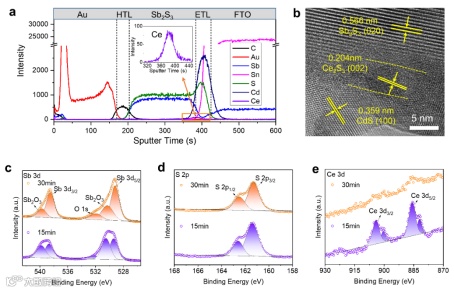
Figure 3. (a) Secondary ion mass spectrometry (SIMS) depth profiles of the 180 min-deposited 1%Ce-Sb2S3 thin film. (b) HRTEM image at the CdS/Sb2S3 interface of the 180 min-deposited 1%Ce-Sb2S3 thin film. (c-e) High resolution XPS spectra of Sb 3d, S 2p and Ce 3d core levels, along with peaks fitted to these spectra, for the 15 min- and 30 min-deposited 1%Ce-Sb2S3 film samples.
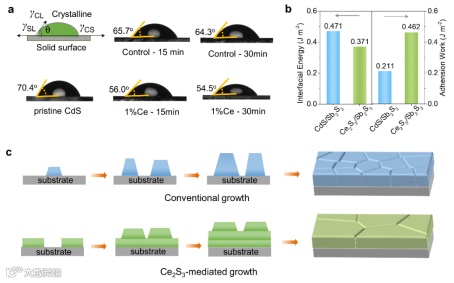
Figure 4. (a) Illustration of the contact angle (θ) for heterogeneous nucleation, and the water contact angles of pristine CdS film, as well as CdS films that have undergone 15 min- and 30 min- hydrothermal deposition in Sb2S3 precursor solutions (both without and with 1% Ce). (b) Histogram of the calculated interfacial adhesion work and interfacial energy for the heterointerfaces of CdS/Sb2S3 and Ce2S3/Sb2S3. (c) Schematic illustrating conventional growth and Ce2S3-mediated growth of Sb2S3 thin films.
要点三:Sb2S3薄膜太阳能电池的器件性能
作者进一步构筑了平面结构Sb2S3薄膜太阳能电池:FTO/SnO2/CdS/Sb2S3/Spiro-OMeTAD/Au。器件表现出良好的性能以及重复性。与对照组器件相比,引入Ce2S3界面层的Sb2S3光伏器件性能获得显著提升。最佳1% Ce-Sb2S3器件光电转换效率为7.66%,Voc为796 mV,Jsc为16.67 mA cm-2,FF为57.72%。接近800 mV的Voc是迄今为止报道的Sb2S3光伏器件的最大值。
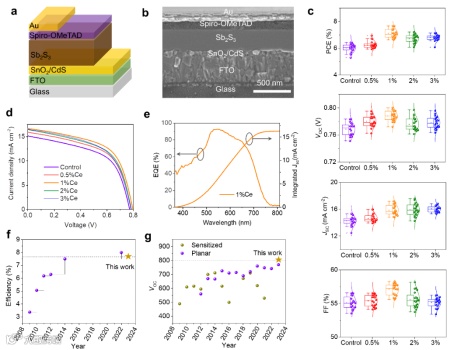
Figure 5. (a) Illustration and (b) cross-sectional SEM image of the device structure, which have the configuration: FTO/SnO2/CdS/Sb2S3/Spiro-OMeTAD/Au. (c) The statistics of the performance parameters of the control Sb2S3 device and Ce-Sb2S3 devices obtained with the addition of different concentrations of Ce3+ to the precursor solution. 20 devices were measured for each condition, and the performance metrics of each device is shown as individual data points. (d) J-V curves of the control Sb2S3 and Ce-Sb2S3 solar cells, measured under AM 1.5G (100 mW cm-2) illumination. (e) External quantum efficiency (EQE) curves of best-performing 1%Ce-Sb2S3 solar cells. (f) Evolution in the record efficiency of Sb2S3 solar cells. (g) VOC values of previous work on well-developed planar and sensitized Sb2S3 solar cells.
要点四:太阳能电池器件物理
阐明薄膜缺陷特性并建立缺陷与器件性能之间的关联十分重要。作者利用深能级瞬态谱(DLTS)探索了Sb2S3薄膜中的缺陷深度和密度。与对照组Sb2S3器件相比,1%Ce-Sb2S3器件内部吸收层薄膜中的缺陷密度降低,从而抑制了器件内部的电荷复合。超快瞬态吸收光谱(TAS)表明:与对照组样品相比,1%Ce-Sb2S3薄膜样品中的载流子寿命更长,揭示体相与(或)界面处的载流子复合获得有效抑制。光生少数载流子空穴的寿命延长将改善器件Voc。此外,电荷密度差分析揭示:Ce2S3/Sb2S3异质界面的键合比CdS/Sb2S3异质界面更强,即Ce2S3界面层的存在有助于形成更理想的异质界面,改善Sb2S3光伏器件中异质结界面处的载流子传输特性。
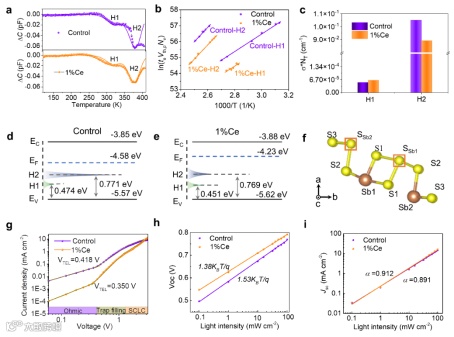
Figure 6. (a) Deep-level transient spectroscopy (DLTS) signals from the control Sb2S3 and 1%Ce-Sb2S3 devices. (b) Arrhenius plots derived from DLTS signals. The data points were obtained by calculating internal transients included in DLTS signals with the discrete Laplace transform, and the solid lines are corresponding linear fits. H1 and H2 correspond to SSb1 and SSb2 anti-site defects, respectively. (c) The statistical histogram of calculated σ·NT for different hole traps in the control Sb2S3 and 1%Ce-Sb2S3 devices. (d, e) Schematic of band edge positions and defect levels of the control Sb2S3 and 1%Ce-Sb2S3, respectively, including CB (EC) and VB (EV) edges, Fermi level (EF) and defect energy levels (H1, H2), relative to the vacuum level. (f) Illustration of SSb1 and SSb2 defects in a [Sb4S6]n unit of Sb2S3 crystal structure. (g) Space-charge limit current density (SCLC) measurements of the control Sb2S3 and 1%Ce-Sb2S3 based on the electron-only structure device of FTO/CdS/Sb2S3/PCBM/Au. (h, i) The dependence of VOC and JSC on the light intensity for the control Sb2S3 and 1%Ce-Sb2S3 solar cells.
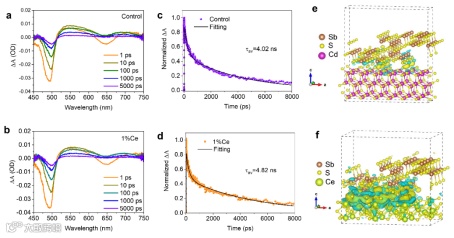
Figure 7. (a, b) Transient absorption (TA) spectra obtained at 1, 10, 100, 1000, and 5000 ps pump-probe delay for control Sb2S3 and 1%Ce-Sb2S3 film samples. Excitation was with a 400 nm wavelength pulsed laser at a fluence of 251 μJ cm-2 pulse-1 and a repetition rate of 1000 Hz. (c, d) Transient kinetic decay (scatter) and corresponding bi-exponential curve fittings (solid line) monitored at 560 nm of the control Sb2S3 and 1%Ce-Sb2S3 films. ΔA is defined as the change in the absorption of the sample before and after pumping. (e, f) Diagram of the charge density difference analysis of the heterointerfaces of CdS/Sb2S3 and Ce2S3/Sb2S3.
文 章 链 接
Grain Engineering of Sb2S3 Thin Films to Enable Efficient Planar Solar Cells with High Open-Circuit Voltage
https://doi.org/10.1002/adma.202305841


添加官方微信 进群交流
SCI二氧化碳互助群
SCI催化材料交流群
SCI钠离子电池交流群
SCI离子交换膜经验交流群
SCI燃料电池交流群
SCI超级电容器交流群
SCI水系锌电池交流群
SCI水电解互助群
SCI气体扩散层经验交流群
备注【姓名-机构-研究方向】
投稿请联系contact@scimaterials.cn

点分享

点赞支持

点在看