



研 究 背 景
The rise of electric vehicles demands batteries with higher energy density than traditional Li-ion batteries (LIBs). Meanwhile, the scarcity and cost of metals like cobalt and nickel, crucial for conventional cathodes, keep rising. Lithium/sulfur (Li/S) batteries are generally recognized as one of the most promising solutions to both challenges, given the high capacity, high abundance, and low cost of sulfur.
电动车的崛起需要比传统锂离子电池(LIBs)具有更高能量密度的电池。与此同时,对传统阴极至关重要的钴和镍等金属的稀缺性和成本不断上升。锂/硫 (Li/S) 电池被普遍认为是应对这两个挑战的最有前途的解决方案之一,因为硫的高容量、高丰度和低成本。
An important but generally overlooked condition for translating the high capacity of sulfur into increased cell energy density is lean electrolyte operation, to which the conventional sulfur redox mechanism (i.e., soluble polysulfide-assisted) represents a formidable challenge. When the electrolyte amount is limited, the adverse effect of soluble polysulfide species on electrolyte conductivity, viscosity, and reactivity with lithium anode is significant and unavoidable. Sulfurized polyacrylonitrile (SPAN) cathodes, well-known for their polysulfide-free redox mechanism and excellent cycling stability, represent an elegant approach to circumvent this issue.
将高容量硫转化为增加电池能量密度的一个重要但通常被忽视的条件是稀释电解质操作,传统的硫氧化还原机制(即可溶性多硫化物辅助)对此构成了巨大挑战。当电解液用量有限时,可溶性多硫化物对电解质电导率、粘度、与锂阳极的反应性等的不利影响是显着且不可避免的。硫化聚丙烯腈(SPAN)阴极以其无多硫氧化物的氧化还原机理和出色的循环稳定性而闻名,是解决此问题的一种有效方法。
Insufficient understanding of Li-SPAN batteries (both on material and cell levels), however, greatly hinder effective research efforts, especially given their distinct dynamics compared to conventional lithium batteries with intercalation cathodes. Our work aims to highlight frequently neglected or misunderstood aspects within the field through rigorous quantitative analysis, with the goal of providing clear, informed guidance towards commercializable Li-SPAN batteries.
然而,对Li-SPAN电池(在材料和电池水平上)的了解不足,极大地阻碍了其有效的研究工作,特别是考虑到与具有插层阴极的传统锂电池相比,它们具有独特的动力学特性。我们的工作旨在通过严格的定量分析突出该领域经常被忽视或误解的方面,目的是为可商业化的Li-SPAN电池提供清晰、明智的指导。
文 章 信 息
The perspective paper titled “Realizing high-energy and long-life Li/SPAN batteries” was published in Joule in May 2024. The article provides an overview of the development of SPAN cathodes and batteries since their invention in 2002, with an emphasis on frequently overlooked and/or misunderstood issues. Quantitative approaches were employed to better understand the dynamics of Li/SPAN batteries. Through our analysis, key bottlenecks hindering the commercialization of Li/SPAN batteries were pinpointed, and innovative solutions were proposed.
《实现高能量和长寿命的Li/SPAN电池》一文于2024年5月在《Joule》杂志上发表。本文概述了自2002年发明以来SPAN阴极和电池的发展,重点介绍了其经常被忽视或误解的问题。采用定量方法更好地了解Li/SPAN电池的动力学特性。通过分析,确定了阻碍锂/SPAN电池商业化的关键瓶颈,并提出了创新的解决方案。
本 文 要 点
Point one: Understanding of SPAN (electro)chemistry, especially their residual hydrogen atoms, is important for SPAN capacity improvement.
第一点:理解SPAN(电)化学,尤其是其残余氢原子,对于提高SPAN容量非常重要。
The SPAN capacity has been constantly limited to below 850 mAh g-1 (Figure 1). A significant issue in SPAN research at the material level is the lack of design principles, which stems from inadequate understanding of the SPAN synthesis reaction, their structure and (de)lithiation mechanism. It is noteworthy that literatures generally report SPAN with a significant hydrogen molar content. However, the fact is usually neglected, likely due to the small atomic weight of hydrogen. These residual hydrogen atoms might hold the answer to the mechanism and the optimization of SPAN synthesis towards higher specific capacity.
SPAN 容量一直被限制在 850 mAh g-1 以下(图 1)。在材料水平上,SPAN研究面临的一个重要问题是缺乏设计规范,这源于对SPAN合成反应、它们的结构和(脱)锂化机制的理解不足。值得注意的是,文献通常报道SPAN具有显着的氢摩尔含量。然而,这一事实通常被忽视,可能是由于氢的原子量小。这些残余的氢原子可能为SPAN合成的机理和优化提供了答案,以实现更高的比容量。
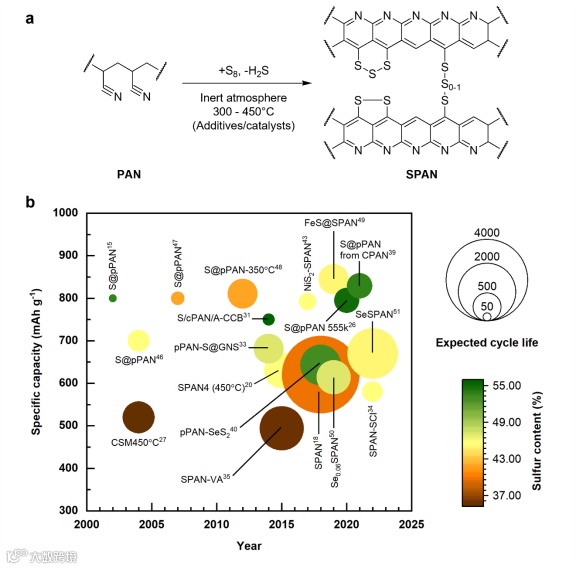
Figure 1. Overview of SPAN material (a) and its development history since invention in 2002 (b).
图 1.SPAN材料概述(a)及其自2002年发明以来的发展历史(b)。
Point two: Achieving high cell-level energy density requires more than just high SPAN capacity.
第二点:实现高电池级能量密度需要的不仅仅是高SPAN容量。
The sensitivity of energy density towards five cell design parameters was quantified and ranked via the so-called “sensitivity factor”. The five parameters, in descending order of sensitivity factor, are: cell voltage, electrolyte weight, inactive (i.e., current collector, separator, and package) weights, SPAN capacity, and N/P ratio (Figure 2). Our finding implies that directing most research effort in the field to improve SPAN capacity (like the current situation) does not align well with the high energy density objective. More focus on the top three important parameters is recommended. As appropriate, we also includes informed suggestions for optimizing these parameters, together with the assessment of their practical relevance.
通过所谓的“敏感性因子”,对能量密度对五个电池设计参数的敏感度进行了量化和排名。这五个参数按灵敏度因子降序排列,分别是:电池电压、电解质重量、非活性(即集流体、隔膜和封装)重量、SPAN容量和 N/P 比(图 2)。我们的发现表明,将大部分研究工作集中在提高SPAN容量(就像目前的情况)并不符合高能量密度的目标。建议更多关注前三个重要参数。在适当的情况下,我们还提供了优化这些参数的明智建议,并评估了它们的实际相关性。
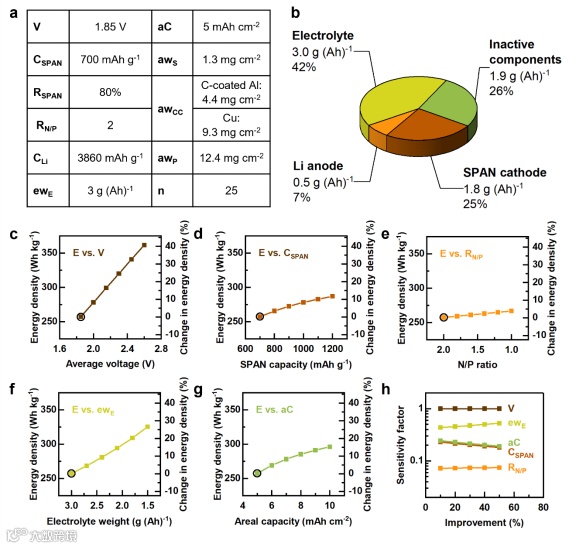
Figure 2. Analysis of Li/SPAN cell-level energy density: starting point (a); weight distribution (b); effects of voltage (c), SPAN capacity (d), N/P ratio (e), electrolyte weight (f), and areal capacity (g) on energy density and their sensitivity factors (h).
图2.Li/SPAN电池级能量密度分析:起点(a);重量分布(b);电压(c)、SPAN容量(d)、N/P比(e)、电解液重量(f)和面容量(g)对能量密度及其敏感因子(h)的影响。
Point three: Electrolyte consumption rather than Li consumption controls the cycle life of Li/SPAN
第三点:电解液消耗而不是锂消耗控制Li/SPAN的循环寿命
For Li/SPAN batteries to achieve commercially viable cycle life, Li plating/stripping Coulombic efficiency (Li CE) of > 99.9% is mandatory. However, different from the common assumption within the community, high Li CE is needed to avoid electrolyte dry-out rather than Li inventory loss. Accordingly, the significance of side reaction (electro)chemistry is underlined (Figure 3). Given similar Li CE, lightweight components are shown to slow electrolyte consumption, implying support for weakly-solvating electrolytes based on alkyl ethers.
为了使Li/SPAN电池达到商业化可行的循环寿命,锂沉积/脱除库仑效率(Li CE)必须大于99.9%。然而,与公众的普遍假设不同,需要高Li CE 来避免电解质干涸,而不是锂含量的损失。因此,强调了副反应(电)化学的重要性(图3)。鉴于类似的 Li CE,轻质组分被证明可以减缓电解质消耗,这意味着支持基于烷基醚的弱溶剂化电解质。
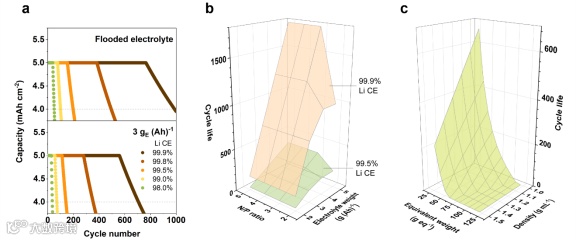
Figure 3. Analysis of Li/SPAN cycle life: simulated cycling performance (a); effect of cell-design parameters (b); and effect of side reaction (electro)chemistry (c).
图3.Li/SPAN循环寿命分析:模拟循环性能(a);电池设计参数的影响(b);和副反应(电)化学(c)的影响。
Point four: Defining quantitative requirements in terms of ion transport
第四点:根据离子传输定义定量要求
To achieve high energy density, very high areal capacity (> 5 mAh cm-2) needs to be employed, significantly raising the transport requirements set by the Sand’s equation (i.e., requirements to avoid dendrite growth due to Li+ depletion at the Li metal surface). Failure to meet these requirements lead to either unacceptably low power density or premature cell short circuit. It is therefore important to identify the numerical transport targets (Figure 4) to be realized through electrolyte and separator engineering.
为了实现高能量密度,需要采用非常高的面容量(> 5 mAh cm-2),这显著提高了由Sand方程设定的传输要求(即避免由于锂金属表面的Li+耗竭而引起的树枝晶生长的要求)。如果不能满足这些要求,将导致难以接受的低功率密度或电池过早短路。因此,确定要通过电解质和隔膜工程实现的数值传输目标(图4)非常重要。
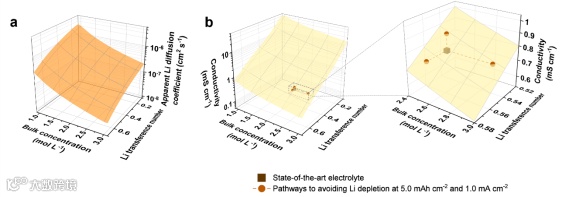
Figure 4. Required Li diffusion coefficient (a) and conductivity (b) to avoid Li+ depletion during Li plating/stripping at 1.0 mA cm-2 and 5.0 mAh cm-2.
图4.所需的锂扩散系数 (a) 和电导率 (b) 以避免在 1.0 mA cm-2 和 5.0 mAh cm-2 下镀锂/剥离过程中 Li+ 耗尽。
文 章 链 接
Realizing high-energy and long-life Li/SPAN batteries.
https://doi.org/10.1016/j.joule.2024.04.003
通 讯 作 者 简 介
王春生教授:
王教授的研究方向为电分析技术、充电电池先进材料、燃料电池和超级电容器。他在同行评审期刊上发表了340多篇论文,包括Nature, Nature Energy, Nature Materials, Nature Nanotechnology, Nature Chemistry, Nature Communications, Science Advance, Joule, Proceedings of the National Academy of Sciences, Journal of the American Chemical Society, Advanced Materials。他的研究被引用超过56000次,H指数为123。他与ARL科学家合作,发明了用于锂离子电池的盐中水电解质(Science 2015)和基于卤化物-石墨转化-插层的过渡无金属阴极化学(Nature 2019)和Zn-air电池(Nature Materials,2018),在电解质材料方面取得了科学突破,开辟了前所未有的高压水电化学和电池的全新领域, 并引起了许多研究人员的效仿。他还开发了一种氟化电解质,用于在阳极上形成富含LiF的固体电解质界面相(SEI),在高压阴极上形成阴极电解质界面相(CEI),以稳定电极(Nature Nanotechnology,2018)。SEI的这一新设计理念为未来几年的新电池化学成分奠定了基础。
Phung Le博士目前是电化学材料与系统小组的科学家。她的研究重点是设计用于能量转换和存储系统的新材料。她在液体电解质溶液(尤其是离子液体)的物理和电化学方面拥有丰富的经验。她一直在应用物理化学重点实验室-VNU HCM 领导不同的研究项目,开发用于锂/钠电池、超级电容器和燃料电池的创新材料。她在知名期刊上撰写/合著了 30 多篇论文,包括 Nature Energy、Joule、Advanced Functional Materials、ACS Energy Letters、Electrochimica Acta 和 Journal of Physical Chemistry。
添加官方微信 进群交流
SCI二氧化碳互助群
SCI催化材料交流群
SCI钠离子电池交流群
SCI离子交换膜经验交流群
SCI燃料电池交流群
SCI超级电容器交流群
SCI水系锌电池交流群
SCI水电解互助群
SCI气体扩散层经验交流群
备注【姓名-机构-研究方向】
投稿请联系contact@scimaterials.cn

点分享

点赞支持

点在看