



科学材料站
文 章 信 息
通过触发氧化钠阴离子氧化活性获得高容量正极补钠剂
第一作者:陈毅龙
通讯作者:乔羽*,张桥保*,蒯笑笑*,宁子杨*
科学材料站
研 究 背 景
目前,锂离子电池 (LIBs) 是便携式设备和汽车应用中最卓越的储能技术。然而,由于锂资源的稀缺性和地理限制,难以维持和满足迅猛增长的市场需求。鉴于钠资源的广泛可用性和成本效益,钠离子电池 (SIBs) 技术成为锂离子电池 (LIBs) 的一个有吸引力的替代方案。在 SIBs 的初始循环中,负极不可逆地消耗了从正极释放的有限钠离子,导致首圈库仑效率 (ICE) 降低,从而降低了能量密度。在整个电池系统中,充分释放正极材料的全部容量是一项复杂且具挑战性的任务。特别是当与主流硬碳 (HC) 负极结合使用时,其相对较低的 ICE (70-90%) 不可避免地会引发活性钠的不可逆消耗,导致电池容量显著损失。此外,SIBs 的能量密度显著低于 LIBs,任何微小的容量损失都会对其应用产生重大影响。因此,开发补钠技术势在必行。
科学材料站
文 章 简 介
近期,来自厦门大学的乔羽教授、张桥保教授、蒯笑笑博士和宁德时代21C创新实验室宁子杨博士等在国际知名期刊Advanced Materials上发表题为“Achieving High-Capacity Cathode Presodiation Agent Via Triggering Anionic Oxidation Activity in Sodium Oxide”的研究工作。
该研究团队选用NiO作为过渡金属源,将Ni元素精确植入到Na2O框架中,借此引入掺杂能级和Na空位,从而调控Na2O的能级和能带结构,提高其导电性。同时,结合NiO表面的催化作用,加速Na─O键的断裂和O─O键的形成,协同促进Na2O的分解。进一步阐明了补钠剂的局部结构演变和氧阴离子的反应路径,明确了过渡金属与氧阴离子氧化活性之间的相互作用,并对相关反应产物和残留物进行了定性和定量分析。与金属氧电池中表面接触机制(如ORR产物与催化框架之间)不同,作者通过调控材料内部结构和补钠剂的表面催化网络框架,加速了Na2O的分解动力学。此外,还对正极补钠剂进行了综合评价,倡导在未来的研究中建立规范化的研究范式,实现补钠剂和补锂剂的高效利用,从而显著提高钠离子和锂离子电池的能量密度。
科学材料站
本 文 要 点
要点一:Na2O基大容量补锂剂的制备和特性分析
为了激活氧阴离子的氧化活性,降低Na2O在实际应用中的分解电位(从4.5 V降低到2.8 V),作者借助高能球磨工艺成功将Ni元素植入到Na2O的晶格中,制备Ni-Na2O大容量补钠剂 (≈710 mAh/Na2O),脱出≈1.64Na+离子,分解效率高达82%)。由同步辐射XRD和中子衍射精修结果证明了Ni取代了Na2O框架中的Na位点(功能性位点)并引入了Na空位。由DFT计算表明,Ni原子的注入和Na空位的生成调节了Na2O的能级/能带结构,增强了原始Na2O的导电性,激活了O阴离子的氧化活性。此外,结合NiO的催化作用,加速了Na2O分解动力学。
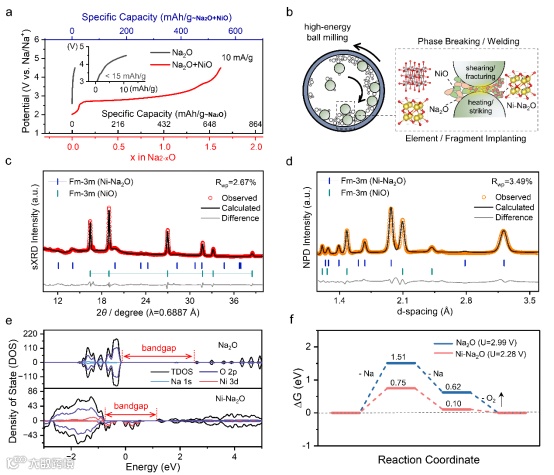
Figure 1. Characterization of Na2O-based high capacity presodiation agent. a) Voltage profile for (Na2O+ NiO) composite cathode at 10 mA g−1 with a 4.5 V upper cutoff potential; the inset shows the pure Na2Ocathode capacity (<15 mAh g−1) at cutoff 4.5 V. b) Schematic illustration of the preparation procedure of NNO composite presodiation agent by high-energy ball milling. c) sXRD pattern and d) NPD pattern of NNO presodiation agent and the results of fitting via Rietveld refinement. e) The density of states (DOS) of Na2O(top) and Ni–Na2O(bottom). f) Gibbs free energy diagrams during the pure Na2Oand Ni–Na2Odecomposition process.
要点二:补钠剂分解过程的精细结构演化。
同步辐射表征证明了在Na2O结构框架中掺杂Ni,形成了四面体Ni-O配位结构。随着气态O2的不可逆逸出和活性钠的脱出,其结构发生了根本性的演变。结合HR-TEM表明Ni-Na2O在充电至4.5 V时完全分解仅残存少量的NiO。NiO在指定的电压窗口内进行的充放电过程不发生Na的脱出和嵌入。
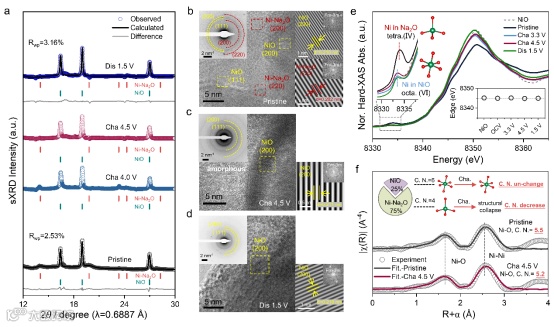
Figure 2. The structural and local covalent environment evolution during NNO decomposition. a) Ex situ sXRD patterns and the results of fitting via Rietveld refinement of NNO presodiation agent in different voltages. The sXRD peak intensities of Ni–Na2Opresodiation agent at 2𝜃 = 14.0°, 19.8°, 23.3°, 24.3°, and 28.3° (Ni–Na2O), 2𝜃 = 16.4°, 18.9°, and 26.9° (NiO), respectively. b–d) TEM images of charged NNO presodiation agent cathode at pristine, charge 4.3 V, and discharge 1.5 V. Insets present the corresponding SEAD patterns.
The red and yellow marker lines represent the NiO and Ni–Na2Ophases, respectively, and the white ones represent the amorphous phase. e) Ni K-edge X-ray absorption near-edge structure (XANES) spectra at different voltage states. Upper left inset: enlarged pre-edge of Ni K-edge XANES spectra and a schematic illustration of Ni–O tetrahedral (tetra.) configuration (Ni in Na2O) and octahedral (octa.) configuration (Ni in NiO). Inset below right: edge positions of Ni K-edge at different voltage states. f) Ni K-edge EXAFS spectra (weighted by k3) of pristine and charged 4.5 V NNO presodiation agent. The Ni molar percentage pie chart of Ni–Na2O(green region) and NiO (purple region) in NNO presodiation agent. The fitted Ni–O coordination numbers (C.N.) are shown in the inset.
要点三:NNO补钠剂中Na2O氧化过程中的氧行为分析
此外,通过系统的原位/非原位表征技术(如OEMS、滴定-质谱、软X射线等),作者揭示了NNO分解过程中O阴离子的氧化途径,明晰了Na2O分解过程中产生多种O─O二聚体的多步反应过程。有效的Ni植入和NiO表面催化加速了Na─O键的裂解O─O键的形成动力学,证实了中间物质O2−、O22−(O2−)和气态O2的多步转化途径。
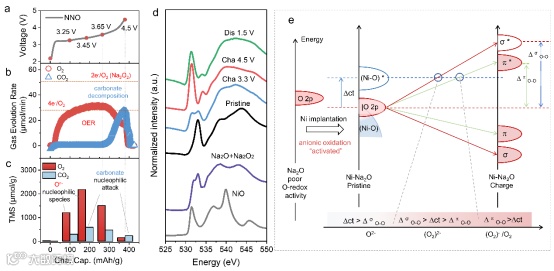
Figure 3. Analysis of oxygen behavior upon Na2Ooxidation in NNO. a) The top panel shows the galvanostatic charge curve for the initial charging process of the NNO presodiation agent cathode at a current density of 50 mA g-1. Five points are labeled in the charge curve: OCV, 3.25 V,3.45 V, 3.65 V, and 4.5 V, respectively. b) The middle panel shows OEMS results of corresponding time-resolved evolution rates for O2 and CO2 during initial charging. c) TMS result: amounts of O2 and CO2 collected from the NNO presodiation agent plates with different specific voltages. d) O K-edge XANES spectra of the NNO presodiation agent cathode and standard samples at TEY modes.
The peak at 533 eV represents oxygen in the antifluorite structure of Na2O; the peak at 531.4 eV represents 𝜎* (O─O) peroxide species; and the peak at 531.2 eV represents the hybridized state of O 2p and Ni 3d orbitals in NiO. e) The schematic diagram illustrating the dynamics of electrochemical transfer oxidation process during the charging of Ni–Na2O. The electronic structure of Na2Oexhibits a charge transfer electronic ground state in the reduced phase (left). The O (2p) lone pairs denote |O 2p. The splitting of the O 2p narrow band into distinct 𝜎, 𝜋, 𝜋*, and 𝜎* states is illustrated by the red (Δ𝜎O─O) and green (Δ𝜋O─O) arrows, with respect to the conversion of O─O dimer species (bottom horizontal axis).
要点四:补钠剂耦合正极后的电化学性能
最后,将NNO补钠剂应用于HC||Na3V2(PO4)3 (NVP)全电池,使电池容量从75.3 mAh/gNVP提高到93.3 mAh/gNVP。同样,在HC||Na2/3Ni2/3Mn1/3O2 (NNMO)全电池中,初始放电容量显著提高12.1 mAh/gNNMO。这表明了NNO作为预沉淀剂的普遍性,为提高SIBs的能量密度提供了新的视角。
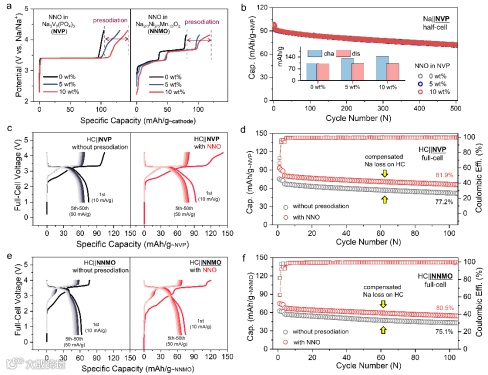
Figure 4. Electrochemical performance after presodiation. a) Initial charge profiles of Na3V2(PO4)3 (NVP) and Na2/3Ni2/3Mn1/3O2 (NNMO) with n wt % (n = 0%, 5%, and 10%) NNO presodiation agent cathodes at 10 mA g-1 in the range from 2.5 to 4.3 V and from 2.0 to 4.15 V, respectively. b) Cycling performance of NVP without or with NNO presodiation agent cathodes at 50 mA g-1 in the range from 2.5 to 4.3 V. Inset: the bar chart corresponds to the charge and discharge capacity of the initial cycle at 10 mA g-1.
c) Galvanostatic charge/discharge curves of HC||NVP without or with 10 wt% NNO presodiation agent coin-type full-cell at 10 mA g-1 (1 st) and 50 mA g-1 (5–50 th) in the range from 1.0 to 4.2 V. d) Cycling performance of HC||NVP without or with 10 wt% NNO presodiation agent coin-type full-cell in the range from 1.0 to 4.2 V. e) Galvanostatic charge/discharge curves of HC||NNMO without or with 10 wt% NNO presodiation agent coin-type full-cell at 10 mA g-1 (1st) and 50 mA g-1 (5–50 th) in the range from 0.5 to 4.0 V. f) Cycling performance of HC||NNMO without or with 10 wt% NNO presodiation agent coin-type full-cell in the range from 0.5 to 4.0 V.
要点五:补钠剂对电极-电解质界面的影响及其看法
通过飞行时间二次离子质谱(TOF-SIMS)证明了补钠剂引入会改变正极的CEI膜组分和分布。补钠剂分解过程中的亲核物种一方面加速了电解液的分解,另一方面也同时促进电解液添加剂FEC的分解,最后构建了富氟组分的CEI膜结构。这种内柔外刚的多层分布有助于在正极表面形成更坚固的CEI结构。此外,作者不仅对补钠剂的分解动力学进行了全面的评估,还对补钠剂分解过程中的正极-负极穿梭、寄生反应、电极结构稳定性和安全性等各个方面进行了全面的评估,并提出相应的解决方案。
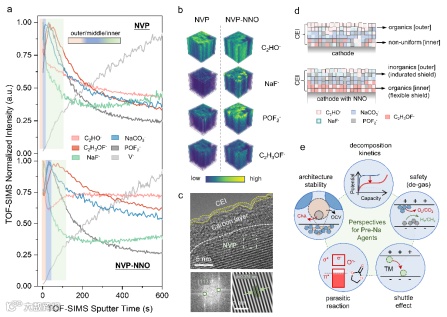
Figure 5. The impact of NNO on the electrode–electrolyte interface and associated perspective on presodiation agent. a) TOF-SIMS characterization of pure NVP and NVP-NNO cycled cathode electrodes after 150 cycles. The normalized depth profiles of the interface and bulk fragments illustrate the structure of CEI. b) 3D renderings of selected secondary ion fragments of different CEI. The sputtered volume is 100 μm (length) × 100 μm (width) × 150 nm (height). c) TEM images of NVP-NNP after 200 cycles.
The IFFT results for the surface and bulk regions are also listed in the figure. The light green-dashed ground state region is identified as NVP structure, white is defined as carbon layer region, and yellow is assessed as a CEI architecture. d) Scheme of CEI formation and changes on NVP and NVP-NNO cathodes summarized from characterization data in FEC-containing electrolytes. e) Perspectives for cathode presodiation agent.
科学材料站
文 章 链 接
Yilong Chen, Yuanlong Zhu, Zhefei Sun, Xiaoxiao Kuai*, Jianken Chen, Baodan Zhang, Jianhua Yin, Haiyan Luo, Yonglin Tang, Guifan, Zeng, Kang Zhang, Li Li, Juping Xu, Wen Yin, Yongfu Qiu, Yeguo Zou, Ziyang Ning*, Chuying Ouyang, Qiaobao Zhang*, Yu Qiao*, and Shi-Gang Sun,Achieving High-Capacity Cathode Presodiation Agent Via Triggering Anionic Oxidation Activity in Sodium Oxide.
https://doi.org/10.1002/adma.202407720
科学材料站
通 讯 作 者 简 介
乔羽教授简介:博士生导师,厦门大学化学化工学院/固体表面物理化学国家重点实验室,中国福建能源材料科学与技术创新实验室(嘉庚创新实验室)。研究内容:二次电池相关新型储能体系(富锂、高镍等高电压正极材料中阴离子氧化还原机理,电极电解液表界面电化学过程及相关溶剂化构型改性研究,二次电池产气精细分析等);电化学原位谱学表征(电化学原位气相质谱色谱联用、拉曼、红外等)。学术成果:2017年以来,以第一作者和通讯作者身份在Nature Energy (2篇), Nature Catalysis, Nature Sustainability, Joule (7篇), J. Am. Chem. Soc. (3 篇), Angew. Chem. (7篇), Adv. Mater. (10篇), Energy Environ. Sci. (4篇), Adv. Energy Mater. (5篇)等科研期刊发表学术论文50余篇。获奖情况:国家海外高层次青年引进人才计划、福建省杰青、闽江特聘教授等。
科学材料站
课 题 组 招 聘
厦门大学孙世刚院士/乔羽教授招聘二次电池方向博士后 (正极结构方向)
应聘条件:
1、已取得或即将取得博士学位,年龄在35周岁以下;
2、具有独立开展研究工作的能力,以第一作者身份发表过二次电池能源电化学方向SCI一区论文2篇以上(能力特别突出、或课题组紧缺方向可降低要求);
3、熟练掌握锂离子电池为主的二次电池体系相关知识,有较强的独立研究工作能力。优先考虑具有正极材料研发(富锂/钠材料、材料结构分析)的申请者;
4、良好的英文阅读与写作能力;并且能够协助指导研究生完成科研工作(另有偿);
5、优秀的学术道德和团队合作精神。
待遇条件:
1、基本薪酬:年薪32-35 W;
2、提供厦大博士后公寓(翔安校区:约六七十平方米,房租 8-10元/平方米/月)或相应租房补贴;
3、博士后子女按学校教职工子女同等待遇办理入托儿所、幼儿园、入学;(注)入选 “博士后创新人才支持计划项目(博新计划)”、“香江学者计划”者,相关待遇按照国家及厦门大学相关规定执行。详情和具体规定,请登录厦大博士后网站查询:https://postdoctor.xmu.edu.cn/main.htm;
4、成果特别突出的博士后,可协助其申报厦门大学南强拔尖人才计划,入选后可直接聘为正式副教授、特任研究员,具体待遇如下:享受厦门大学教授同等待遇,年薪35万;购房和安家补贴100万元,并可优先享受政府人才购房政策;学校提供100-200万元科研启动经费;每年可配备至少两名硕博士研究生,协助完成科研工作。
申请方式:
欢迎感兴趣的学者加盟,提供以下材料:个人简历,包括学习工作经历、主要研究工作内容、代表论文论著清单、代表作、获得的奖励情况等,发送至以下邮箱,邮件主题请注明“姓名+博士后申请”。
邮箱:yuqiao@xmu.edu.cn
(cc: qiaoyu09206@163.com)


添加官方微信 进群交流
SCI二氧化碳互助群
SCI催化材料交流群
SCI钠离子电池交流群
SCI离子交换膜经验交流群
SCI燃料电池交流群
SCI超级电容器交流群
SCI水系锌电池交流群
SCI水电解互助群
SCI气体扩散层经验交流群
备注【姓名-机构-研究方向】
投稿请联系contact@scimaterials.cn

点分享

点赞支持

点在看