



科学材料站
文 章 信 息
添加剂工程助力实现效率超17%硫化锑室内光伏电池
第一作者:陈骁、舒晓萱
通讯作者:周儒、陈洁洁、Robert Hoye
单位:合肥工业大学、中国科学技术大学、牛津大学
科学材料站
研 究 背 景
物联网技术的快速发展带来各类智能终端市场呈指数级增长。此类终端节点通常设计为循环运行且功耗较低(微瓦到毫瓦量级),可持续能源供给是物联网技术成功实施的重要保障。目前,自主物联网终端节点主要利用储能电池供电。然而,使用储能电池寿命有限,严重制约数据传输距离和频率;且应用范围也仅限于允许更换电池的场景。当物联网生态系统发展到终端数量达万亿设备的水平时,每天将需要更换或充电数亿块电池,从而产生大量的运营和维护成本。室内光伏(Indoor photovoltaics, IPVs)从环境照明(人工光源或日光)中收集能量,可为基于低功耗蓝牙、RFID标签、LoRa、无源Wi-Fi、Zigbee、ANT等通信协议的无线物联网节点提供可持续电力供给。室内照明无处不在,室内光伏依赖于辐射能量传输,使其部署范围广。此外,与其他环境能量收集技术相比,室内光伏可提供相对较高的能量密度。因此,发展先进室内光伏技术对于可持续物联网应用具有重要意义。
室内光源(如WLED和荧光灯)的发射光谱范围为400~700 nm,这决定了室内光吸收材料的最佳带隙为1.80~2.00 eV。在室外光伏市场占据主导地位的晶体硅(c-Si),由于其带隙太窄(~1.12 eV),不太适合用于室内能量收集。目前,室内光伏的商业解决方案是氢化非晶硅(a-Si:H)电池,然而,标准商用a-Si:H模组的光电转换效率通常仅在4.4%至9.2%之间,亟需探索新型高效室内光伏材料体系。Sb2S3是一种储量丰富、低毒性、理化性质稳定的半导体材料,其带隙约为1.75 eV,十分接近室内光伏应用的最佳带隙值。根据理论计算,在1000勒克斯WLED照明下,光谱限制极限效率高达约47%。然而,截至目前,Sb2S3太阳能电池性能仍然远远落后于理论效率,有待进一步优化提升;Sb2S3器件的室内光伏应用也亟需深入探索。
科学材料站
文 章 简 介
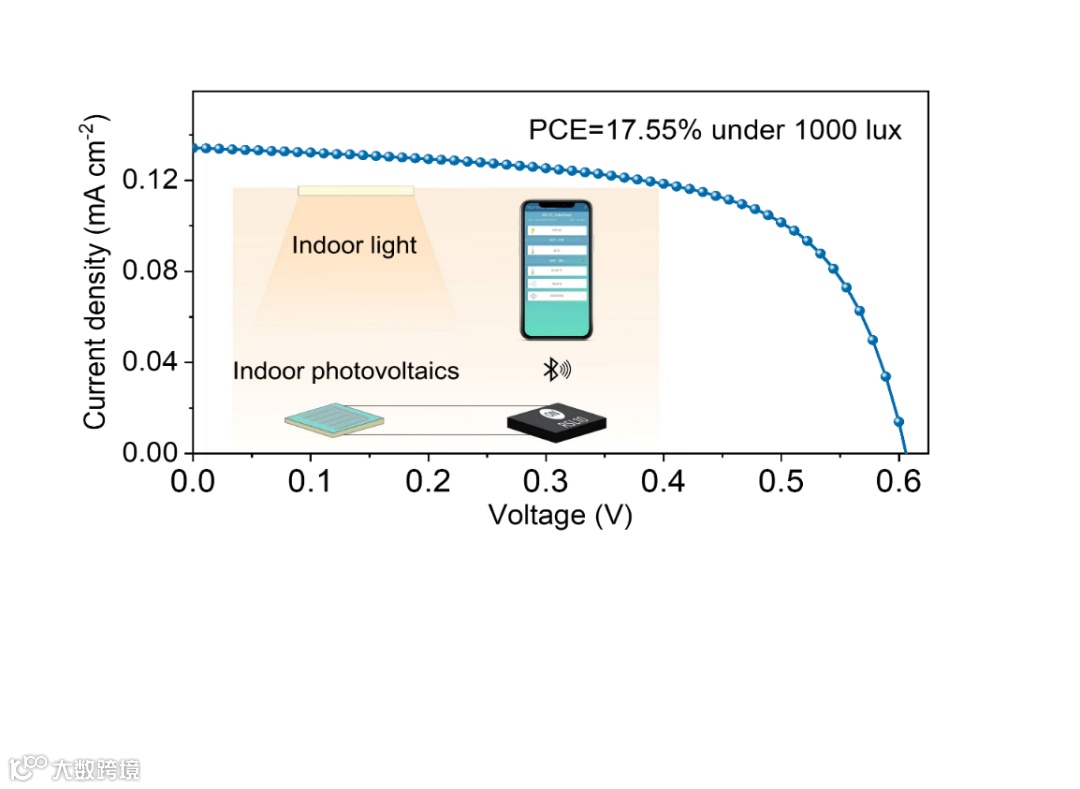
近日,合肥工业大学周儒课题组与中国科学技术大学陈洁洁、牛津大学Robert Hoye 课题组合作,在著名学术期刊《Light: Science & Applications》上发表题为“Additive engineering for Sb2S3 indoor photovoltaics with efficiency exceeding 17%”的研究论文。该文章基于添加剂工程有效调控吸收层薄膜质量,制备获得高效平面异质结Sb2S3室内光伏器件。研究表明,在前驱体溶液中加入单乙醇胺(MEA)能够调控Sb2S3薄膜成核和生长,沉积制备高质量Sb2S3吸收层薄膜。得益于Sb2S3薄膜中载流子复合受到抑制、电荷收集得到提升,基于MEA调制制备的Sb2S3太阳能电池性能获得有效提升。最佳器件在一个太阳(AM1.5G,100 mW cm-2)辐照下的光电转换效率为7.22%,在1000 lux白光二极管(WLED)辐照下的室内光伏效率为17.55%。进一步构建了高性能大面积Sb2S3室内光伏电池模组,成功为低功耗物联网传感器供能,实现日常WLED照明下办公室环境参数的长时连续记录。该工作展示出Sb2S3光伏器件应用于室内环境能量收集的广阔前景。
科学材料站
本 文 要 点
要点一:基于添加剂工程策略提升器件光伏性能
作者基于添加剂工程策略开发制备高性能平面异质结Sb2S3薄膜太阳能电池。添加剂工程是一种调控溶液法沉积半导体薄膜性质的有效策略。研究发现:通过在水热沉积Sb2S3薄膜的前驱体溶液中加入适量单乙醇胺(MEA)络合剂,能够有效调控薄膜成核和生长,沉积制备高质量Sb2S3吸收层薄膜,使晶界密度有效降低、能带排列获得优化、载流子浓度得到增加。结合第一性原理计算,揭示:MEA独特的分子桥接作用促进了Sb2S3在衬底上的非均相成核,使薄膜晶粒尺寸增大、沉积速率加快。在此基础上,构筑了平面异质结Sb2S3太阳能电池,器件结构为FTO/SnO2/CdS/Sb2S3/Spiro-OMeTAD/Au。得益于器件内部载流子复合受到抑制、载流子输运增强,基于MEA调控制备获得的Sb2S3太阳能电池在一个太阳辐照下的光电转换效率达7.22%,比对照组器件效率提高约16%。且器件性能表现出良好的重复性和稳定性。
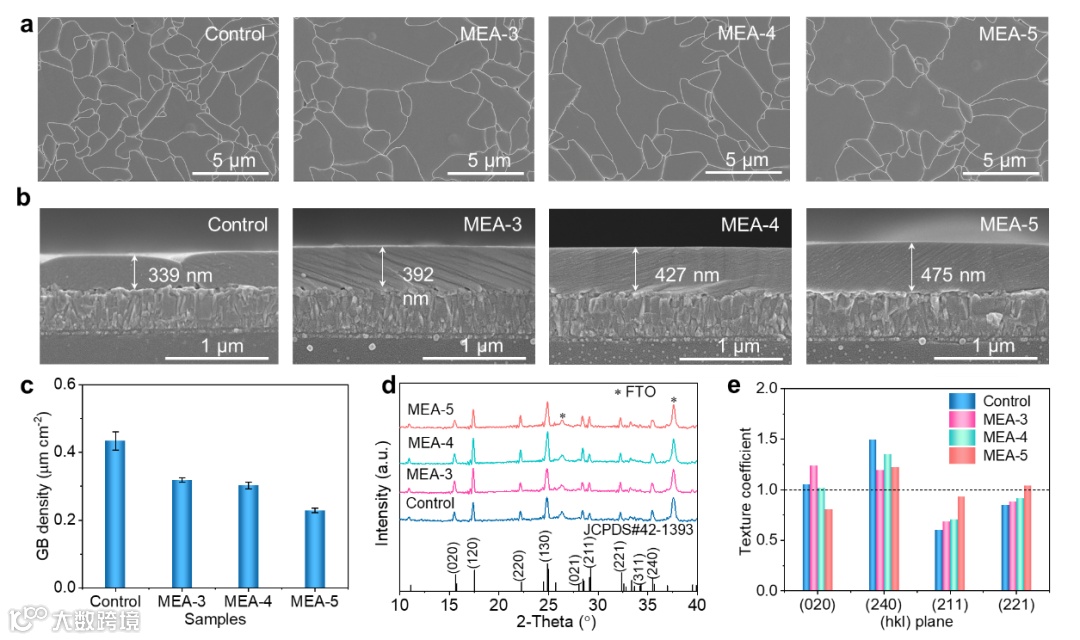
Fig. 1 Morphological and structural properties of Sb2S3films. a, b Top-view and cross-sectional SEM images and c GB densities of hydrothermally deposited Sb2S3 thin films prepared without (control) and with MEA additives. Three samples were measured to determine the mean GB density values shown, and the error bars represent the standard deviation. d, e XRD patterns and texture coefficients of the dominant (020), (240), (211) and (221) peaks of the control film and MEA-Sb2S3 films prepared with different concentrations of MEA additives.
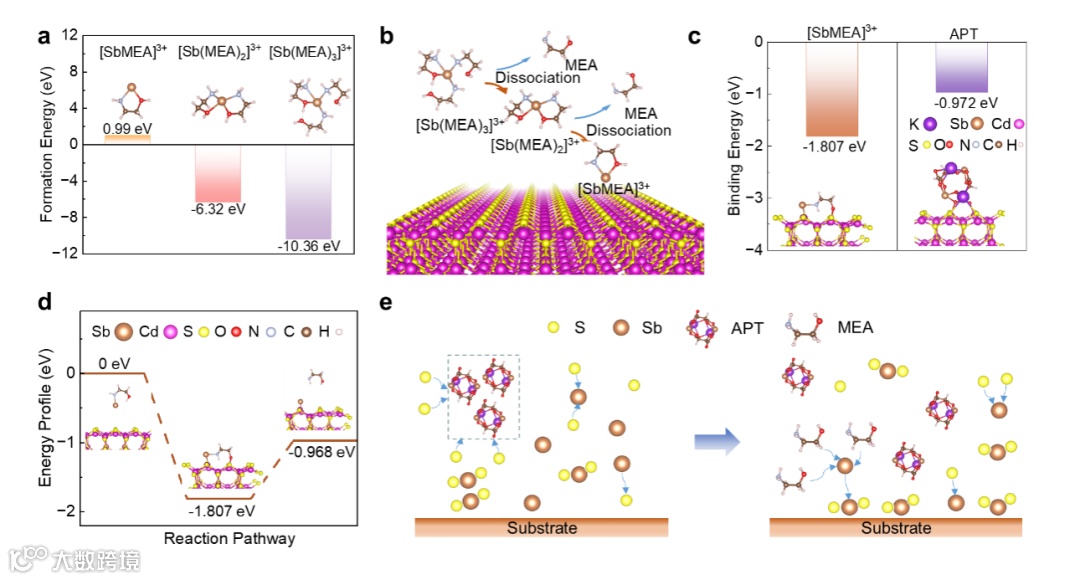
Fig. 2 Mechanisms of additive engineering for the deposition of Sb2S3 films. a The formation energy of [Sb(MEA)n]3+, n = 1, 2, and 3. b Schematic diagram depicting the sequential dissociation of [Sb(MEA)3]3+ into [Sb(MEA)2]3+ and further into [SbMEA]3+ on the CdS substrate with the addition of MEA. c The binding energy between the Sb3+ complexes ([SbMEA]3+ and APT) and the CdS substrate. d The reaction energy profile diagram of [SbMEA]3+ binding to the CdS substrate and releasing the MEA ligand. e Schematic illustration of the evolution of the Sb2S3 deposition process on the substrate with the addition of MEA.
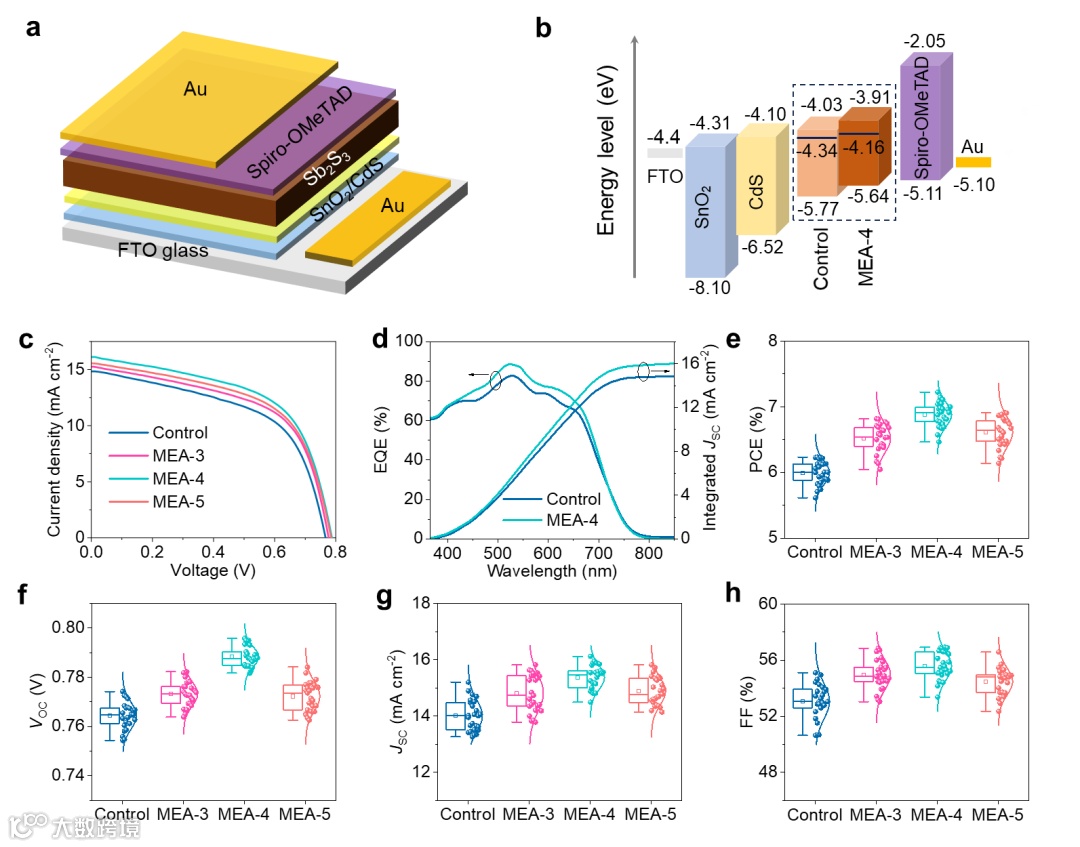
Fig. 3 Photovoltaic performances of Sb2S3 solar cells under AM1.5G illumination. a Schematic illustration of the device configuration of planar Sb2S3solar cells. b Band alignment of the components of Sb2S3 solar cells. c J-V curves of best-performing control and MEA-Sb2S3 solar cells, measured under 1-sun (AM1.5G, 100 mW cm-2) illumination. d EQE spectra of the control and MEA-4 Sb2S3 solar cells. e-h Statistics of the performance parameters of the control and MEA-Sb2S3 devices obtained with the addition of different concentrations of MEA.
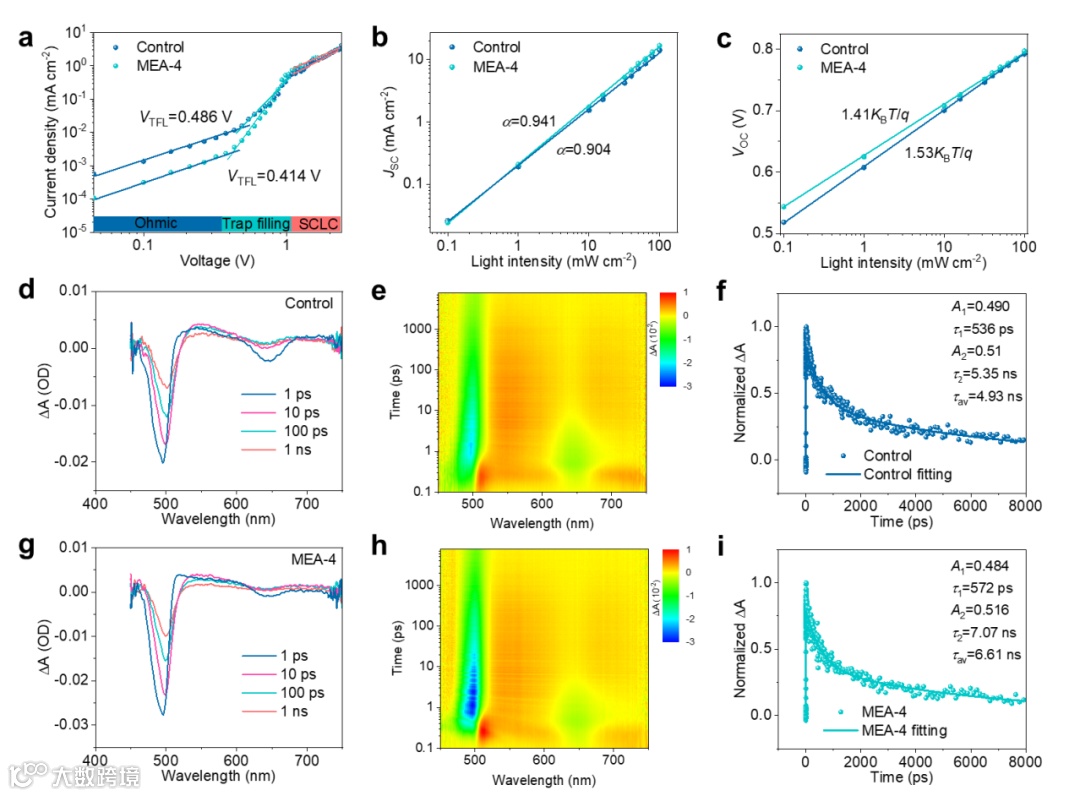
Fig. 4 Device physics and charge-carrier kinetics. a SCLC measurements of the control and MEA-4 devices based on the electron-only device configuration of FTO/CdS/Sb2S3/PCBM/Au. b, c The dependence of JSC and VOC on the light intensity for the control and MEA-4 Sb2S3solar cells. d, g Time-resolved absorption spectra obtained at 1, 10, 100 and 1000 ps, excited by a 400 nm laser pulse, e, h 2D TA spectroscopy pseudo-color images for the time-resolved absorption spectra, and f, i Transient kinetic decay (scatter) and corresponding bi-exponential curve fittings (solid line) monitored at 560 nm of the control and MEA-4 Sb2S3films. ΔA is defined as the variation of absorption.
要点二:室内光伏性能与物联网应用探索
作者系统研究了Sb2S3太阳能电池在常见室内光源辐照下的光伏性能,并进一步开展了面向自驱动物联网的室内光伏应用探索。正如预期,Sb2S3太阳能电池在低照度室内光照下表现出优异的室内光伏性能。其中,在照度为1000 lux、500 lux和200 lux的WLED辐照下,器件效率分别为17.55%、17.17%和16.41%。与受到广泛研究的Ag-Bi-I、BiOI、空位有序钙钛矿等新兴室内光伏材料相比,该研究中Sb2S3太阳能电池超过17%的室内光伏效率是该领域的重要进展。进一步,研究人员首次将高效Sb2S3太阳能电池应用于自驱动物联网。所制备面积为1 cm2的Sb2S3太阳能电池在照度为1000 lux的WLED辐照下的器件效率为15.77%。通过将5个子电池进行串联获得Sb2S3小型模组(5×1 cm2),该模组在照度为1000 lux的WLED辐照下的器件效率为12.82%,最大功率点的输出功率为187.17 μW。与商用氢化非晶硅室内光伏产品相比,该Sb2S3小型模组在光电转换效率和输出功率方面都表现出竞争优势。在日常办公室WLED照明条件下(~726 lux),利用该模组将室内环境光能转换为电能,成功驱动多传感器平台(RSL10-SOLARSENS-GEVK)稳定工作。传感器通过低功耗蓝牙与手机通信,实现实时监测和收集环境数据。研究表明Sb2S3模组能够在室内光照下连续稳定地驱动低功耗物联网电子设备。
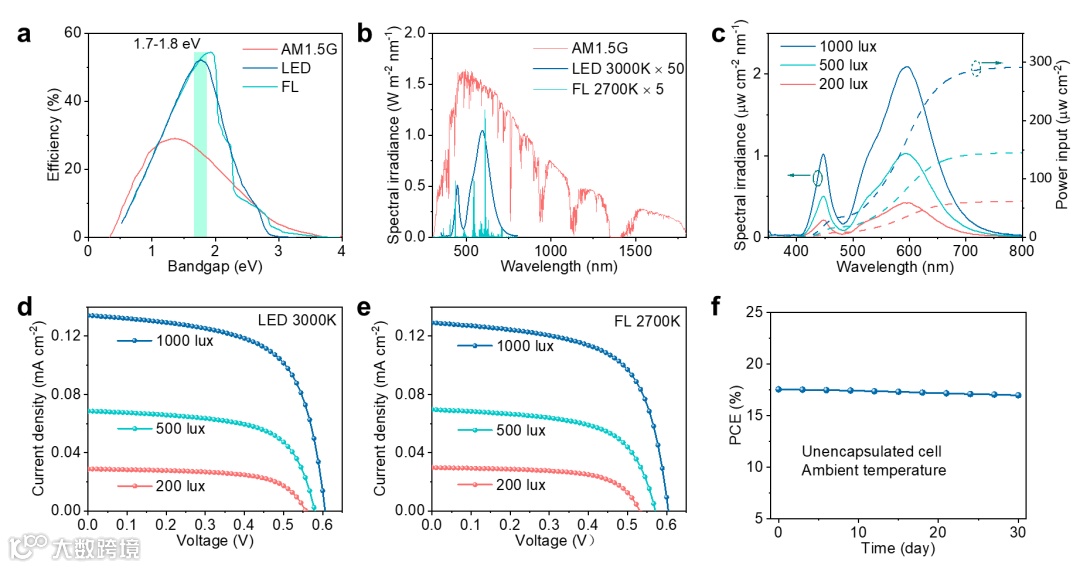
Fig. 5 IPV performance of Sb2S3solar cells. a Calculated efficiency limit of Sb2S3devices under 1-sun (AM1.5G, 100 mW cm-2), 3000 K WLED at 1000 lux, and 2700 K FL at 1000 lux illuminations, respectively.45 b Comparison of the emission spectra of AM1.5G solar, 3000 K WLED at 1000 lux, and 2700 K FL at 1000 lux. The spectral intensities of WLED and FL are amplified by 50 and 5 times, respectively, in order for these spectra to be legible in this plot. c Spectral irradiance and integrated power densities of a 3000 K WLED at 1000, 500, and 200 lux. d, e J–V curves of the MEA-4 Sb2S3solar cells measured under the illumination of LED and FL at 1000, 500, and 200 lux. f Device stability of unencapsulated MEA-4 Sb2S3solar cells stored in the dark under ambient temperature in a cabinet with 15% relative humidity.
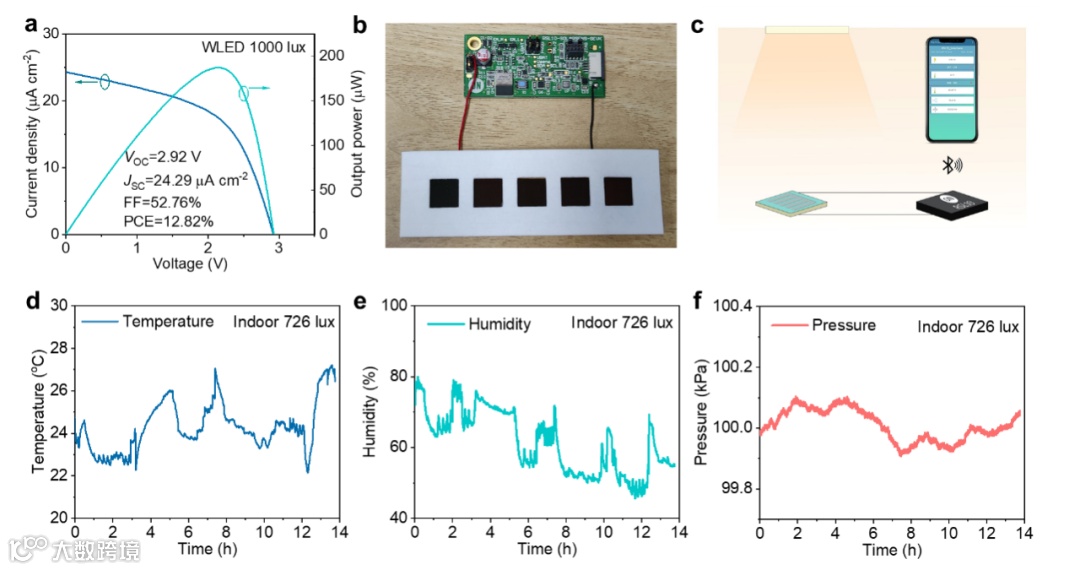
Fig. 6 Demonstration for powering IoT electronics. a J-V curve of Sb2S3solar minimodule (5×1 cm2). b The picture showing the connection between the sensor platform and the Sb2S3minimodule. c Schematic circuit diagram of an IPV-driven sensor device. d-f Temperature, humidity, and atmospheric pressure variations recorded by the IPV-driven sensor in the office with the 726 lux indoor illumination for nearly 14 hours.
科学材料站
文 章 链 接
Additive engineering for Sb2S3 indoor photovoltaics with efficiency exceeding 17% Xiao Chen, Xiaoxuan Shu, Jiacheng Zhou, Lei Wan, Peng Xiao, Yuchen Fu, Junzhi Ye, Yi-Teng Huang, Bin Yan, Dingjiang Xue, Tao Chen, Jiejie Chen*, Robert L. Z. Hoye*, Ru Zhou* Light: Science & Applications (2024) 13:281
https://doi.org/10.1038/s41377-024-01620-0

添加官方微信 进群交流
SCI二氧化碳互助群
SCI催化材料交流群
SCI钠离子电池交流群
SCI离子交换膜经验交流群
SCI燃料电池交流群
SCI超级电容器交流群
SCI水系锌电池交流群
SCI水电解互助群
SCI气体扩散层经验交流群
备注【姓名-机构-研究方向】
投稿请联系contact@scimaterials.cn

点分享

点赞支持

点在看