



文 章 信 息
锌负极上锌沉积与析氢反应的竞争权衡
第一作者:赵庆奥,余小雨
通讯作者:乔羽*,邹业国*,余小雨*
单位:厦门大学
研 究 背 景
由于水系电解液的安全性和环境友好性,水系锌离子电池在储能领域具有广阔的前景。然而,水系电解液不可避免的析氢反应(HER)严重阻碍了其大规模应用。到目前为止,已经发表了许多关于电池性能提升策略的文章。其中,高浓电解液作为一种方便且易于扩展的设计策略被广泛使用。
遗憾的是,目前还没有对高浓电解液的结构性质和抑制HER的影响机制进行深入的探索。一方面,高浓电解液对HER的实际影响以及这种影响的根本原因不能用溶剂化结构随浓度的变化来充分解释。一方面,高浓电解液如何调节HER和锌沉积之间的竞争性权衡的机制尚不清楚,这不能用浓度下本体溶剂化结构的变化来充分解释。另一方面,在电极/电解质界面动态锌沉积过程中,对氢键结构的演变和Zn2+相关配位结构的消耗的观察至关重要。
文 章 简 介
基于此,来自厦门大学的乔羽教授、邹业国博士和余小雨博士在国际知名期刊ACS Energy Letters上发表题为“Competitive Tradeoff between Zn Deposition and Hydrogen Evolution Reaction on Zn-Metal Anode”的研究工作。
该研究团队基于ZnCl2电解液,通过对高浓电解液各种热力学参数的分析,发现高浓电解液反而在HER上更具热力学优势,这似乎是与对高浓电解液的普遍认知“矛盾”的。通过分析电极/电解液界面的氢键的动态演变,并使用半定量化的方式将氢键的变化来与Zn2+的消耗关联起来。结合对电解液体系的理论计算,发现上述“矛盾”的关键在于电极电解液界面的Zn2+-H2O与Zn2+-Cl-两种配位结构的数目比。在相同的锌沉积电位下,高浓电解液电极/电解液界面会形成多Zn2+-Cl-少Zn2+-H2O的氛围,这将有利于锌沉积而非HER。该项工作将加深对高浓电解质如何调节锌沉积与HER之间的竞争权衡的理解。
本 文 要 点
要点一:1 m 和 15 m ZnCl2 电解质中镀锌/剥离的电化学性能
该研究团队选择了1 m和15 m的ZnCl2电解液来验证高浓电解液对水系锌离子电池化学性能的增强和对HER的抑制。通过对Zn/Zn对称电池的循环寿命和Zn/Cu电池的库伦效率测定并且利用扫描电子显微镜(SEM)对循环后的极片进行分析,结果表明15 m的ZnCl2电解液有效改善了负极上的锌沉积,从而提高了电池的循环寿命。此外,根据Tafel曲线测试,说明15 m ZnCl2电解液抑制HER的能力大于1 m ZnCl2。
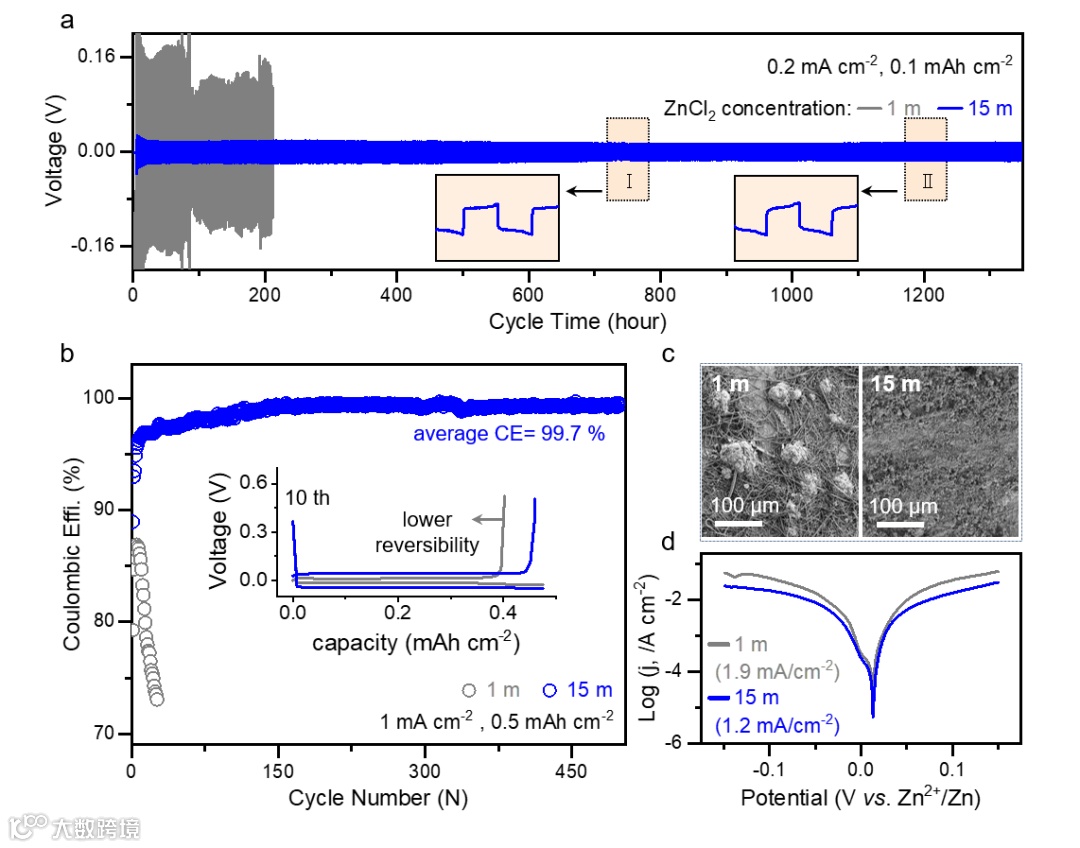
Figure 1. (a) Cycle stability of the Zn-metal anode in 1 and 15 m ZCE at a current density of 0.2 mA cm−2 and a capacity of 0.1 mAh cm−2.
(b) The Zn-plating and Zn-stripping reversibility on a Cu-metal anode in 1 and 15 m ZCE at a current density of 1.0 mA cm−2 and a capacity of 0.5 mAh cm−2. The inset in (b) represents the potential−capacity profiles of the 10th cycle. (c) SEM images of Zn-metal anode (Zn- plating surface) after 100 cycles in 1 and 15 m ZCE at a current density of 1 mA cm−2 and a capacity of 1 mAh cm−2. (d) Polarization curves of 1 and 15 m ZCE.
要点二:HER热力学和动力学的影响因素
ZnCl2作为强酸弱碱盐,基于水解理论与能斯特方程。15mZnCl2pH更低,对应的析氢电位要高于1mZnCl2。通过线性扫描伏安法(LSV)以及在线质谱(OEMS)对析氢电位的测定液验证了上述推断。通过DFT计算,发现其中原因则是由于高浓电解液中具有更多的强HER活性的Zn2+-H2O。然而对实际电池循环观察及对产氢量的测定,高浓电解液对应的产氢量是要少的,而这则或许则是由于在电解液中热力学与动力学的双重影响下所导致的“矛盾”。
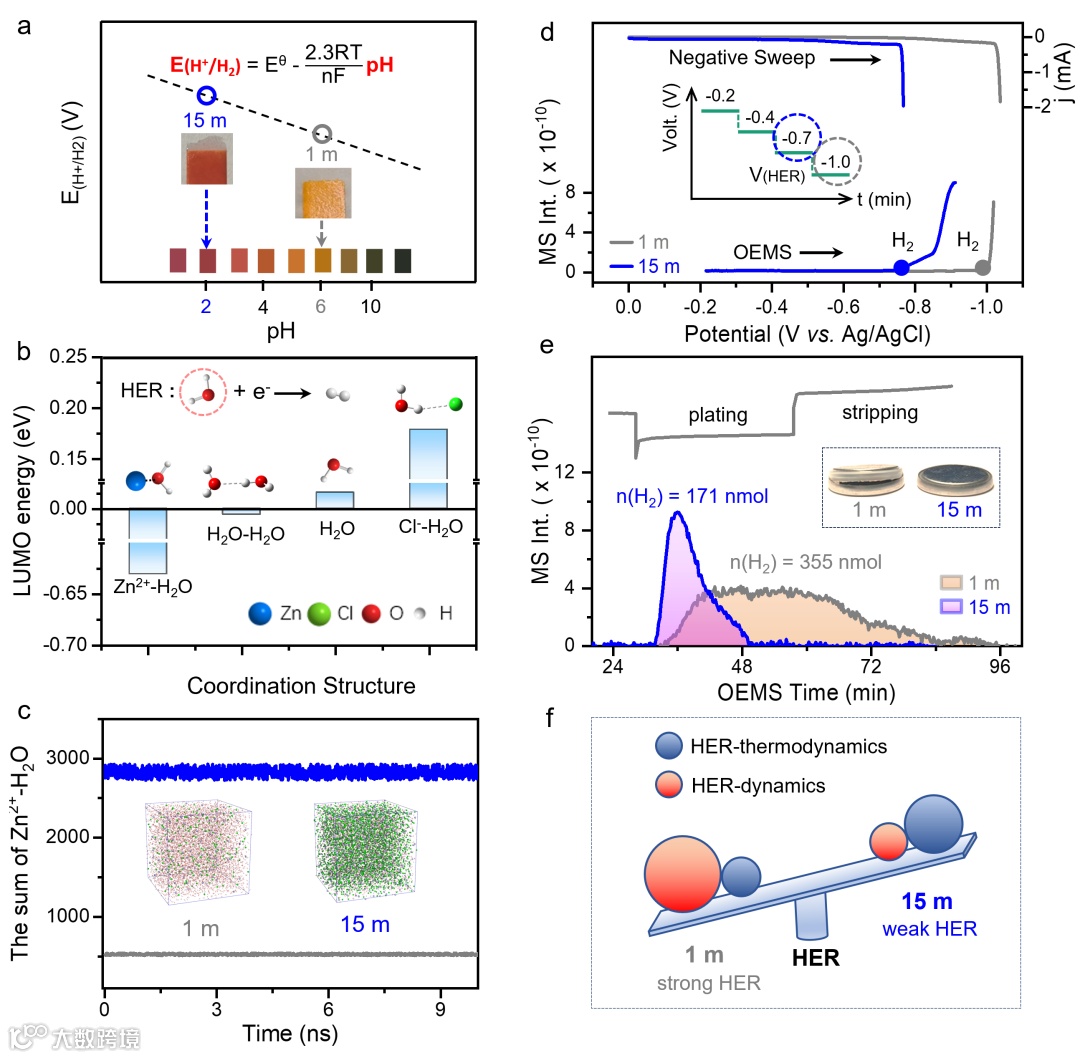
Figure 2. (a) The Nernst equation related to the HER potential and the pHs of 1 and 15 m ZCE. (b) LUMO energy levels of four different coordination structures related to H2O existing in 1 and 15 m ZCE. (c) The sum of the Zn2+-H2O coordination structure in the MD simulation. (d) OEMS data for the initial Zn-plating and Zn-stripping of Zn/Zn cells. The accumulation of H2 in the two electrolytes are 171 nmol (15 m) and 355 nmol (1 m), respectively. Inset: the optical images of Zn/Zn cells after 100 cycles with different electrolyte concentrations. (e) HER potential testing (top) and H2 evolution under different potentials (bottom). Inset: the schematic of the potential step. H2 begins to be produced at −0.7 and −1.0 V in 15 and 1 m ZCE, respectively. (f) Schematic diagram of the HER affected by both thermodynamics and dynamics.
要点三:电解质溶剂化结构及其界面动态演化研究
此外,结合系统的原位/非原位表征技术(如NMR、FTIR)以及分子动力学模拟(MD),揭示了电解液浓度从低浓到高浓对Zn2+溶剂化结构以及水的氢键结构的影响。通过对原位FTIR数据的深入分析,将电极/电解液界面氢键的动态演化与Zn2+相关的配位结构进行关联,并以水的氢键的变化为指标定量校准了Zn2+的消耗。
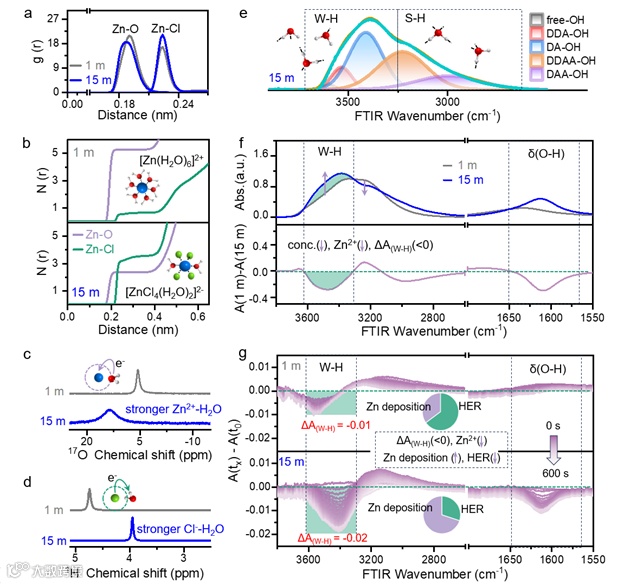
Figure 3. (a) Radial distribution function (g(r)) of Zn2+-O/H2O (0.18 nm) and Zn2+-Cl− (0.22 nm), (b) Coordination numbers (N(r)) of Zn2+-O/H2O and Zn2+-Cl−(c) 17O NMR spectra and (d) 1H NMR spectra in 1 and 15 ZCE. (e) Deconvolution of the O−H/H2O stretching vibration band in 15 m ZCE. The five sub-bands represent the main local H-bond networks for a water molecule. The types of DDAA and DAA are assigned to strong H-bonds (S-H), and those of DA, DDA, and free −OH are weak H-bonds (W-H). (f) Raw FTIR spectra of 1 and 15 m ZCE and the corresponding difference spectra (A(1 m) − A(15 m)). (g) In situ FTIR spectra collected in 1 m (top) and 15 m (bottom) ZCE during Zn plating lasting 600 s. The Zn-plating process is consistent with the variation of spectra color from violet to light pink. Note that the baseline was the first collected spectrum after filling the electrolyte without current (A(t )), and then the subsequent spectra were collected with current applied (A(tx)). The pie charts in (f) represent the consumed Zn2+during the same Zn- plating time.
要点四:锌沉积与HER的竞争权衡
最后,作者揭示了上述“矛盾”的关键在于15 mZnCl2电解液中Zn2+-H2O与Zn2+-Cl-配位结构之和之和比值较高。这意味着在高浓电解液中,电极/电解液界面会形成多Zn2+-Cl-少Zn2+-H2O的氛围,Zn2+-Cl-配位结构捕获电子进行锌沉积的概率较高,同时Zn2+-H2O配位结构将进行HER的概率较低。
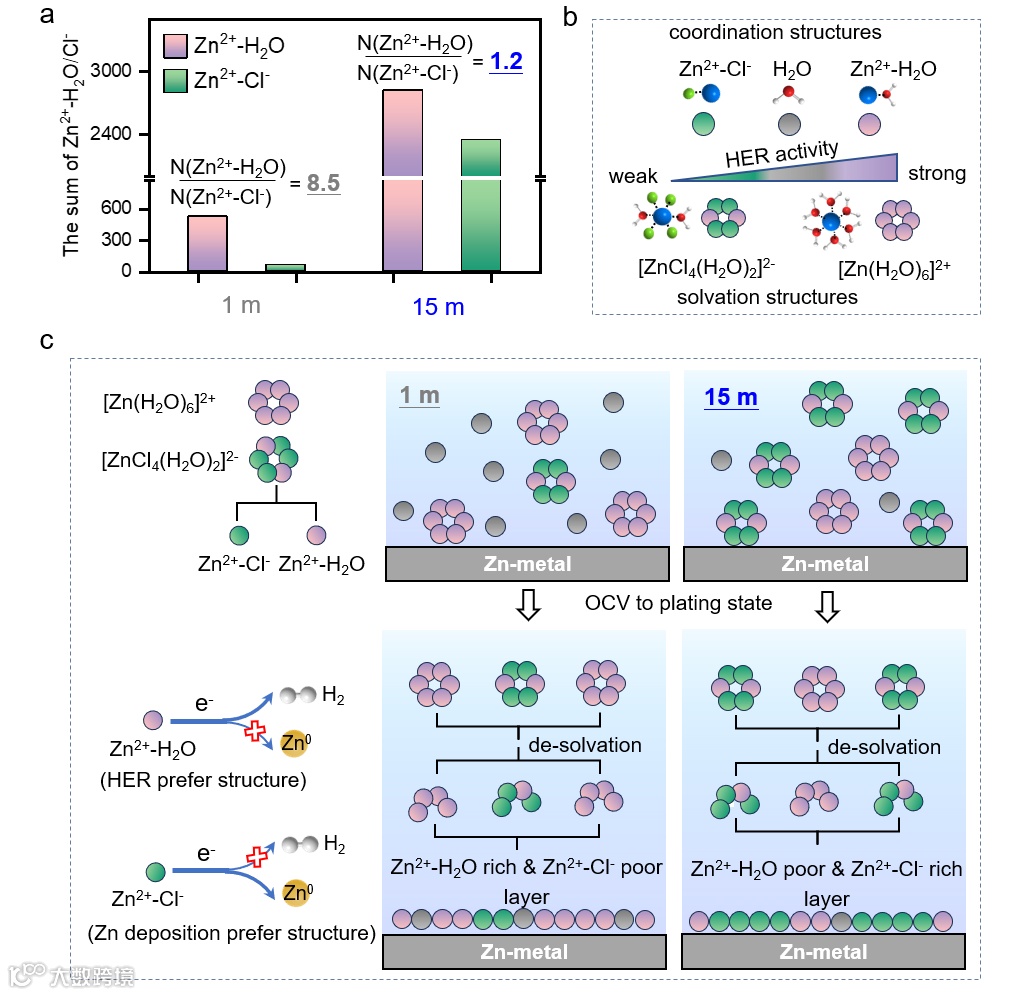
Figure 4. (a) Number of the coordination structures of Zn2+-H2O and Zn2+-Cl− in the MD simulation cells and the corresponding ratio of the number between Zn2+-H2O and Zn2+-Cl− in 1 and 15 m ZCE. (b) HER probability of three typical coordination structures: Zn2+-Cl− green), H2O (gray), and Zn2+-H2O. (c) Schematic of the competitive tradeoff between Zn deposition and HER in 1 and 15 m ZC during Zn-plating: (top) the corresponding coordination structures and solvation structures and the state of bulk electrolyte without current/OCV; (bottom) the preferred reaction of the coordination structures and the state of electrode/electrolyte interface with the corresponding desolvation process.
文 章 链 接
Qingao Zhao, Xiaoyu Yu,*Jiyuan Xue, Minghao Zhang, Zhengang Li, Junhao Wang, Yang Yang, Yeguo Zou,* Yu Qiao,* and Shi-Gang Sun, Competitive Tradeoff between Zn Depositionand Hydrogen Evolution Reaction on Zn-MetalAnode
https://doi.org/10.1021/acsenergylett.4c01657
通 讯 作 者 简 介
乔羽教授简介:博士生导师,厦门大学化学化工学院/固体表面物理化学国家重点实验室,中国福建能源材料科学与技术创新实验室(嘉庚创新实验室)。研究内容:二次电池相关新型储能体系(富锂、高镍等高电压正极材料中阴离子氧化还原机理,电极电解液表界面电化学过程及相关溶剂化构型改性研究,二次电池产气精细分析等);电化学原位谱学表征(电化学原位气相质谱色谱联用、拉曼、红外等)。
学术成果:2017年以来,以第一作者和通讯作者身份在Nature Energy (2篇),Nature Catalysis, Nature Sustainability,Joule(7篇), J. Am. Chem. Soc. (3 篇), Angew. Chem. (7篇), Adv. Mater. (10篇), Energy Environ. Sci. (4篇), Adv. Energy Mater. (5篇)等科研期刊发表学术论文50余篇。获奖情况:国家海外高层次青年引进人才计划、福建省杰青、闽江特聘教授等。
课 题 组 招 聘
厦门大学孙世刚院士/乔羽教授招聘二次电池方向博士后 (正极结构方向)
应聘条件:
1、已取得或即将取得博士学位,年龄在35周岁以下;
2、具有独立开展研究工作的能力,以第一作者身份发表过二次电池能源电化学方向SCI一区论文2篇以上(能力特别突出、或课题组紧缺方向可降低要求);
3、熟练掌握锂离子电池为主的二次电池体系相关知识,有较强的独立研究工作能力。优先考虑具有正极材料研发(富锂/钠材料、材料结构分析)的申请者;
4、良好的英文阅读与写作能力;并且能够协助指导研究生完成科研工作(另有偿);
5、优秀的学术道德和团队合作精神。
待遇条件:
1、基本薪酬:年薪32-35 W;
2、提供厦大博士后公寓(翔安校区:约六七十平方米,房租 8-10元/平方米/月)或相应租房补贴;
3、博士后子女按学校教职工子女同等待遇办理入托儿所、幼儿园、入学;(注)入选 “博士后创新人才支持计划项目(博新计划)”、“香江学者计划”者,相关待遇按照国家及厦门大学相关规定执行。详情和具体规定,请登录厦大博士后网站查询:https://postdoctor.xmu.edu.cn/main.htm;
4、成果特别突出的博士后,可协助其申报厦门大学南强拔尖人才计划,入选后可直接聘为正式副教授、特任研究员,具体待遇如下:享受厦门大学教授同等待遇,年薪35万;购房和安家补贴100万元,并可优先享受政府人才购房政策;学校提供100-200万元科研启动经费;每年可配备至少两名硕博士研究生,协助完成科研工作。
申请方式:
欢迎感兴趣的学者加盟,提供以下材料:个人简历,包括学习工作经历、主要研究工作内容、代表论文论著清单、代表作、获得的奖励情况等,发送至以下邮箱,邮件主题请注明“姓名+博士后申请”。
邮箱:yuqiao@xmu.edu.cn
(cc: qiaoyu09206@163.com)
添加官方微信 进群交流
SCI二氧化碳互助群
SCI催化材料交流群
SCI钠离子电池交流群
SCI离子交换膜经验交流群
SCI燃料电池交流群
SCI超级电容器交流群
SCI水系锌电池交流群
SCI水电解互助群
SCI气体扩散层经验交流群
备注【姓名-机构-研究方向】
投稿请联系contact@scimaterials.cn

点分享

点赞支持

点在看