



科学材料站
文 章 信 息
第一作者(或者共同第一作者):中国科学技术大学刘馨、钱佳伟,中国海洋大学陈经纬
通讯作者(或者共同通讯作者):中国科学技术大学陈立锋教授、俞书宏院士和浙江大学陆俊教授
通讯单位:中国科学技术大学
论文DOI:10.1002/anie.202504613
台湾碳能CeTech【W0S1011生碳布&W0S1011H亲水碳布】性能可靠 正品保证 科研必备!
科学材料站
全 文 速 览
针对锌离子电池中锌负极稳定性不足的问题,中国科学技术大学陈立锋教授、俞书红院士和浙江大学陆俊教授合作,设计了一种在界面层中原位诱导梯度合金成核位点以提升锌负极稳定性的策略,构建了基于生物质基葡萄糖酸铜@羧甲基壳聚糖@高岭土的界面层,获得了高纵向锌沉积容量和锌沉积/剥离可逆性,在非对称电池、对称电池和全电池中都实现了优异的稳定性,并且实现了-30°C~60°C的超宽工作温度范围。
科学材料站
背 景 介 绍
迄今为止,水系锌金属电池因其安全性、成本效益和耐用性,已成为先进智能电子设备和大规模储能系统的最佳选择之一,然而锌负极依旧面临析氢反应,腐蚀以及枝晶生长的问题和挑战。在多种锌负极保护的策略中,引入界面层可以有效避免锌箔水系电解液的直接接触,从而抑制副反应,提升锌负极稳定性。
然而,如何综合调控界面层的亲锌性、结合强度和质荷传输动力学,从而均匀锌负极局部电流密度,降低锌成核能垒,避免锌枝晶产生,提升纵向锌沉积容量和锌沉积/溶解可逆性,仍然需要进一步的研究和关注。
科学材料站
研 究 出 发 点
基于此,中国科学技术大学陈立锋教授、俞书红院士和浙江大学陆俊教授合作,通过在层状高岭土中预载铜离子,并耦合置换反应和恒电流沉积,设计了一种在界面层中原位诱导梯度合金成核位点以提升锌负极稳定性的策略,构建了基于生物质基葡萄糖酸铜@羧甲基壳聚糖@高岭土的界面层,获得了高度稳定的Zn负极。
科学材料站
图 文 解 析
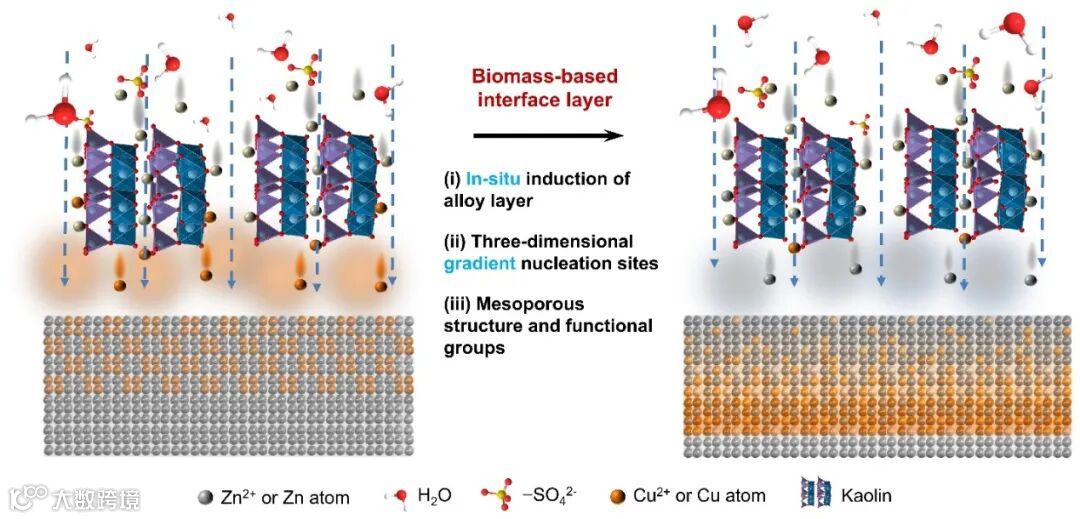
Figure 1. Schematic showing the in-situ induced gradient nucleation sites in biomass-based CuCK interface layers for improving electrochemical performance of Zn anodes.
该生物质基锌负极界面层由葡萄糖酸铜、高岭土与羧甲基壳聚糖混合形成。高岭土作为有效的铜离子载体,不仅可以通过原位置换,提升与锌箔的结合力,同时还可以在锌沉积的过程中,实现铜离子的“缓释”,从而在界面层中实现原位诱导梯度合金亲锌位点的形成。
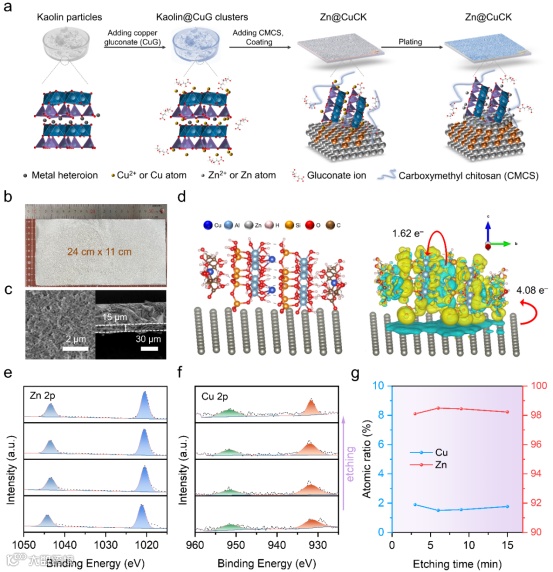
Figure 2. Characterization of CuCK interface layer. (a) Schematic of the synthesis route of Zn@CuCK. (b) Optical photograph, c Top-view and cross-sectional SEM images of Zn@CuCK. (d) Corresponding differential charge density distribution of Zn@CuCK, the yellow and green regions correspond to the gain and loss of charge, respectively (the isosurface level is set at 0.0008 e/Å3). (e, f) Depth etching analysis profiles from XPS of Zn 2p and Cu 2p of fresh Zn@CuCK anode surface (CuCK layer removed). (g) Atomic ratio of Zn 2p and Cu 2p as the etching progresses according to the XPS results in (e), (f).
该界面层制备工艺简单,首先将葡萄糖酸铜与高岭土进行离子交换,实现铜离子在高岭土中的有效负载。其次将负载铜离子的高岭土与羧甲基壳聚糖混合形成浆料,并通过涂覆,形成生物质基锌负极界面层Zn@CuCK,制备过程环境友好且易实现规模化制备。DFT理论计算表明锌基底和CuCK界面层之间具有显著的电荷转移,XPS测试也表明界面层和基底层之间通过原位置换作用形成了Cu-Zn合金位点。
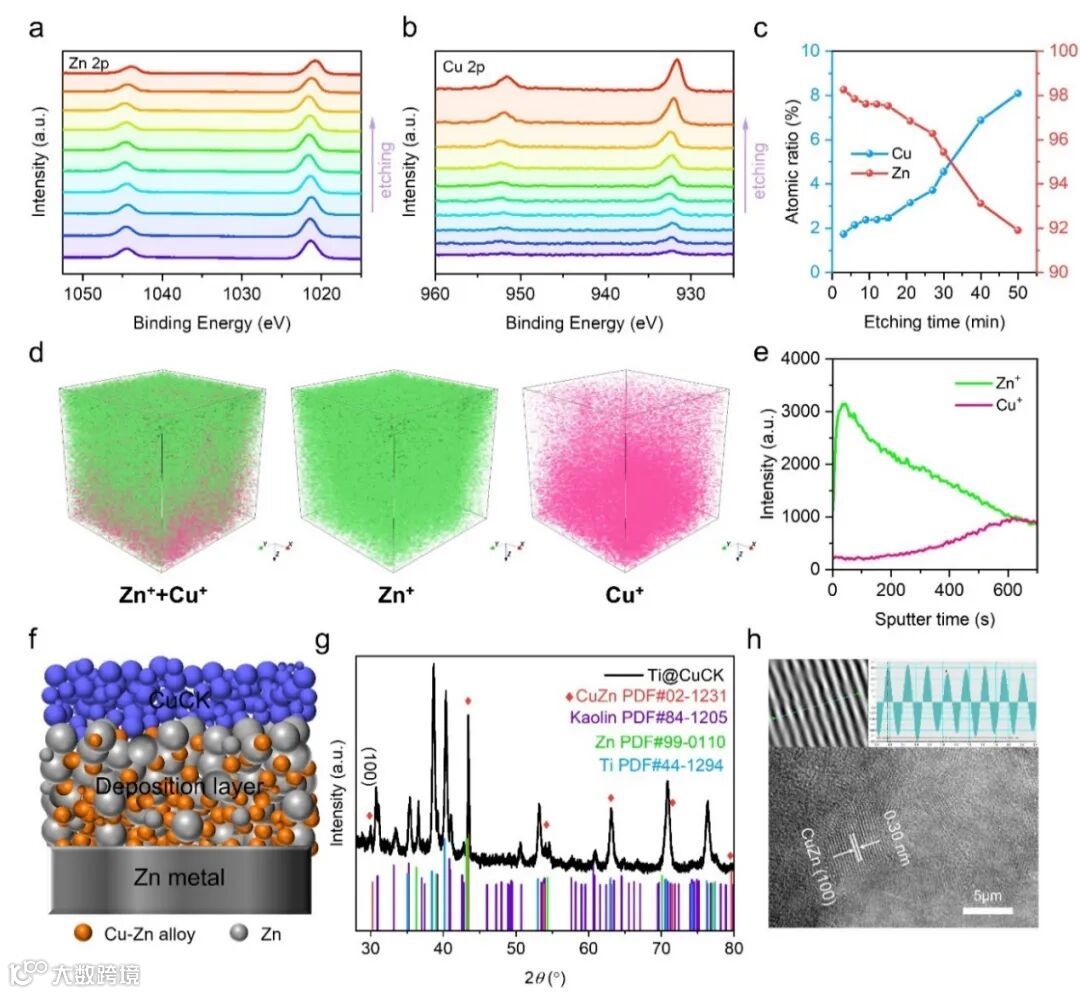
Figure 3. Analysis and characterization of CuCK gradient layer. (a, b) Depth etching analysis from Zn 2p and Cu 2p XPS spectra of plated (0.4 mA cm−2 and 0.1 mAh cm−2) Zn@CuCK anode (CuCK layer removed). (c) Atomic ratio of Zn and Cu vs. etching time according to the XPS results in (a, b). (d) 3D render overlay of Zn+ and Cu+ distributions and (e) Corresponding depth profiles of time-of-flight secondary ion mass spectrometry (TOF-SIMS) analysis of plated Zn@CuCK anode in symmetrical cell. (f) Schematic of galvanically induced and galvanostatically plated gradient Cu-Zn layer on Zn@CuCK anode. (g) XRD pattern and (h) HRTEM image of the Ti@CuCK electrode after 5 cycles.
除去原位置换过程外,在恒电流锌沉积过程中,高岭土作为有效的铜离子载体,可以实现铜离子的“缓释”,从而在界面层中实现原位诱导梯度合金亲锌位点的形成。XPS和TOF-SIMS测试也证实了原位诱导梯度Cu-Zn合金的形成,从锌箔表面往上,铜的含量逐渐降低,锌的含量逐渐升高。XRD和TEM测试也检测到了CuZn合金相的存在。
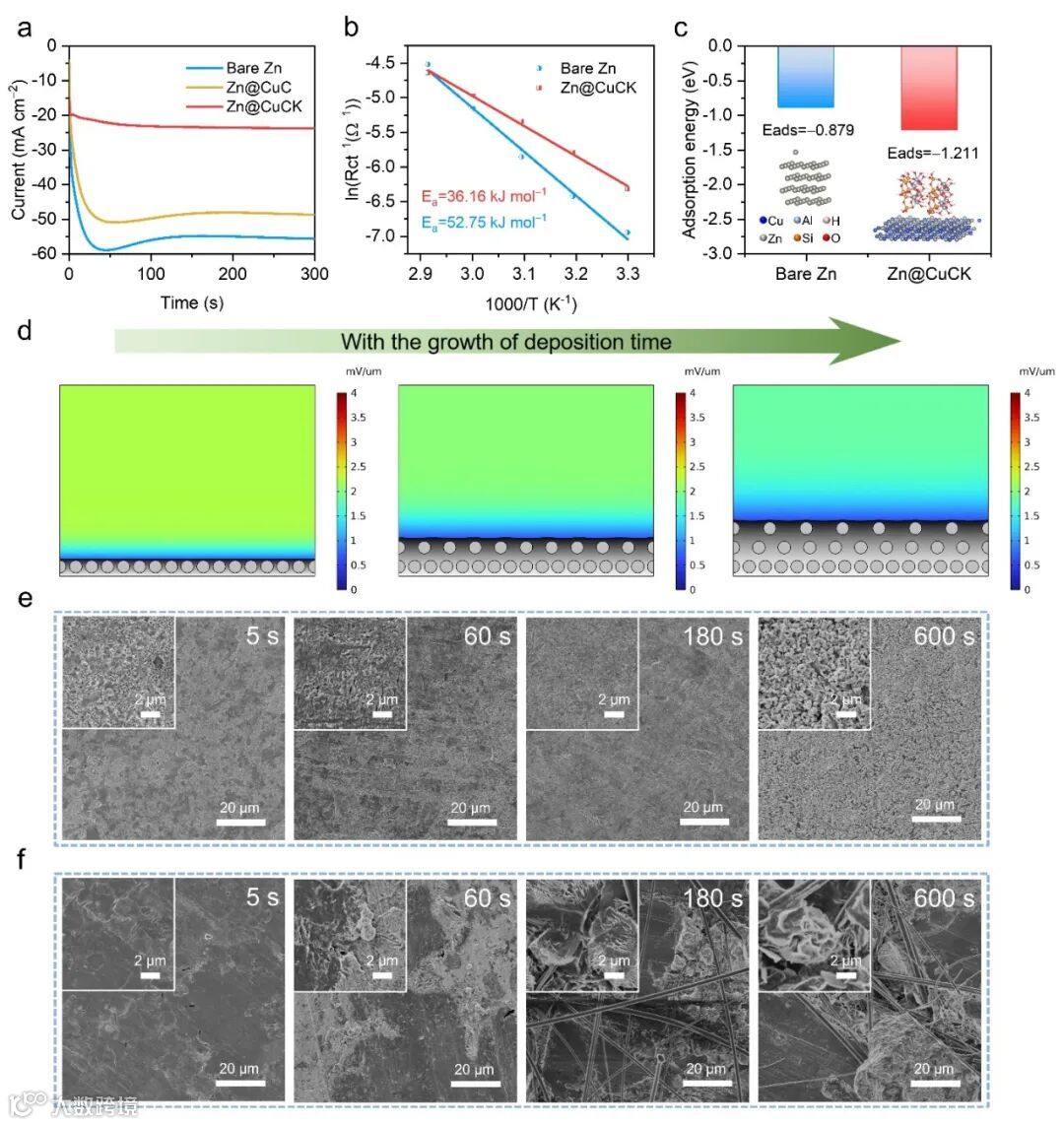
Figure 4. (a) Chronoamperograms (CA) of bare Zn, Zn@CuC and Zn@CuCK at a −200 mV overpotential. (b) Arrhenius curves and comparison of activation energies for different Zn anodes. (c) Adsorption energy of Zn atom on bare Zn and Zn@CuCK substrates. (d) Electric field distribution of Zn@CuCK anode with gradient CuxZny alloy during the Zn deposition process by finite element method simulation. (e, f) SEM images of the zinc surface in (e) Zn@CuCK anodes (CuCK layer removed) and (f) bare Zn after deposition at 5 mA cm−2 for 5, 60, 180, and 600 s, respectively.
通过结构表征和电化学测试,以及DFT计算和COMSOL模拟,证实了该生物质衍生界面层和锌箔结合力强,亲锌性高,锌沉积的活化能低,可以实现锌离子的三维沉积行为,并且其中的高岭土和羧甲基壳聚糖能够有效促进锌离子的传递和脱溶剂化过程,提高了锌离子的迁移数,实现了锌的均匀沉积。
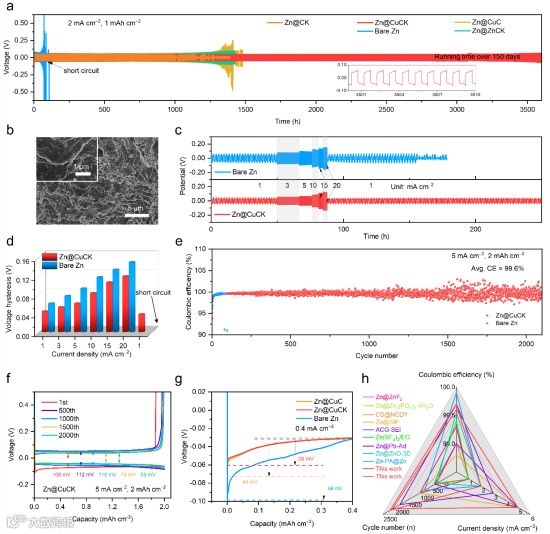
Figure 5. Plating/stripping cycling stability of Zn@CuCK symmetrical and asymmetrical cells. (a) Long-term galvanostatic cycling performance of symmetrical cells with different electrodes. (b) SEM images of Zn@CuCK in symmetrical cells after 40 cycles at current densities of 2 mA cm−2. (c) Rate performance of symmetrical cells and (d) corresponding voltage hysteresis at different current densities from 1 to 20 mA cm−2, at fixed charge/discharge capacity of 1 mAh cm−2. (e) CEs of asymmetrical cells with Zn@CuCK and bare Zn anode at a current density of 5 mA cm−2 with an areal capacity of 2 mAh cm−2. (f) Voltage profiles of Zn@CuCK||Cu asymmetrical cell at the current density of 5 mA cm−2 and areal capacity of 2 mAh cm−2. (g) Nucleation overpotential on different Zn substrates at 0.4 mA cm−2 and 0.4 mAh cm−2. (h) Comparison of Zn@CuCK with other reported Zn anodes (details seen in Table S5).
经过对称电池的循环性能测试,确认了CuCK界面层中,高岭土和葡萄糖酸铜的重要性,只有通过二者的离子交换,实现在高岭土中预载铜离子,才能在锌沉积过程中“缓释”铜离子,从而原位诱导梯度合金亲锌位点的形成。电化学测试证实了CuCK界面层在对称电池和非对称电池中优异的循环稳定性,更低的电压极化,更高的库伦效率和更低的形核过电位,并且与其他相关报道的界面层相比,该CuCK界面层的循环稳定性也具有明显的优势。
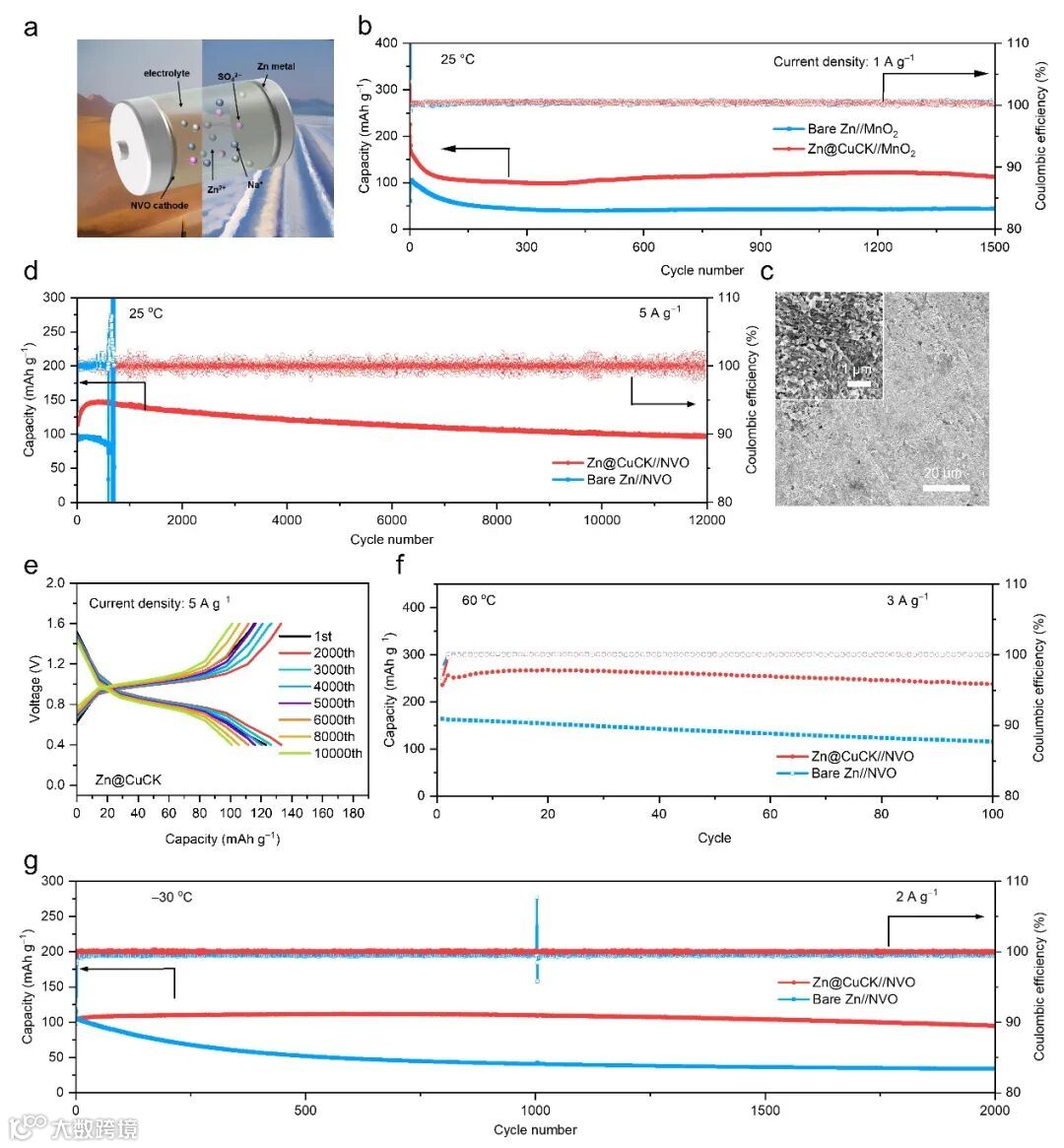
Figure 6. Electrochemical performance of the full cells at wide temperature. (a) Schematic diagram of the full battery under different environmental circumstances. (b) Long-term cycling performance of bare Zn||MnO2 and Zn@CuCK||MnO2 full cells at 1 A g−1. (c) SEM images of Zn@CuCK after 100 cycles at 1 A g−1. (d) Long-term cycling performance and (e) corresponding GCD curves of Zn@CuCK||NVO full cells at 25 °C, 5 A g−1. Long-term cycling performance of Zn@CuCK||NVO and bare Zn||NVO full cells (f) at 60 °C, 3 A g−1 and (g) at −30 °C, 2 A g−1.
通过与二氧化锰或与钒酸钠正极匹配组装全电池,也证实了该界面层修饰锌负极具有优异的循环稳定性,并且在与钒酸钠匹配的全电池中实现了超过10000次的循环稳定性和-30°C~60°C的超宽工作温度范围。
科学材料站
总 结 与 展 望
该生物质衍生界面层保护的锌负极在非对称电池(2100次循环的平均库仑效率为99.6%)、对称电池(在电流密度2 mA cm-2下3600小时,在10 mA cm-2下累积容量为5500 mAh cm-2)和全电池(1.2万次循环后容量保持率为83.5%)中均表现出优异的稳定性,并且实现了全电池在-30°C~60°C的超宽工作温度范围。该项研究工作提出的可持续、可规模化制备的原位梯度诱导策略为实现大规模生产高度可逆锌负极提供了新思路。


添加官方微信 进群交流
SCI二氧化碳互助群
SCI催化材料交流群
SCI钠离子电池交流群
SCI离子交换膜经验交流群
SCI燃料电池交流群
SCI超级电容器交流群
SCI水系锌电池交流群
SCI水电解互助群
SCI气体扩散层经验交流群
备注【姓名-机构-研究方向】
投稿请联系contact@scimaterials.cn

点分享

点赞支持

点在看