



福耀科技大学,青岛科技大学,韩国中央大学蒋建中,刘希恩,Haeseong Jang, 候利强等人发表AEM:高度晶格匹配的Ru/W2C异质界面促进有效的可逆氢溢流,进而加速碱性氢析出反应
科学材料站
研 究 背 景
生产氢气的最经济和可持续的方法之一是将水电解与可再生能源相结合,这种方法具有零碳排放的潜力来储存能量。之前的研究已经证实,商业Ru/C在酸性条件下具有良好的电催化HER活性。然而,在碱性条件下,由于在碱性HER过程中受限于H2O分解步骤的低H覆盖度,Ru表面的HER活性大大降低。因此,需要采取有效的方法来提高Ru基材料在碱性条件下的HER活性。最近的研究表明,金属与支撑体之间的氢溢流或氢反溢流过程可以大大加速碱性HER反应速率。特别是,载体向金属的氢反溢流过程可能为提高Ru表面的H覆盖度提供潜在途径。然而,在氢反溢流过程中,通常需要进行氢转移过程来克服长距离传输和高界面能垒之间的热力学障碍。因此,在不克服高界面能垒的情况下,弱化这种氢反转移过程中的界面质子吸附是一个致命的挑战。据报道,在不同组件上构建晶格匹配的异质界面可以诱导界面处形成平滑的晶体结构,并有效促进载流子传输。晶格匹配的异质界面可能为高效率和自发促进的氢逆向传输提供一条高速公路。然而,据我们所知,迄今为止尚未报道晶格匹配的异质界面对加速碱性HER反应动力学的作用,这是一项艰巨但极具价值的挑战。
科学材料站
工 作 内 容
针对上述挑战,福耀科技大学,青岛科技大学,韩国中央大学蒋建中,刘希恩,Haeseong Jang, 候利强等人在Adv. Energy Mater.发表论文,该团队报告了采用简便的配位热解法成功合成了与碱液中氢析出反应(HER)具有高效催化活性的晶格匹配Ru/W2C异质结构。值得注意的是,以前合成的大多数钨碳化物是相纯的WC或WC和W2C的相混合物,这是因为W2C通常作为WC的副产品在1250 °C以下根据W-C相图生成。因此,在Ru/W2C异质结构中形成相纯W2C的原因通过理论计算进行了研究。与天然氢生物催化系统类似,在天然氢生物催化系统中,Mn4CaO5活性中心会分解水分子生成H中间体,然后[FeFe]氢酶将H中间体耦合生成氢气。在该催化剂中,W2C活性中心可以促进水分子分解生成H中间体,相邻的界面Ru活性中心可以加速H-H偶联和氢气释放。两个反应步骤(沃尔默和塔菲尔/海洛夫斯基步骤)之间的关键结合是,具有快速质子转移特性的晶格匹配异质界面为Ru活性中心提供了丰富的H覆盖,这是通过氢的逆向扩散实现的。
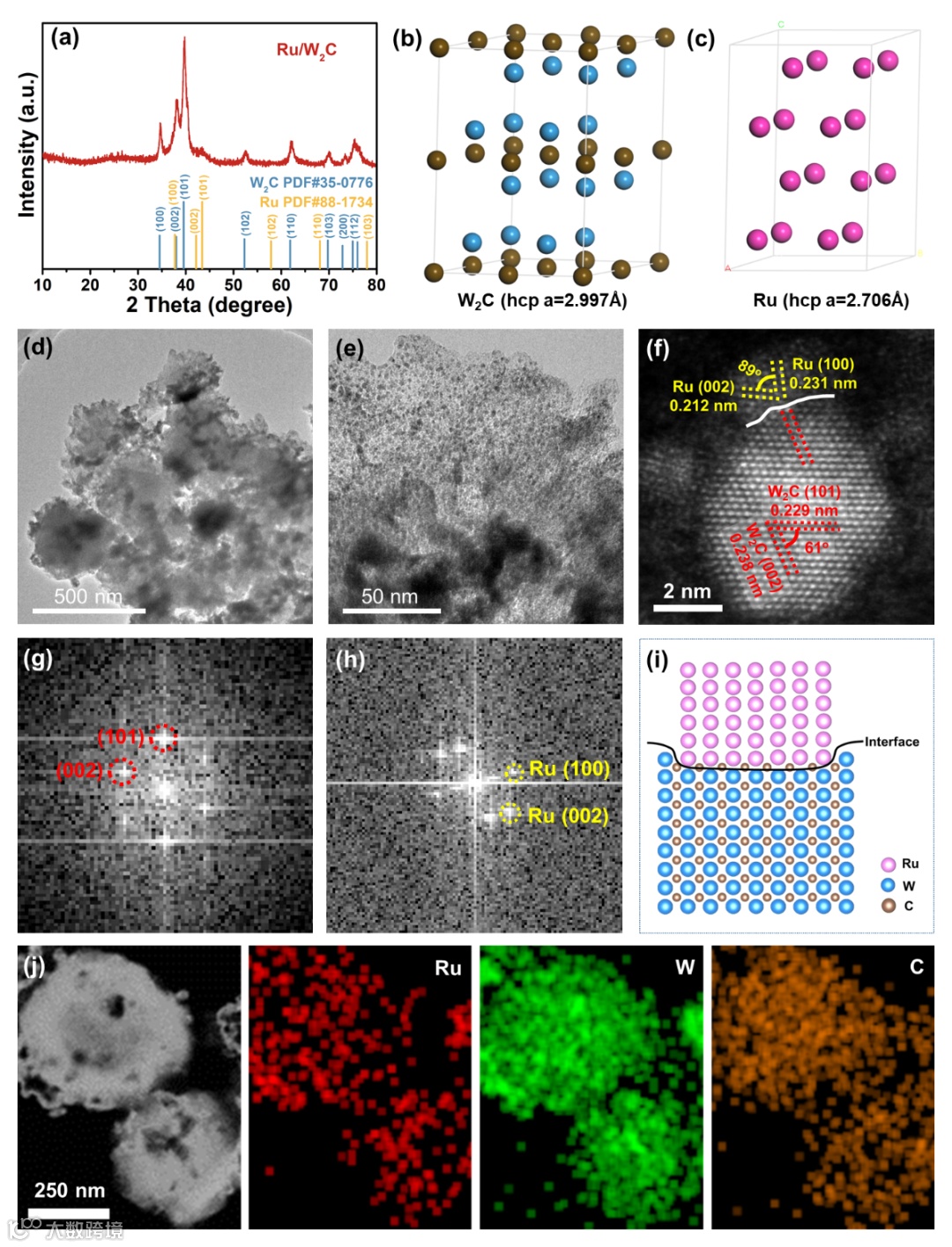
Figure 1. (a) XRD pattern of Ru/W2C. Crystal structures of (b) W2C and (c) Ru. (d,e) TEM images of Ru/W2C. (f) Aberration-corrected high-resolution HAADF-STEM image of Ru/W2C. (g,h) The FFT images of the Ru region and W2C region in (f). (i) Schematic diagram of lattice-matched Ru/W2C heterostructure. (j) STEM image and elemental mapping images for Ru/W2C.
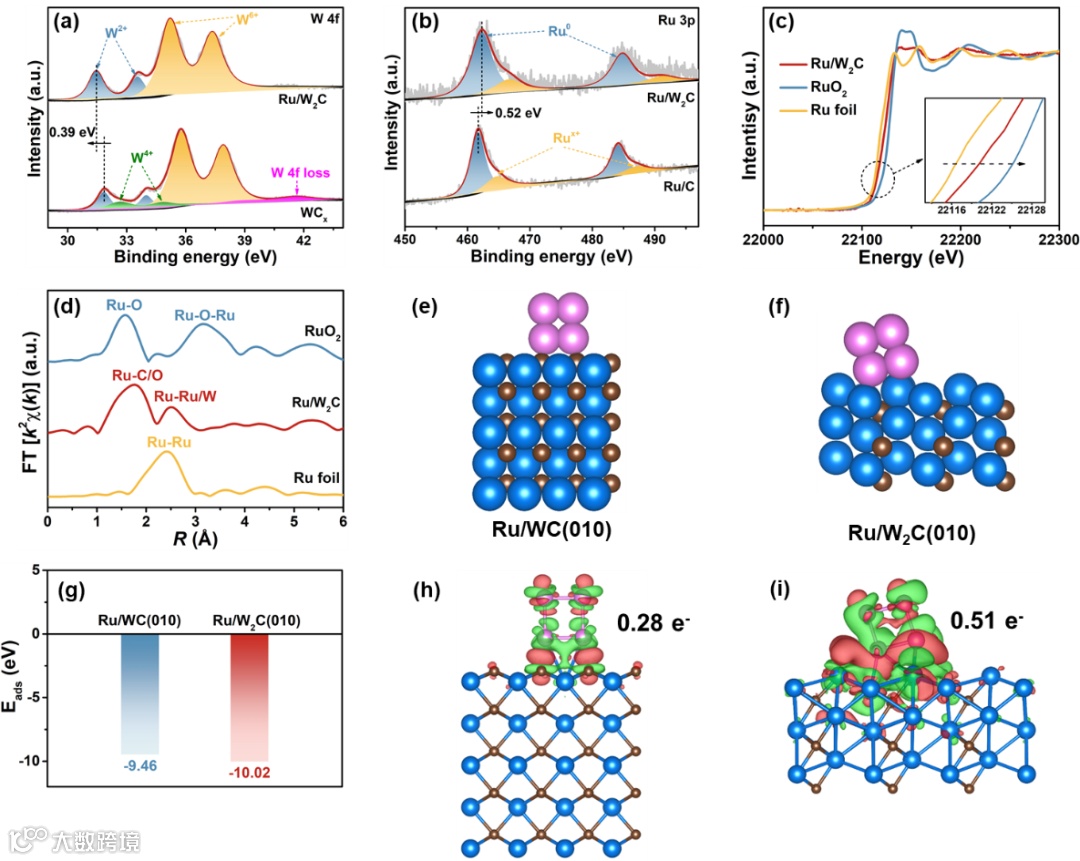
Figure 2. (a) High-resolution W4f XPS spectra of Ru/W2C and WCx. (b) High-resolution Ru3p XPS spectra of Ru/W2C and WCx. (c) Ru K-edge XANES and (d) Ru K-edge EXAFS spectra for Ru/W2C, commercial RuO2, and Ru foil. The structural models of (e) Ru/WC(010) and (f) Ru/W2C(010). (g) The adsorption energy (Eads) of Ru nanocluster on WC and W2C. Charge density difference of (h) Ru/WC(010) and (i) Ru/W2C(010).
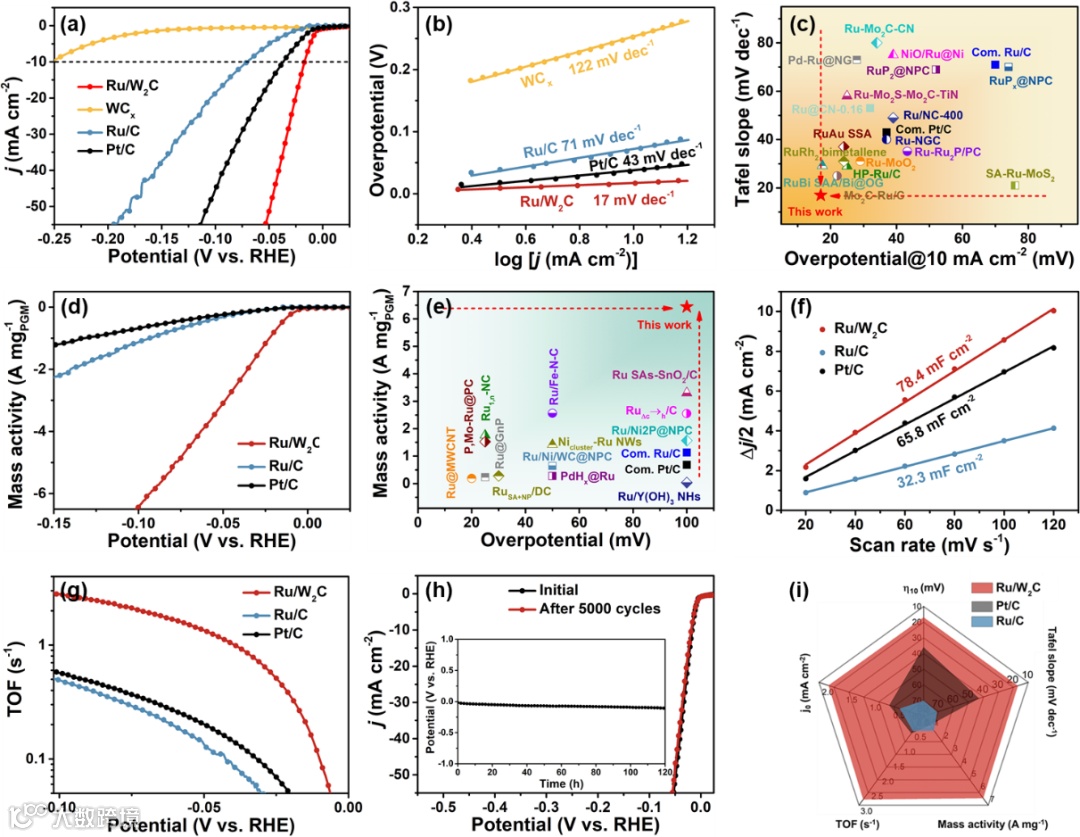
Figure 3. (a) HER polarization curves in 1.0 M KOH and (b) corresponding Tafel slopes of Ru/W2C, WCx, commercial Ru/C, and commercial Pt/C. (c) The overpotential at the current density of 10 mA cm-2 and corresponding Tafel slope for representative Ru-based catalysts from recent studies. (d) The mass activity of Ru/W2C, commercial Ru/C, and commercial Pt/C. (e) The mass activity of various Ru-based electrocatalysts from previous reports. (f) The electrochemical double-layer capacitance (Cdl) of different catalysts. (g) The turnover frequency (TOF) curves of various electrocatalysts. (h) The initial and 5000 cycles polarization curves were recorded from Ru/W2C (inset: Chronopotentiometry plot at a current density of 10 mA cm-2). (i) Comparison of HER performance metrics for Ru/W2C, commercial Ru/C, and commercial Pt/C.
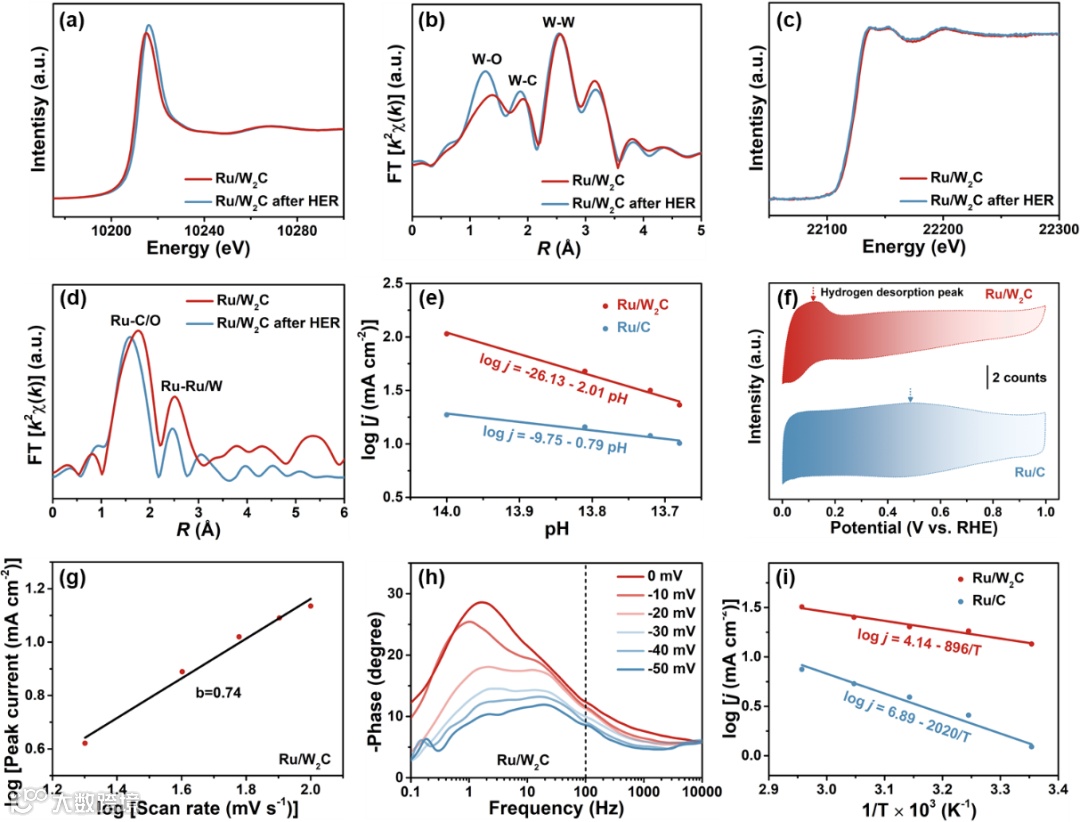
Figure 4. (a) W L3-edge XANES spectra and (b) FT-EXAFS spectra of the Ru/W2C before and after HER. (c) Ru K-edge XANES spectra and (d) FT-EXAFS spectra of the Ru/W2C before and after HER. (e) Plots of log |j@-100 mV vs. RHE| vs. pH for Ru/W2C and Ru/C. (f) CV curves of Ru/W2C and Ru/C. (g) Absolute current density and scan rate follow the power law of Ru/W2C. (h) Phase angles of Ru/W2C. (i) Typical Arrhenius plots for Ru/W2C and Ru/C.
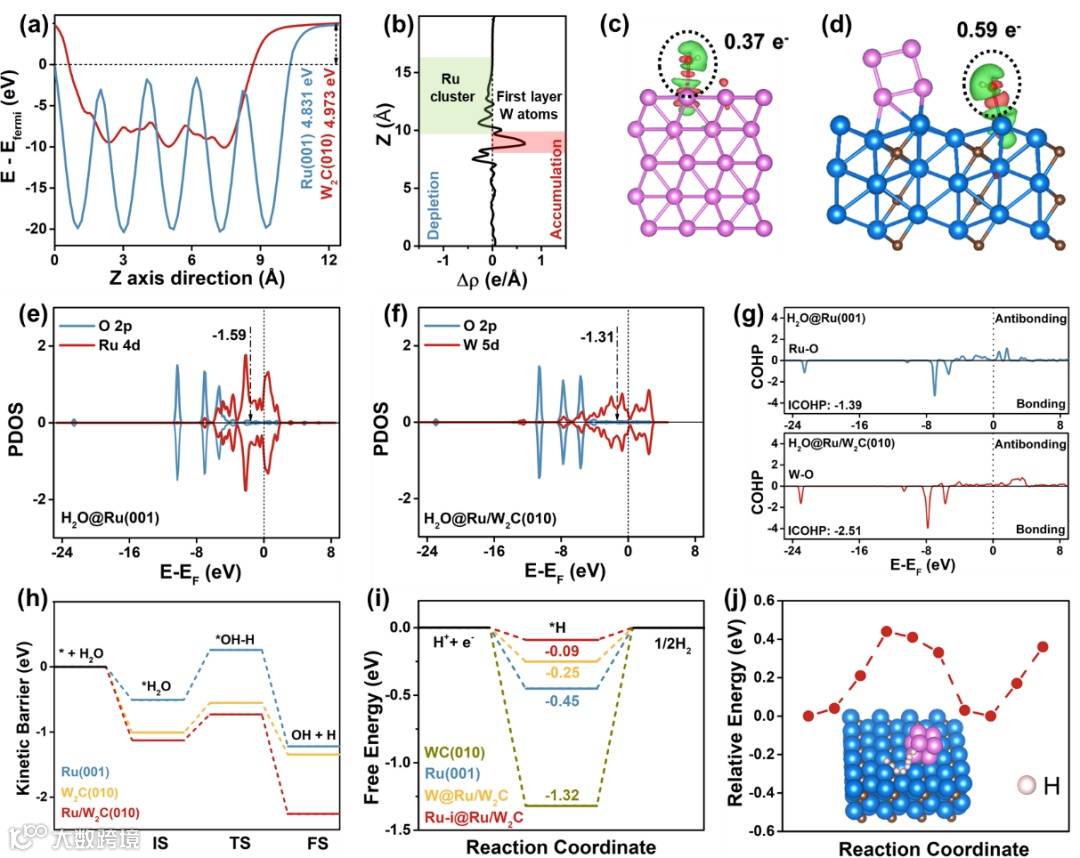
Figure 5. (a) The work functions of Ru(001) and W2C(010) systems. (b) plane averaged charge density difference of Ru/W2C(010) system. Charge density distributions for H2O adsorbed on (c) Ru(001) and (d) Ru/W2C(010). The PDOS of the O atom form adsorbed H2O and the 4d orbital of the Ru atom or 5d orbital of the W atom that directly involved in HER for (e) Ru(001) and (f) Ru/W2C(010) with corresponding Ru 4d band center and W 5d band center denoted by dash lines. (g) COHP of active Ru atom for Ru(001) and O atom for adsorbed H2O (up) and COHP of active W atom for Ru/W2C(010) and O atom for adsorbed H2O (down). (h) Kinetic barrier of H2O dissociation on Ru(001), W2C(010) and Ru/W2C(010) systems. IS, TS, and FS represent the initial, transition state, and final state, respectively. (i) The Gibbs free energy diagrams for HER relative to standard hydrogen electrode for Ru(001), WC(010), and Ru/W2C(010) systems. (j) Hydrogen reverse spillover path diagram.
科学材料站
原 文 信 息
Jian-Zhong Jiang, Shangguo Liu, Zijian Li, Min Gyu Kim, Haeseong Jang, Xien Liu, Liqiang Hou, Lattice-Matched Ru/W2C Heterointerfaces with Reversible Hydrogen Spillover for Efficient Alkaline Hydrogen Evolution, Adv. Energy Mater. 2024, 10.1002/aenm.202405546.
https://doi.org/10.1002/aenm.202405546.

添加官方微信 进群交流
SCI二氧化碳互助群
SCI催化材料交流群
SCI钠离子电池交流群
SCI离子交换膜经验交流群
SCI燃料电池交流群
SCI超级电容器交流群
SCI水系锌电池交流群
SCI水电解互助群
SCI气体扩散层经验交流群
备注【姓名-机构-研究方向】
投稿请联系contact@scimaterials.cn

点分享

点赞支持

点在看