



新兴柔性电子的快速发展正在引领如可穿戴设备、电子皮肤、智能纺织品的快速发展。为了支持这些电子设备的发展,迫切需要具有良好电化学性能以及柔韧性的储能器件。由于重量轻、体积小、柔韧性和可缝合性的进步,纤维状电池引起了学术界和工业界的高度关注,并且随着高安全性锌锰(Zn-Mn)纤维电池的发展,有望取得重大进展。然而,目前报道的纤维电池制备工艺都有着严格的要求,活性物质难以快速连续在电极纤维上均匀涂覆;锌负极固有的枝晶生长以及吸氢反应在纤维电池中更加猖獗,同时较低的电化学窗口限制了纤维锌离子电池的发展。
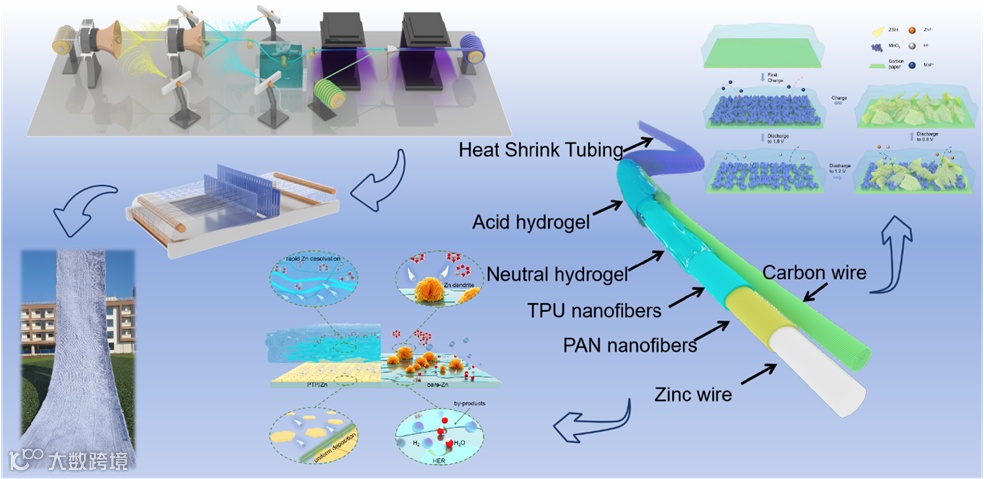
鉴于此,浙江理工大学纺织科学与工程学院(国际丝绸学院)博士生导师胡毅教授课题组以及南京邮电大学赵进教授课题组报道了一种无阴极结构的纤维锌离子电池,该电池消除了在制备过程中繁琐的涂覆活性物质工艺,在正极仅导电集流体,通过恒压充电工艺将电解质中的锰离子沉积到集流体表面以负载活性物质;利用具有“钢筋混凝土”结构的纳米纤维基复合凝胶电解质优化了与Zn2+离子的相互作用,加速了Zn2+离子的输运,抑制了HER和Zn枝晶的生长。通过质子插入与碱式硫酸锌的辅助沉积/溶解作用,有效电池的电压窗口和容量,相关工作以“Cathode-less zinc-manganese fiber batteries with reinforced-concrete structured composite hydrogel electrolytes”为题发表在国际著名期刊Chemical Engineering Journals上(影响因子13.3),doi:10.1016/j.cej.2024.158509。
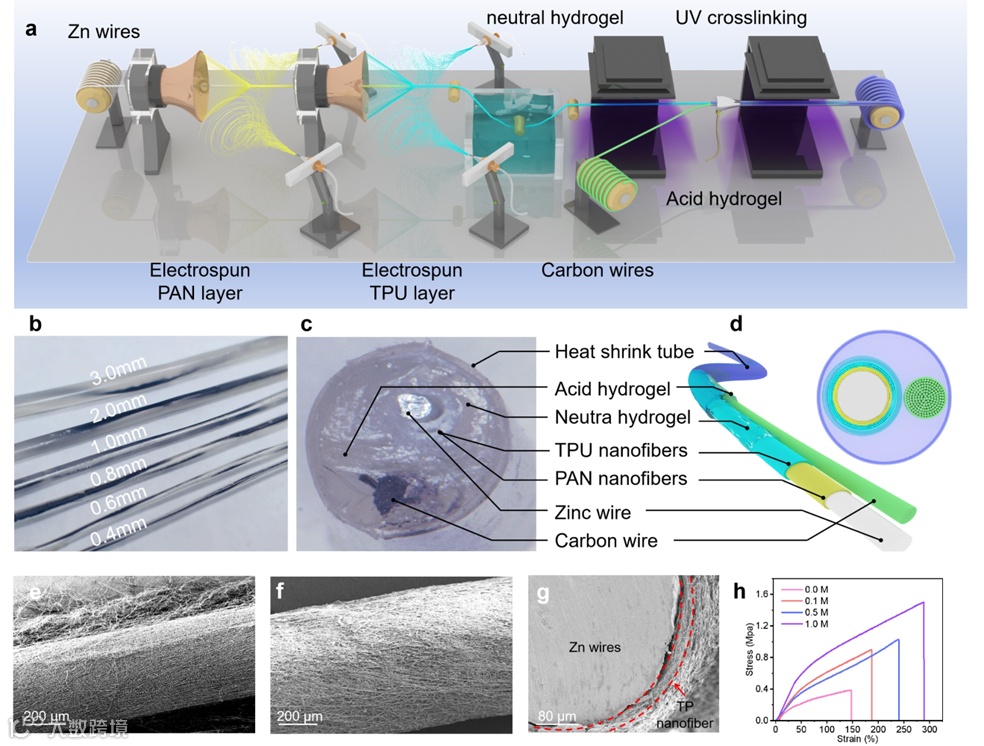
Fig.1 Preparation of Zn-Mn fiber batteries. (a) Schematic illustration of the preparation procedure. (b,c) photograph of the fiber batteries with different diameters (b) and the cross-section view (c). (d) Structure illustration of the fiber batteries (inset: cross-section). (e-g) SEM images of the Zn wires coated by PAN (e) and TPU/PAN (f-g) at different preparation stages. (g) is the cross-section of (f). (h) Stress-strain curves of PAM hydrogel with different concentrations of MnSO4.
本文开发了一种连续制造纤维电池的工艺,以满足现代纺织行业的规模化和效率需求。通过静电纺纱工艺以及简单的紫外引发凝胶前驱体溶液等工艺,在锌线负极表面构建了具有钢筋混凝土结构的复合凝胶电解质,并于导电碳丝复合构建了纤维状无正极水系锌离子电池。本项技术不仅有效提高了生产效率,降低制备成本至每米0.046美元,同时连续化制备的纤维电池可以根据需求制备不同尺寸以及长度,从而适用于多种消费场景。
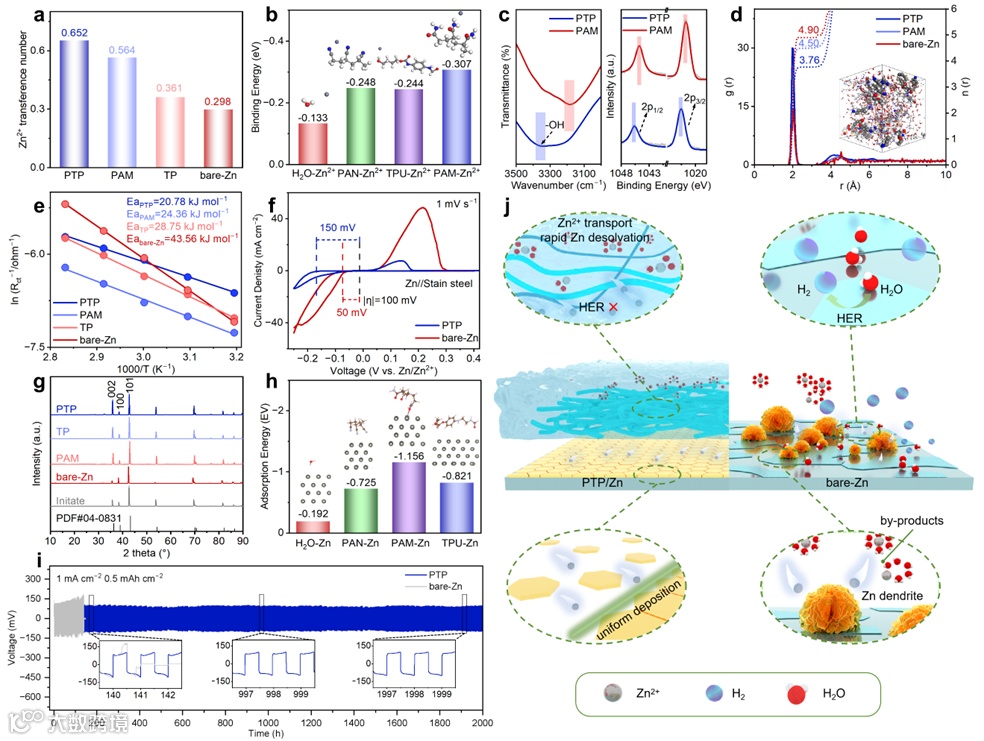
Fig.2 The influence of PTP on Zn anode. (a) Zn2+ transference numbers in different electrolytes. (b) Binding energies of Zn2+ ions with H2O, PAN, TPU, PAM molecules. (c) FTIR spectra (left) and the Zn2p XPS spectra (right). (d) RDF of Zn-O (H2O) and the radius-dependent coordination numbers. (Inset is the image of PTP system obtained by molecular dynamics). (e) Arrhenius activation energy. (f) CV curves of Zn//stainless steel batteries with different electrolytes at a scanning rate of 1 mV s−1. (g) XRD patterns of the Zn anodes with different systems after 50 cycles at 1 mA cm−2 and 1 mAh cm−3. (h) Adsorption energies of H2O, PAN, TPU, PAM molecules on Zn anode. (i) Cycling performance of Zn//Zn symmetric button batteries containing different electrolytes. (j) Schematic illustration of the mechanism of PTP composite hydrogel electrolyte in inhibiting HER, accelerating Zn2+ transport, and inducing uniform deposition of Zn2+.
复合凝胶电解质有效提高了锌负极性能,通过DFT计算,复合凝胶电解质中各组分和锌离子之间的结合能均高于水和锌离子之间的结合能,因此能进一步促进锌离子的脱溶剂化结构,促进锌离子在凝胶电解质中的快速迁移;同时复合凝胶电解质能够促进锌阳极在(002)面的优先吸附,其优异的机械物理性能也能进一步抑制锌枝晶生长。因此复合凝胶电解质相较于传统的水系电解液具有更好的循环稳定性,在1 mA cm−2/0.5 mAh cm−2条件下,复合凝胶电解质体系下的对称电池稳定运行时间超过2000小时。
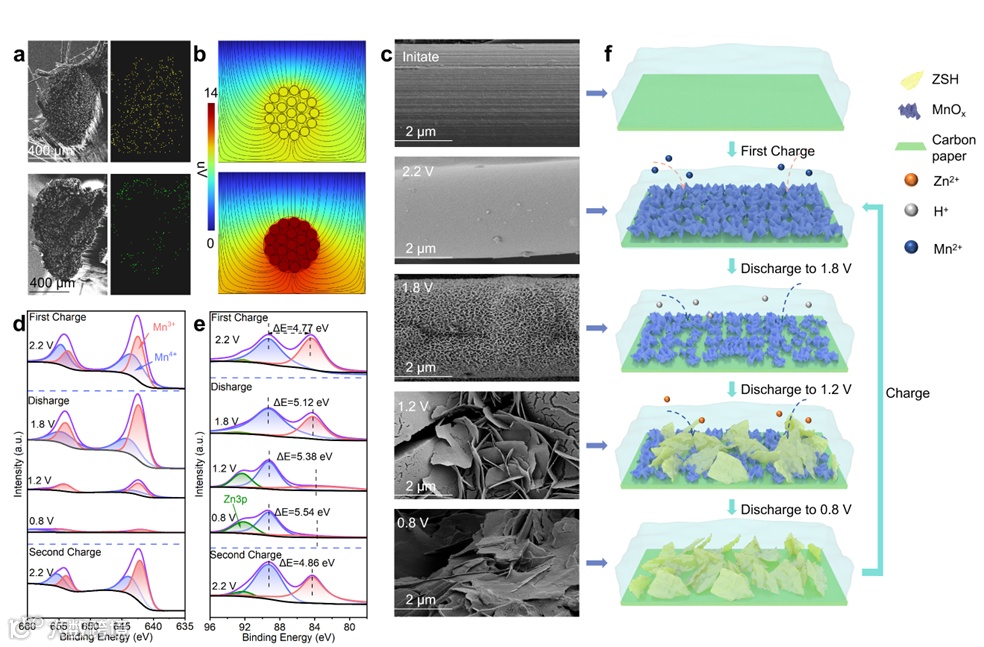
Figure 3. Deposition and dissolution of active species on carbon wire cathode. (a) SEM images (left) and Mn mappings (right) of the cross section of carbon wire cathode prepared by constant voltage charging (top) and traditional coating (bottom). (b) Finite element simulation in potential for the carbon wire cathode prepared by constant voltage charging (top) and traditional coating (bottom). (c) SEM images of the carbon wire cathode at different charge and discharge voltages. (d-e) XPS spectra of Mn2p (d) and Mn3s (e) in cathode at different voltages. (f) Schematic illustration of charge/discharge mechanism on carbon wire cathode.
在正极部分,通过恒压充电沉积活性物质,减少工艺流程的同时降低了成本,同时相比于传统涂敷,在具有高孔隙率的纤维电极上使用恒压充电负载活性物质能够渗透入集流体纤维内部,从而提高了MnOx形成过程中的电子传递效率和高分散;通过在弱酸条件下的碱式硫酸锌(ZSH)辅助沉积/溶解作用,有效提高了容量。
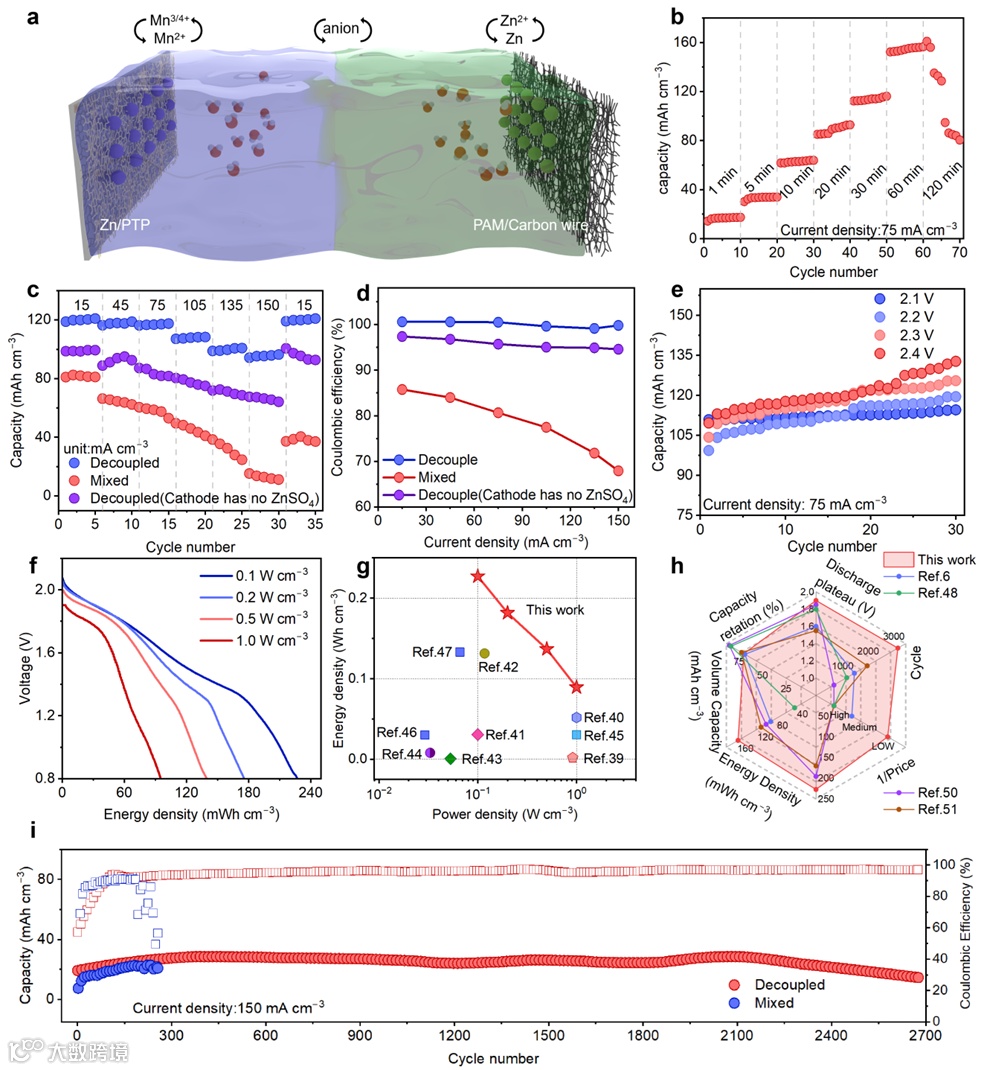
Figure 4. Electrochemical performance of fiber batteries. (a) Schematic illustration of the battery structure with the decoupled hydrogel electrolyte. (b) Cycling performance with different charging time. (c) Rate performance. (d) Coulombic efficiency at different current densities. (e) Cycling performance at different charge voltages. (f) Voltage-energy density curves at different power densities. (g) Ragone plots of the devices in this work compared with recently reported batteries. (h) Comparison of electrochemical performances with previously reported zinc-ion fiber batteries. (i) Long cycle performance of the fiber batteries with decoupled and mixed electrolytes at a charge voltage of 2.2 V for 5 min and a discharge current density of 150 mA cm−3.
因此,制备的纤维电池具有优异的倍率性能,同时能够适应一定电压范围下进行充电,以预防在日常生活中的电压波动,纤维电池的容量高达156 mAh cm−3,同时能量密度高达227.08 mWh cm−3,在2700次循环后能够保持76.5%的容量,经过综合评价,我们的光纤电池在目前报道的锌离子光纤电池中名列前茅。
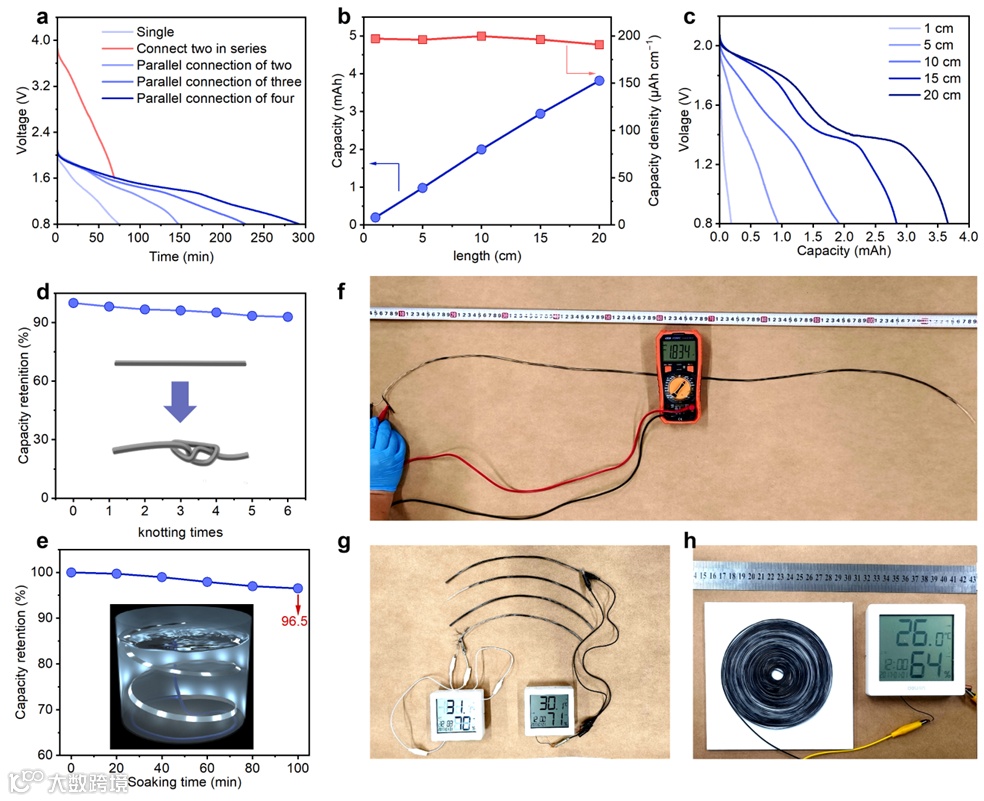
Figure 5. Adaptability and scalability of fiber batteries. (a) Discharge curves of the fiber batteries under series and parallel conditions. (b) Capacity of the fiber batteries with different lengths. (c) Discharge curves of the fiber batteries with different lengths. (d) Capacity retention of the knotted fiber battery. (e) Capacity retention of the fiber battery immersed in water. (f,g) Photograph of the fiber battery before (f) and after (g) shearing. (h) Photograph of the fiber battery with a length of 5 meters.
纤维电池可以任意进行串并联,同时由于纤维电池独特的一维结构,电池的尺寸可以根据需求裁剪成不同长度,而电池容量也会随着长度的增长而增长,而由于水系锌离子电池的高安全性,被裁剪得每一个部分也能进行单独供电;优秀的机械物理性能以及防水性能能保证纤维电池在任意弯曲条件和水中下进行充放电。
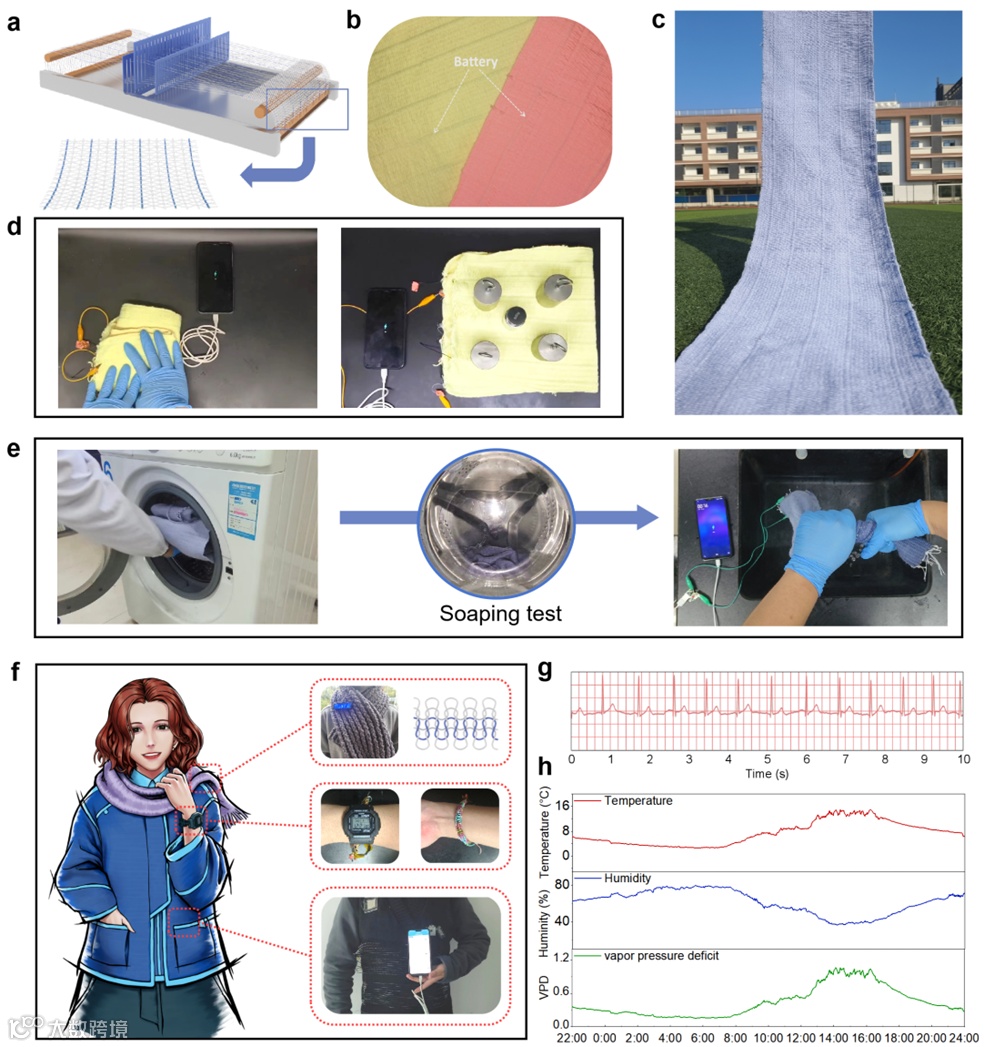
Figure 6. Production and practical application of fabric battery. (a) Schematic illustration of commercial weaving loom. (b) Photograph of the position of fiber batteries in textiles. (c) Photograph of a large-scale fabric battery with spanning 3 meters in length and 0.5 meters in width. (d) Photograph of the fabric batteries powering a mobile phone under folding and heavy pressuring. (e) Soaping test in soapy water with a washing machine and powering a mobile phone after washing. (f) Demonstration of practical application of the fabric battery. (g) Electrocardiography monitored and drawn using the HTS sensor in (f) with a running speed of 25 mm s−1 and a transmission gain of 10 mV mm−1. (h) Environmental data, including temperature, humidity, and vapor pressure deficit, recorded by the HTS sensors in (f) and transmitted to the mobile app by Bluetooth.
凭借纤维电池的种种特性,使用商用织布机将纤维电池和传统纱线进行集成,制备织物电池,织物电池集成了纤维电池优异物理机械性能,能够抵御在日常生活中的外力影响;将织物电池与柔性微型传感器进行集成,构建人体健康检测织物,这些创新的设计代表了可穿戴技术的重大进步,在保持电化学性能和可穿戴性的同时,为能量存储提供了卓越的便利,预示着智能纺织品发展的一个关键里程碑。
小结:为了提高锌锰纤维电池的电化学性能和提高电压,本文引入了一种双策略,包括具有“钢筋混凝土”结构的复合水凝胶电解质和无阴极设计。该电解质富含官能团,增强了与Zn离子的相互作用,加速了它们的运输,抑制了阳极上HER和Zn枝晶的生长。因此,光纤电池的能量密度达到227.08 mWh cm-3,几乎是现有光纤型电池的两倍,并且在2700次循环后保持了76.5%的容量,最高容量为156.48 mAh cm-3。无阴极设计进一步促进了ZSH在阴极上的溶解/沉积,MnOx的均匀沉积/溶解促进了ZSH在阴极上的溶解/沉积,工作电压提高到1.9 V。纤维电池还表现出优异的环境适应性,在洗涤或切割后仍能保持功能。利用商用编织机,我们将纤维电池编织成3米× 0.5米大小的大型织物电池,展示了可扩展性。与商用纺织品相结合,形成了一个多功能的健康跟踪系统,可穿戴电子设备可实时监测人体和环境指标。这一演示标志着可穿戴和智能织物技术的重大飞跃。
本文第一作者为浙江理工大学纺织科学与工程学院(国际丝绸学院)硕士研究生许仕林,第一通讯作者为浙江理工大学博士生导师胡毅教授,第二通讯作者为南京邮电大学赵进教授。
胡毅,男,博士,教授,博士生导师。浙江理工大学纺织科学与工程学院(国际丝绸学院)副院长,主要从事非水介质染整新技术和柔性电子智能纺织品研究。以第一作者或通讯作者在 Advanced Functional Materials, Nano Letters, Energy Storage Materials, Chemical Engineering Journal等刊物上发表SCI论文60余篇,授权和转化国家发明专利30余项。获得国家级教学成果二等奖和浙江省教学成果特等奖各1项;主持获得中国纺织工业联合会教学成果一、二、三等奖,浙江省自然科学奖三等奖和中国商业联合会科技进步奖二等奖各1项。
赵进,教授,博士生导师,南京邮电大学高层次引进人才。主要围绕纳米能源材料与新型电化学储能技术开展研究工作,在超级电容器、锂/钠离子电池、水系锌离子电池电极材料的设计、可控制备、调控机制和储能机理方面取得了系列成果。以第一/通讯作者在Adv. Mater.、Angew. Chem. Int. Ed.、Adv. Energy Mater.、Adv. Funct. Mater.、ACS Energy Lett.、Nano Lett.、Nano Energy等高水平期刊发表SCI论文40余篇。主持国家自然科学基金青年基金,江苏省自然科学基金青年基金等项目,入选江苏特聘教授(特别资助),江苏省“双创博士”,任江苏省材料学会秘书处副秘书长。
添加官方微信 进群交流
SCI二氧化碳互助群
SCI催化材料交流群
SCI钠离子电池交流群
SCI离子交换膜经验交流群
SCI燃料电池交流群
SCI超级电容器交流群
SCI水系锌电池交流群
SCI水电解互助群
SCI气体扩散层经验交流群
备注【姓名-机构-研究方向】
投稿请联系contact@scimaterials.cn

点分享

点赞支持

点在看