



科学材料站
文 章 信 息
第一作者:沈云
通讯作者:袁守怡*,Junwei Lucas Bao*,王永刚*
通讯单位:昆明理工大学,波士顿学院,复旦大学
科学材料站
研 究 背 景
随着近年来电动汽车的迅猛发展,市场对高能量密度动力电池的需求与日俱增。采用锂金属负极的电池因其超高比容量(3860 mAh g⁻¹)和极低电化学电位(-3.04 V vs. 标准氢电极),理论上可实现500 Wh kg⁻¹的能量密度。为实现这一目标,需在低N/P比和贫电解液体系中匹配LiNi0.8Co0.1Mn0.1O2NCM811等高电压正极材料。锂金属表面固态电解质界面层(SEI)在循环过程中的反复破裂与重组,会持续造成活性锂损耗和电解液剧烈消耗,导致SEI层的稳定化成为重大技术挑战。通常而言,含硝酸锂(LiNO₃)添加剂的醚类电解液与锂金属负极高度兼容,能实现超过98%的锂沉积库伦效率(CE)。这种高CE源于LiNO₃分解形成的优异富无机SEI层。然而,醚类溶剂的氧化稳定性较差(低于4.0 V),限制了其在与高活性正极匹配的高压锂金属电池中的应用。另一方面,尽管酯类电解液具有更宽的电化学窗口,但由于其与锂金属电池的兼容性较差,相关研究在高电压体系中的应用鲜见报道。更严重的是,LiNO₃在酯类电解液中的溶解度极低。因此,大量研究致力于拓展醚类电解液的阳极稳定性,近年来开发的高浓度电解液、局部高浓度电解液、弱溶剂化电解液及高熵电解液等新型醚类体系,在保持锂沉积高度可逆性的同时,成功拓宽了醚类溶剂的电化学窗口。然而,由于酯类电解液中形成的SEI层稳定性不足,锂金属电池在酯基电解液中的研究进展依然缓慢。
科学材料站
文 章 简 介
基于此,来自昆明理工大学锂离子电池及材料制备技术国家地方联合工程中心袁守怡,联合美国波士顿学院Junwei Lucas Bao课题组、复旦大学王永刚课题组在国际知名期刊Advanced materials上发表了一篇名为“Integrating Ethereal Molecular Backbones into the Ester Solvent with High Solubility of Nitrate for High-Voltage Li Metal Batteries”的文章。该文章提出了一种用大尺寸有机阳离子取代Li+来降低LiNO3晶格能和在酯类溶剂中引入醚分子骨架提高溶剂化能的策略,极大地提高了硝酸盐在酯类溶剂中的溶解度。最终将N-丙基-N-甲基吡咯烷硝酸盐离子液体(Py13NO3)和二丙二醇甲醚醋酸酯(DPGMEA)成功用于高压锂金属电池体系。得益于这一优化设计,在目标电解液中实现了高的初始库伦效率(95.18%)以及稳定的Li+沉积;另外,Ah级的Li||NCM811软包电池在超过150次循环后仍然有89.5%的高容量保持率。本研究为设计适用于高压锂金属电池的酯类电解液提供了新的思路。
科学材料站
本 文 要 点
要点一:设计具有高硝酸盐溶解度的酯类溶剂
本研究首先分析了锂盐进入有机溶剂的溶解过程,提出了锂盐的晶格能与有机溶剂的溶剂化能是决定锂盐在有机溶剂中溶解性的两大关键参数。LiNO3因其较高的晶格能使其在有机溶剂中难以解离,即便采用特殊策略使其晶格结构暂时解离,高晶格能也会迅速诱导其重新结合形成沉淀。因此研究团队提出,在LiNO3盐中采用大体积有机阳离子(Py13+)替代Li+,可显著降低硝酸盐的晶格能;另外,以乙二醇二甲醚(DME)为起点,设计了具有高氧化稳定性和高硝酸盐溶解度的酯类溶剂二丙二醇甲醚醋酸酯(DPGMEA)。
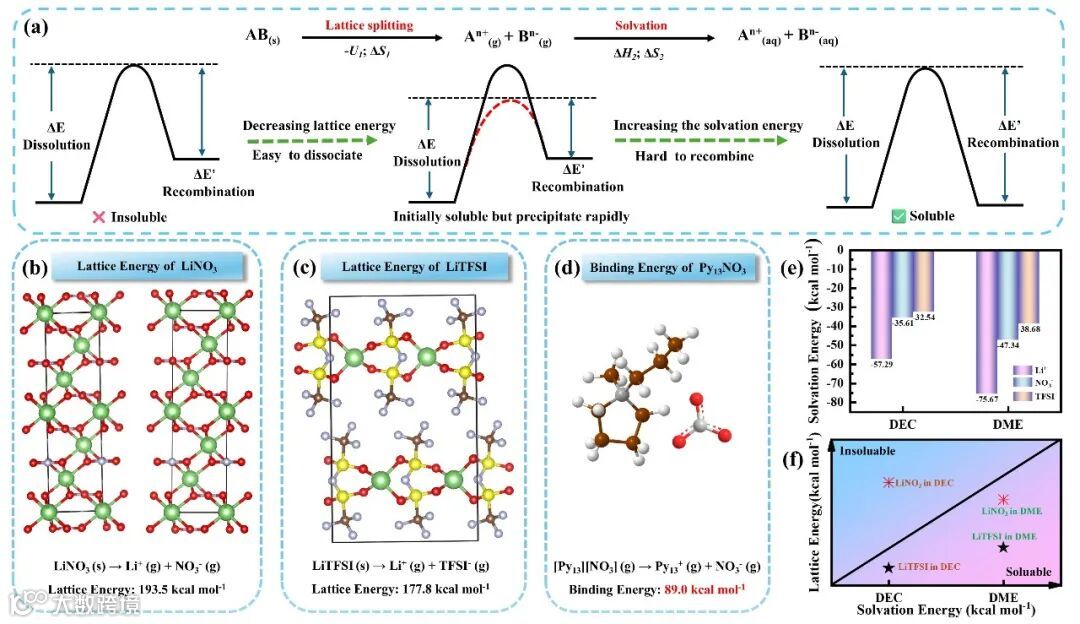
Figure 1. a) Strategies for improving the solubility of salts during the dissolution process. They include decreasing lattice energy of salts (U) and incerasing solvation energy of organic solvents (ΔH). b) Optimized structure for LiNO3 lattice and DFT-predicted lattice energy calculation of LiNO3. c) Optimized structure for LiTFSI lattice and DFT-predicted lattice energy calculation of LiTFSI. d) The structure for Py13NO3 and DFT-predicted binding energy of Py13+ and NO3−. e) DFT-predicted solvation energy calculations of Li+, NO3−, TFSI− in DEC and DME solvent. f) The dissolution equilibrium for different salts (LiNO3, LiTFSI) in DEC or DME solvent.
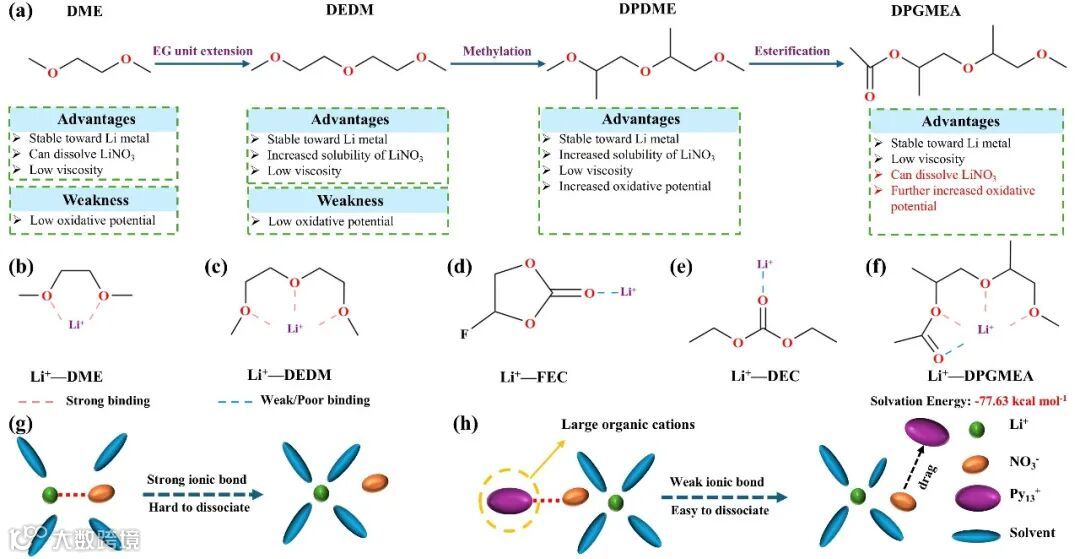
Figure 2. a) Design of solvent molecules to enhance the electrochemical performance of electrolytes. The revealed coordination between Li ion and different solvent molecules: b) DME; c) DEDM; d) FEC; e) DEC; f) DPGMEA. g) Schematically illustration of dissolution processes of LiNO3 in organic electrolytes. h) Schematically illustration of dissolution process of Py13NO3 ionic liquid in organic electrolytes.
要点二:抑制锂枝晶的形成以及稳定NCM811正极结构
在目标电解液(1.2 M LiFSI 0.3 M Py13NO3 FEC:DPGMEA(2:8))中展示出了优异的Li+沉积性能和致密、平滑的沉积形貌,这归功于SEI层中丰富的含氮物种。同时,NO3-阴离子同样可作为NCM811正极的有效成膜添加剂,在材料表面分解后能形成含氮无机CEI层,有效地稳定了NCM811材料的层状结构和极大地抑制了阳离子混排。
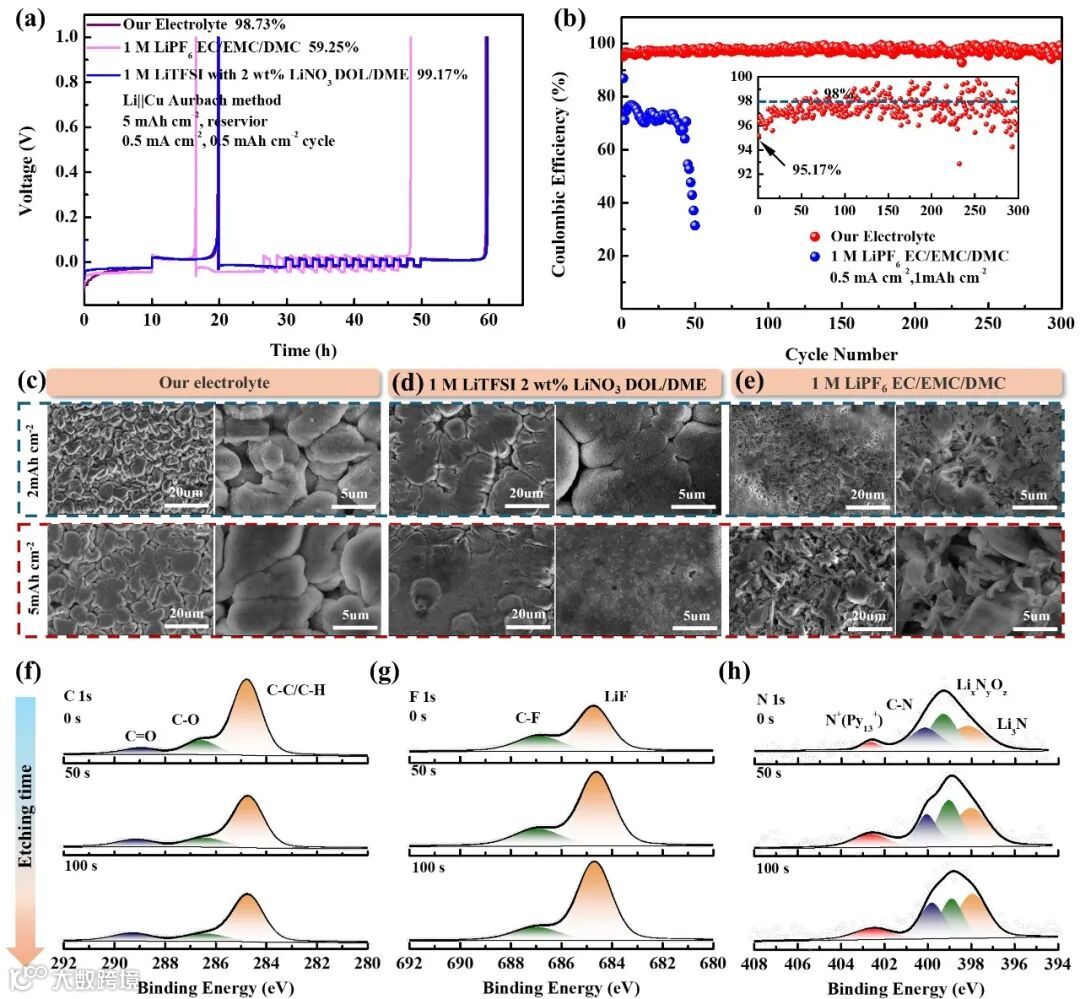
Figure 3. Characterization of Li metal anode in different electrolytes. a) Long-term Li plating/stripping average CE test performed with deposition capacity of 0.5 mAh cm−2 at 0.5 mA cm−2. b) Cycling performances of Li||Cu half cells in different electrolytes with deposition capacity of 1.0 mAh cm−2 at 0.5 mA cm−2. Morphologies of Li deposition at 0.5 mA cm−2 in c) our electrolyte. d) 1 M LiTFSI 2 wt% LiNO3 DOL/DME electrolyte. e) 1 M LiPF6 EC/EMC/DMC electrolyte. In-depth XPS spectra in our electrolyte of f) C ls, g) F ls, h) N ls.
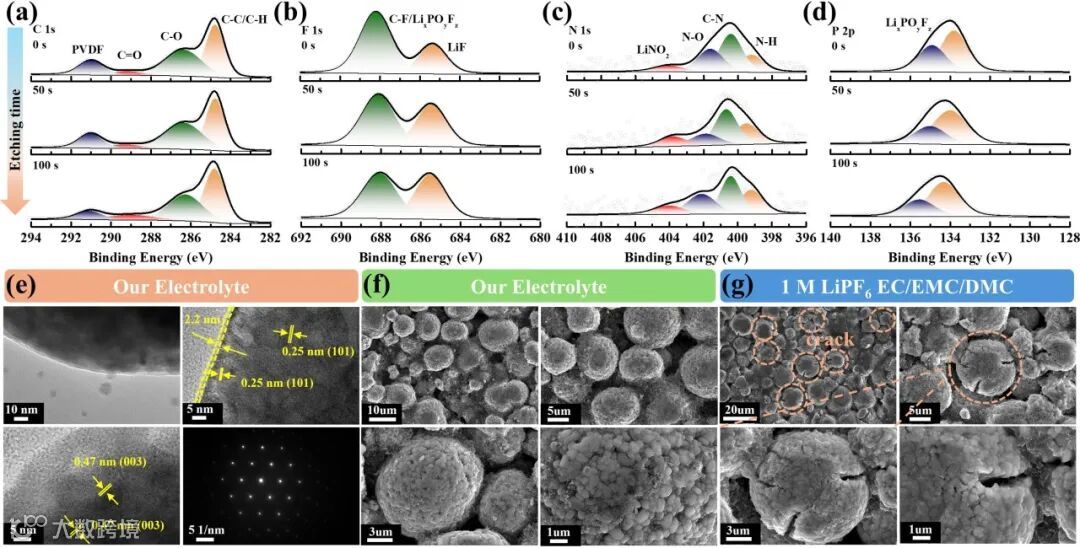
Figure 4. Characterization of NCM811 cathode in our electrolytes and 1 m LiPF6 EC/EMC/DMC electrolyte. In depth XPS spectra of the NCM811 cathode in our electrolyte: a) C 1s; b) F 1s; c) N 1s; d) P 2p; e) HRTEM and SAED characterization of NCM811 cathode in our electrolyte after 100 cycles; SEM images for the surface of NCM811 cathodes after 100 cycles at 1 C in (e) our electrolyte; f) 1 M LiPF6 EC/EMC/DMC electrolyte.
要点三:优异的电化学性能以及提高了NCM811正极材料的热稳定性
基于LiFSI盐的锂金属电池在高充电状态下会引发严重的Al腐蚀现,因此通过向目标电解液中添加0.1 M LiPO2F2来缓解Al腐蚀。实验结果表明:LiPO2F2的添加不仅提高了电解液的氧化稳定性,还能有效抑制铝集流体的腐蚀现象。最终,Li||NCM811电池在超过800次循环后仍然有93.93%的容量保持率;同时Ah级的软包电池也展示了优异的循环稳定性。
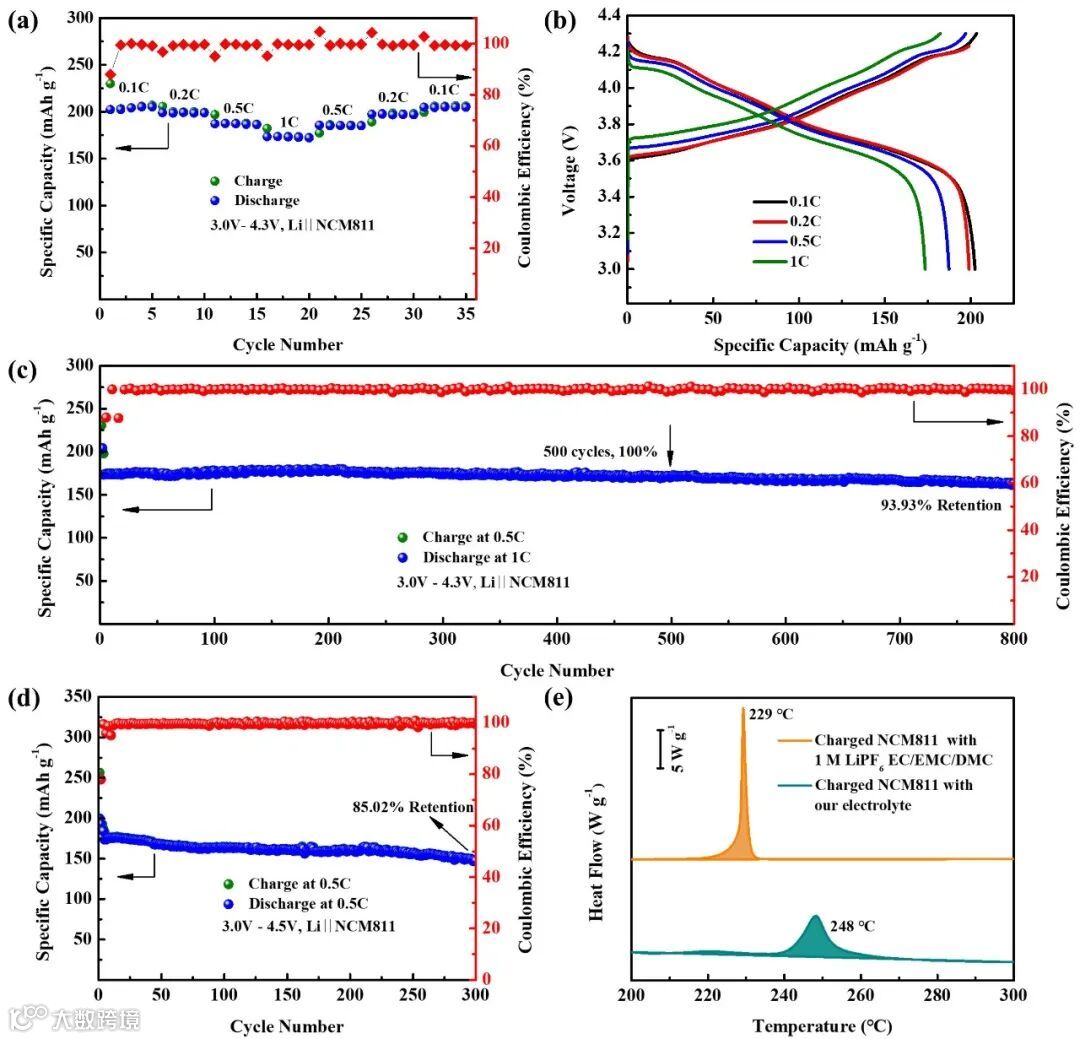
Figure 5. Electrochemical performance and safety assessment of Li metal cell. a) Rate performance of Li||NCM811 cells. b) Charge/discharge profiles from selected cycles within 3.0–4.3 V. c) Long-term cycling performance of Li||NCM811 cells operated at 0.5 C charge/1 C discharge within 3.0–4.3 V. d) Cycling performance of Li||NCM811 cells operated at 0.5 C within 3.0–4.5 V. e) DSC curves of fully charged NCM811 with different electrolytes.
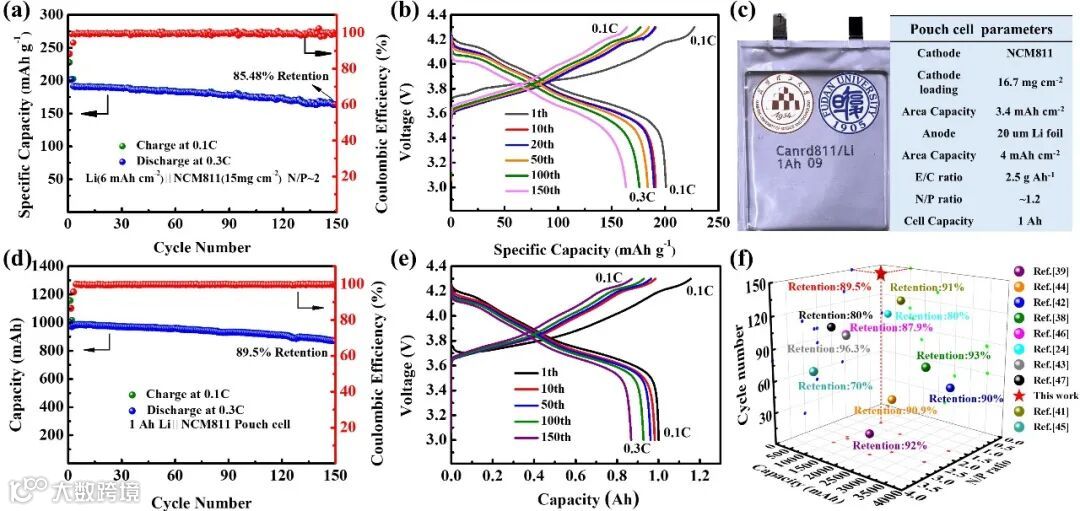
Figure 6. Electrochemical performance of Li||NCM811 full cells in our electrolyte under low N/P. a) Cycling performance of Li||NCM811 full cell under N/P ratio of 2. b) Charge/discharge profiles from selected cycles under N/P ratio of 2. c) Image of the Li||NCM811 pouch cell with low N/P and parameters of the pouch cell. d) Cycling performance of Li||NCM811 pouch cell performed at 0.1 C charge/0.3 C discharge within 3.0–4.3 V. e) Charge/discharge profiles of Li||NCM811 pouch cell from selected cycles. f) The comparison of cycle number, capacity and N/P ratio with previously reported (References are from Supporting Information).
科学材料站
文 章 链 接
Integrating Ethereal Molecular Backbones into the Ester Solvent with High Solubility of Nitrate for High-Voltage Li Metal Batteries
https://advanced.onlinelibrary.wiley.com/doi/10.1002/adma.202501654
添加官方微信 进群交流
SCI二氧化碳互助群
SCI催化材料交流群
SCI钠离子电池交流群
SCI离子交换膜经验交流群
SCI燃料电池交流群
SCI超级电容器交流群
SCI水系锌电池交流群
SCI水电解互助群
SCI气体扩散层经验交流群
备注【姓名-机构-研究方向】
投稿请联系contact@scimaterials.cn

点分享

点赞支持

点在看