



科学材料站
文 章 信 息
电负性偶氮酸盐框架人工界面层实现改善离子动力学和离子在界面层的富集实现长循环稳定性
第一作者:李文波
通讯作者:黄文欢*,张晓禹*,陈元平*
通讯单位:江苏大学;陕西科技大学
科学材料站
研 究 背 景
水性锌离子电池(ZIBs)的快速发展面临着水性电解液与锌阳极之间兼容性方面的关键挑战。已经探索了多种水性锌盐电解液,包括 ZnSO4(aq)、ZnCl2(aq)、ZnClO4(aq)·、Zn(Ac)2(aq)、Zn(Nos)2(aq)和 Zn(OTF)2(aq)。然而,锌在沉积过程中发生的脱溶过程带来了诸多不利因素。具体而言,锌离子必须克服能量壁垒导致大量还原性结合的水分子释放。由此产生的氢氧根(OH-)离子以及电极-电解质界面处相关的 pH 波动加剧了界面腐蚀和枝晶形成。在初始沉积之后,在锌表面形成了一层相对较松散的枝晶层,这不仅破坏了阳极的结构完整性,而且在后续的电化学循环中还导致离子耗尽和浓差极化。这种浓差极化现象进一步加剧了枝晶的生长,因为离子流会优先集中在枝晶的顶端,从而促进进一步的沉积和枝晶的延伸。 为应对这些挑战,探索了多种无机人工界面层(AILs)材料,包括金属有机框架(MOFs)、共价有机框架(COFs)、层状双氢氧化物(LDH)、MXene。这些材料在减少锌枝晶形成和腐蚀方面显示出良好的潜力。然而,仍存在一些固有的局限性,主要与固体-液体界面以及材料本身中的离子传输不良有关。MOFs 和 COFs 的电子导电性较低,以及 MXenes 中的离子通道无序性,阻碍了它们在促进有效离子传输方面的有效性。
科学材料站
文 章 简 介
近日,来自江苏大学张晓禹教授,陈元平教授团队和陕西科技大学黄文欢教授团队,在国际知名期刊Chemical Engineering Journal上发表题为“Enhancing ion dynamics and ion-enrichment through electronegative azolate framework for zinc anode stabilization”的研究性论文。该工作引入了一种负电性的三维 m-PO₃([N(CH₃)₄]+1/3·[Zn₂(mPO₃)₂/3(5-mtz)₃])作为锌阳极的人工界面层(AILs)。这种 AILs 具有双重作用:防止水直接与锌表面接触,从而抑制析氢和腐蚀,并在界面处增强离子富集。在不同温度下的阻抗测量结果显示,m-PO₃@Zn的活化能(Eₐ)(18.29 KJ/mol)低于纯锌阳极的活化能,这表明离子迁移动力学有了显著改善。因此,m-PO₃@Zn 阳极表现出出色的循环稳定性,其库仑效率为 95.6%,突显了其在长期、高性能锌基电池中的应用潜力。这项工作也是首次尝试此材料用于水系锌离子电池体系, 可以进一步尝试和开发电负性框架结构材料在水系锌离子电池的应用潜力
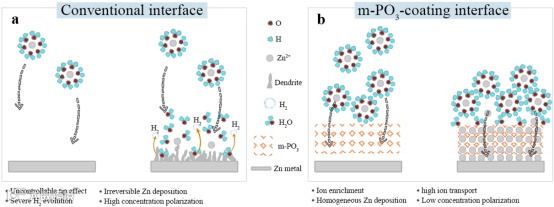
Scheme 1. Schematic illustrations of structure and Zn plating behavior for different layers. a) Zn2+ plating behavior in Zn metal electrodes. b) Zn2+ enrichment behavior in the coating layer made of m-PO3.
科学材料站
本 文 要 点
要点一:m-PO3@Zn负极与电解质的兼容性
通过Zn||Zn和Zn||Cu电池在多种测试和COMSOL模拟条件下的研究了电解质和负极兼容性和离子富集,使用光学显微镜和SEM对沉积在锌箔上的锌进行观测表现出均匀的锌沉积
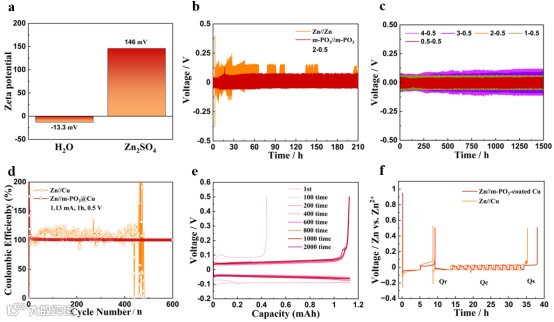
Fig. 1. The m-PO3@Zn electrochemical performance. (a) Zeta of m-PO3particle surface soaking in deionized water and 2M ZnSO4. (b) The symmetrical cells of pure Zn, m-PO3@Zn at 2 mA cm-2 and 0.5 mAh cm-2. (c) Cycle performance of m-PO3@Zn symmetric cell ranging from 1 to 4 mA cm-2 and 0.5 mAh cm-2. (d) CE of Zn plating/stripping process in m-PO3@Cu|Zn and Cu|Zn cells at 1.13 mA, 1h, 0.5V. (e) Voltage profiles of m-PO3@Cu|Zn cells at 1.13 mA, 1h, 0.5V. (f) The plots show Zn stripping/plating Coulombic efficiency (CE) for Cu|Zn and m-PO3@Cu|Zn cells at 25 °C.
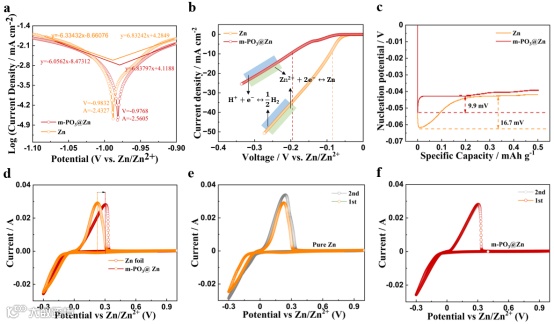
Fig. 2. The electrochemical performance. (a) Linear polarization curves of different electrodes in a 2 M ZnSO4 electrolyte. (b) The LSV curves of pure Zn and m-PO3@Zn electrodes in 2 M ZnSO4 aqueous electrolyte at a sweep rate of 5 mV/s. (c) Nucleation overpotential curves of symmetrical cells with different electrodes in a 2 M ZnSO4 electrolyte. (d, e, f) The CV curve for Zn|Cu and m-PO3@Zn|Cu half-cells.
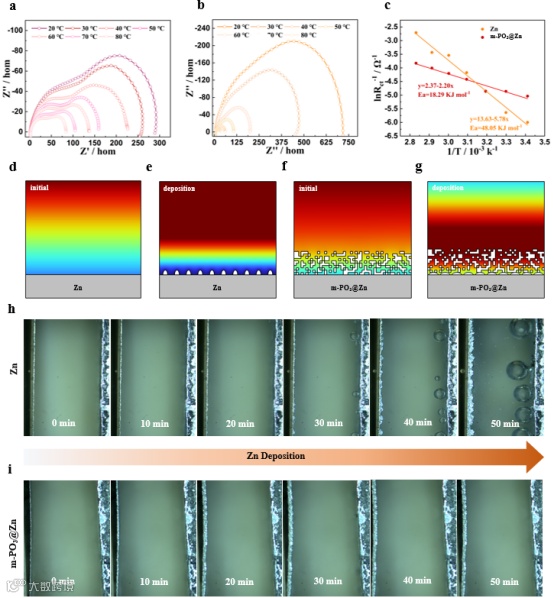
Fig. 3. Study of Zn2+ Deposition and Diffusion Behavior. (a, b) EIS spectra of different electrode surfaces at different temperatures. (c) Arrhenius plots of different electrode surfaces. COMSOL simulation of Zn-concentration distribution. (d, e) pure Zn surface region. (f, g) m-PO3@Zn surface region. (h, i) In-situ optical microscope images of Zn deposition on the surfaces of different electrodes at a current density of 5 mA cm-2.
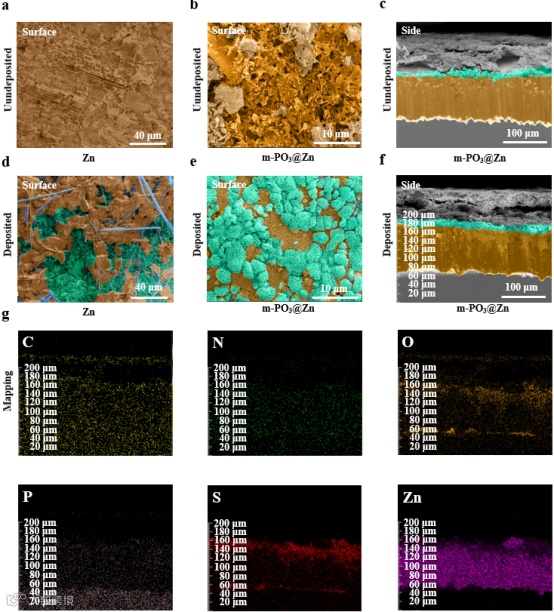
Fig. 4. SEM images of pure Zn and m-PO3coated Zn cells before and after deposition in 2 M ZnSO4. (a, d) Surface of pure Zn before and after deposition. (b, e) Surface of coating layer with PVDF before and after deposition. (c, f) Side of coating layer with PVDF before and after deposition. (g) Mapping of m-PO3-coated Zn.
要点二:不同人工界面层性能对比
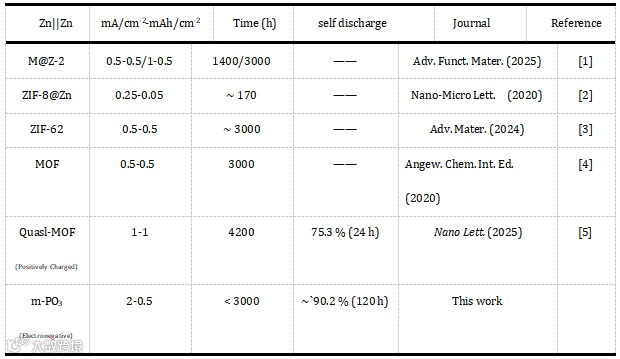
相比电正性Quasl-MOF材料,电负性m-PO3有更好的循环稳定性
Table S1. Comparison of electrochemical properties of different coating layers.
要点三:全电池的电化学性能
在MnO2||Zn全电池测试中, 展示更优异的稳定性
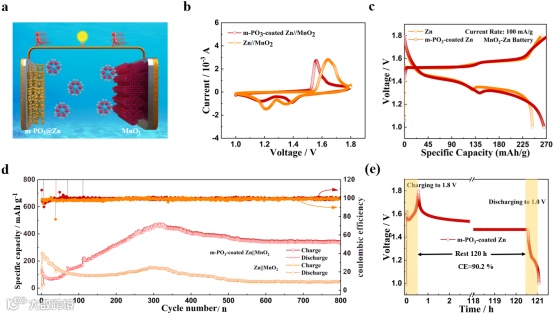
Fig. 5. The electrochemical performance of full cells in 2M ZnSO4. (a) The 3D structural design of full batteries. (b) CV curves at a scan rate of 0.1 mV s−1. (c) Initial charge and discharge curves of Zn//MnO2and m-PO3@Zn||MnO2. (d) Cycling and CE performance of Zn||MnO2and m-PO3@Zn||MnO2full batteries. (e) Self-discharge tests of the Zn||MnO2full batteries using the m-PO3@Zn as the anode after a rest of 120 h.
综上所述,锌金属阳极在水性电解液中存在热力学和动力学稳定性差的问题表现为无法控制的枝晶生长、短的循环寿命以及低的库仑效率(CE)(这是由于严重的副反应所致)。为解决相关问题,本研究探索了先进的固液界面工程。通过使用电负性金属有机框架(MOF)材料,在锌表面构建了一个离子富集层。这一策略不仅增强了离子动力学并降低了界面的浓度极化,而且还有效地抑制了与水有关的副反应。由此产生的稳定界面显著提高了电池的长期循环稳定性,证明了这种方法在推进水性锌基储能系统方面具有潜力。

添加官方微信 进群交流
SCI二氧化碳互助群
SCI催化材料交流群
SCI钠离子电池交流群
SCI离子交换膜经验交流群
SCI燃料电池交流群
SCI超级电容器交流群
SCI水系锌电池交流群
SCI水电解互助群
SCI气体扩散层经验交流群
备注【姓名-机构-研究方向】
投稿请联系contact@scimaterials.cn

点分享

点赞支持

点在看