





科学材料站
文 章 信 息
基于氯化镁后生长活化策略实现阴离子空位缺陷钝化的高效硒硫化锑太阳能电池
第一作者:苏学胜、李冬冬
通讯作者:周儒
单位:合肥工业大学
科学材料站
研 究 背 景
硫属化合物基光吸收材料因其在高效新一代薄膜太阳能电池中的应用潜力而受到广泛关注。过去几十年间,多种环境友好型金属硫属化合物材料已成功应用于光伏器件,如Cu2ZnSn(S,Se)4(CZTSSe)、Bi2S3、SnS、FeS、Sb2S3、Sb2Se3、AgBiS2、NaBiS2等。其中,锑硫属化合物(尤其是三元化合物Sb2(S,Se)3)展现出多项适用于光伏领域的关键优势:高光吸收系数(紫外-可见光区>10⁵ cm⁻¹)、可调带隙(1.1-1.7 eV)、无高毒性及稀有元素、化学组成简单可抑制二次相形成,以及独特的准一维(Q1D)晶体结构赋予各向异性电荷传输特性和良性晶界。近年来,基于水热法制备的Sb2(S,Se)3薄膜太阳能电池快速发展,其光电转换效率(PCE)从2018年的5.73%跃升至2020年的10%、2022年的10.7%、2023年的10.75%及2024年的10.81%。这一效率的快速提升表明,Sb2(S,Se)3光伏器件有望在短期内实现15%的PCE目标。目前,其性能已超越长期研究的二元无机吸收体(如FeS2和SnS),并接近CZTSSe器件水平。
尽管平面异质结型Sb2(S,Se)3太阳能电池发展迅速,其效率仍远低于Shockley-Queisser极限预测的理论辐射效率上限(32%)。关键挑战在于吸收层中存在大量本征及非本征缺陷,尤其是深能级缺陷易形成载流子复合中心。这是由于Sb2(S,Se)3的低对称性Q1D结构导致体相及界面处存在复杂且非常规的缺陷。晶胞中Sb与S/Se的不同化学环境形成两个不等价Sb位点和三个不等价S(或Se)位点。研究表明:富Sb的Sb2(S,Se)3薄膜主要存在阴离子空位(VS和VSe)及反位缺陷(SbS和SbSe),而富S(Se)的薄膜则以阳离子空位缺陷(VSb)为主,其中空位缺陷被证实为最有害的“致命”缺陷。对于创纪录效率的水热法制备Sb2(S,Se)3薄膜,飞行时间二次离子质谱(TOF-SIMS)分析显示,(S+Se)/Sb元素比通常低于标准化学计量比1.5,表明薄膜呈现S(Se)缺失特性。在此情况下,阴离子空位及反位缺陷因形成能较低,易在带隙中部产生深能级缺陷态。因此,开发有效策略钝化Sb2(S,Se)3吸收体中的深能级缺陷对提升器件性能至关重要。
科学材料站
文 章 简 介
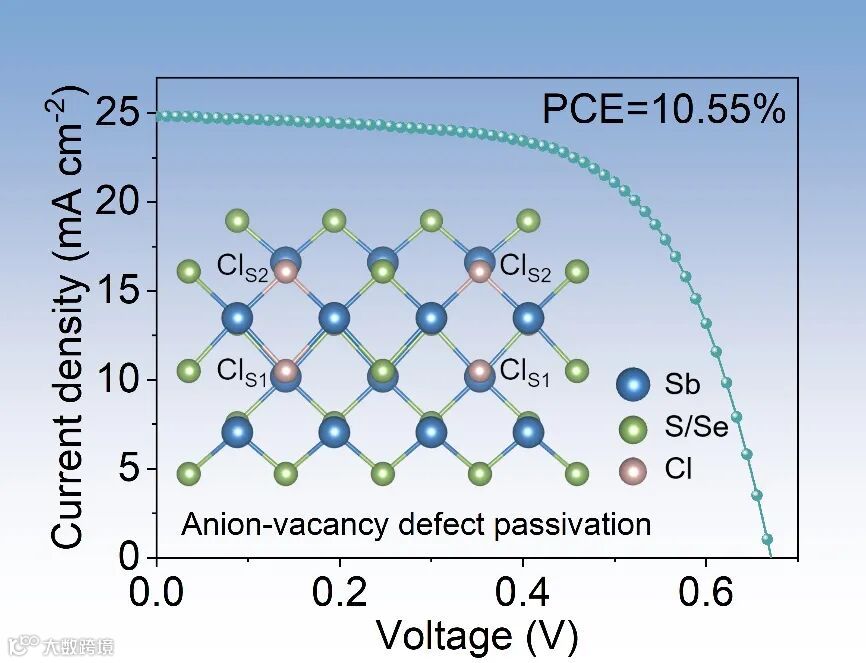
近日,合肥工业大学周儒课题在著名学术期刊《Small》上发表题为“Anion-Vacancy Defect Passivation for Efficient Antimony Selenosulfide Solar Cells via Magnesium Chloride Post-growth Activation”的研究论文。该文章基于缺陷钝化工程成功制备高效硒硫化锑太阳能电池。通过采用氯化镁溶液对硒硫化锑薄膜进行后处理,结合多尺度表征与理论计算揭示了其三重协同优化机制:氯掺杂有效钝化阴离子空位缺陷,诱导小晶粒再结晶形成致密大晶粒薄膜,并构建级联能带结构优化载流子传输。实验结果表明,基于缺陷工程的平面异质结硒硫化锑太阳能电池在标准太阳光(100 mW cm-2, AM 1.5G)照射下获得了10.55%的光电转换效率,这一性能指标位居锑基硫属薄膜太阳能电池领域前列。该工作从实验与理论层面论证了阴离子空位缺陷钝化对提升锑基硫属薄膜太阳能电池性能的关键作用,为新型锑基硫属薄膜光伏器件的设计与制备提供了重要参考。
科学材料站
本 文 要 点
要点一:基于缺陷钝化工程策略提升器件光伏性能
作者基于缺陷钝化工程策略开发制备高性能平面异质结Sb2(S,Se)3薄膜太阳能电池。研究发现:通过采用一定浓度氯化镁溶液对水热沉积的硒硫化锑薄膜进行后处理活化,通过一系列系统表征揭示了该活化步骤通过三重协同机制抑制电荷复合以提升器件性能:①通过Cl离子掺杂钝化阴离子空位缺陷;②诱导小晶粒再结晶形成大晶粒致密薄膜;③构筑级联能带结构优化电荷传输。基于此,经氯化镁处理的器件结构为FTO/SnO2/CdS/Sb2(S,Se)3/Spiro-OMeTAD/Au的Sb2(S,Se)3太阳能电池获得了10.55%的最佳光电转换效率,较对照组提升14%。且器件性能表现出良好的重复性和稳定性。
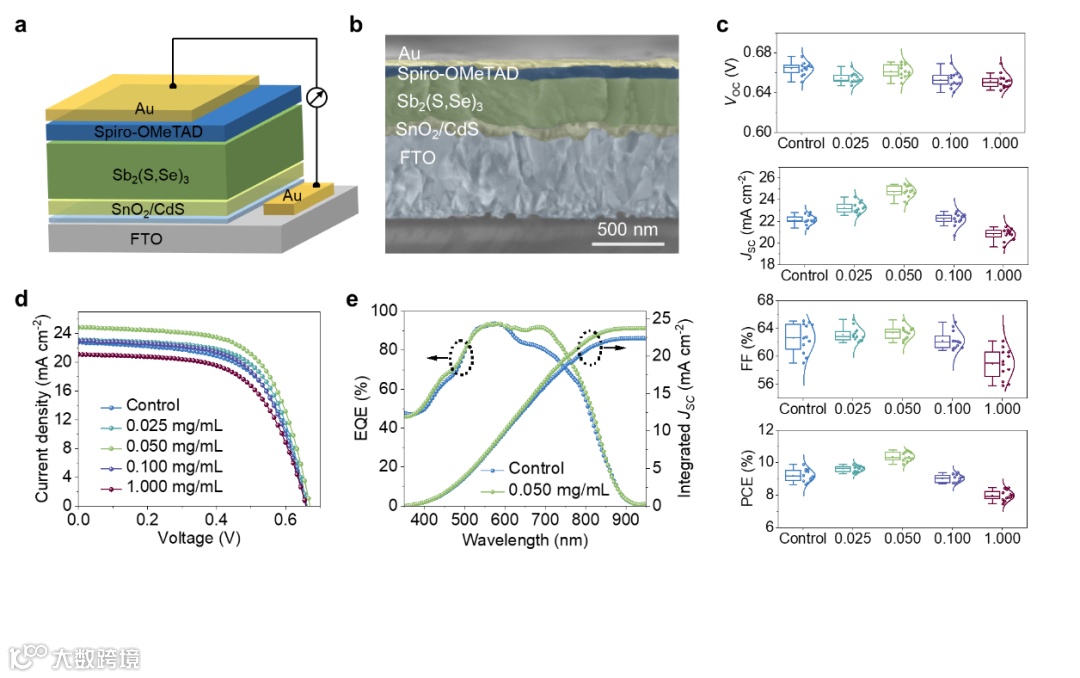
Figure 1. (a) Schematic illustration of Sb2(S,Se)3 solar cells with the device configuration of FTO/SnO2/CdS/Sb2(S,Se)3/Spiro-OMeTAD/Au, and (b) corresponding cross-sectional scanning electron microscopy (SEM) image. (c) Statistics of the performance parameters of the control devices and Sb2(S,Se)3 devices treated with different MgCl2 concentrations. 12 devices were measured for each type of devices, and the performance metrics of each device are shown as individual data points. (d) J-V curves of the best-performing control devices and Sb2(S,Se)3 devices treated with different concentrations of MgCl2. (e) External quantum efficiency (EQE) curves of the control and 0.050 mg mL-1 MgCl2-treated Sb2(S,Se)3 devices.
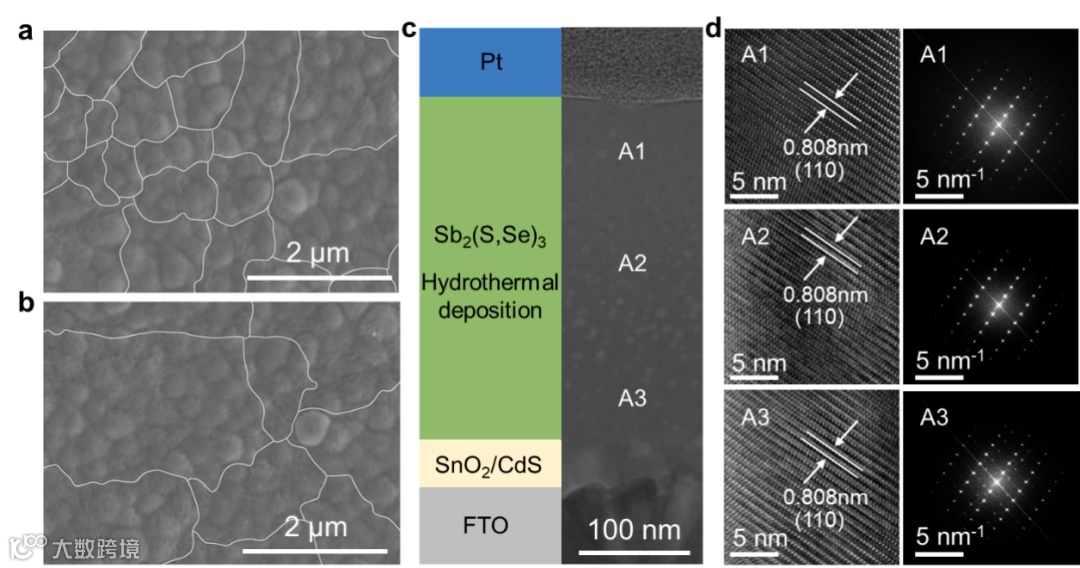
Figure 2. (a,b) Top-view scanning electron microscopy (SEM) images of control and 0.050 mg mL-1 MgCl2 treated Sb2(S,Se)3 film samples. (c) Cross-sectional transmission electron microscopy (TEM) image of MgCl2 treated Sb2(S,Se)3 sample deposited on FTO/SnO2/CdS substrate. (d) High-resolution TEM images and fast Fourier transform (FFT) patterns at points A1, A2, and A3.
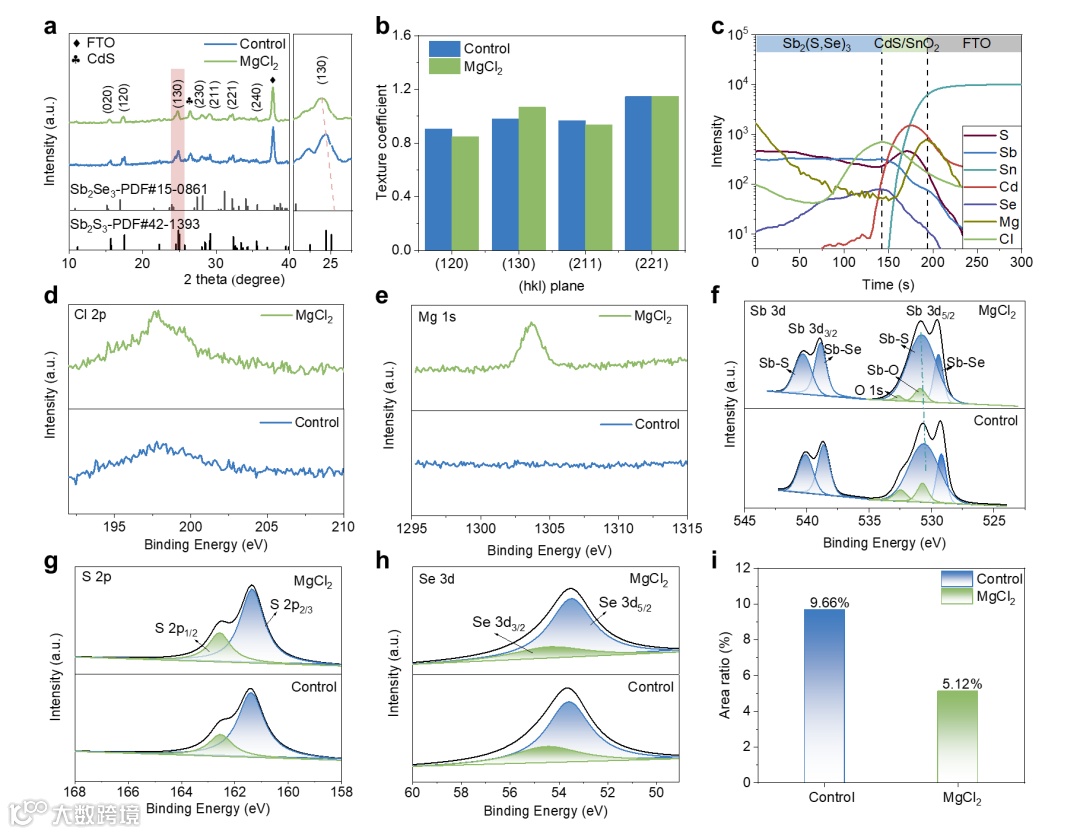
Figure 3. (a) X-ray diffraction (XRD) patterns of the control and 0.050 mg mL-1 MgCl2-treated Sb2(S,Se)3 film samples and partially enlarged spectra with 2-theta in the range from 24o to 25.5o. (b) Texture coefficients of the (120), (130), (211), and (221) peaks, which dominate the diffraction patterns of the Sb2(S,Se)3 films. (c) Time-of-flight secondary ion mass spectrometry (TOF-SIMS) depth profiles of the MgCl2-treated Sb2(S,Se)3 film sample. (d-h) High-resolution X-ray photoelectron spectroscopy (XPS) spectra of Cl 2p, Mg 1s, Sb 3d, S 2p, and Se 3d core levels, along with peaks fitted to these spectra, for the control and 0.050 mg mL-1 MgCl2-treated Sb2(S,Se)3 film samples. (i) The area ratio of Sb-O peak in Sb 3d XPS spectra.
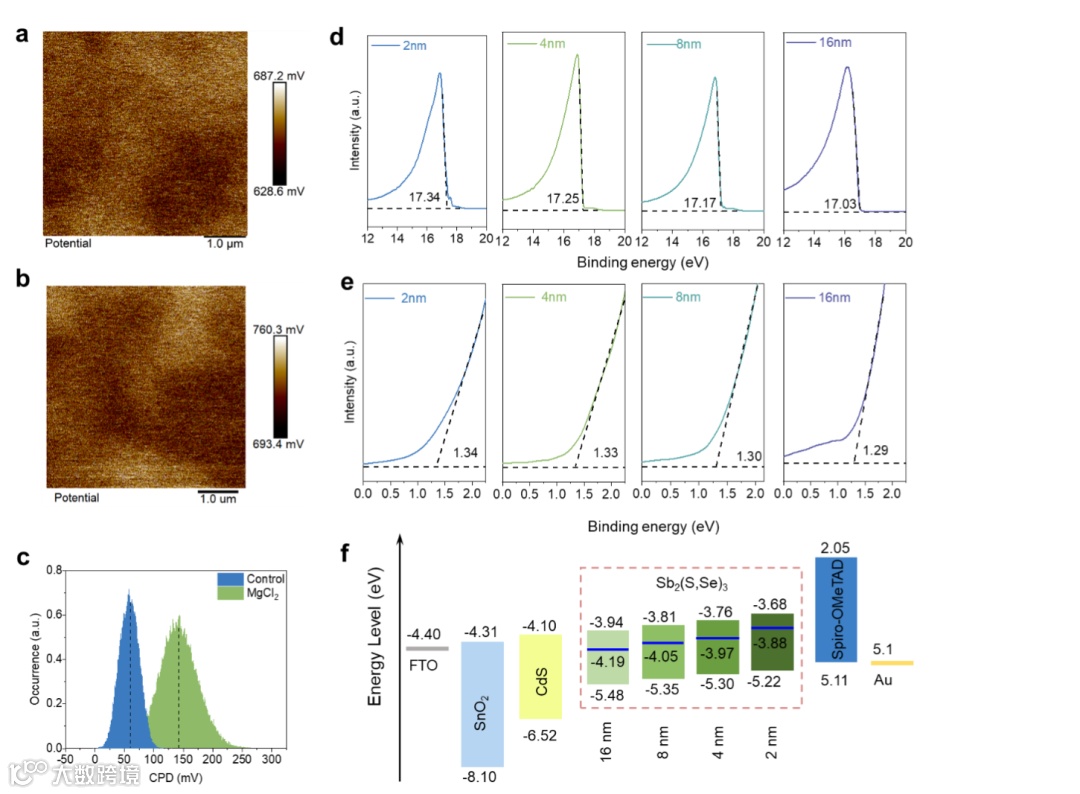
Figure 4. Kelvin probe force microscopy (KPFM) images of the (a) control and (b) MgCl2-treated film samples. (c) Contact potential difference (CPD) distribution of the control and MgCl2-treated Sb2(S,Se)3 films. Depth-dependent UPS spectra of MgCl2-treated Sb2(S,Se)3 film at (d) the secondary electron cutoff edge and (e) the Fermi edge. (f) Schematic diagram of the cascade band structure in the MgCl2-treated Sb2(S,Se)3 device.
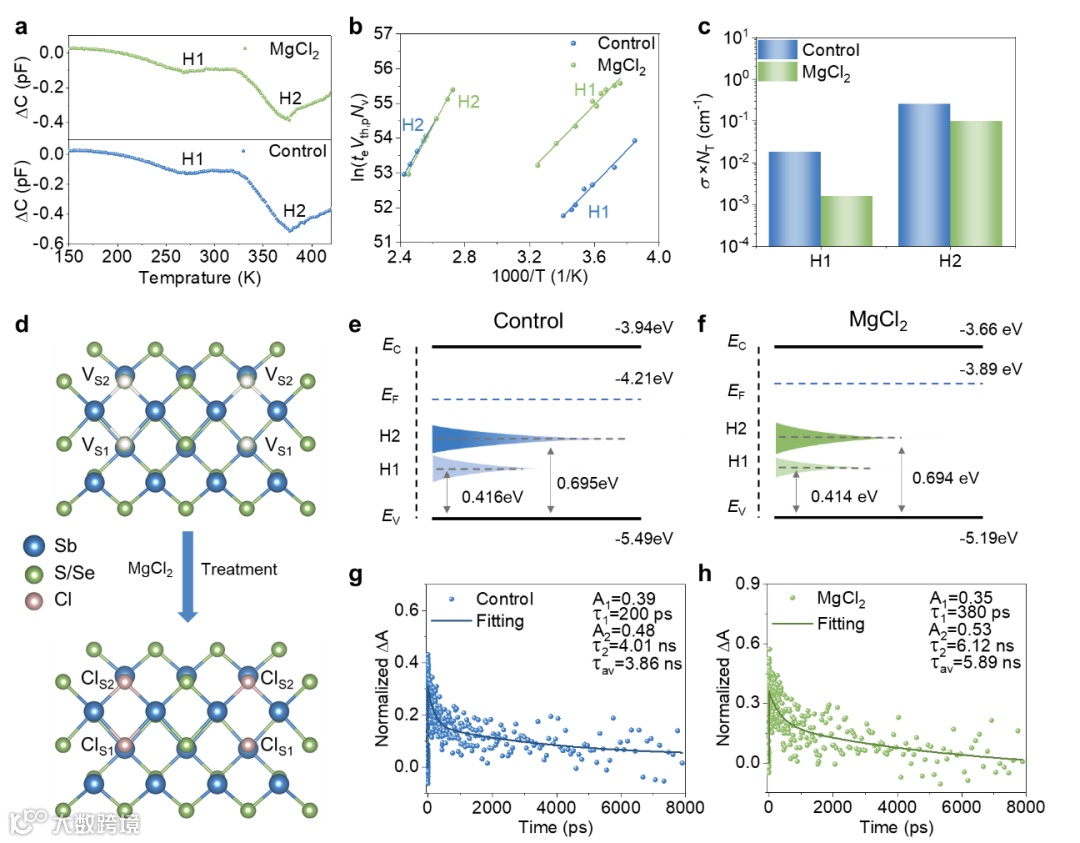
Figure 5. (a) Deep-level transient spectroscopy (DLTS) signals from the control and MgCl2 treated Sb2(S,Se)3 devices. (b) Arrhenius plots derived from DLTS signals. The data points were obtained by calculating internal transients included in DLTS signals with the discrete Laplace transform, and the solid lines are corresponding linear fits. H1 and H2 correspond to VS1 and VS2 anti-site defects, respectively. (c) The statistical histogram of calculated 𝜎×NT for different hole traps in the control and MgCl2treated Sb2(S,Se)3 devices. (d) The possible position of H1 (VS1) and H2 (VS2) defects in Sb2(S,Se)3 lattice. (e,f) Schematic of band edge positions and defect levels of the control and MgCl2treated Sb2(S,Se)3, respectively, including CB (ECB)and VB (EVB) edges, Fermi level (EF), and defect energy levels (H1, H2), relative to the vacuum level. (g,h) Transient kinetic decay (scatter) and corresponding biexponential curve fittings (solid line) monitored at 687 nm of the control and MgCl2 treated Sb2(S,Se)3 films. ΔA is defined as the change in the absorption of the sample before and after pumping.
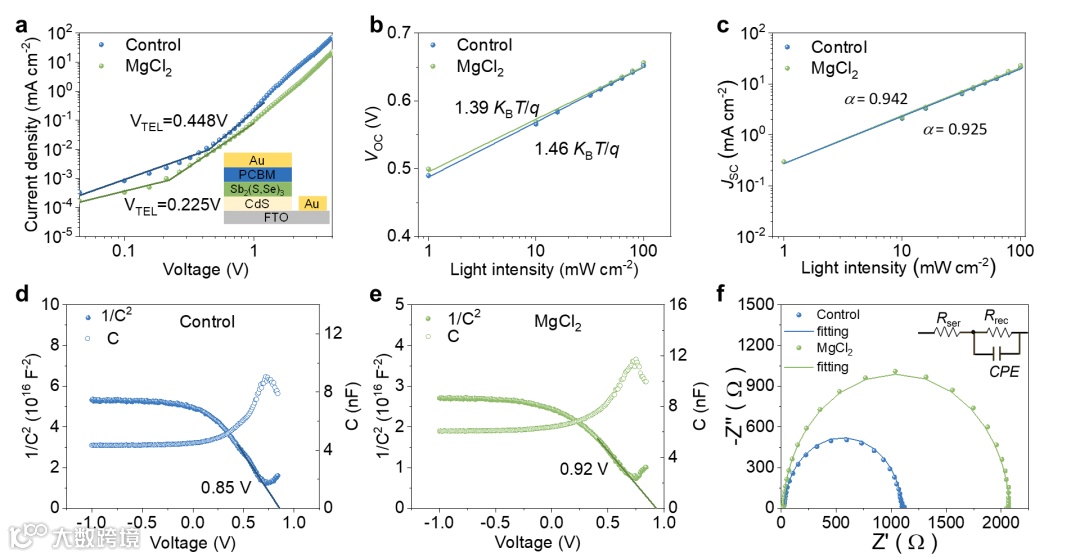
Figure 7. (a) Space-charge limit current density (SCLC) measurements of the control and MgCl2 98treated Sb2(S,Se)3 devices based on the electron-only structure device of FTO/CdS/ Sb2(S,Se)3/PCBM/Au. (b,c) The dependence of VOC and JSC on the light intensity for the control and MgCl2-treated Sb2(S,Se)3 solar cells. (d,e) C-V and Mott-Schottky (1/C2 versus V) plots for the control and MgCl2-treated Sb2(S,Se)3 devices measured in the dark at a frequency of 10 kHz. (f) Nyquist plots of impedance measurements of the control and MgCl2 treated Sb2(S,Se)3 devices, and the inset shows the simplified equivalent circuit model used for fitting curves.
要点二:基于第一性原理计算的阴离子空位钝化研究
作者为深入解析MgCl2后处理对锑硫族化合物吸收层中阴离子空位缺陷的钝化机制,基于第一性原理计算探究了Cl⁻与Mg2⁺离子在Sb2S3(为简化模型替代Sb2(S,Se)3)中的迁移行为。迁移路径分析表明:Cl⁻向硫空位(VS1或VS2)迁移的路径L2无能量势垒,因此Cl⁻容易进入硫空位体系,且逆过程需克服高达2.58-2.81 eV能垒说明了Cl⁻填充硫空位具有不可逆性;Mg2+离子更倾向沿着[Sb4S6]n链的方向方向扩散以IMg1的形式存在。该理论计算阐明MgCl2后处理通过间隙Cl⁻自发迁移至S空位实现缺陷钝化,从而优化器件电荷输运与收集性能。
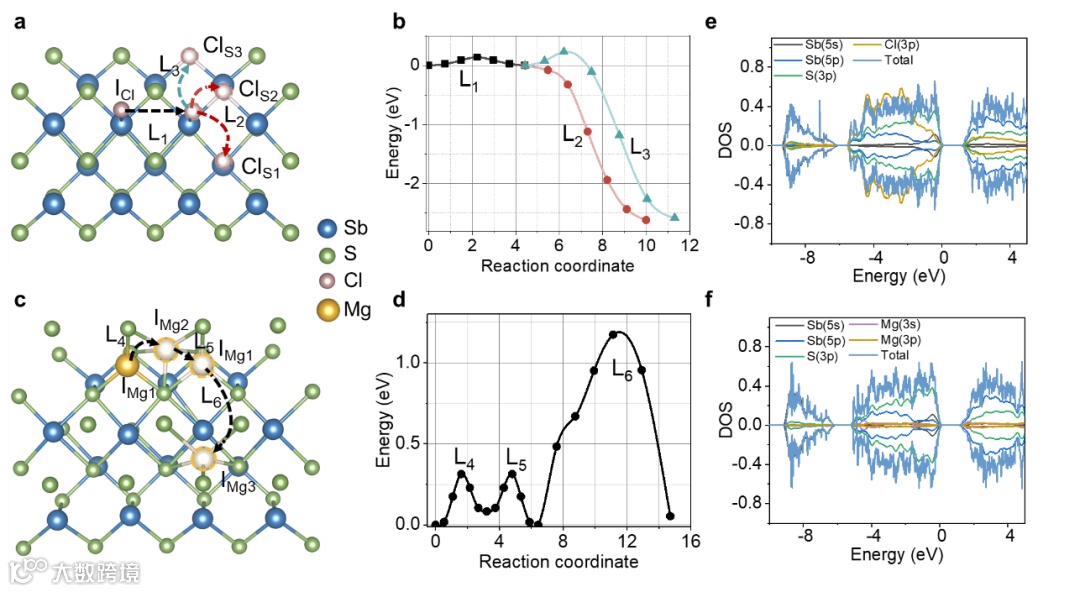
Figure 6. (a) Schematic diagrams and (b) energy versus the reaction coordinate for an interstitial Cl- ion migrate in Sb2S3. (c) Schematic diagrams and (d) energy versus the reaction coordinate for an interstitial Mg2+ ion migrate in Sb2S3. (e) The density of states of Sb2S3with a ClS3 inside. (f) The density of states of Sb2S3with an IMg1 inside.
科学材料站
文 章 链 接
Anion-Vacancy Defect Passivation for Efficient Antimony Selenosulfide Solar Cells via Magnesium Chloride Post-growth Activation Xuesheng Su, Dongdong Li, Qiang Xie, Bingxin Yang, Haolin Wang, Heng Chen, Zhiqiang Li, Tao Chen and Ru Zhou*Small, 2025, 21, 2412322
https://doi.org/10.1002/smll.202412322
科学材料站
课 题 组 介 绍
合肥工业大学电气与自动化工程学院周儒教授课题组现有教授1名、副教授2人、讲师1人。团队依托教育部光伏系统工程中心成立“先进光伏技术研究所”,围绕新能源产业发展,重点开展高效率、低成本、环境友好的下一代光伏技术基础与应用研究,并已建立完善的薄膜太阳能电池制造工艺路线与器件性能检测平台。课题组注重前沿交叉科学研究,近三年专注于面向自驱动物联网应用的先进室内光伏。承担国家自然科学基金面上项目/国际合作交流/区域联合基金、安徽省自然科学基金、企业委托项目等科研项目20余项;在Light: Science & Applications、Advanced Materials、Advanced Energy Materials等国际学术期刊发表SCI论文100余篇;获授权发明专利20余项。课题组与国内外多家科研结构和企业建立良好合作关系,包括英国牛津大学、美国华盛顿大学、新加坡南洋理工大学、中国科学技术大学等。
科学材料站
课 题 组 招 聘
因工作需要,课题组拟招聘光伏新能源方向青年教师/博士后。要求学科背景:材料学、物理学、电气工程和光学等。按照合肥工业大学政策统一要求,根据应聘者经历及业绩,提供具有竞争力的薪酬和科研启动专项经费(具体信息参考合肥工业大学人事处人才招聘公告https://rcb.hfut.edu.cn/2021/0123/c4181a250652/page.htm)。博士后待遇:正常聘期2年,A类年薪40万元/年(具有优秀学术背景和科研能力学术成果突出);B类年薪30万元/年(具有扎实的专业基础和较好科研潜力)。另外,学院提供配套支持津贴10万元/年(详见电气与自动化工程学院招聘公告https://ea.hfut.edu.cn/info/1081/3420.htm)。科研启动费≥5万元。在站期间获“尚新”博士后特别津贴者,可申请教职岗位;获一等及以上资助者,可按优先通道申请教职岗位。注:“尚新”博后特别津贴(具体参考合肥工业大学博士后管理办法https://rsc.hfut.edu.cn/2024/0624/c11787a304983/page.htm):特等资助(30万元,税前);一等资助(16万元,税前);二等资助(8万元,税前)。请有意者发送个人简历 (包括个人基本情况、教育和科研经历、代表性研究成果等)至邮箱zhouru@hfut.edu.cn。


添加官方微信 进群交流
SCI二氧化碳互助群
SCI催化材料交流群
SCI钠离子电池交流群
SCI离子交换膜经验交流群
SCI燃料电池交流群
SCI超级电容器交流群
SCI水系锌电池交流群
SCI水电解互助群
SCI气体扩散层经验交流群
备注【姓名-机构-研究方向】
投稿请联系contact@scimaterials.cn

点分享

点赞支持

点在看