



科学材料站
文 章 信 息
VN诱导的柔性多孔碳纳米纤维膜作为锂硫电池夹层
第一作者:王浩
通讯作者:邓南平*,曾树明*,康卫民*
科学材料站
研 究 背 景
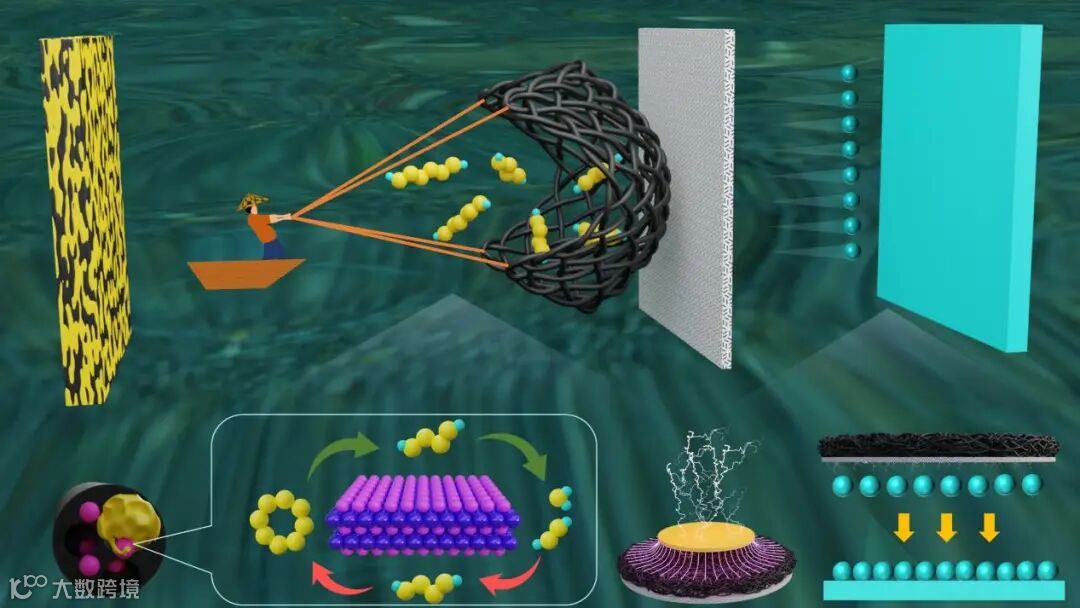
锂硫电池具有高比容量和高能量密度,有望替代传统的锂离子电池成为下一代储能设备。但是多硫化锂反应动力学缓慢和严重的“穿梭效应”影响了锂硫电池的循环性能。开发高性能的催化剂作为电池夹层来吸附和加速LiPSs的催化转化是LSBs发展的关键。本研究开发了含有N空位的VN(VN1-x)掺杂柔性PCNFs膜作为自支撑中间层,以调节电催化氧化还原动力学并减少LiPSs的“穿梭效应”。 实验结果和密度泛函理论(DFT)计算均表明,VN1-x/PCNFs膜具有较强的吸附能力和优异的电催化性能,有力地证明了其双向催化LiPSs转化的较强能力。同时还验证了其他纳米颗粒如MnF2,MnS等也能制备柔性的PCNFs膜,表现出普适性。
科学材料站
文 章 简 介
今日,天津工业大学的康卫民教授、邓南平副教授与扬州大学的曾树明副教授合作,在国际知名期刊Chemical Engineering Journal上发表标题为“A Flexible VN-Induced Porous Carbon Nanofibers Membrane as Multi-functional Interlayer for Li-S batteries”的实验文章。该文章研究了VN1-x/PCNFs膜的柔性生成机理以及对LiPSs的催化转化能力,并且通过原位阻抗技术和DRT分析阐释了VN1-x/PCNFs能够减小LSB内部阻抗的原因。文章最后还验证了MnF2,MnS等纳米颗粒也能使PCNFs表现出柔性。
Graphical Abstract
科学材料站
本 文 要 点
要点一:开发具有优异催化活性的柔性PCNFs膜
采用一步煅烧法设计并制备了柔性VN诱导PCNFs膜。透射电镜和双样例共聚焦电镜观察表明,VN纳米颗粒均匀分布在多孔碳的内部。柔性VN诱导PCNFs膜的第一性原理计算和电化学测试进一步证明了VN优异的催化性能。
要点二:令人惊叹的电化学性能表现
装配有自支撑中间层的Li-S电池在高载硫下表现出优异的倍率和循环性能。组装的软包电池也显示出1097.13 mAh g-1的初始放电比容量。此外,原位EIS和DRT分析表明,引入自支撑中间层可以有效降低Li-S电池循环过程中的内阻。
要点三:研究的普适性
进一步的研究发现,在PVP基纺丝溶液中加入不同种类的锰盐,煅烧后可以生成MnF2和MnS颗粒,也可以诱导柔性PCNFs膜,并且表现出优异的电化学性能
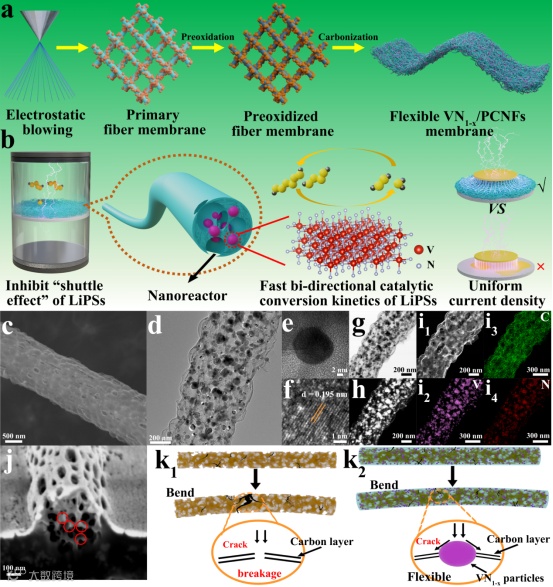
Fig. 1. Preparation and characterization of VN1-x/PCNFs membrane. a) Scheme of the synthetic process of VN1-x/PCNFs membrane. b) The merits of VN1-x/PCNFs membrane as self-interlayer for Li-S batteries. c) SEM image of VN1-x/PCNFs membrane. d-f) HRTEM image of VN1-x/PCNFs and measurement of VN1-x lattice spacing. g-i4) STEM image of VN1-x/PCNFs and corresponding EDS. j) FIB image of VN1-x/PCNFs. k1-k2) Schematic diagram of mechanism of formation in the flexibility of VN1-x/PCNFs.
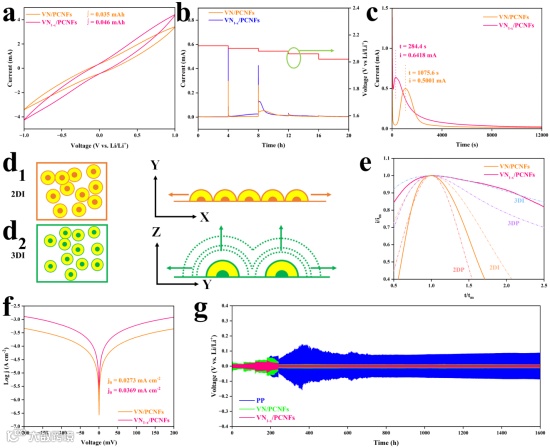
Fig. 2. Test of LiPS catalytic kinetics and DLi+. a) CV plots, b) PITT curves of a discharge process from 2.12 to 2.02 V of Li2S nucleation, and c) potentiostatic discharge curves of VN/PCNFs and VN1-x/PCNFs Li||Li2S6 cells. Schematic diagram of the mechanism of d1) 2DI and d2) 3DI, where x and y represent the horizontal plane and z represents the direction perpendicular to the horizontal plane. The dimensionless transient in comparison with theoretical 2D and 3D models for (e) VN1-x/PCNFs and VN/PCNFs Li||Li2S6 cells. im: peak current; tm: time needed to achieve the peak current. f) Voltage profiles at a current density of different Li||Li symmetrical battery. g) Tafel plots of different cells in exchange current density test.
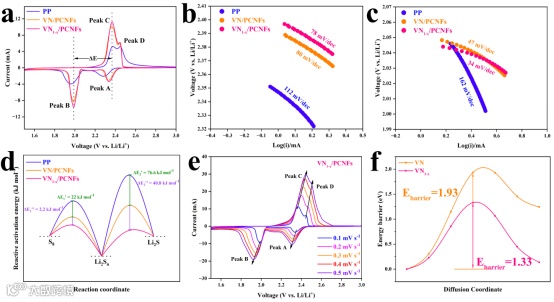
Fig. 3. CV texts of VN1-x/PCNFs cell. a) CV of different cells at 0.1 mV s-1. Tafel plots calculated from reduction b) Peak A, c) Peak B and corresponding d) relative activation energy of S species conversion process. e) CV curves of the VN1-x/PCNFs cells at scan rate ranging from 0.1 to 0.5 mV s-1. f) Energy barrier profile of Li+ migration on the (200) surface of VN1-x and VN.
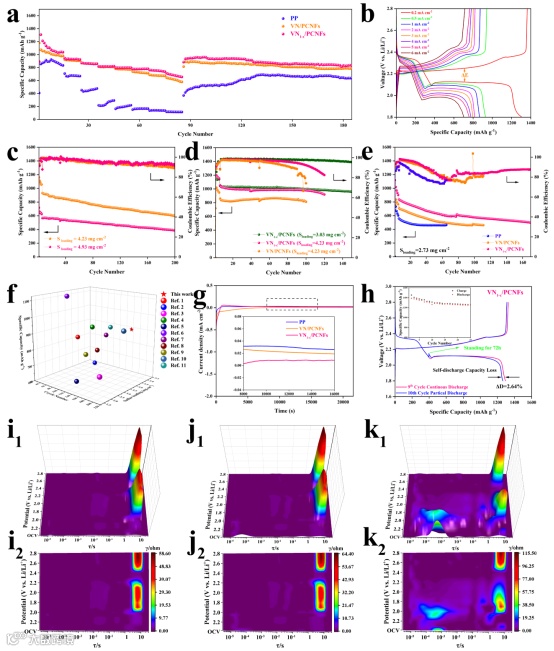
Fig. 4. Electrochemical performance of VN1-x/PCNFs cell. a) Rate performance of different cells. b) Galvanostatic charge-discharge curves of VN1-x/PCNFs cell at different current density. c) Cycling performance of high-sulfur-loaded VN1-x/PCNFs batteries. Cycling performance d) (-5℃) and e) (60℃) of Li-S batteries. f) Comparison of performances of the LSBs (see Table 3 for details). g) The shuttle current of the different cells. h) Self-discharge test of VN1-x/PCNFs cell. i1-k2 Corresponding DRT spectrum 3D image and its projection of in situ EIS plots during first discharging and charging processes.
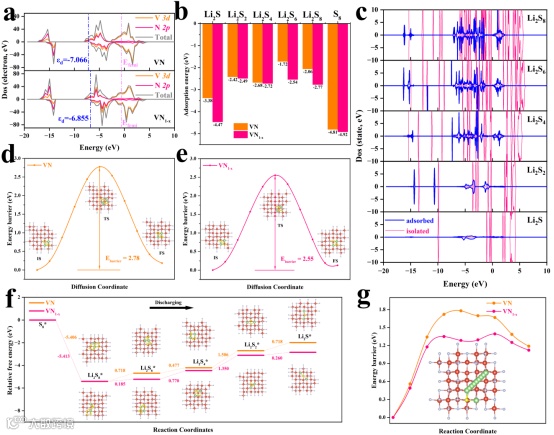
Fig. 5. DFT calculations of VN1-x and VN. a) The density of state (DOS) of VN and VN1-x. b) Adsorption energies of S8 and Li2Sx on (200) surface of VN1-x and VN. c) Comparison of DOS of the isolated and adsorbed Li2Sx. The geometry and corresponding energy profile of Li2S4 migration on the (2 0 0) surface of d) VN and e) VN1-x. f) The Gibbs free energy profiles of LiPS on VN1-x and VN. g) Energy barrier profiles of Li2S decomposition on the (200) surface of VN1-x and VN.
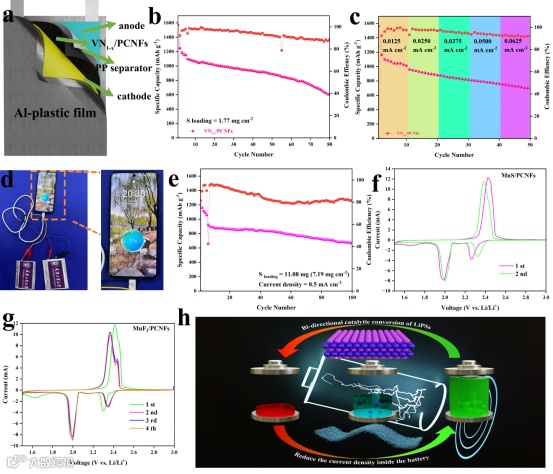
Fig. 6. The research of VN1-x/PCNFs pouch cell and universality of the flexible PCNFs. a) Schematic diagram of the structure of the assembled pouch cell. b) Cycling performance, c) Rate performance of the VN1-x/PCNFs pouch cell. d) The application test of pouch cells. e) Cycling performance of the VN1-x/PCNFs cell with VN1-x/PCNFs in cathode at the current density of 0.5 mA cm-2. The CV of f) MnS/PCNFs and g) MnF2/PCNFs cells at 0.1 mV s-1. h) The advantages of flexible PCNFs in Li-S batteries and their future application scenarios.
科学材料站
文 章 链 接
A flexible VN-induced porous carbon nanofibers membrane as multi-functional interlayer for Li-S batteries
https://authors.elsevier.com/sd/article/S1385-8947(25)08389-5
科学材料站
通 讯 作 者 简 介
康卫民教授简介:天津工业大学纺织科学与工程学院教授、博士生导师,中国纺织学术带头人、天津市中青年科技领军人才、全国纺织青年科技创新领军人才、天津市“131”创新型人才培养工程第一层次人选、天津市创新能手、天津市优秀科技工作者。康卫民教授长期从事纳微纤维材料理论研究、制备技术及应用开发,先后主持或参与国家级项目12项,天津市和企业项目20余项,研究成果荣获国家科技进步奖二等奖1项、省部级科技进步一等奖3项、二等奖4项。
邓南平副教授简介:天津工业大学纺织科学与工程学院副教授、博士生导师,主要从事纳微纤维材料的制备及其在锂电池领域的应用研究,目前主持国家自然科学基金、天津市面上项目、中国博士后科学基金特别资助项目及企业横向项目多项。近年来,申请人以第一和通讯作者在eScience、ACS Nano、AFM、ESM、AFMs等期刊发表SCI论文90余篇,4篇入选ESI高被引,总引用次数6619次,h-index为49。获授权专利12项,荣获2023年度中国纺织工业联合会发明专利金奖,专著《熔喷非织造材料》被评为部委级优秀出版物一等奖。连续入选“全球前2%顶尖科学家榜单”,并获“天津市优秀青年科技工作者”、“优秀创新创业导师奖”等称号。
曾树明副教授简介:2019年7月博士毕业于清华大学物理系,研究方向为凝聚态物理理论、计算和机器学习,以第一作者/通讯作者发表SCI论文30多篇。2021年1月入职扬州大学,获省、市人才项目,现专业技术职务为副教授。正主持国家自然科学基金青年项目1项(2022),低维量子国家重点实验室开放基金1项(2022)。已完成中国材料基因工程高通量计算平台开放基金1项(2021)。作为合作单位负责人参与山东省重大基础研究计划项目(2023)1项。

添加官方微信 进群交流
SCI二氧化碳互助群
SCI催化材料交流群
SCI钠离子电池交流群
SCI离子交换膜经验交流群
SCI燃料电池交流群
SCI超级电容器交流群
SCI水系锌电池交流群
SCI水电解互助群
SCI气体扩散层经验交流群
备注【姓名-机构-研究方向】
投稿请联系contact@scimaterials.cn

点分享

点赞支持

点在看