



科学材料站
文 章 信 息
双界面工程与溶剂化结构调控助力聚醚基半固态聚合物电解质在高压锂金属电池中的应用
第一作者:任玉杰
通讯作者:赵东林*
单位:北京化工大学
科学材料站
研 究 背 景
固态锂电池因其高能量密度和出色的安全性而被认为是下一代电化学储能技术的潜在候选者。然而,它们面临着电极-电解质界面接触不良的挑战。在这项工作中,通过原位聚合设计了一种聚(1,3-二氧戊环)半固体聚合物电解质(PDE-PF),表现出优异的高压稳定性和阻燃性能。引入二氟磷酸锂可以调控溶剂化环境,降低脱溶剂能垒,从而提高离子电导率(1.26 mS cm-1)和离子转移数(tLi+ = 0.55)。此外,它还可以在两侧电极表面同时分解,形成稳健的富无机电极-电解质界面。这有利于提高Li+沉积/剥离的可逆性,减少副反应。因此,使用PDE-PF的锂电池可以稳定循环1000 h而无极化电压增大。LFP||Li电池在3 C下循环300圈后的放电容量可达112.3 mAh g−1 。即使在高镍高压锂电池(NCM811||Li,4.4 V)中,它也显示出良好的循环稳定性。为了提高其安全性,添加了含磷/含氟阻燃溶剂,有效地捕获了热失控过程中产生的氢和羟基自由基,使电解质表现出不易燃性能。PDE-PF的成功开发为高安全、长寿命和高能量密度的锂金属电池提供了前瞻性方向。
科学材料站
文 章 简 介
近日,北京化工大学赵东林教授团队在国际知名期刊Chemical Engineering Journal上发表题为“Dual-interface engineering and solvation structure regulation enable polyether based semi-solid polymer electrolyte in high voltage lithium metal battery”的观点文章,第一作者为硕士研究生任玉杰。文章原位聚合技术,成功制备了半固态聚合物电解质PDE-PF。二氟磷酸锂的引入可以调控溶剂化环境,降低脱溶剂能垒,加速离子传输速率。此外,它还可以在电极表面率先分解构建出稳健的界面膜。还添加了含磷和含氟的溶剂,它们可以有效捕获热失控过程中产生的氢自由基和羟基自由基,使电解质表现出不易燃特性。
经过双界面工程和溶剂化结构调控,实现了聚醚基电解质在高压锂金属电池中的稳定循环。
科学材料站
本 文 要 点
我们合理设计了一种基于PDOL的固态聚合物电解质(PDE-PF),具有高电压稳定性和阻燃性能。通过引入LiPO2F2,构建了一个松散的溶剂化鞘,降低了锂离子脱溶剂化能垒,进而实现了更高的离子电导率和锂离子迁移数。此外,LiPO2F2作为双界面工程的关键组分,可以分别在正极和负极表面分解,形成稳定的电极-电解质界面。因此,PDE-PF电解质可以在锂对称电池中稳定循环1000 h,有效抑制了锂枝晶的生长。当应用于Li||LFP时,3C下循环300次后,其放电比容量可达112.3 mAh g−1。值得注意的是,使用PDE-PF的NCM811||Li电池在4.4 V的高截止电压下循环100圈后容量保持率为70.1%。此外,添加含磷/氟溶剂可以捕获H·和OH·,使电解液在明火下不易燃,提高了电池的安全性。双界面工程、溶剂化结构调节和阻燃溶剂引入的策略为下一代高密度、高安全性和长循环寿命的锂金属电池的发展提供了方向。
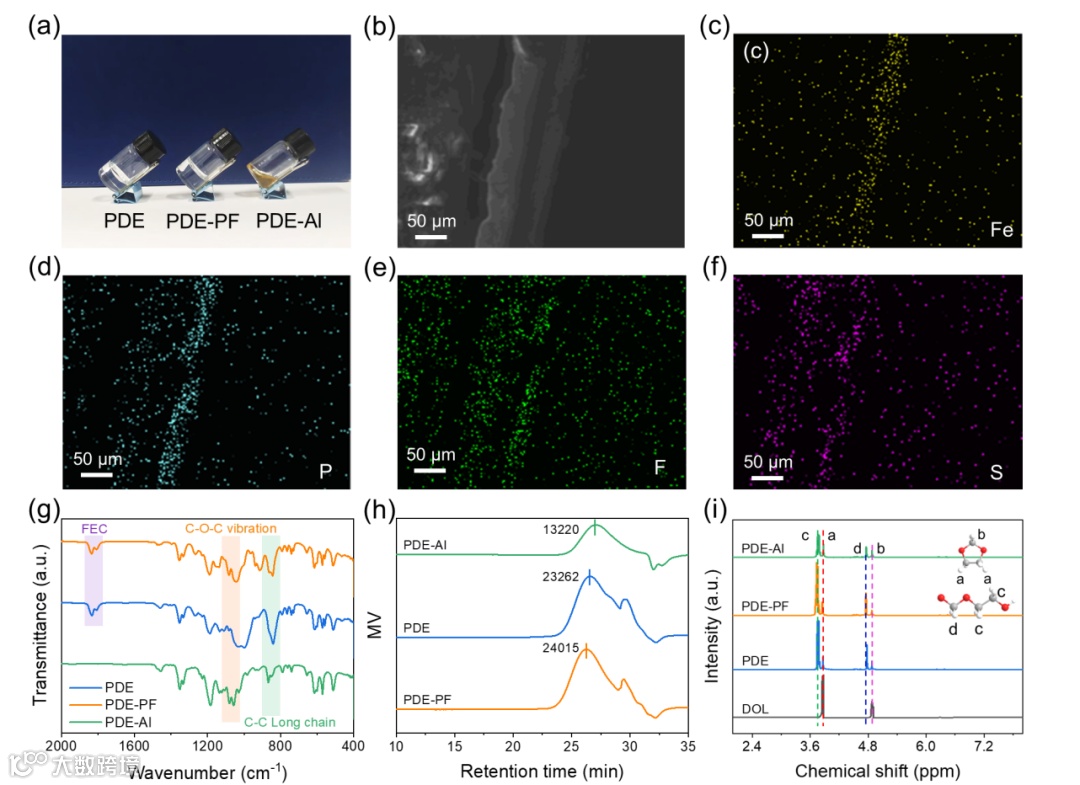
Fig. 1 (a) Digital photos of the three electrolytes; (b) the cross-section SEM image and element distribution of (c) Fe, (d) P, (e) F and (f) S in LiFePO4||Li battery using PDE-PF; (g) Fourier Transform Infrared Spectroscopy and (h) Gel permeation chromatography tests of PDE, PDE-PF and PDE-Al; (i) 1H NMR spectra of the three different electrolytes.
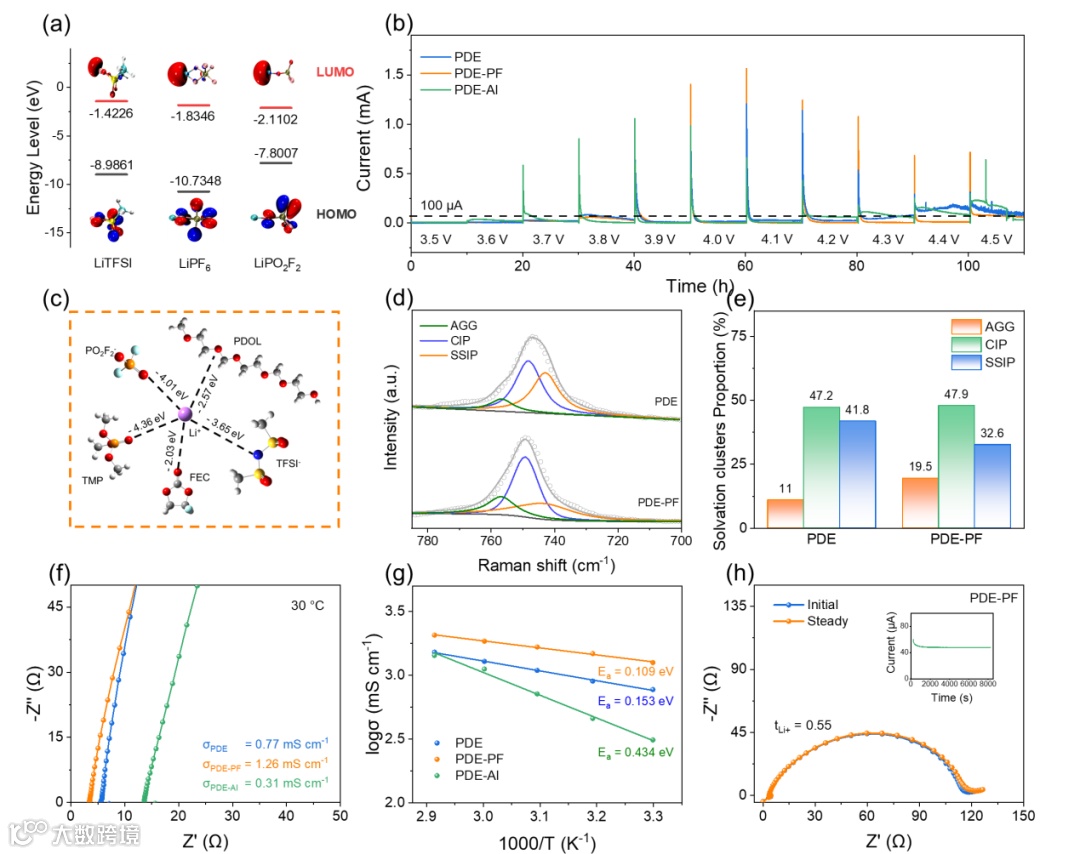
Fig. 2 (a) HOMO and LUMO energy levels of different lithium salts; (b) the electrochemical floatation tests of different electrolytes; (c) The binding energies of Li+ with different solvent molecules and anions; (d) Raman spectroscopy test and (e) the proportion of different solvated clusters in PDE and PDE-PF; (f) the ion conductivity and (g) activation energy of different electrolytes; (h) EIS curves before and after polarization and the chronoamperometry curves of PDE-PF.
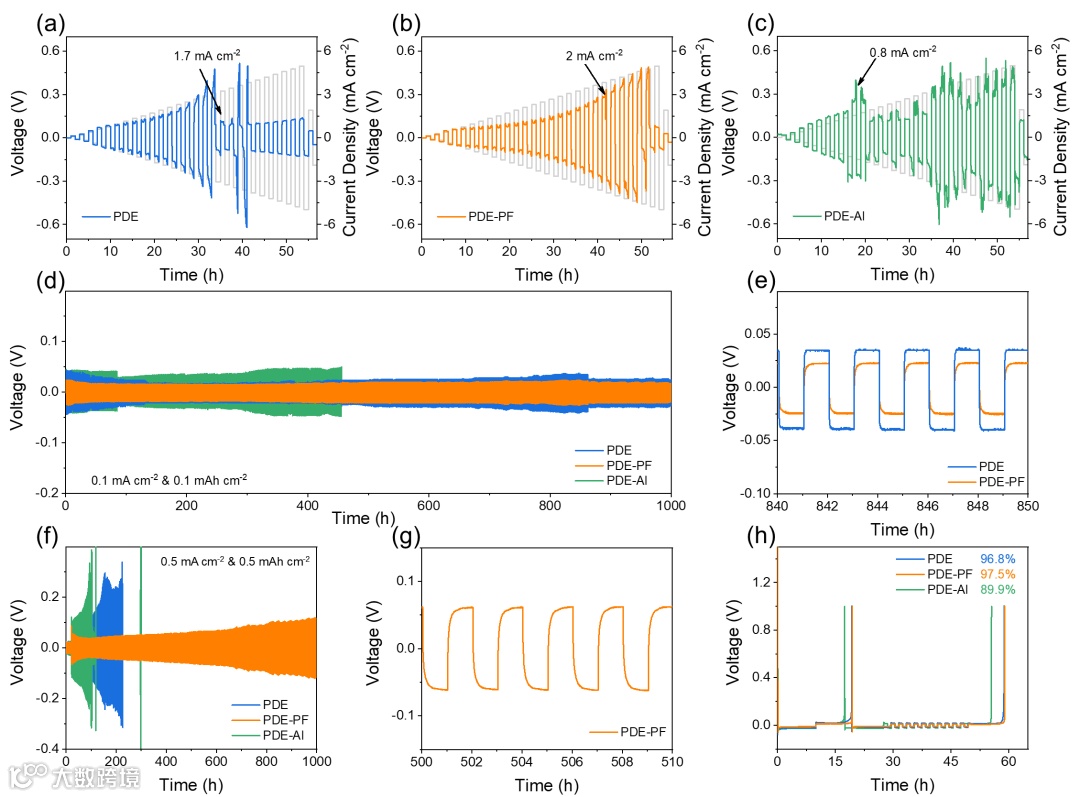
Fig. 3 The critical current density of (a) PDE-PF (b) PDE and (c) PDE-Al; (d) the cycle performance comparation and (e) the corresponding local magnification image during 840-850 h of Li||Li symmetric batteries using different electrolytes under 0.1 mA cm-2 & 0.1 mAh cm-2, (f) the cycle performance at 0.5 mA cm-2 & 0.5 mAh cm-2; (g) the polarization voltage curve during 500-510 h using PDE-PF at high current density; (h) the coulombic efficiency of three different electrolytes.
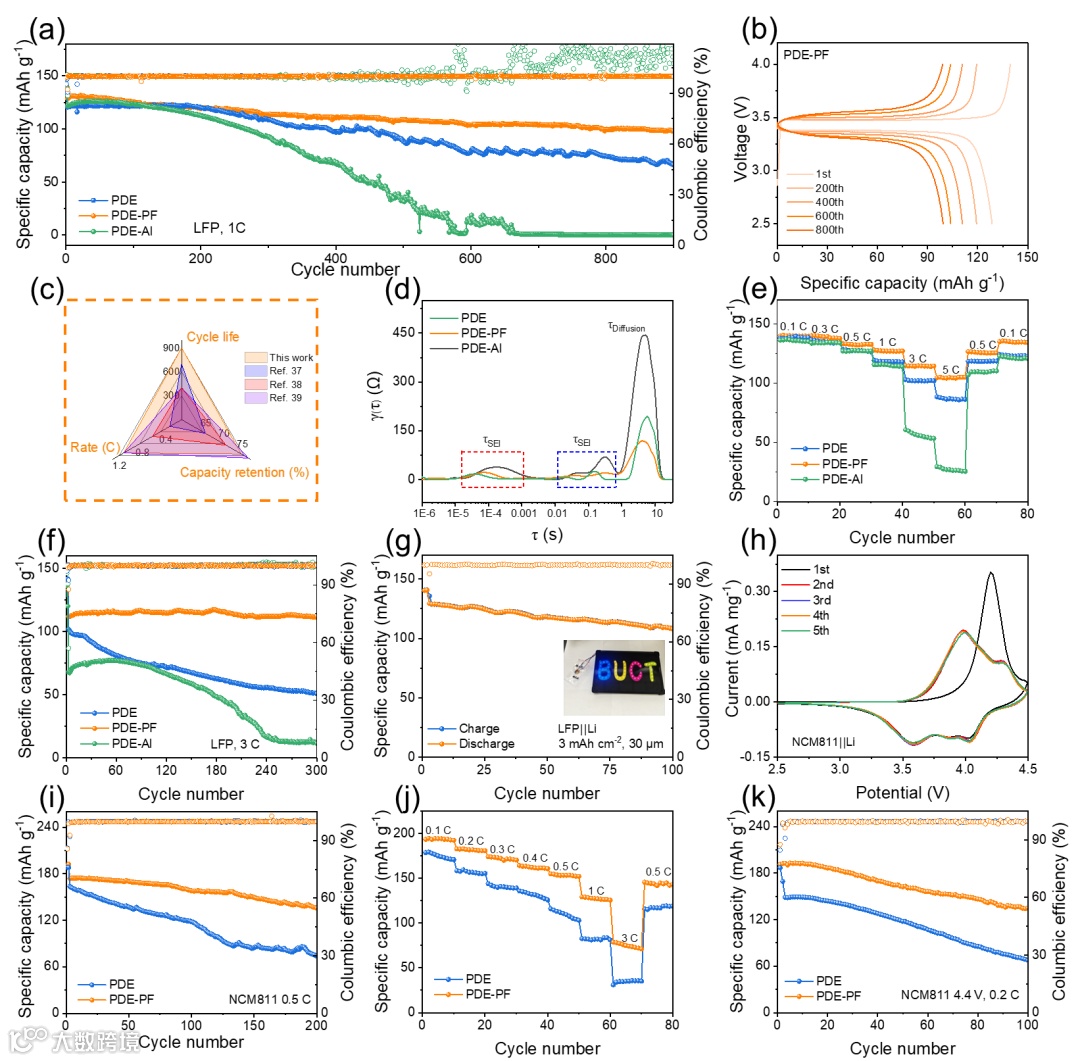
Fig. 4 (a) Long cycle performance of batteries using three different electrolytes with a current density of 1 C; (b) the charge and discharge curve of PDE-PF during cycling; (c) the comparative radar plot of this study with other existing work; (d) DRT results of the three electrolytes after cycle; (e) the rate performance of PDE, PDE-PF and PDE-Al; (f) the cycle performance of three electrolytes at 3 C; (g) the cycle performance of coin battery assembled with high-load cathode (3 mAh cm-2) and thin lithium foil (30 µm) using PDE-PF in LFP||Li battery, and the lighting experiment in internal illustration; (h) Cycle voltammetry curves of PDE-PF in NCM811||Li battery; (i) the cycle performance assembled with different electrolytes at 0.5 C; (j) The rate performance comparison of NCM811||Li batteries using PDE and PDE-PF; (k) the cycle performance of different electrolytes with a voltage window of 2.8-4.4 V.
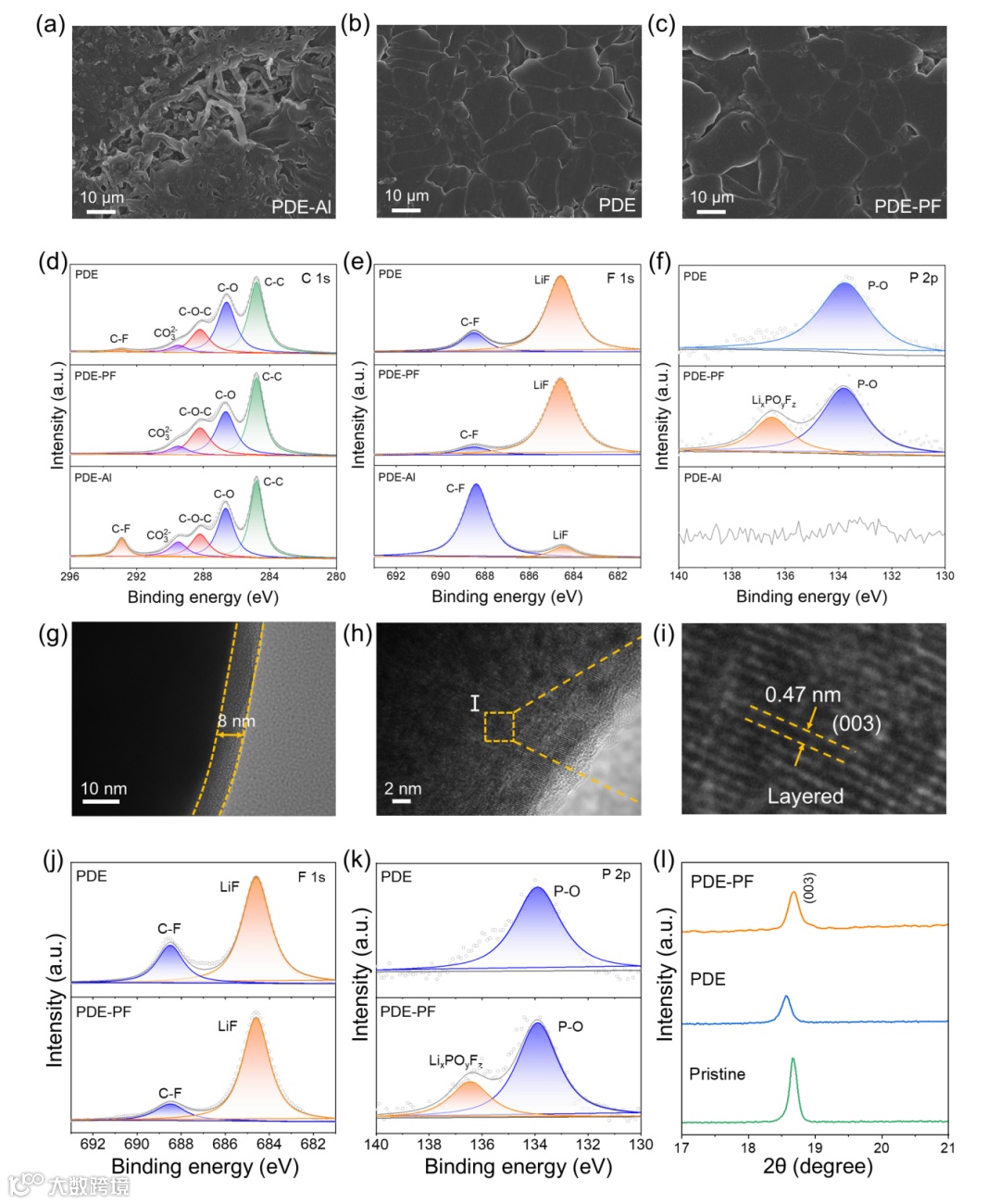
Fig. 5 SEM images of lithium metal anodes using (a) PDE Al, (b) PDE and (c) PDE-PF as electrolytes after 100 cycles; the high resolution XPS spectra of (d) C 1s, (e) F 1s and (f) P 2p on the surface of lithium metal anodes after cycle using different electrolytes; (g-i) the TEM images of cathode surface of NCM811||Li battery using PDE-PF after cycle; the high resolution XPS spectra of (j) F 2p and (k) P 1s on the surface of NCM811 electrode after cycling; (l) the XRD spectrum of pristine NCM811 electrode and the NCM811 cathode using different electrolytes.
科学材料站
文 章 链 接
Dual-Interface engineering and solvation structure regulation enable polyether based semi-solid polymer electrolyte in high voltage lithium metal battery
https://doi.org/10.1016/j.cej.2026.175769
科学材料站
通
赵东林教授简介:赵东林,男,1968年生,汉族,北京化工大学教授,博士导师。主要研究方向为碳纤维及其复合材料、碳纳米管、石墨烯、吸波材料、锂离子电池负极材料、超级电容器电极材料、半固态/固态锂电池等,作为项目负责人先后主持国家“863”项目、国家自然科学基金、教育部博士点基金(博导基金)、北京市自然科学基金、北京市科技新星计划项目、企业委托项目等30余项。2002年入选北京市科技新星计划,2013年入选苏州工业园区科技领军人才,2016年入选姑苏创新创业领军人才,1998年获地质矿产部科技成果二等奖1项,2009年获国防技术发明三等奖1项,2014年获中国石油和化学工业协会科技进步三等奖1项。

添加官方微信 进群交流
SCI二氧化碳互助群
SCI催化材料交流群
SCI钠离子电池交流群
SCI离子交换膜经验交流群
SCI燃料电池交流群
SCI超级电容器交流群
SCI水系锌电池交流群
SCI水电解互助群
SCI气体扩散层经验交流群
备注【姓名-机构-研究方向】
投稿请联系contact@scimaterials.cn

点分享

点赞支持

点在看