



科学材料站
文 章 信 息
通过电子结构工程为全固态锂金属电池设计与锂金属兼容的硫化物电解质
第一作者:刘盛
通讯作者:陈东江*,雷天宇*,陈伟*
单位:电子科技大学
科学材料站
研 究 背 景
全固态锂金属电池(ASSLMBs)因兼具高能量密度与本征安全性,被视为下一代储能技术的核心方向。其中,硫化物电解质因其高离子电导率和良好的机械性能而受到广泛关注。然而,硫化物电解质与锂金属负极之间的自发化学反应性会导致界面处生成混合离子-电子导电界面(Li2S、Li3P等),诱发持续的电解质分解和活性锂消耗并带来锂枝晶生长的隐患,降低电池的循环性能。传统改性策略(如人工界面层、锂合金化)虽可延缓副反应,却未能解决PS₄结构单元本征不稳定性这一根源问题——其脆弱的P-S共价键易被富电子的锂原子攻击并生成Li₃P/Li₂S。通过电子结构工程精准调控PS₄单元的轨道杂化状态(如P 3p-S 3p轨道能级重构),可从根本上抑制电子转移驱动的界面降解,为突破ASSLMBs商业化困境提供新范式。
科学材料站
文 章 简 介
近日,电子科技大学陈东江/雷天宇/陈伟团队在Nano Energy期刊发表题为“Design of lithium metal- compatible sulfide electrolytes by electronic structure engineering for all- solid- state lithium metal batteries”的研究论文。团队通过F/Ca双原子协同掺杂重构硫化物固态电解质(Li₆PS₅Cl)的化学键特性,解决了其与锂金属负极的界面兼容性难题,实现了高临界电流密度(1.6 mA cm-2)和长循环稳定性(0.2 mA cm-2下循环超3000小时)。组装的Li||LiCoO₂全电池400次循环后容量保持率80%,柔性软包电池成功驱动LED阵列。该工作为通过本征电子结构调控设计高稳定性固态电解质提供了新范式。
科学材料站
本 文 要 点
要点一:电解质结构表征
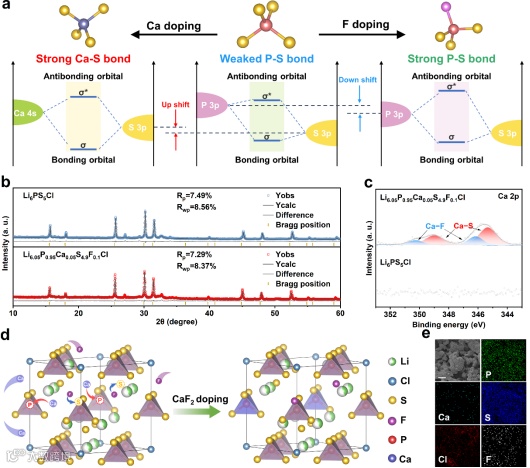
Figure 1. The structure properties of Li6PS5Cl and Li6.05P0.95Ca0.05S4.9F0.1Cl SSEs. (a) Schematic illustration of bonding and antibonding states. (b) XRD pattern and corresponding Rietveld refinement results of Li6PS5Cl and Li6.05P0.95Ca0.05S4.9F0.1Cl SSEs. (c) Ca 2p XPS spectra of Li6PS5Cl and Li6.05P0.95Ca0.05S4.9F0.1Cl SSEs. (d) Crystal structure diagram of Li6PS5Cl and Li6.05P0.95Ca0.05S4.9F0.1Cl SSEs. (e) Scanning electron microscope images and corresponding element mapping of Li6.05P0.95Ca0.05S4.9F0.1Cl SSEs. The scale bar is 5 μm.
要点二:电子结构分析
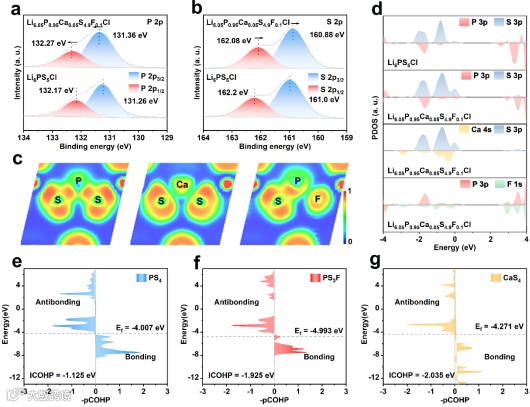
Figure 2. The electronic structure analysis of Li6PS5Cl and Li6.05P0.95Ca0.05S4.9F0.1Cl SSEs. (a) P 2p and (b) S 2p XPS spectra of Li6PS5Cl and Li6.05P0.95Ca0.05S4.9F0.1Cl SSEs. (c) Electronic localization function of Li6PS5Cl (left) and Li6.05P0.95Ca0.05S4.9F0.1Cl (middle and right) SSEs. (d) Calculated partial density of state of Li6PS5Cl and Li6.05P0.95Ca0.05S4.9F0.1Cl SSEs. The crystal orbital Hamilton population of the (e) PS4 unit in Li6PS5Cl SSEs and the (f) PS3F and (g) CaS4 unit in Li6.05P0.95Ca0.05S4.9F0.1Cl SSEs.
要点三:对锂稳定性分析
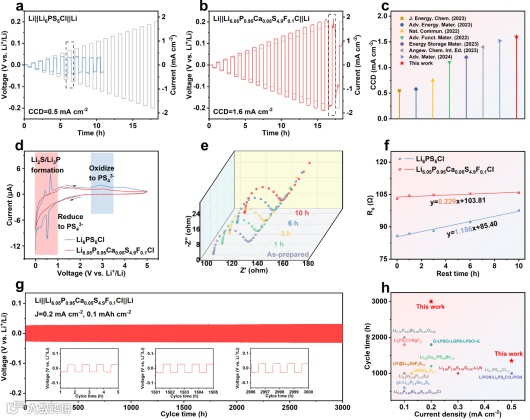
Figure 3. Stability properties of Li6PS5Cl and Li6.05P0.95Ca0.05S4.9F0.1Cl SSEs. The critical current density of the Li||Li symmetric cell with (a) Li6PS5Cl and (b) Li6.05P0.95Ca0.05S4.9F0.1Cl SSEs. (c) Summary of reported critical current density of SSEs. (d) CV profile of Li||In cell with Li6PS5Cl and Li6.05P0.95Ca0.05S4.9F0.1Cl SSEs. (e) The Nyquist plots of Li||Li symmetric cell with Li6.05P0.95Ca0.05S4.9F0.1Cl SSEs. (f) The relationship between cell impedance and rest time. (g) The cycling performance of Li||Li symmetric cell with Li6.05P0.95Ca0.05S4.9F0.1Cl SSEs. (h) Summary of reported cycling performance and corresponding plating/stripping current density of Li||Li symmetric cell with SSEs.
要点四:电极/电解质界面分析
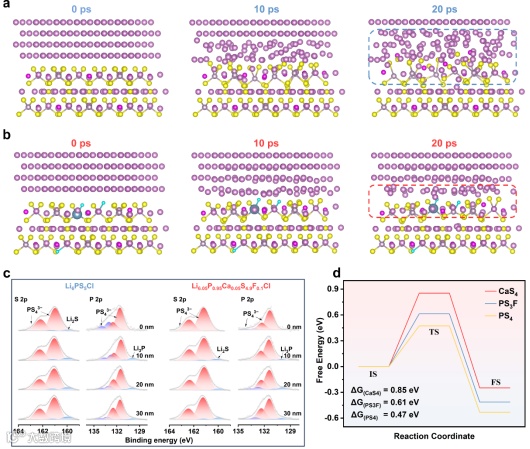
Figure 4. Analysis of interface reaction with Li||Li6PS5Cl and Li||Li6.05P0.95Ca0.05S4.9F0.1Cl . Ab initio molecular dynamics snapshots of (a) Li||Li6PS5Cl and (b) Li||Li6.05P0.95Ca0.05S4.9F0.1Cl interface at 0, 10, and 20 ps. (c) P 2p and S 2p XPS spectra of the Li electrodes after 10 cycles in Li||Li symmetric cells with Li6PS5Cl and Li6.05P0.95Ca0.05S4.9F0.1Cl SSEs, respectively, with different sputtering depth. (d) The calculated Gibbs free energy for the reaction of Li metal with different units.
要点五:全电池性能分析
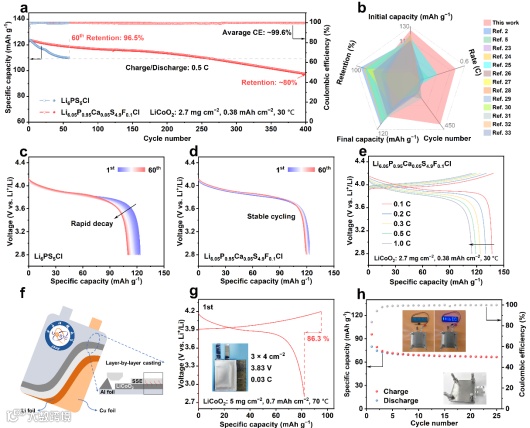
Figure 5. Electrochemical performance of all−solid−state Li metal batteries. (a) Cyclability of Li||LiCoO2 full cells with Li6PS5Cl and Li6.05P0.95Ca0.05S4.9F0.1Cl SSEs. (b) Performance comparison of Li6.05P0.95Ca0.05S4.9F0.1Cl with other SSEs for Li||LiCoO2full cells. Discharge voltage profiles of Li||LiCoO2full cells with (c) Li6PS5Cl and (d) Li6.05P0.95Ca0.05S4.9F0.1Cl SSEs from 1st to 60th cycles. (e) Charge/discharge voltage profiles of Li||LiCoO2full cells with Li6.05P0.95Ca0.05S4.9F0.1Cl SSEs at different rate. (f) Schematic illustration of all−solid−state pouch cell and layer−by−layer casting. (g) Charge/discharge voltage profiles (insert: digital photographs of all−solid−state Li metal pouch cell) and (h) cyclability of all−solid−state Li||LiCoO2 pouch cell with Li6.05P0.95Ca0.05S4.9F0.1Cl SSEs (insert: digital photograph of all−solid−state Li metal pouch cell inserted into test fixture and lighting up LEDs).
科学材料站
主 要 结 论
本文提出了一种电子结构工程策略,通过F/Ca双原子协同掺杂重构硫化物固态电解质(Li₆PS₅Cl)的化学键特性,解决了其与锂金属负极的界面兼容性难题。研究揭示:F掺杂通过增强P 3p-S 3p轨道杂化降低PS4单元反应活性,而Ca取代诱导S位点富电子态形成稳定CaS4单元,协同抑制了界面副反应。优化后的Li6.05P0.95Ca0.05S4.9F0.1Cl 电解质展现了1.6 mA cm⁻²的高临界电流密度(原始材料3倍)和2.67×10⁻³ S cm⁻¹离子电导率,可支持Li||Li对称电池在0.2 mA cm⁻²下稳定循环3000小时。组装的Li||LiCoO2全电池400次循环容量保持率80%,柔性软包电池成功驱动LED阵列,验证了商业化潜力。该工作为通过本征电子结构调控设计高稳定性固态电解质提供了新范式。
科学材料站
文 章 链 接
Design of lithium metal−compatible sulfide electrolytes by electronic structure engineering for all−solid−state lithium metal batteries
https://doi.org/10.1016/j.nanoen.2025.111176

添加官方微信 进群交流
SCI二氧化碳互助群
SCI催化材料交流群
SCI钠离子电池交流群
SCI离子交换膜经验交流群
SCI燃料电池交流群
SCI超级电容器交流群
SCI水系锌电池交流群
SCI水电解互助群
SCI气体扩散层经验交流群
备注【姓名-机构-研究方向】
投稿请联系contact@scimaterials.cn

点分享

点赞支持

点在看