



科学材料站
文 章 信 息
基于3D打印技术研制适配高倍率锂电池分级多孔结构的厚电极
第一作者:吕俊宏
通讯作者:张东材*,黄燕平*,邱景义*,陈熙邦*
单位:广西大学,防化研究院,北部湾大学
科学材料站
研 究 背 景
锂离子电池因高能量密度和长循环寿命等优点,已成为便携式电子设备、电动汽车和可穿戴医疗设备的主要电源,但是随着电子设备的快速发展,对锂电池提出了更高能量密度和功率密度的挑战。开发兼具高能量输出、优异倍率性能及长循环寿命的电极已成为“双高”电池的的研究热点。增加电极厚度是提高能量密度的有效策略,传统涂布方法制备的厚电极存在离子传输路径曲折、动力学迟缓以及严重的浓度极化问题,导致高倍率下电池的容量保持率下降。具有多孔结构的厚电极可以缩短离子扩散路径并降低迂曲度,从而同时提高能量密度和功率密度,但如何快速实现微观分级多孔孔隙的跨尺度构建,是当前研究的难点。
科学材料站
文 章 简 介
近日,来自防化研究院、广西大学、北部湾大学等单位的研究人员合作,在Advanced Energy Materials期刊上发表题为"3D Printing Manufacturing of Thick Electrodes With Hierarchical Porous Structures for High-Power Lithium Metal Batteries"的研究论文。
科学材料站
文 章 简 介
该研究开发了一种将3D打印、冰模板法和相分离法相结合的制造策略,成功构建了具有分级多孔结构的磷酸铁锂厚电极。通过优化得到P-30%墨水具有优异的剪切变稀行为、形状保持能力和高孔隙率,其中屈服应力为538.9 Pa,储能模量为21480 Pa,孔隙率为79.57%。使电极的电荷转移电阻降低至69.8 Ω,锂离子扩散系数提高至1.65 × 10⁻¹⁰ cm² s⁻¹,组装的扣式电池在5C倍率下比容量达109.3 mAh g⁻¹,2000次循环后容量保持率90.8%。COMSOL模拟证实了离子传输效率的提高和浓度极化的缓解主要来源于电极的分级多孔结构。组装的软包电池在10000次弯曲循环后仍保持稳定性能,展示了出色的机械柔韧性和在高功率储能系统的应用潜力。
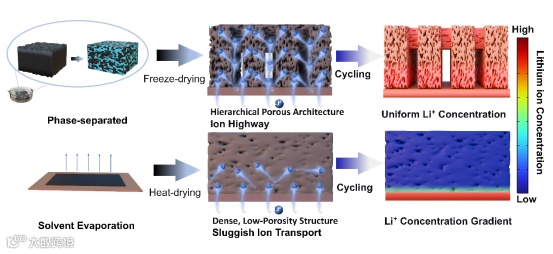
Figure 1.Schematic diagram comparing the structure and ion transport of graded porous electrodes and traditional coated electrodes
科学材料站
本 文 要 点
要点一:建立了3D打印分级多孔厚电极的可打印性标准
研究团队系统探究了固含量对墨水流变性能的影响,建立了评价墨水可打印性的关键标准。墨水需具备剪切变稀行为以确保顺利挤出,屈服应力需低于系统最大剪切应力(约5.1 kPa)以实现挤出启动,储能模量需足够高以维持沉积后结构稳定,结构恢复率需高于75%以保证多层打印的形貌。基于这些标准,P-30%墨水(屈服应力538.9 Pa,储能模量21480 Pa,恢复率>75%)在打印性能和结构稳定性之间达到了最佳平衡。
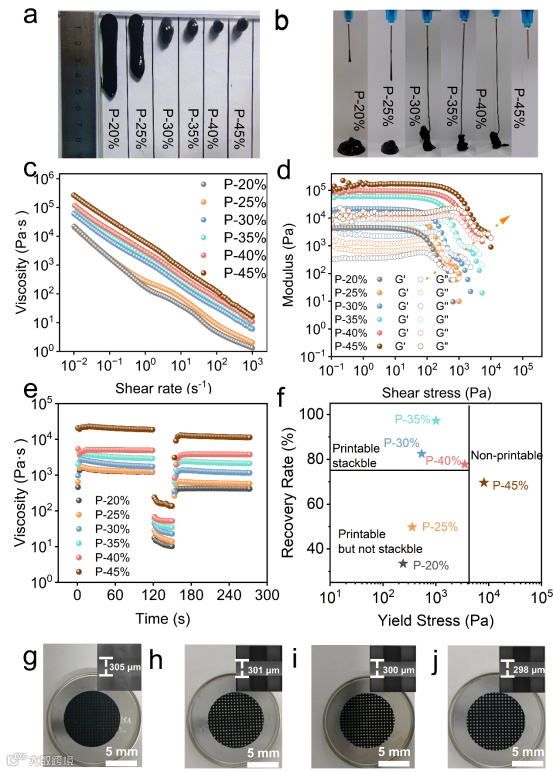
Figure 2. Rheological properties of inks with different solid contents. (a) Viscosity of different slurries measured by doctor blade casting method; (b) Images of slurries with different solid contents extruded from the same nozzle; (c) Apparent viscosity of LiFePO4 inks with different solid contents as a function of shear rate; (d) Variation of storage modulus (G′) and loss modulus (G″) with shear stress; (e) Structural recovery test after shear-induced disruption for various slurries; (f) Assessment of printability and structural stability; (g–j) Images of electrodes printed from slurries with different solid contents. (g) P-25%; (h) P-30%; (i) P-35%; (j) P-40%.
要点二:相分离与冰模板协同构建了多级离子传输网络结构
本研究创新采用两步协同成孔策略:相分离过程中溶剂与非溶剂快速交换,在丝材内部形成连通微孔网络;冰模板过程中冰晶作为物理模板支撑多孔骨架,真空升华避免结构坍塌。微观表征证实,P-30%电极孔隙率79.57%远高于传统涂布电极的58.89%,且呈独特双峰孔径分布。成功构建了“宏观打印通道-相分离微孔”的多级离子传输网络。
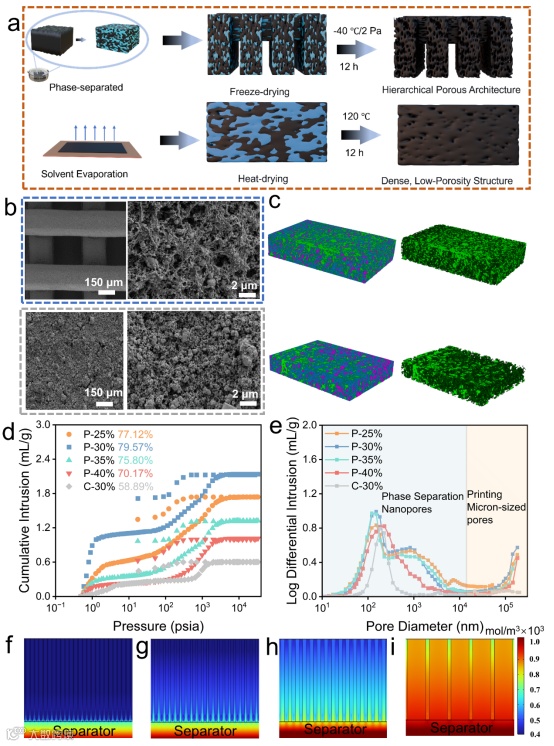
Figure 3. (a) Schematic drying diagrams of printed and coated electrodes. (b) Surface SEM images of electrodes: top:C-30%, bottom: P-30%. (c) CT scan images of electrodes: upper: P-30%; bottom:C-30%. The purple, green, and blue regions represent LiFePO4 particles, pores, and PVDF/Super P, respectively. (d) Mercury intrusion porosimetry curves of the four electrodes. (e) Comparison of average pore sizes of printed electrodes. (f–i) Simulated Li+ concentration profiles for electrodes with pore diameters of: (f) 2 µm, (g) 5 µm, (h) 10 µm, (i) 50 µm, at a 2C rate and t = 120s.
要点三:COMSOL模拟揭示了多级孔结构快离子传输动力学的机制
电化学测试表明,P-30%电极电荷转移电阻最低(69.8 Ω),远低于传统涂布电极(228.6 Ω),锂离子扩散系数达1.65×10⁻¹⁰ cm² s⁻¹。COMSOL模拟显示,随孔径增大锂离子浓度分布均匀性显著提高,2-5 μm孔径呈现明显浓度梯度,而50 μm孔径呈高度均匀分布,证实相互连通的大孔通道为离子传输提供了快速路径,有效抑制浓度极化。
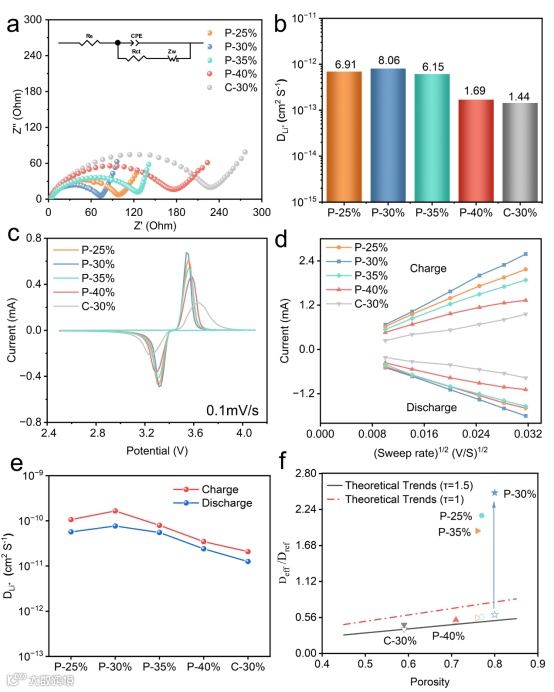
Figure 4. Optimization of ionic dynamics in electrodes. (a) Nyquist plots of fibrous electrodes measured at 3.4 V. (b) Li+ diffusion coefficients derived from EIS results. (c) Cyclic voltammetry (CV) curves of different electrodes at a scan rate of 0.1 mV s−1. (d) Normalized peak current vs. square root of scan rate for various electrodes during charge/discharge processes. (e) Li+ diffusion coefficients obtained from fitting results of CV measurements at different scan rates. (f) Correlation between electrode porosity and normalized effective Li+ diffusion coefficient. Solid scatter points represent experimental measurements. Hollow markers represent theoretical predictions calculated from the measured porosity (ε) and tortuosity (τ).
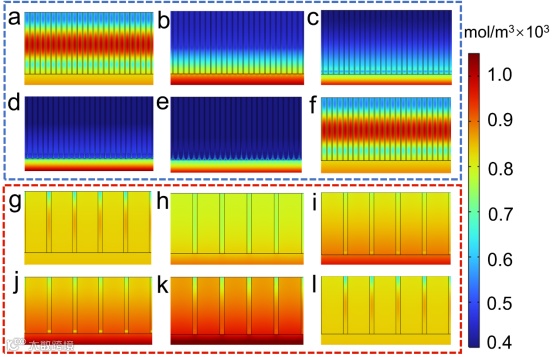
Figure 5 COMSOL simulation analysis of electrolyte salt con-centration distribution on the electrode surface for coated and printed electrodes discharged to the cutoff voltage at different rates: (a-f) Coated electrode at (a) 0.1C, (b) 0.5C, (c) 1C, (d) 2C, (e) 5C, (f) 0.1C; (g–l) Printed electrode at (f) 0.1C, (g) 0.5C, (h) 1C, (i) 2C, (j) 5C. (l) 0.1C.
要点四:多级孔结构赋予电极优异电化学性能及机械性能
P-30%电极倍率性能优异,5C下仍保持109.3 mAh g⁻¹;循环稳定性突出,5C高倍率下2000次循环后容量保持率达90.8%。组装软包电池经车辆碾压及10000次弯曲循环后性能无衰减,仍可点亮LED阵列。卓越机械耐受性源于多级孔结构:三维互联聚合物骨架提供结构支撑(拉伸强度4 MPa,压缩强度2 MPa)的同时实现可观变形,展现出在高功率柔性储能系统中的实际应用潜力。
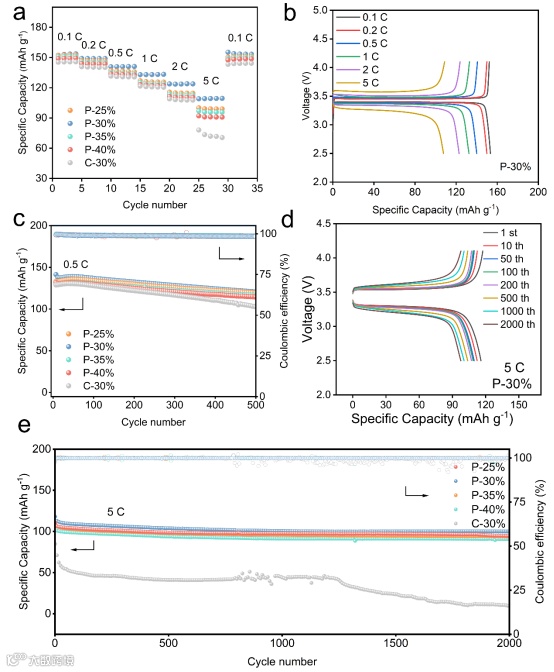
Figure 6. Electrochemical rate performance of electrodes with different solid contents: (a) Rate capability; (b) GCD curves of P-30% electrode at various current rates; (c) Cycling performance of five electrodes at 0.5C; (d) GCD curves of P-30% electrode at different cycle numbers at 5C charging-discharging rate; (e) Cycling performance of five electrodes at 5C.
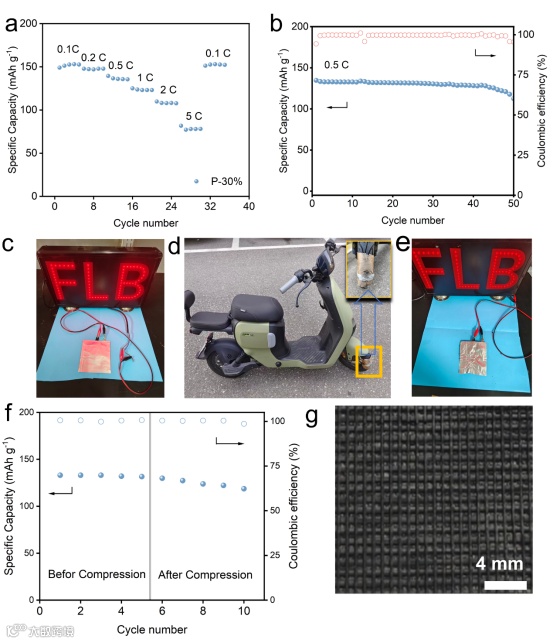
Figure 7. Performance of flexible printed electrode pouch cells. (a) Performance of the printed electrode pouch cell; (b) Cycling performance of the pouch cell at 0.5C; (c) Photo of the pouch cell lighting up the LED array before compression; (d) Schematic diagram of the pouch cell positioned under a vehicle wheel; (e) Photo of the pouch cell lighting up the LED array after compression; (f) Capacity retention of the pouch cell before and after compression; (g) Photograph of the P-30% electrode after the compression test.
科学材料站
文 章 链 接
3D Printing Manufacturing of Thick Electrodes With Hierarchical Porous Structures for High-Power Lithium Metal Batteries
https://doi.org/10.1002/aenm.202506389
科学材料站
通 讯 作 者 简 介

张东材,现任北部湾大学教师。深圳大学博士后,湖南大学博士,中南大学硕士。现主要研究方向为特种高能量锂电池及其原位工况机理表征、高温质子膜燃料电池。第一或通讯作者在Advanced Energy Materials、journal of Energy Chemistry、Science China Chemistry、Science China Materials等期刊上发表多篇高水平学术论文。

黄燕平,广西大学助理教授,硕士生导师,本科、硕士、博士就读于中南大学,2021年获得中南大学工学博士学位,同年6月加入广西大学化学化工学院,主要从事电化学储能和纳米电催化方面的基础理论及其应用开发研究,在Advanced Energy Materials、Advanced Science、Carbon等国际知名刊物发表科研论文30余篇;申请国家发明专利7项,其中授权专利1项,担任Advanced Functional Materials、Electrochimica Acta等国际知名期刊独立审稿人,先后主持和参与多项国家级/省部级/厅级/校企联合等项目。
科学材料站
第 一 作 者 简 介

吕俊宏,23级硕士研究生,于广西大学-防化研究院联合培养,研究方向为3D打印设计高性能厚电极结构及储能器件。

添加官方微信 进群交流
SCI二氧化碳互助群
SCI催化材料交流群
SCI钠离子电池交流群
SCI离子交换膜经验交流群
SCI燃料电池交流群
SCI超级电容器交流群
SCI水系锌电池交流群
SCI水电解互助群
SCI气体扩散层经验交流群
备注【姓名-机构-研究方向】
投稿请联系contact@scimaterials.cn

点分享

点赞支持

点在看