


薄角膜帽设计SMILE™术后效果
作者:Suphi Taneri, MD, FEBOS-CR, H. Burkhard Dick, MD, PhD, FEBOS-CR
通讯单位:德国门斯特圣弗朗西斯医院眼科屈光手术中心
发表杂志:J Cataract Refract Surg
点击查看《蔡司屈光学术期刊》电子期刊小程序,阅读更多精彩临床前沿、手术技巧和并发症防控文献!

电子期刊,点击查阅
持续更新,敬请关注
Taneri S, Arba-Mosquera S, Rost A, Hansson C, Dick HB. Results of thin-cap small-incision lenticule extraction. J Cataract Refract Surg. 2021 Apr 1;47(4):439-444. doi: 10.1097/j.jcrs.0000000000000470. PMID: 33149046.
背景:
摘 要

目的
设计
方法
结果
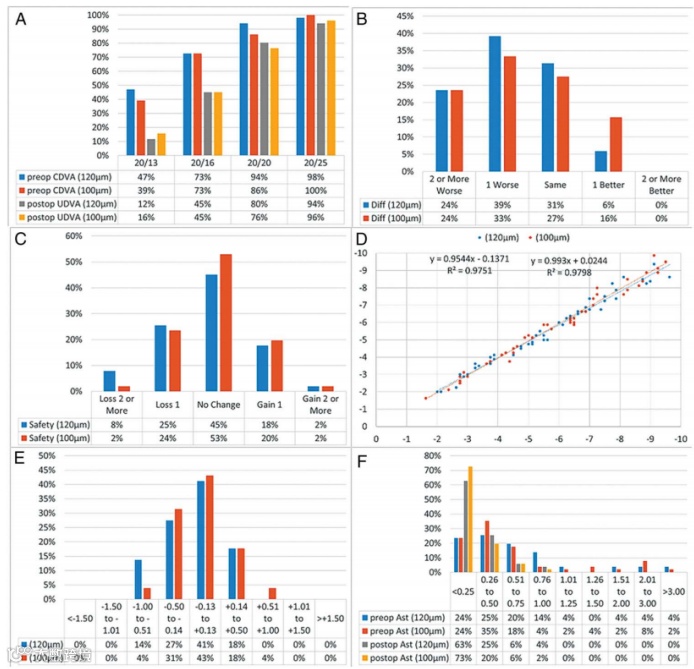
▲两组术后视力和屈光结果对比(A:术前CDVA和术后UDVA的分布,B:术前CDVA和术后UDVA差异的分布,C:手术前后CDVA的差异,D:预矫正等效球镜和实际矫正等效球镜散点图,E:术后等效球镜的分布,F:手术前后散光的分布)
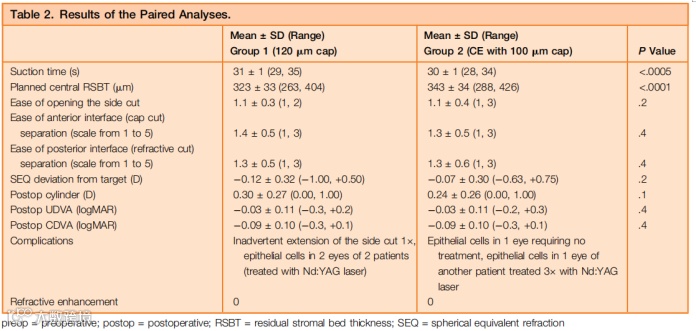
▲ 两组在透镜分离情况和术后效果的配对分析
屈光度及视力:术后3个月,在51名患者(102眼)中,帽120μm组的等效球镜相较于100μm组略呈欠矫结果,差异为0.06 ± 0.39 D (0.7% ± 5.7%),但是该差异无统计学意义。术后两组间散光和术后视力的差异也无统计学意义。
术中情况:两组透镜分离难易度相同,帽100 μm组的负压吸引时间相对较短(0.4±0.9s)。
帽100 μm组术后中央剩余角膜基质厚度相较于120 μm组厚20 ± 15 μm,两组的并发症发生率相同。
结论
Results of thin-cap small-incision lenticule extraction
Suphi Taneri, MD, FEBOS-CR, Samuel Arba-Mosquera, PhD, H. Burkhard Dick, MD, PhD, FEBOS-CR
Abstract

PURPOSE
To evaluate the influence of a thin cap in small-incision lenticule extraction (SMILE) for the correction of myopia or myopic astigmatism.
SETTING
Department of Ophthalmology, Medical University of Innsbruck, Innsbruck, Austria.
METHODS
A chart review of 102 eyes of 51 patients was performed. The effect of 120 µm vs 100 μm cap thickness on postoperative spherical equivalent refraction (SEQ), cylinder, corrected and uncorrected visual acuities, and ease of lenticule separation was assessed in a contralateral manner, whereas all other parameters were identical between eyes (including optical zone, minimum lenticule thickness, incision size, and energy and spot settings) using paired t test.
RESULTS
At 3 months postoperatively, SMILE with 120 μm cap thickness was undercorrected in SEQ relative to SMILE with 100 μm cap thickness in a cohort of 102 eyes of 51 consecutive patients. The difference of 0.06 ± 0.39 diopter (or 0.7% ± 5.7%) did not reach statistical significance. Postoperative cylinder was not statistically different in both groups. Visual acuity was similar in both groups. Ease of lenticule separation was identical in both groups. Suction time was shorter with a 100 μm cap (P < .005). Postoperative central residual stromal thickness was 20 ± 15 μm thicker with a 100 μm cap (P < .0001). Adverse events were comparable.
CONCLUSIONS
Postoperative refraction, visual acuity, ease of lenticule separation, and incidence of adverse events were not significantly affected by cap thickness. Surgeons might safely use 100 μm instead of 120 μm caps without nomogram adjustment. Alternatively, after suction loss during the lenticule cut, a second docking with a programmed cap thickness of 100 μm (and a larger optical zone) might be a rescue technique enabling surgeons to still perform the intended SMILE procedure.