


摘要
21世纪以来,随着各种交通方式的快速发展,综合交通枢纽规划正在发生新的变化。综合枢纽不仅是连接多种运输方式的重要载体,而且反映了不同运输方式的整体运输效率和服务水平。如何提高城市综合交通枢纽的客流组织效率具有重要的现实意义。本文以交通枢纽功能区比例为切入点,依托天津滨海新区综合交通枢纽,旨在优化综合交通枢纽各功能区之间的权重关系,根据权重关系分配各功能区的位置和空间序列关系,并探讨了提高综合交通枢纽客流组织效率的问题及相应措施。
1 Introduction
In recent years, China has gradually carried out the theoretical research and practical exploration on the planning and construction of urban comprehensive transportation hub, which is mainly reflected in the comprehensive transportation transfer hub construction and logistics center construction mode of the transportation junction. Through the construction of comprehensive transportation hub, the efficient operation of the regional comprehensive transportation network will be driven, and the formation and development of the city will be promoted.
Throughout the domestic and foreign research on the connection mode of urban comprehensive transportation hub, scholars have made a lot of remarkable research results. Pan Hong [1] summarized the main problems faced by the planning and construction of Baiyun Airport comprehensive transportation hub by comprehensively analyzing the passenger flow characteristics and traffic status of Guangzhou Baiyun airport hub; Zhang [2] took Chengdu North railway station, Shanghai railway station and Hankou railway station as examples to verify the relevant theories and empirical research of indicators, and analyzed the calculation results, so as to demonstrate the feasibility and reliability of the indicator system; Liu et al. [3,4] analyzed the planning and design concept and characteristics of Futian comprehensive transportation hub in Shenzhen, which has been in operation for three years, and evaluated the current operation experience and deficiencies of the hub; Li [5] focused on the comprehensive transportation hub planning of Xi'an station reconstruction and expansion, on the basis of describing the current situation of Xi'an station, predicted the long-term planning passenger flow of Xi'an station, and put forward the existing problems of Xi'an station reconstruction and expansion. It can be seen that researchers have carried out a series of studies on urban transportation hub planning.
In addition, the urban comprehensive transportation hub is an important external gateway of the city and the transportation core of the city's internal and external links. The function of transportation hub is complex and diverse, the flow of people is intensive, and the investment is huge. Therefore, the determination of the scale of comprehensive transportation hub is the primary problem to be determined in the design. In view of this, based on the urban traffic network, this paper makes a systematic study on the connection mode of comprehensive hub, in order to provide some reference for similar projects.
2 Analysis of comprehensive traffic connection system from the perspective of travel chain
In order to realize the integration and balance of transportation hubs, we need to rely on a perfect and efficient transportation connection and transfer system. Only through the transportation connection system can we realize the effective connection within the same transportation mode, between different transportation modes, between private car transportation and public transportation, and between urban transportation and external transportation, so as to give full play to the overall benefits of the transportation system, Only in this way can transportation facilities achieve real integration and balance. Taking several super large cities in China as examples, through investigation and analysis, the connection modes of major transportation hubs are obtained, as shown in Table 1. Obviously, walking, private cars, taxis, rail transit, public transport and intercity railway are the more common modes of connecting traffic, while trams only appear in Chengdu West Railway Station, while the other major stations do not. In addition, the survey found that the most efficient vertical mode is the main mode of connection. The reasonable arrangement of various traffic connection modes in the three-dimensional space can greatly shorten the distance and time required for transfer, so the maximum comfort can be obtained in the transfer comfort.
Table 1. Connection mode of major transportation hubs.
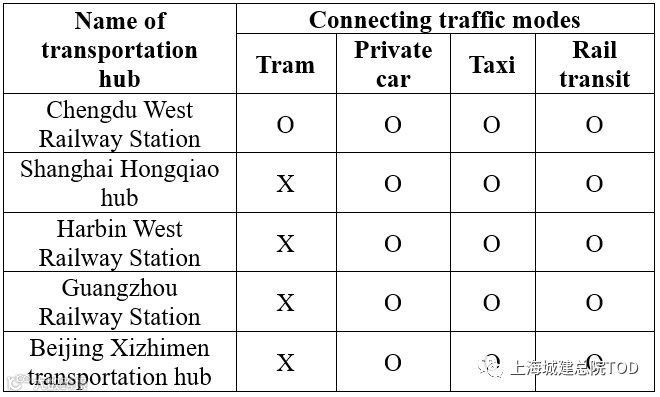
In the travel mode chain formed by the close combination of various modes of transportation, transfer is a key link and an indispensable part to realize the effective conversion of various modes of transportation. The transportation hub is an effective facility to realize this kind of transfer. By integrating various modes of passenger transportation, the hub facilities provide convenient transfer conditions for travelers, and ensure that residents can realize the smooth transfer through medium transfer Fast travel. Through the effective connection between multiple modes and public transport (rail transit and conventional public transport), the effective gathering and dispersion of passenger flow at urban transport nodes can be achieved. Taking several typical transport hubs in Table 1.1 as examples, through multi-party investigation and research, the priority of connection types of major transport hubs is obtained, as shown in Table 2. Through the investigation, it is found that rail transit has become the first choice for people's transfer travel with the advantages of fast and convenient, while tram, taxi and bus become the second choice, while walking and intercity railway are the most forced choice for people's transfer travel.
Table 2. Priority of connection types of major transport hubs.
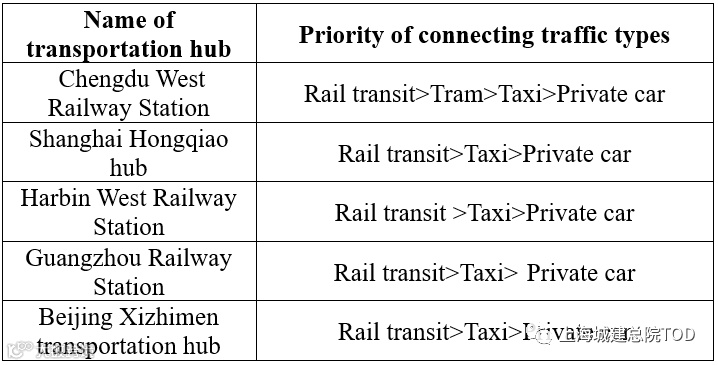
To sum up, all kinds of traffic connection modes will bring different transfer experience. How to use all kinds of traffic connection modes reasonably and effectively can coordinate traffic operation and achieve efficient traffic management.
3 Case analysis based on function weight
Taking Yujiapu comprehensive transportation hub as an example, according to the passenger flow forecast results, the total number of passengers boarding and alighting in peak hours of Yujiapu hub in the long term is 72000 person times, including 12000 person times of intercity railway and 60000 person times of rail transit [6]. The weight analysis of each functional area is shown in Table 3, and the scale proportion of each functional area is shown in Figure 1.
Table 3. Weight analysis of each functional area of Yujiapu comprehensive transportation hub [6].
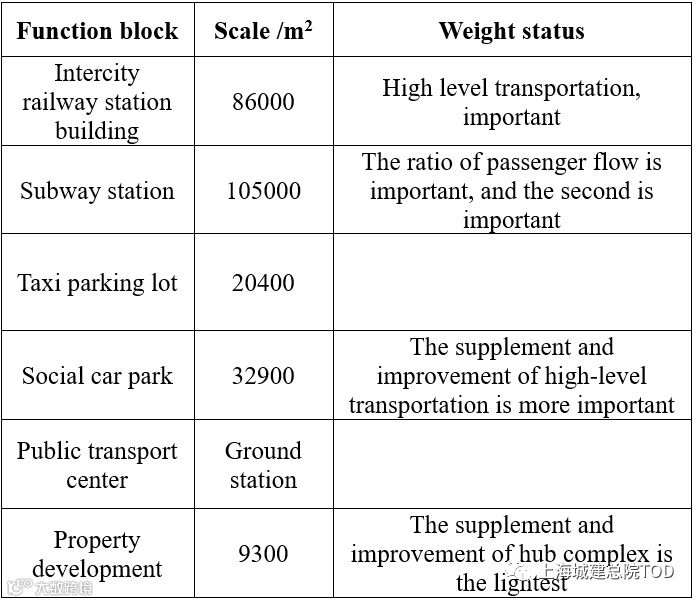
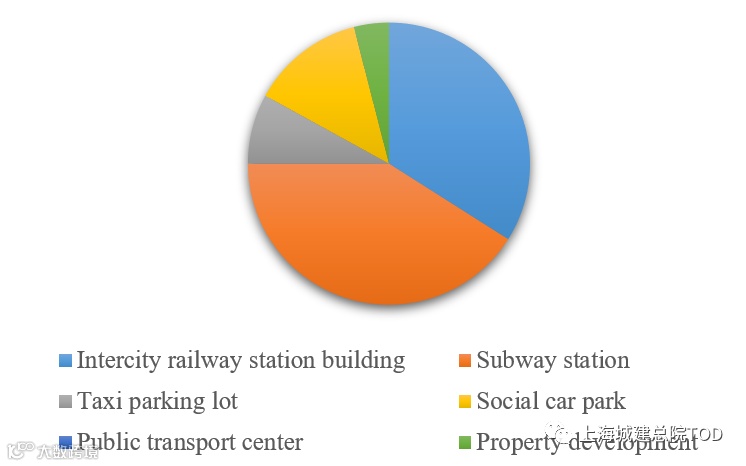
Fig. 1. Scale proportion of each functional area of Yujiapu comprehensive transportation hub.
According to the weight analysis of each functional area of Yujiapu comprehensive transportation hub, intercity station building is in an important central position in the hub due to its high attribute and large scale; As the most important municipal supporting facilities, the proportion of passenger flow in subway station is required to be large, and attention should be paid to the convenience of passenger evacuation, abundant distribution space and reasonable transfer mode between three lines; Taxi parking lot, social car parking lot and public transport center have a small proportion of passenger flow, and their functions are relatively independent, so they can be set up separately; Property development space should be based on the principle of making full use of underground space, making use of passenger flow resources, centralized setting, and forming scale effect.
The internal function of comprehensive transportation hub is mainly the intersection and transfer of various traffic forms. The comprehensive hub is not only the simple superposition of various functional blocks, but also should pay attention to the interpenetration and close connection of functional blocks, so as to make the passenger flow convenient and fast in space use. The transfer facilities between various modes of transportation in the comprehensive transportation hub should be arranged in an integrated way. The plane and vertical layout of various modes of transportation should be highly "integrated". The distribution of functional blocks should be targeted according to the characteristics of the project itself and the nature of passenger flow, which should be combined and divided, compact and intensive, and inclusive. Through field investigation and data analysis, the influence circle of comprehensive transportation hub is obtained, as shown in Figure 2.
The combined space by weight attribute level (see Figure 3) is distributed from large to small by attribute weight of traffic mode to peripheral area. The distance between the largest modes of traffic exchange is the shortest, so as to quickly distribute the flow of people and improve the service level of the high-level traffic mode with high weight.
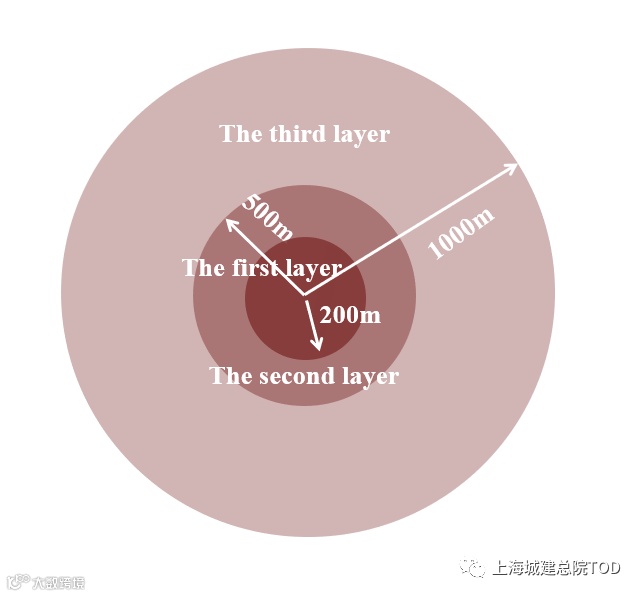
Fig. 2. Comprehensive hub influence circle.
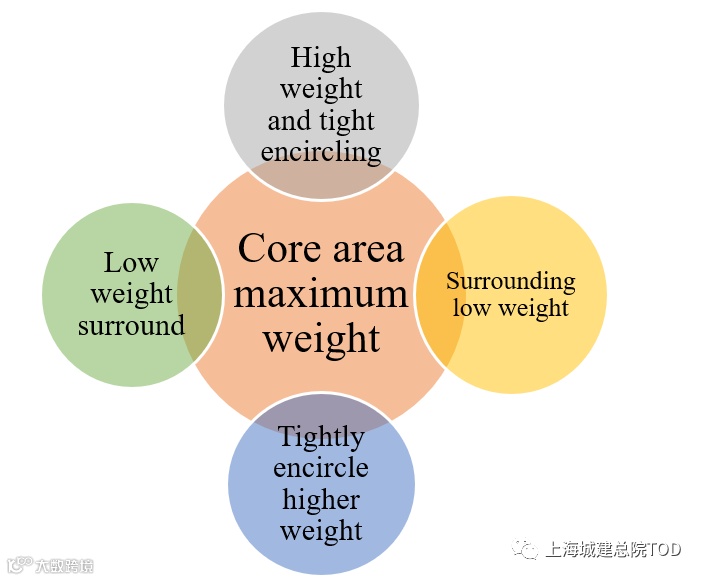
Fig. 3. Combining spaces by weight attribute level.
4 Principles of setting up traffic connection modes
The construction of transfer hub increasingly emphasizes the efficiency and comfort of transfer. According to the successful experience of foreign transportation transfer hub construction, the space design of transfer hub must be based on the following principles:
1. Efficient transfer principle.
The principle of efficient transfer is the core of the construction of transportation hub. The goal of efficient transfer is to minimize the total number of people per hour among various means of transportation in the transfer hub system, rather than the minimum number of people per hour for a certain mode of transportation. At present, in the construction of public transport hubs in some big cities in China, the minimum transfer time of one mode of transportation is often taken as the construction goal. As a result, the bus transfer or subway transfer in the hub is reasonable, but it is unreasonable for the whole transfer hub. The transfer time is too long, which affects the operation efficiency of the whole transport hub.
2. People oriented principle
People oriented is an important principle of urban construction and urban development. In the construction of urban transfer system, people-oriented must also be adhered to. The comfort and convenience of transfer should be the primary goal of transfer space organization. For example, when designing transfer passage between different modes of transportation, automatic rolling ladder or small slope should be used as far as possible to replace the ladder, and special carts should be provided for rent to facilitate passengers. In addition, the indoor and centralized transfer hub construction is also an effective way to improve the comfort of transfer.
5 Conclusion
(1) Through the summary of the functional composition of the built and operated projects, the most basic centralized space combination mode of this kind of buildings is obtained. In the actual project, one or the centralized mode can be used to combine the functional areas according to the actual needs.
(2) The design of comprehensive transportation hub should be combined with the planning, starting from the regional positioning of the hub, analyzing the functional composition of the hub from the perspective of urban function, studying the weight classification of the functional composition of the hub, and guiding the distribution of functional blocks.
(3) The transfer facilities should be arranged in an integrated way. The plane and vertical layout of various modes of transportation should be highly integrated. The transfer distance should be short and the distribution space should be sufficient.
(4) The research results of this paper can provide necessary support for the planning of comprehensive transportation hub, and have important practical value.
References
1. Q. Li. (2020)Renovation Plan of Xi’an Railway Station as an Integrated Transportation Hub. Railway Transport and Economy, 09:7-13.
2.Y.P. Liu, P.K. Li. (2019)P Planning and Design of Passenger Experience-ori-ented Qianhai Integrated Transportation Hub in Shenzhen City. Urban Mass Transit, 07:1-4+8.
3.Y.P. Liu, L. Li. (2019)Planning Practice of Futian Comprehensive Transportation Hub in Shenzhen and Enlighten- ment. Urban Mass Transit, 07:41-45.
4.S.J. Zhang. (2016)Study on the Collaborative Planning of City Comprehensive Transportation Hub and Adjacent Area of Index System. Southwest Jiaotong University.
5.H. Pan. (2013)Study on planning and design of comprehensive transportation hub of Guangzhou Baiyun International Airport. South China University of Technology.
6.L.W. Ji. (2015)Study of Combination and Articulation of Integrated Transport Hub Functional Space. Railway Standard Design, 01:108-110+131.