


New South Wales speed limits
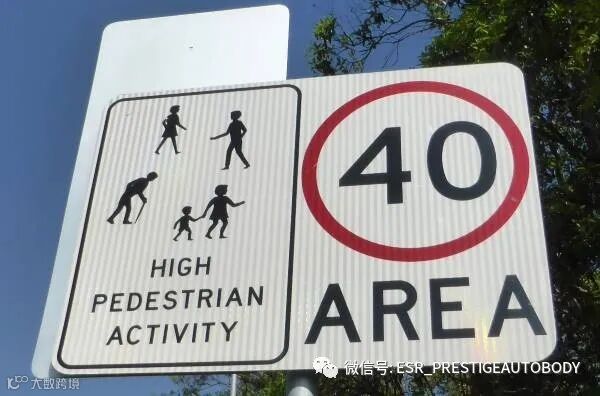
Speed limit signs are always a black number inside a red circle. In New South Wales the speed limits range from 10kph to 110kph in 10kph increments, but the majority of roads will either be 50kph in urban areas, 100kph in rural areas or 110kph on motorways and freeways.
Other territories have different speed limits (up to 130kph in Northern Territory) and different tolerances for exceeding the limit.
Within shared pedestrian zones the speed limit is as low as 10kph. Companies and individuals may place speed limit signs on their own property as low as 5kph, but these are not enforced by police or traffic authorities.
Speed Limits
10kph is the limit in shared zones including car parks and reserves
40kph is the limit in high pedestrian activity areas (as per the sign above), local traffic areas, school zones at prescribed times and school bus blackspot areas
50kph is the default urban speed limit in built-up areas. It may be signposted if unclear, but if a road has street lights and is urban in the absence of other posted limits it will be 50kph. It may be signposted if unclear.
60kph is the limit on significant urban undivided arterial roads (with direct driveway accesses), divided roads with high volume where the lanes are narrow (less than 3.0 metres), and rural residential roads in villages with minimal development.
80kph is the limit on urban high standard divided roads (generally without driveway access), undivided arterial and sub-arterial roads on the fringes of urban areas and lower quality rural roads, undivided rural roads with less than 5.6 metres wide sealed pavement or no marked dividing line.
100kph is the default rural speed limit and default speed limit for non-built-up areas – urban motorways (freeways/tollways), rural undivided road with sealed pavement wider than 5.6 metres, rural divided roads.
110kph is the maximum allowable speed limit in NSW. Motorways (freeways/tollways) in non-built-up areas, high-quality rural divided roads, undivided rural road with low traffic volume
west of the Newell Highway.
Roadworks have speed limits of 40, 60 or 80kph depending on the road and the type of works.
Unsealed roads are often limited to 80kph
Seasonal zones can have different limits depending on the season (e.g. because of weather conditions or tourist numbers).
Advisory speeds at corners are not speed limits. They are to advise that a certain speed is a safe speed in dry weather.
Zone lengths
Different speed limits have different minimum zone lengths
40kph – 200m
50kph (urban) – no limit
50 or 60kph (signposted) – 500m
70-90kph – 2km
100kph – 3km
110kph – 10km
Types of vehicles and licence classes and their maximum limits
Leaner licence holders: 80 kph
P1 licence holders: 90 kph
P2 licence holders: 100 kph
Road trains: 90 kph (may have a speed limiter fitted)
Other heavy vehicles (i.e. a vehicle with a GVM of over 4.5 tonnes, including B doubles): 100 kph (may have a speed limiter fitted).
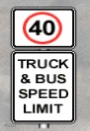
Some classes of vehicle will be restricted in certain areas while other vehicles don’t have that restriction. The image above shows that trucks and buses are restricted to 40kph in this zone. Cars and motorbikes are exempt from the restriction and the standard or posted speed limit for that area will apply (for example 50kph).
Tolerance for exceeding the speed limit
Exceeding the speed limit by any speed is technically against the law and you can be fined even if you are doing 1kph over the limit. However, some tolerance is allowed for common sense purposes: there is some variation in speedometer accuracy, a new set of tyres will read a lower speed than a worn set because of the greater circumference, drivers of different heights have a different view of the speedo needle, and it’s not beneficial to encourage drivers to be looking at their speedometer all the time as it means their eyes are diverted from the road.
If you are driving sensibly for the conditions with an appropriate gap to the vehicle in front then it’s unlikely you will stopped and ticketed for a coupe of kilometers per hour over the limit.
There is an undisclosed margin that you are allowed to exceed the limit by. This is sometimes said to be 10% yet at other times 3 or 5kph.
The best way to get an accurate speed reading is to use a GPS.
In reality, all new cars are set to under-read. I.e. if your speedo says you are doing 100kph you are more likely doing around 97kph. This is so that manufacturers avoid multiple law suits from people who thought they were driving within the limit but then get a ticket.
限速标志总是用红圈内的黑数字。在新南威尔士州,限速从每小时10公里到每小时110公里不等,但大多数道路要么是城市地区每小时50公里,农村地区每小时100公里,要么是高速公路和高速公路每小时110公里。
其他地区有不同的限速(北领地最高可达130公里每小时)和不同的容许超速。
在共享步行区内,车速限制低至每小时10公里。公司和个人可能会在他们自己的财产上设置低至每小时5公里的限速标志,但这些标志不是由警察或交通当局执行的。
速度限制
在停车场和保护区等共享区域,每小时限速为10公里
在行人活动频繁的地区(如上述标志所示)、本地交通区域、学校区域在规定时间内的行驶时速为40公里,以及校车黑点区域
在建成区,每小时50公里是默认的城市速度限制。如果路况不清楚,可能会有路标,但如果道路有路灯,并且是城市道路,而没有其他的路标限制,车速将是每小时50公里。如果不清楚,可能会标明。
60km / h是重要的城市未分割的主干道(有直接的车道入口)、车道狭窄(小于3.0米)、容量大的分割道路以及发展程度最低的村庄的农村住宅道路的限速。
城市高标准划分道路(通常没有私人车道)、城市地区边缘未分割的主干道和次主干道、质量较差的乡村道路、宽度小于5.6米的密封路面或没有明显分界线的未分割乡村道路的限速为每小时80公里。
每小时100公里是乡村的默认速度限制,非建成区的默认速度限制包括城市高速公路(高速公路/收费公路)、路面宽度超过5.6米的封闭乡村公路、乡村分隔公路。
110公里每小时是新南威尔士州的最大允许速度限制。非建成区的高速公路(高速公路/收费公路)、高质素的乡郊分隔公路、低交通量的未分隔乡郊公路
纽厄尔高速公路以西
道路工程的速度限制为每小时40、60或80公里,视乎道路及工程类别而定。
未封路的时速通常限制在80公里
季节性区域可能有不同的限制,取决于季节(例如,由于天气条件或游客数量)。
弯道的建议速度不是速度限制。他们提醒说,在干燥的天气里,一定的速度是安全的。
区长度
不同的限速有不同的最小区域长度
40公里- 200 m
50kph(市区)-不限
50或60公里/小时(指示)- 500米
70 - 90公里/小时- 2公里
100公里- 3公里
110公里- 10公里
车辆类别、牌照类别及其最高限额
精简许可证持有人:80公里每小时
P1牌照持有人:每小时90公里
P2牌照持有人:每小时100公里
公路列车:每小时90公里(可能装有限速器)
其他重型车辆(即GVM超过4.5吨的车辆,包括B双车):每小时100公里(可能装有限速器)。
某些类别的车辆将在某些区域受到限制,而其他车辆则没有这种限制。上图显示,在这一区域内,卡车和公共汽车时速限制在40公里以内。汽车和摩托车不受限制,该地区的标准或公布的速度限制将适用(例如每小时50公里)。
超速公差
从技术上讲,以任何速度超过速度限制都是违法的,即使你超过速度每小时1公里,你也会被罚款。然而,出于常识的考虑,也允许有一些宽容:速度计的准确度有一些变化,一套新的轮胎会比一套旧的轮胎读出更低的速度,因为更大的周长,不同高度的司机对速度针有不同的看法,鼓励司机一直盯着速度表是没有好处的,因为这意味着他们的眼睛从道路上转移了。
如果你在与前面的车有适当的距离的情况下明智地驾驶,那么你就不太可能停下来,因为超过限速的两公里每小时开出罚单。
有一笔未公开的保证金你可以超出限额。这是有时说10%,但在其他时候3或5公里每小时。
获得准确的速度读数的最好方法是使用GPS。
例如,如果你的速比显示你的速度是100公里每小时,那么你的速度很可能是97公里每小时左右。这是为了避免那些认为自己在限行范围内开车却被开罚单的人提起诉讼。