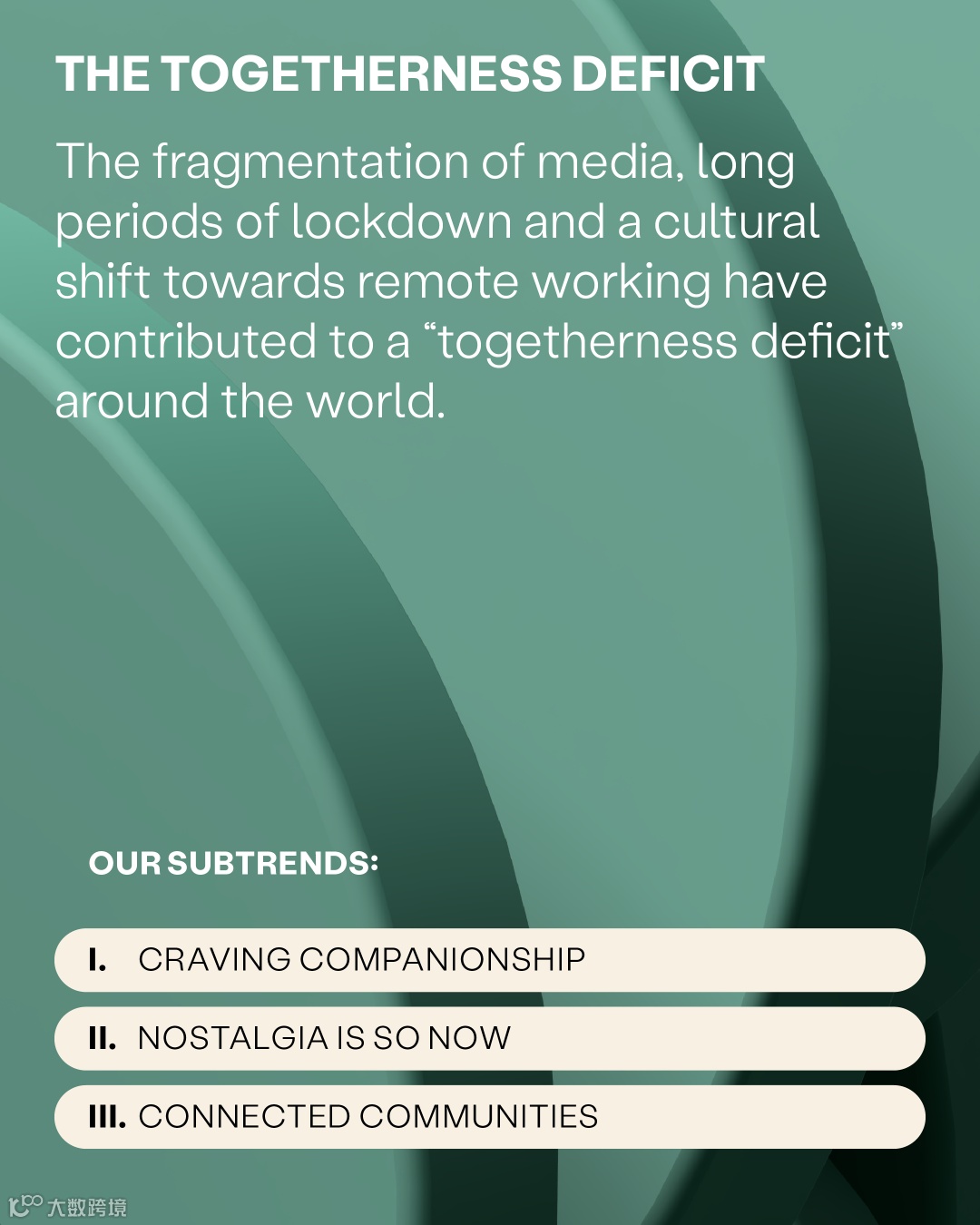
This builds on an existing loneliness epidemic (WHO, 2024) which is mutating in profound ways – China is experiencing a “friendship recession” with young people reporting that they have on average only 2.5 close friends (Soul via Jing Daily, 2024).
As shared cultural experiences grow rarer, they become more precious. Data from the UK’s live music scene shows that no fewer than nine music festivals have been canceled in 2024 alone due to rising costs, while data from the US shows that the frequency with which Americans go out to bars, nightclubs, etc. has dropped dramatically over the last two decades.
The traditional ties that connected us, like watching sports together, are perhaps weakening – just 23% of Generation Z in the US identify as passionate sports fans, versus 42% of Millennials. Newer, virtual communities are replacing them, but how this impacts our long-term sense of connection and social cohesion with those with different interests remains to be seen.
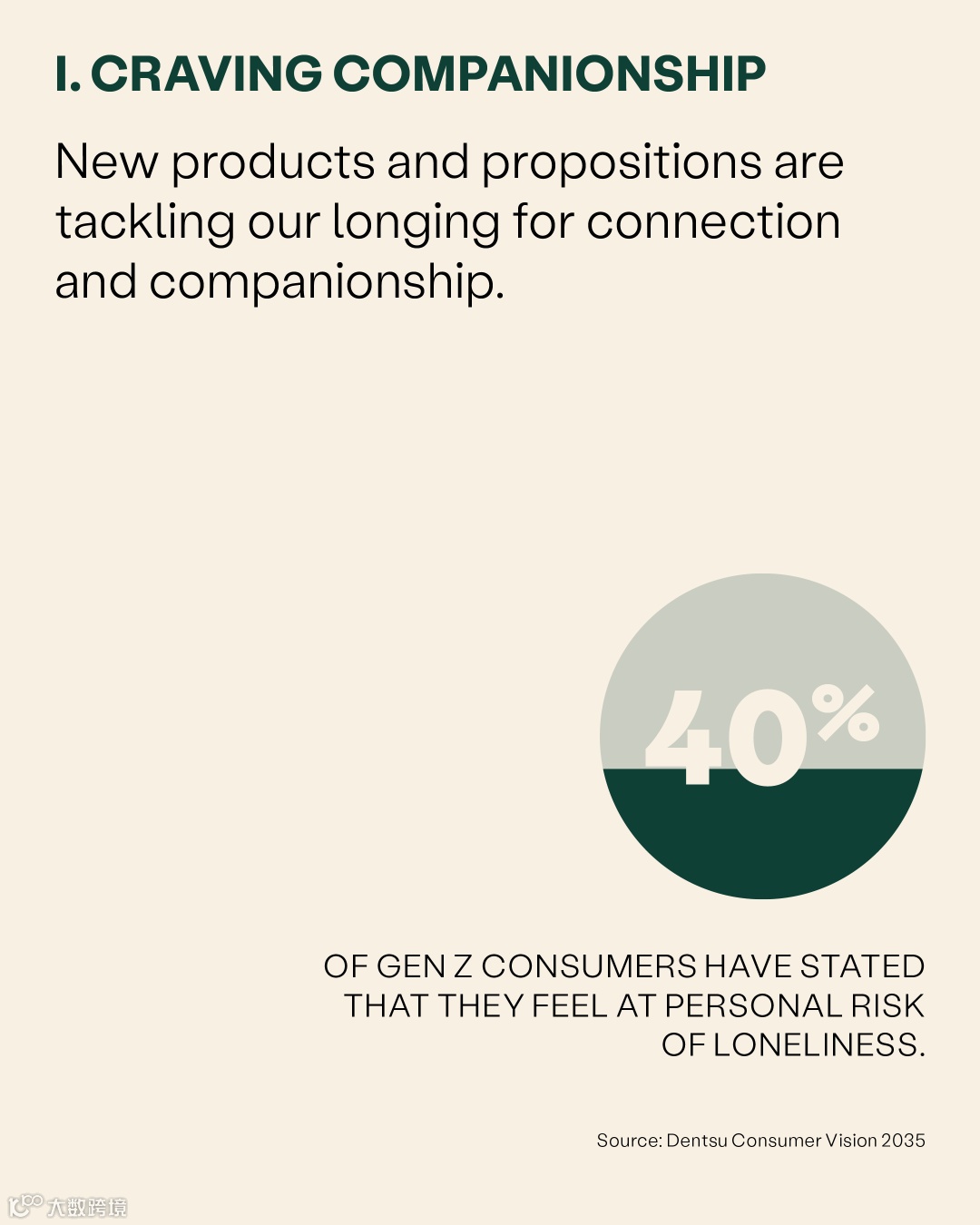
In response to The Togetherness Deficit we see a longing for connection and companionship, influencing new ways of seeking out friendship in both the online and offline worlds. New platforms and technologies are aiming to provide companionship and support in a fragmented world.
The matchmaking app trend evolves beyond romantic relationships. In China, the “blind box” matchmaking phenomenon involves purchasing the contacts of another person to find a potential partner. This mechanic is being adapted to connect individuals to others with a common interest.
Dedicated platforms like Timeleft App seek to fill the gap – a global project where every Wednesday, in cities over the world, individuals book their seat at a dinner with five strangers matched by a personality algorithm with the promise of “Safe moments to interact with people around you so that you can be more involved with the world you live in”.
Meanwhile technology startups are negotiating the potential role of AI in combating loneliness. Since the launch of its vocal search feature, we see the rise of ChatGPT as a proxy “psychologist”, with young people using it as a personal diary and advisor. US start-up “Friend” acts as a kind of digital friendship surrogate offering a wearable pendant that listens to the users’ daily experiences and sends conversational messages in response.
People are also attempting to stage their own “meet cutes” in unexpected places. Among single people in Spain, we saw a viral dating trend whereby people head to a Mercadona supermarket and place an upside-down fresh pineapple in their basket between 7-8pm to indicate they are looking for romance. In the Netherlands, supermarket chain Jumbo opened “chat checkouts” for folk who want a slower retail experience and want to engage in conversation with cashiers.
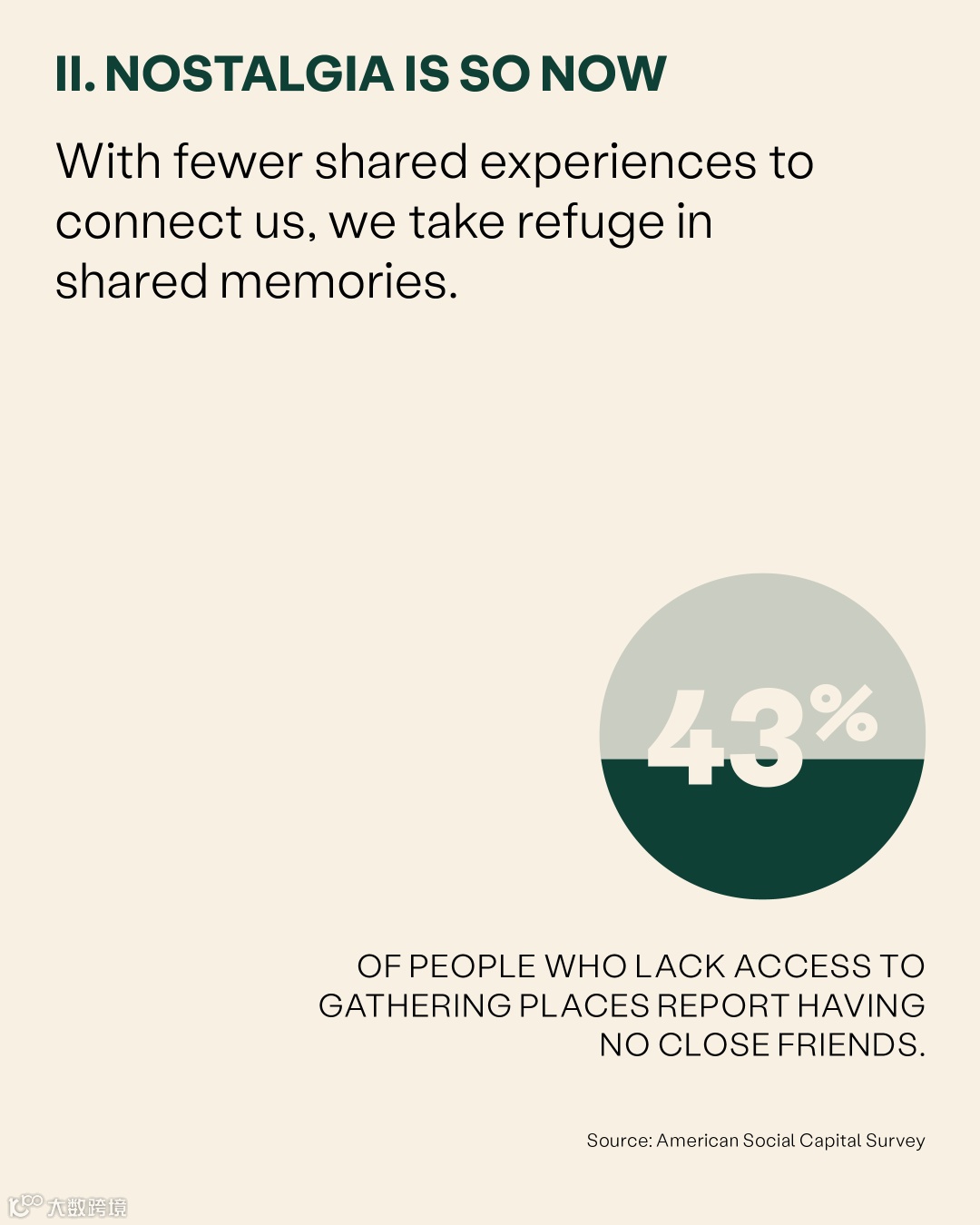
 The desire for togetherness has also triggered nostalgia for a time when cultural references were simpler and more collective. The Britpop band Oasis’ Reunion is an obvious example for those who came of age in the 90s and early 00s. The comfort of nostalgic snacks is in high demand, while Disney’s adaptation of seminal 1980s novel “Rivals” evokes a time of unabashed hedonism and ambition. Similarly, November’s Gladiator sequel throws back to the simpler days of 2000 when masculinity was perhaps less complex and conflicted. Are we not Entertained?!
As Agnes Arnold-Forster’s new book Nostalgia: A History of a Dangerous Emotion explains, nostalgia has the power to “boost self-esteem, increase meaning in life, foster a sense of social connectedness, encourage people to seek help and support for their problems, improve mental health and attenuate loneliness, boredom, stress or anxiety”.
A report from Ipsos and the Effies, by Samira Brophy and Rachel Emms, shows that 44% of people in Great Britain agree that “given the choice I would prefer to have grown up at the time when my parents were children”. While data in the same report shows that utilizing aspects of a brand’s heritage in advertising provides an 8% bump in brand attention.
In that spirit, Levi’s recently recreated the iconic Laundrette commercial featuring none other than Beyoncé, while German supermarket Lidl are having some festive fun with the unmistakable Coca-Cola Christmas truck. Gen Z’s obsession with the Y2K aesthetic shows no signs of slowing, while the “Brat summer” channels the grungier, less polished retro aesthetic of years gone by vs today’s “clean girl” culture.
The pull of nostalgia feeds into a craving for analogue experiences as exemplified by the BBC’s hit programme Race Across the World whereby participants navigate their adventure smartphone-free. Meanwhile The Offline Club which began by hosting phone free events in the Netherlands brought the experience to London in recent months. Devices are surrendered at the beginning of the event, with attendees either spending the time more mindfully, or making unexpected human connections.
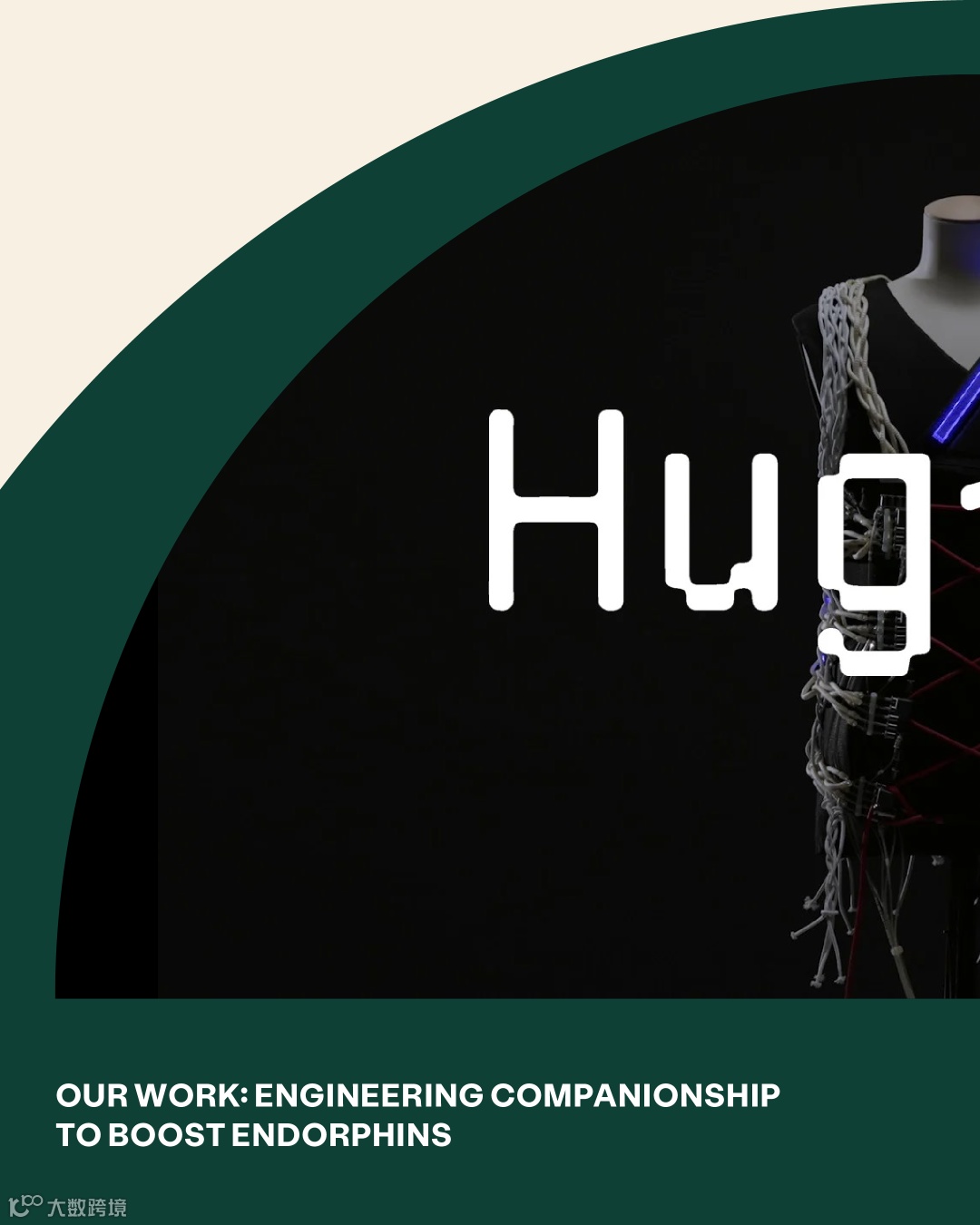
“Hugtics,” co-developed by Dentsu Lab Tokyo and Nobuhiro Takahashi, redefines hugging with technology. The system includes a wearable vest with artificial muscles and a torso with pressure sensors, so that when the torso is hugged, data is transmitted to the vest, simulating a self-hug experience. Designed to boost happiness and self-esteem, it also uses brainwave analysis to track emotional responses, showcasing potential applications in mental health and virtual communication.
III. CONNECTED COMMUNITIES
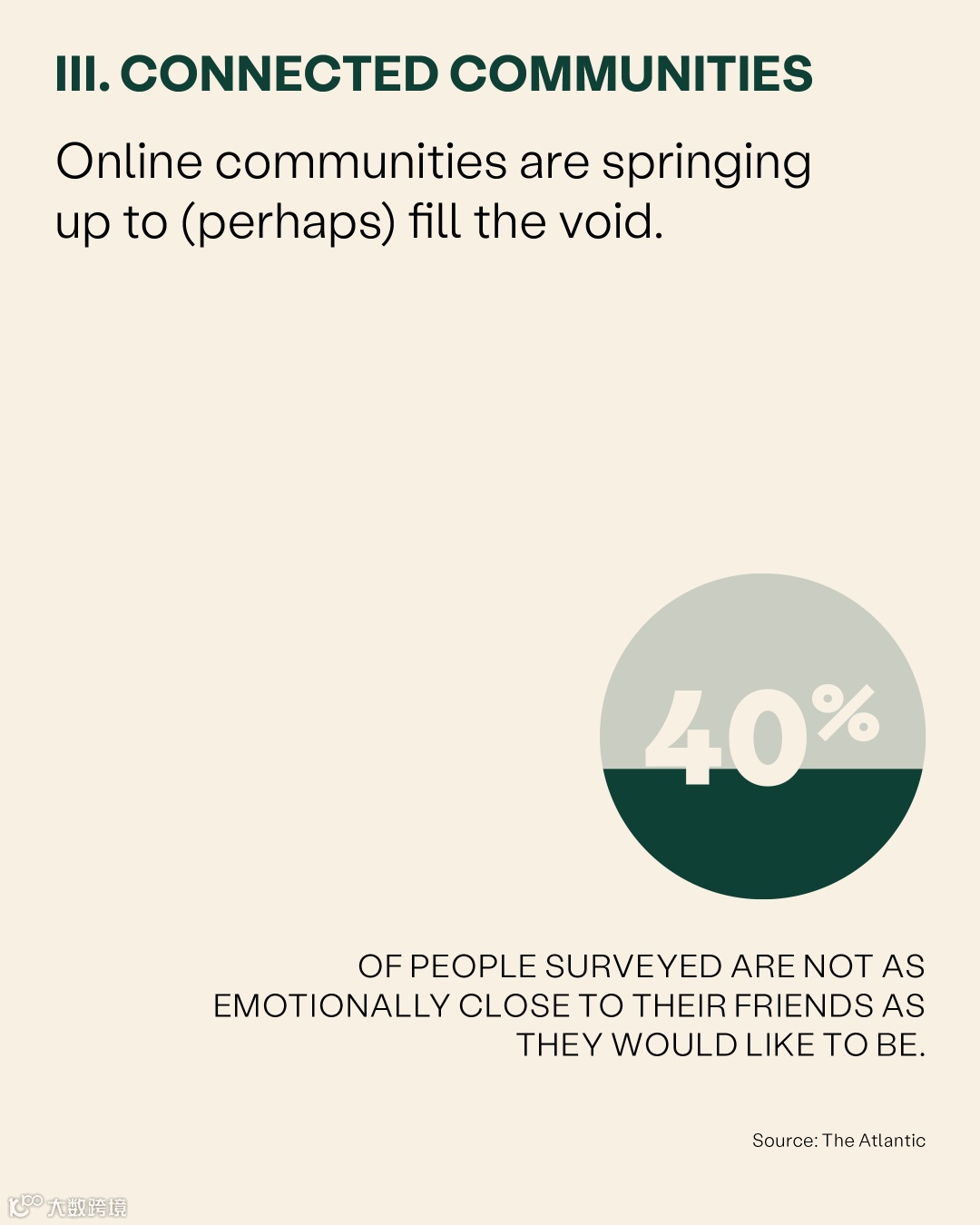
At the heart of our desire to come together in a fragmented world is the rise of online communities of shared passion and interest. In fact, nearly 80% of people say that the most important group they belong to operates online (Exploding Topics, 2024).
The desire for togetherness has also triggered nostalgia for a time when cultural references were simpler and more collective. The Britpop band Oasis’ Reunion is an obvious example for those who came of age in the 90s and early 00s. The comfort of nostalgic snacks is in high demand, while Disney’s adaptation of seminal 1980s novel “Rivals” evokes a time of unabashed hedonism and ambition. Similarly, November’s Gladiator sequel throws back to the simpler days of 2000 when masculinity was perhaps less complex and conflicted. Are we not Entertained?!
As Agnes Arnold-Forster’s new book Nostalgia: A History of a Dangerous Emotion explains, nostalgia has the power to “boost self-esteem, increase meaning in life, foster a sense of social connectedness, encourage people to seek help and support for their problems, improve mental health and attenuate loneliness, boredom, stress or anxiety”.
A report from Ipsos and the Effies, by Samira Brophy and Rachel Emms, shows that 44% of people in Great Britain agree that “given the choice I would prefer to have grown up at the time when my parents were children”. While data in the same report shows that utilizing aspects of a brand’s heritage in advertising provides an 8% bump in brand attention.
In that spirit, Levi’s recently recreated the iconic Laundrette commercial featuring none other than Beyoncé, while German supermarket Lidl are having some festive fun with the unmistakable Coca-Cola Christmas truck. Gen Z’s obsession with the Y2K aesthetic shows no signs of slowing, while the “Brat summer” channels the grungier, less polished retro aesthetic of years gone by vs today’s “clean girl” culture.
The pull of nostalgia feeds into a craving for analogue experiences as exemplified by the BBC’s hit programme Race Across the World whereby participants navigate their adventure smartphone-free. Meanwhile The Offline Club which began by hosting phone free events in the Netherlands brought the experience to London in recent months. Devices are surrendered at the beginning of the event, with attendees either spending the time more mindfully, or making unexpected human connections.
“Hugtics,” co-developed by Dentsu Lab Tokyo and Nobuhiro Takahashi, redefines hugging with technology. The system includes a wearable vest with artificial muscles and a torso with pressure sensors, so that when the torso is hugged, data is transmitted to the vest, simulating a self-hug experience. Designed to boost happiness and self-esteem, it also uses brainwave analysis to track emotional responses, showcasing potential applications in mental health and virtual communication.
III. CONNECTED COMMUNITIES
At the heart of our desire to come together in a fragmented world is the rise of online communities of shared passion and interest. In fact, nearly 80% of people say that the most important group they belong to operates online (Exploding Topics, 2024).
In some cases, these online communities spill over into real-world connection: community-based sports such as park runs, and team sports such as netball and football are booming in popularity versus solitary gym workouts. Book clubs are hugely popular, on and offline, accelerated by the #booktok phenomenon.
In New York, Reading Rhythms is an in-person “reading party” where participants read alongside each other in silence and have the opportunity to talk to strangers.
A recent article in Dazed magazine embellishes, “As literary clubs like these gain popularity, they reflect a broader societal shift towards intentional and meaningful socializing... Although books and topics of discussion may vary from group to group, all these book clubs share a sense of community – and don’t we all need a little more connection in this cold and lonely world?”
Meanwhile lifestyle-led networks like Strava and Goodreads are becoming alternative places to meet potential romantic partners versus dating apps. Chris Stokel-Walker writing in The Guardian UK observes, “Because hobby apps are nicer places to exist, people spend more time on them – and they can eventually turn into services that are more than advertised. That includes finding like-minded people with whom you’d want to spend your time romantically”.
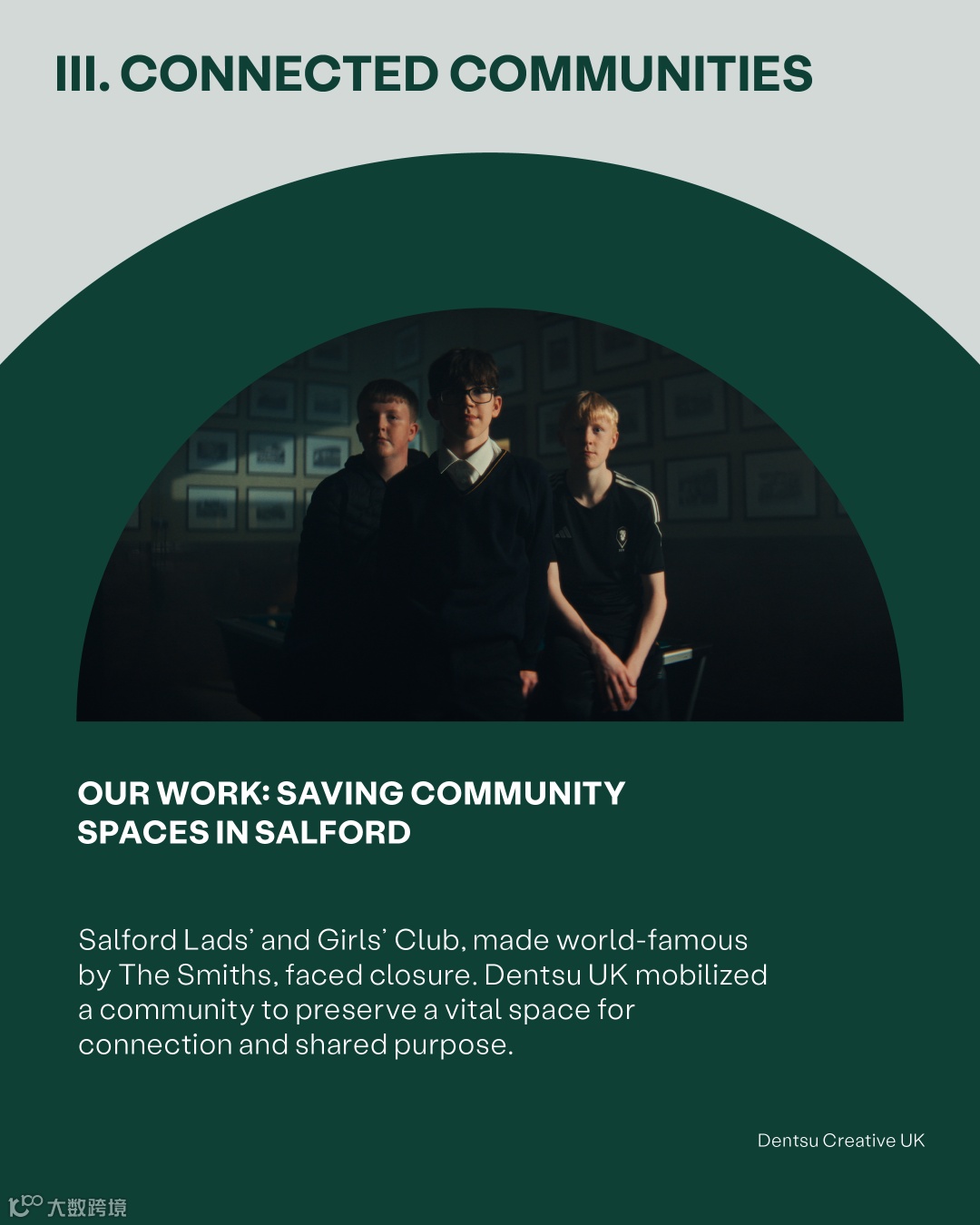
Salford Lads’ and Girls’ Club, made world-famous by The Smiths, faced closure. Dentsu UK mobilized a community to preserve a vital space for connection and shared purpose.
OUR WORK…
HYDRATION CHARGING STATION
ADVERTISER/BRAND: PEPSICO/GATORADE
A widespread notion among Chinese is that drinking water is “a cure-all for various health concerns”. However, the need to replenish electrolytes is often overlooked.
For nearly six decades, Gatorade has led the way in enhancing athletic performance and health, offering a scientifically crafted beverage aimed at rapidly replenishing electrolytes.
Aware of a community of health-conscious urbanites who prefer moderate exercise such as City Walk, Gatorade is exploring how its new “Daily Hydration” collection can support consumers in modernizing their hydration practices to align with their lifestyles.
Welcome to Gatorade’s “Hydration Charging Stations,” which have been launched in seven cities across the country. City Walkers are encouraged to bring their own containers—whether it’s a bathtub, calabash, a phonograph, or any creative vessel—and fill them with Gatorade’s latest products. The initiative not only promotes hydration but also sparks creativity and fun among participants.
In answer to the excited queries from users online, “Can you also recharge me with Gatorade?” Gatorade created a digital map that shows where these Hydration Charging Stations are situated, which allows City Walkers to easily locate hydration spots and recharge on the go.
To elevate the campaign’s impact, Gatorade brought on board brand ambassadors Xian Li and Qinwen Zheng, who visited these locations to encourage people—whether commuting or discovering the city—to stay hydrated and energized.
Get instant hydration with Gatorade Daily Hydration.
WHAT IT MEANS
FOR BRANDS & BUSINESSES…
PARTNER WITH PASSION
In a world where we are together less often in the physical space, togetherness through shared cultural understanding matters more than ever. Winning in the algorithmic era will mean connecting with consumers around shared passions and interests, as community becomes the new scale and the new connective tissue.
WHAT’S OLD IS NEW
Tapping into brand heritage, or older advertising assets, provides comfort and connectivity in a fragmented world. Not to mention the fact that agencies (and marketers) grow tired of iconic campaigns much faster than consumers.
THE SCARCITY OF SHARED
With togetherness in painfully short supply, brands who can create shared occasions will flourish. Those shared occasions might be physical events and connections, virtual ones via gaming platforms or live streaming or simply be shared cultural moments built through joyful, populist brand entertainment.
The content of this article is sourced from the Dentsu Creative Trends Report 2025: Fragment Forward.
Tap ‘Read More’ or below link to visit our global website and download the full report.
www.dentsucreative.com/news/dentsu-creative-trends-2025
Curiouser and Curiouser | CREATIVE TRENDS