
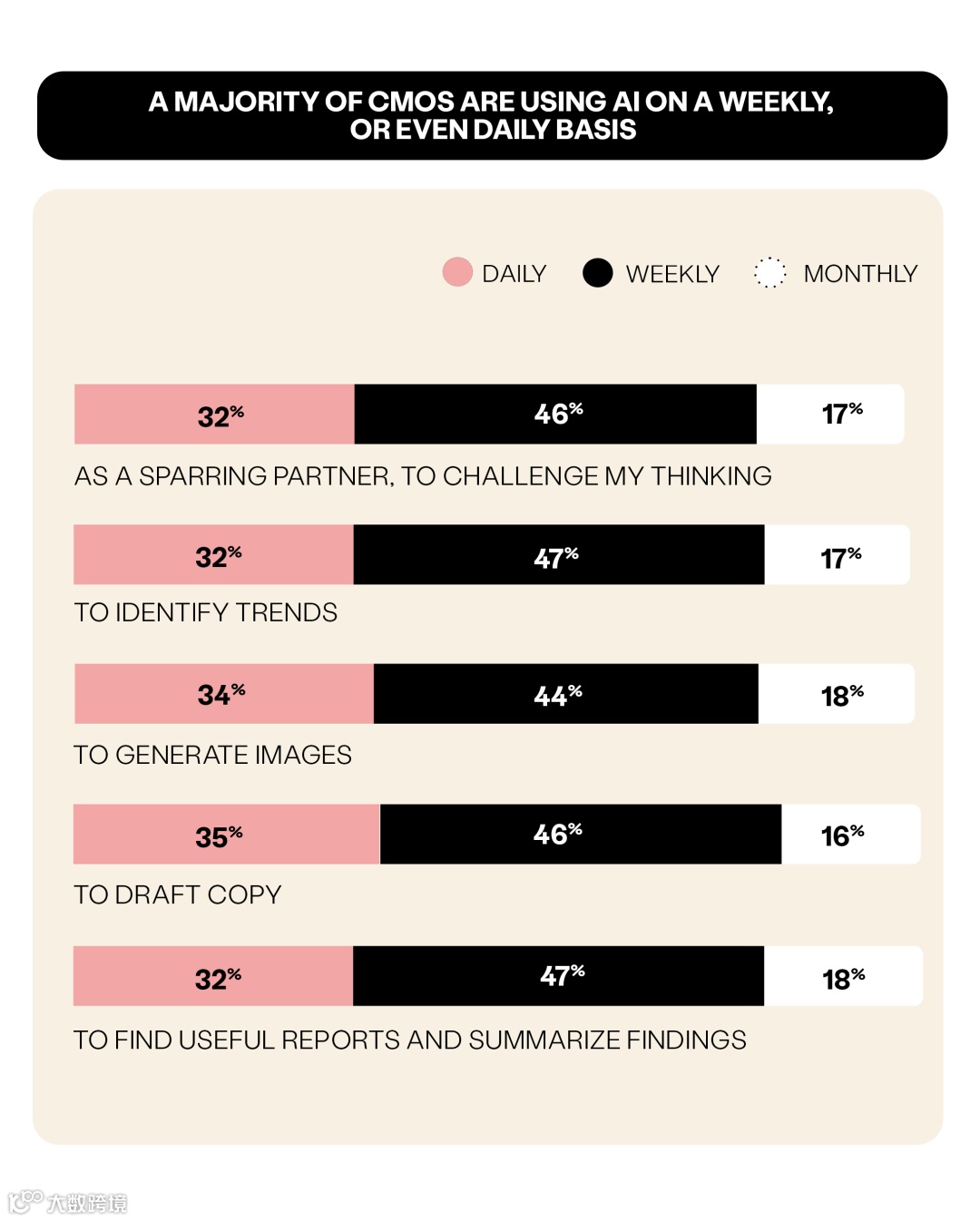
Almost all of today’s CMOs are using AI in their personal workflows to summarize research, draft copy and challenge their thinking, with over 30% using it daily. This fuels a desire for transparency around agency workflows, and new conversations on agency pricing models: 88% believe AI will transform agency pricing models, while the same proportion want to see full transparency on how AI is being used across agency workflows.
Nevertheless, CMOs remain committed to the power of humanity. 86% believe AI should give talented individuals superpowers, not replace them, rising to 92% in APAC but dropping to 76% and 70% in Italy and France respectively (still a strong majority).
88% of marketers agree smart agencies will move quickly beyond using AI to drive efficiency, towards using AI to drive impact and effectiveness – rising to 94% in APAC and 98% in China and India.
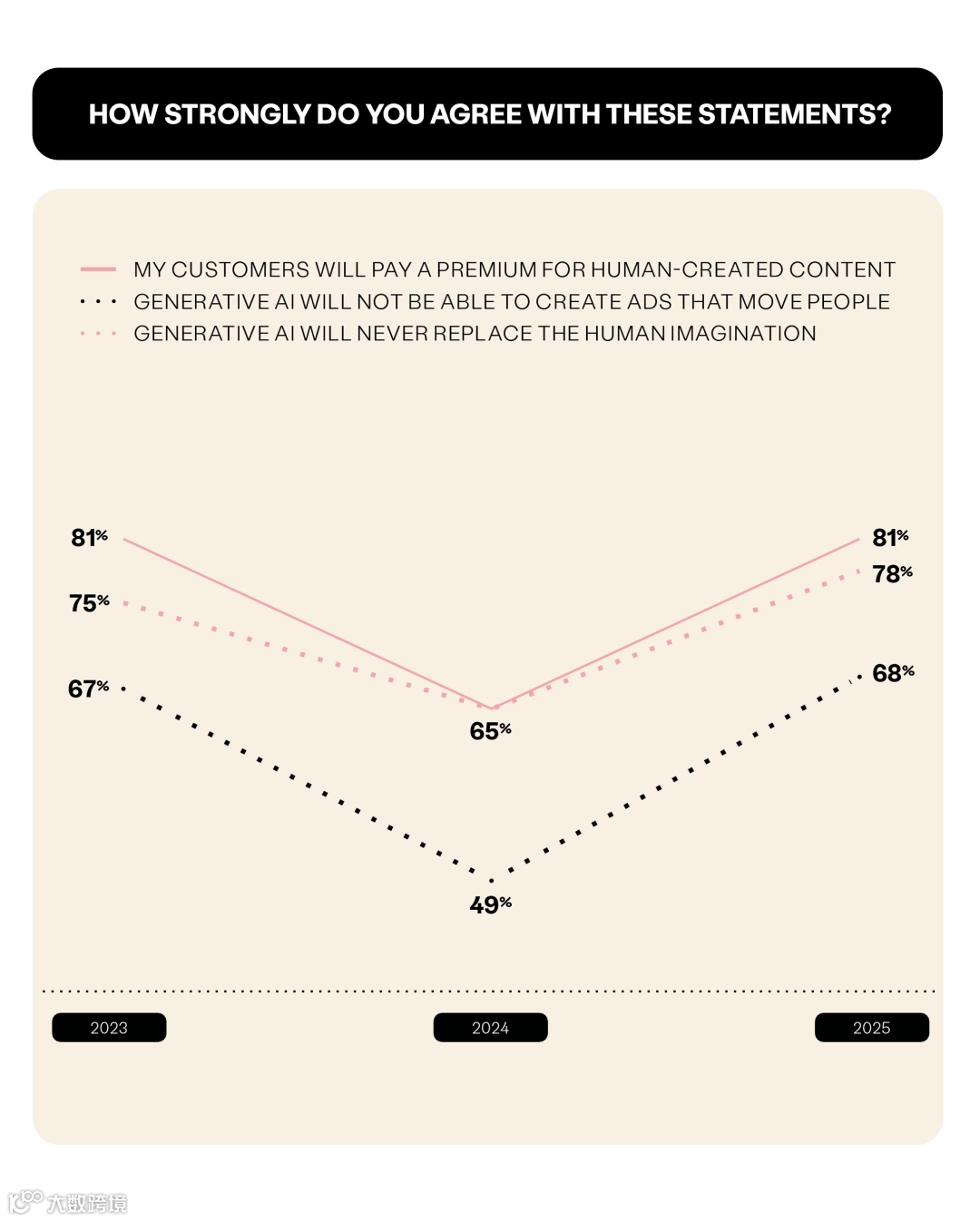
Intriguingly, CMOs’ attitudes to the role of AI versus human craft shows significant volatility year on year. 78% believe “Generative AI will never replace the human imagination” in 2025 (up 13 percentage points from 65% in 2024), while 68% believe “Generative AI will never be able to create content that moves people” (up 19 percentage points from 49% in 2024).
The 2024 data represented a significant decline on these measures vs 2023’s findings as adoption of Generative AI became more widespread but we are seeing a rebound in the belief that humanity is key to creating content that moves us and imagines new possibilities. Similarly, 81% of CMOs believe their customers will pay a premium for human-created products and services, rising to 85% in the North America region, 89%
in China and dipping considerably to 65% in the LATAM region. Globally, this represents a 16 percentage point uplift on 2024, returning to 2023 levels.
What do these movements mean? It’s hard to fully explain, other than that in such a fast moving and emotive space, attitudes change quickly. In 2023, the technology was at a point where it was impressive, but the bugs were often still apparent. By 2024 we had reached enterprise quality imagery and CMOs had much more clarity on what was technically possible.
Yet somehow by 2025, amidst infinitely slicker demos and extraordinary leaps forward in AI-enabled imagery, marketers are questioning whether the output connects on a human level.
It will be fascinating to see how quickly these trends evolve and whether the “uncanny valley” will remain an issue.
Perhaps this emotional delta is one reason why CMOs today are most comfortable with AI as a driver of speed and cost efficiency while they wrestle with its role in craft and ideation: 89% agree “Gen AI will make a massive difference to my ability to produce assets cheaply and quickly”, 90% agree “Gen AI will make it much easier for me to in-house a lot of my marketing” and 91% agree “Gen AI will mean I can use my agency for ideation but use AI for lots of the adaptation and transcreation work”.
However, almost 2/3 of CMOs (65%) feel that AI-assisted creativity cannot yet capture the tone of voice, look and feel of their brand, a sentiment that rises to 84% in Italy and falls to 37% in India, one of the most polarizing sentiments in the study from a market perspective.
OUR WORK…
DETECTIVE JIA
ADVERTISER/BRAND: INTEL
CREATIVE AGENCY: DENTSU CREATIVE
When everyone vies for a sliver of attention, how do you make yours matter?
With the rise of short video platforms and creator economy, personalized algorithmic feeds mean every phone shows a different world. So Intel decided: why not make every user their own ad — and serve it exactly to their tastes?
Intel invited director Da Peng to helm, and popular actor Jia Bing to star, in an AI‑customized, multi‑ending short film, “Detective Jia.” One plot spawns 24 different endings. Starting from a mysterious disappearance, the story branches into suspense, comedy, warmth, sci‑fi, and thriller arcs depending on viewers’ personality tags. Mystery fans see layered identity puzzles; those who prefer heart‑felt drama get unexpected tearjerkers; sci‑fi lovers encounter brain‑teasing aliens and parallel universes.
To deepen engagement, Intel launched the WeChat mini‑program “Jia’s Agency,” using AI face‑swap tech to let millions share the screen with Jia Bing in their own bespoke endings — bringing cutting‑edge tech into everyday play. We also turned the AI production process into three behind‑the‑scenes featurettes, pushing the tech from backstage into the spotlight through the director’s lens.
From script to production, from on‑camera to behind‑the‑scenes, the AI‑powered PC played a deep, hands‑on role across the creative process. Its distinctive storytelling approach delivers a fresh creative experience that fuses technology with entertainment.
READ MORE:Meet Detective Jia, from Intel
This article is selected from Dentsu Creative’s 2025 CMO Report, “Agents of Reinvention: Marketing at the Intersection of AI and Human Ingenuity.”
Drawing on perspectives from over 1,950 senior marketing leaders across 14 markets, the report identifies 10 key themes set to shape marketing in 2025—from anticipating the algorithm and investing in intimacy, to building trust and cultivating taste in the age of Agentic AI.

Explore actionable strategies to meet these challenges and drive growth, while balancing success in both culture and commerce.
To access the full 2025 CMO Report, visit the Dentsu Creative global website:
www.dentsucreative.com/news/dentsu-creative-cmo-report-2025
-ENDS-