


》导语《
近日,Vantbrand正见品牌战略创始人兼CEO崔洪波受邀接受新加坡英文主流媒体《海峡时报》(The Straits Times)专访,并针对中国企业在竞争加剧、利润承压背景下的品牌建设趋势以及品牌全球化进程中的战略议题,分享观察与判断。
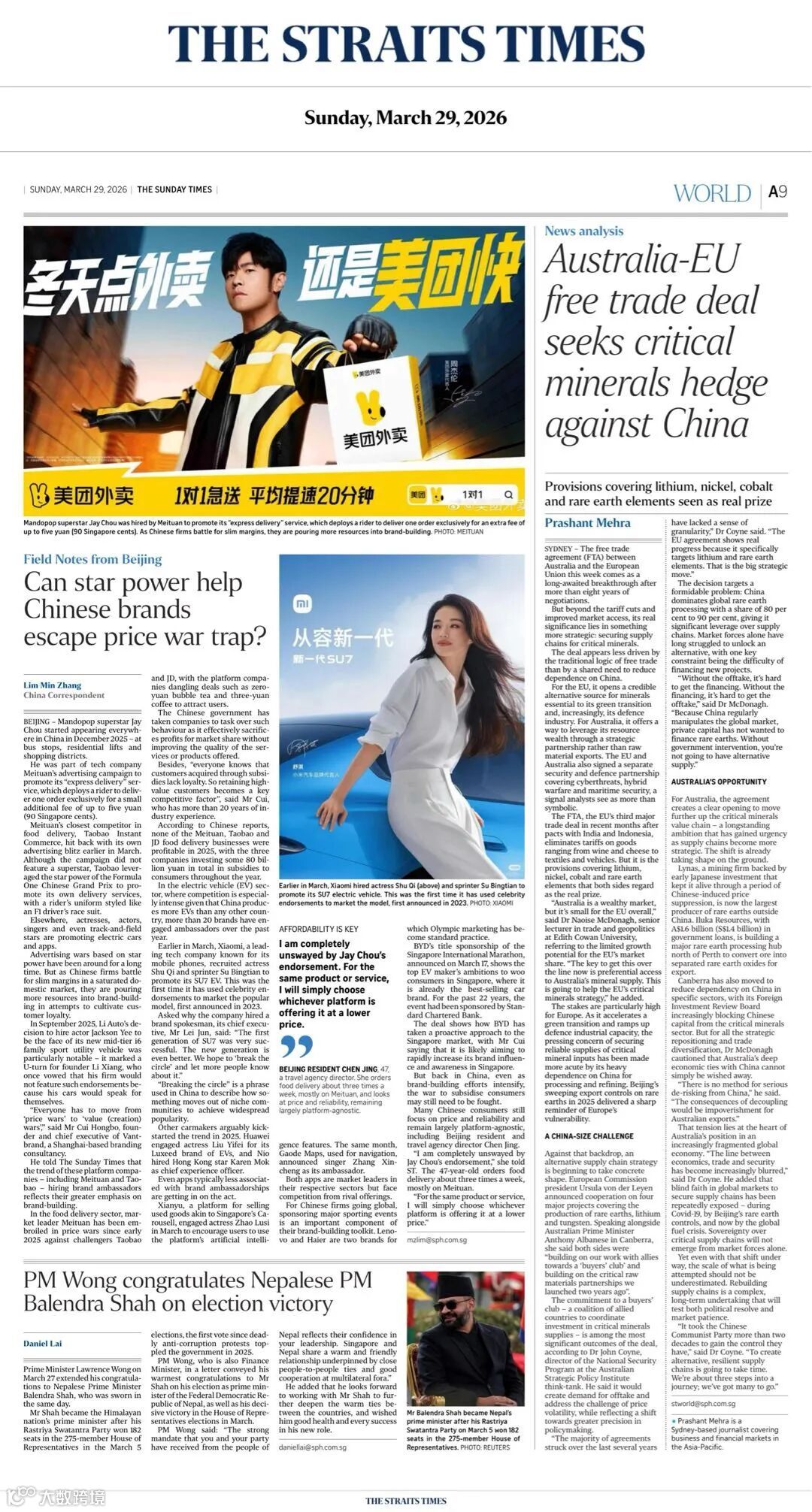
在题为《周杰伦与舒淇的明星效应能否助中国品牌走出价格战陷阱?》(Can the star power of Jay Chou and Shu Qi help Chinese brands escape price war trap?)的报道中,新加坡《海峡时报》以中国平台经济与新能源汽车行业近期的品牌动作作为切口,呈现出几个值得关注的市场现象:一方面,在国内市场趋于饱和、利润空间持续收窄的背景下,越来越多中国企业开始加大品牌建设投入,并借助明星代言、赛事合作等方式强化品牌表达与用户认知;与此同时,消费者依然普遍保持价格敏感,价格竞争与补贴竞争并未真正退出市场。
围绕这些市场现象,崔洪波在采访中提出以下核心观点:
1. 企业竞争逻辑正从价格竞争转向价值创造。
当下,单纯依赖低价剥离与补贴驱动的增长模式已难以为继。企业需通过深度品牌建设与价值体系塑造,将竞争维度从成本竞争升级为价值竞争,从而构建更具韧性与可持续性的内生增长动力。
2. 补贴能够带来短期获客,但难以建立真正的品牌忠诚。
对于品牌而言,客户获取只是起点,真正关键的是形成稳定的用户偏好与留存能力。未来,高价值客户的持续经营将成为影响竞争格局的重要因素。
3. 品牌建设已不只是传播动作,而正日益成为企业核心经营能力。
近期,头部企业密集强化品牌表达与代言动作,本质上反映了企业战略重心向长期价值、客户关系维护及品牌资产积累的回归。
4. 品牌出海不是销量外溢,而是品牌影响力的系统性建设。
中国品牌进入海外市场,必须完成从“产品输出”到“品牌认知”的跨越。赛事赞助、在地化传播等持续的品牌投入动作有助于在全球市场中打造强大的品牌势能。
关于 Vantbrand正见品牌战略
Vantbrand正见品牌战略成立于2011年,是中国较早系统实践新品类战略的咨询机构之一。公司以"开创新品类,创造新增长"为使命,围绕品牌咨询、AI营销与品牌出海,持续为企业提供一体化战略支持,以建立更具长期性的品牌竞争力。
关于 The Straits Times
新加坡《海峡时报》创刊于1845年,是 SPH Media 旗下的旗舰英文日报。作为新加坡历史最悠久、最具代表性的英文媒体之一,《海峡时报》长期关注新加坡、东南亚及全球重要议题,面向区域及国际读者提供综合、持续的新闻报道。
》报道原文《
Can the star power of Jay Chou and Shu Qi help Chinese brands escape price war trap?
The Straits Times|March 28, 2026
Field Notes from Beijing
Lim Min Zhang
BEIJING - Mandopop superstar Jay Chou started appearing everywhere in China in December 2025 – at bus stops, residential lifts and shopping districts.
He was part of tech company Meituan's advertising campaign to promote its "express delivery" service, which deploys a rider to deliver one order exclusively for a small additional fee of up to five yuan (90 Singapore cents).
Meituan's closest competitor in food delivery, Taobao Instant Commerce, hit back with its own advertising blitz earlier in March. Although the campaign did not feature a superstar, Taobao leveraged the star power of the Formula One Chinese Grand Prix to promote its own delivery services, with a rider's uniform styled like an F1 driver's race suit.
Elsewhere, actresses, actors, singers and even track-and-field stars are promoting electric cars and apps.
Advertising wars based on star power have been around for a long time. But as Chinese firms battle for slim margins in a saturated domestic market, they are pouring more resources into brandbuilding in attempts to cultivate customer loyalty.
In September 2025, Li Auto's decision to hire actor Jackson Yee to be the face of its new mid-tier i6 family sport utility vehicle was particularly notable – it marked a U-turn for founder Li Xiang, who once vowed that his firm would not feature such endorsements because his cars would speak for themselves.
"Everyone has to move from 'price wars' to 'value (creation) wars'," said Mr Cui Hongbo, founder and chief executive of Vantbrand, a Shanghai-based branding consultancy. He told The Straits Times that the trend of these platform companies – including Meituan and Taobao – hiring brand ambassadors reflects their greater emphasis on brand-building.
In the food delivery sector, market leader Meituan has been embroiled in price wars since early 2025 against challengers Taobao and JD, with the platform companies dangling deals such as zero-yuan bubble tea and three-yuan coffee to attract users.
The Chinese government has taken companies to task over such behaviour as it effectively sacrifices profits for market share without improving the quality of the services or products offered.
Besides, "everyone knows that customers acquired through subsidies lack loyalty. So retaining high-value customers becomes a key competitive factor", said Mr Cui, who has more than 20 years of industry experience.
According to Chinese reports, none of the Meituan, Taobao and JD food delivery businesses were profitable in 2025, with the three companies investing some 80 billion yuan in total in subsidies to consumers throughout the year.
In the electric vehicle (EV) sector, where competition is especially intense given that China produces more EVs than any other country, more than 20 brands have engaged ambassadors over the past year.
Earlier in March, Xiaomi, a leading tech company known for its mobile phones, recruited actress Shu Qi and sprinter Su Bingtian to promote its SU7 EV. This was the first time it has used celebrity endorsements to market the popular model, first announced in 2023.
Asked why the company hired a brand spokesman, its chief executive, Mr Lei Jun, said: "The first generation of SU7 was very successful. The new generation is even better. We hope to 'break the circle' and let more people know about it."
"Breaking the circle" is a phrase used in China to describe how something moves out of niche communities to achieve widespread popularity.
Other carmakers arguably kick-started the trend in 2025. Huawei engaged actress Liu Yifei for its Luxeed brand of EVs, and Nio hired Hong Kong star Karen Mok as chief experience officer.
Even apps typically less associated with brand ambassadorships are getting in on the act.
Xianyu, a platform for selling used goods akin to Singapore's Carousell, engaged actress Zhao Lusi in March to encourage users to use the platform's artificial intelligence features. The same month, Gaode Maps, used for navigation, announced singer Zhang Xincheng as its ambassador.
Both apps are market leaders in their respective sectors but face competition from rival offerings.
For Chinese firms going global, sponsoring major sporting events is an important component of their brand-building toolkit. Lenovo and Haier are two brands for which Olympic marketing has become standard practice.
BYD's title sponsorship of the Singapore International Marathon, announced on March 17, shows that the top EV maker's ambitions to woo consumers in Singapore, where it is already the best-selling car brand. For the past 22 years, the event had been sponsored by Standard Chartered Bank.
The deal shows how BYD has taken a proactive approach to the Singapore market, with Mr Cui saying that it is likely aiming to rapidly increase its brand influence and awareness in Singapore.
But back in China, even as brand-building efforts intensify, the war to subsidise consumers may still need to be fought.
Many Chinese consumers still focus on price and reliability and remain largely platform-agnostic, including Beijing resident and travel agency director Chen Jing.
"I am completely unswayed by Jay Chou's endorsement," she told ST. The 47-year-old orders food delivery about three times a week, mostly on Meituan, as her default option.
"For the same product or service, I will simply choose whichever platform is offering it at a lower price."