


注释是编程中仅次于“Hello, world!”的单词,通常是你在向世界问好之后学到的下一件事。它们通常有两种形式:单行注释和多行注释,例如//和/* */。它们的目的是解释当前的代码逻辑并提供注释。
什么是评论?
在深入探讨“为什么没有人再想写代码注释?”这个问题之前,让我们先看看人们实际上是如何写注释的。
例如,某些项目或编码标准要求在文件开头声明版权信息。这可能包括 ASCII 艺术或许可详细信息:
/*
 * Copyright 2024-2025 the original author or authors.
 *
 * Licensed under the Apache License, Version 2.0 (the "License");
 * you may not use this file except in compliance with the License.
 * You may obtain a copy of the License at
 *
 *      https://www.apache.org/licenses/LICENSE-2.0
 *
 * Unless required by applicable law or agreed to in writing, software
 * distributed under the License is distributed on an "AS IS" BASIS,
 * WITHOUT WARRANTIES OR CONDITIONS OF ANY KIND, either express or implied.
 * See the License for the specific language governing permissions and
 * limitations under the License.
 */
有些甚至包括 ASCII 艺术:
/*
 *                        _oo0oo_
 *                       o8888888o
 *                       88" . "88
 *                       (| -_- |)
 *                       0\  =  /0
 *                     ___/`---'\___
 *                   .' \\|     |// '.
 *                  / \\|||  :  |||// \
 *                 / _||||| -:- |||||- \
 *                |   | \\\  - /// |   |
 *                | \_|  ''\---/''  |_/ |
 *                \  .-\__  '-'  ___/-. /
 *              ___'. .'  /--.--\  `. .'___
 *           ."" '<  `.___\_<|>_/___.' >' "".
 *          | | :  `- \`.;`\ _ /`;.`/ - ` : | |
 *          \  \ `_.   \_ __\ /__ _/   .-` /  /
 *      =====`-.____`.___ \_____/___.-`___.-'=====
 *                        `=---='
 *
 *      ~~~~~~~~~~~~~~~~~~~~~~~~~~~~~~~~~~~~~~~~~~~
 *
 *            Buddha bless, never crashes, never bugs
 */
在公司工作时,声明函数的作者是很常见的。如果函数有问题,更容易找到责任人(承担责任):
/**
 * Title base agent.<br>
 * Description base agent.<br>
 *
 * @author yuanci.ytb
 * @since 1.0.0-M2
 */
一些 IDE 甚至会自动为您生成注释格式,例如 Laravel(或 Java 的 Spring 框架):
/**
 * Create a new repository builder instance.
 *
 * @param \Dotenv\Repository\Adapter\ReaderInterface[] $readers
 * @param \Dotenv\Repository\Adapter\WriterInterface[] $writers
 * @param bool                                         $immutable
 * @param string[]|null                                $allowList
 *
 * @return void
 */
private function __construct(array $readers = [], array $writers = [], bool $immutable = false, ?array $allowList = null)
{
    $this->readers = $readers;
    $this->writers = $writers;
    $this->immutable = $immutable;
    $this->allowList = $allowList;
}
有时,注释用于禁用旧功能:
{
  // image
}
{
  /* {isValidImageIcon
      ? <img src={imageUrl} className="w-full h-full rounded-full" alt="answer icon" />
      : (icon && icon !== '') ? <em-emoji id={icon} /> : <em-emoji id=' ' />
    } */
}
那么为什么没有人再想写代码注释了?
注释通常分为两类:一类解释信息,另一类注释功能。请考虑以下没有注释的代码 - 需要花费一些时间才能理解它的作用:
function lengthOfLongestSubstring(s) {
  let charIndexMap = new Map(),
    longest = 0,
    left = 0;

  for (let right = 0; right < s.length; right++) {
    if (charIndexMap.has(s[right]) && charIndexMap.get(s[right]) >= left) {
      left = charIndexMap.get(s[right]) + 1;
    }
    charIndexMap.set(s[right], right);
    longest = Math.max(longest, right - left + 1);
  }
  return longest;
}
添加注释可以使其更容易理解:
// Computes the length of the longest substring without repeating characters
function lengthOfLongestSubstring(s) {
  let charIndexMap = new Map(),
    longest = 0,
    left = 0;

  for (let right = 0; right < s.length; right++) {
    // If the character exists in the map and its index is >= left pointer, move left pointer
    if (charIndexMap.has(s[right]) && charIndexMap.get(s[right]) >= left) {
      left = charIndexMap.get(s[right]) + 1;
    }
    // Update the character's latest index in the map
    charIndexMap.set(s[right], right);
    // Update the longest substring length
    longest = Math.max(longest, right - left + 1);
  }
  return longest;
}
人们宁愿事后花五分钟理清逻辑,也不愿在灵感迸发时花时间写评论。
我认为很大程度上是因为害怕以下几种情况:
怕有人会说:
“不就是求最长不重复子串的长度这个计算逻辑吗,小学的时候就学会了,你还写评论?你好弱啊。”
“这个人写了这么多评论,肯定是新手。”
“在你的代码中写注释?明天人工智能就会取代你!”
那么我们为什么不写评论呢?我认为 50% 的原因是纯粹的懒惰,另外 50% 是害怕这种情况。但是,当我们查看别人的项目时,我们希望他们的评论和文档尽可能详细——因为越详细越好。
随着 CSS 的发展,我们很多人都接触过 SASS、Less,这些扩展不可避免地需要数学运算(加减乘除)来实现复杂的效果,例如:
$padding: 12px;

.post {
  // Since these max() calls are valid calculation expressions, they're
  // parsed as calculations.
  padding-left: max($padding, env(safe-area-inset-left));
  padding-right: max($padding, env(safe-area-inset-right));
}

.sidebar {
  // Since these use the SassScript-only modulo operator, they're parsed as
  // SassScript function calls.
  padding-left: max($padding % 10, 20px);
  padding-right: max($padding % 10, 20px);
}
偶尔出现这样的代码片段还好,但如果代码很长,你可能要花很多时间才能弄清楚,甚至调试它。考虑以下较长的代码片段:
body::before {
    --size: 45px;
    --line: color-mix(in hsl, canvasText, transparent 70%);
    content: '';
    height: 100vh;
    width: 100vw;
    position: fixed;
    background: linear-gradient(
          90deg,
          var(--line) 1px,
          transparent 1px var(--size)
        )
        50% 50% / var(--size) var(--size),
      linear-gradient(var(--line) 1px, transparent 1px var(--size)) 50% 50% /
        var(--size) var(--size);
    mask: linear-gradient(-20deg, transparent 50%, white);
    top: 0;
    transform-style: flat;
    pointer-events: none;
    z-index: -1;
  }
许多人可能最终会去 MDN 寻找定义,比如 mask 的作用以及它在这里是如何使用的。
如果我们添加评论,我们可能会遭遇同样的嘲笑:
“不就是个面具吗?这个我小学就学过,你还写评论?你好弱啊。”
“这个人甚至为 CSS 写注释。肯定是新手。”
“写评论?明天AI就来代替你了!”
我们需要代码注释!
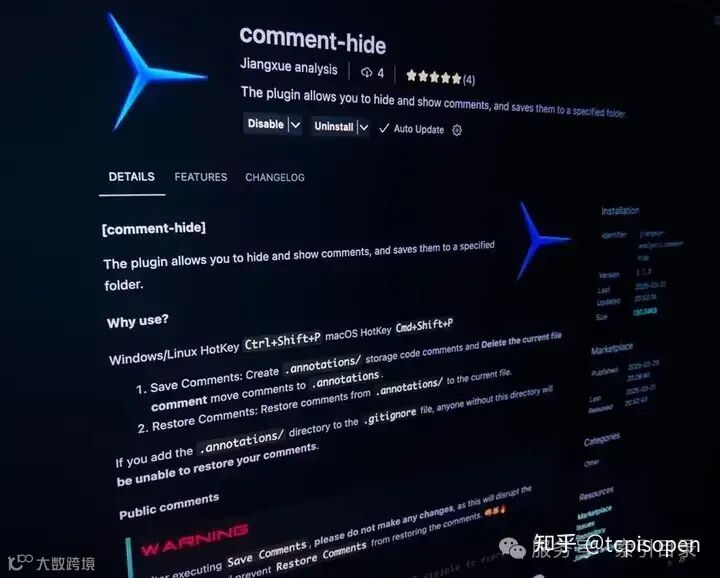
我们需要代码注释,但我们也需要控制哪些注释对其他人可见。许多插件可以隐藏注释,但如果您同时需要可见性和隐私性,则可以使用 comment-hide VSCode 插件。
它提供了两个命令:Save Comments和Restore Comments。前者提取并删除注释,并将其存储在.annotations/目录中,而后者恢复它们 — 前提是文件在此期间没有更改。
Windows/Linux 快捷方式:Ctrl+Shift+P
macOS 快捷方式:Cmd+Shift+P
例如:
0 /* >>>
1   This will not be hidden and will be 2 visible to everyone
2 */
3
4 const x = 42; // This is a comment
5 /* This is a multi-line
6    comment */
7 // Another comment 运行之后Save Comments变成:
1 /* >>>
2   This will not be hidden and will be 3 visible to everyone
3 */
4
5 const x = 42;块/* */保留,因为 comment-hide 允许使用 保留注释>>>。只有块样式/* */注释支持此功能。
这些评论都存放在.annotations/根目录的文件夹中,你可以通过当前文件名来找到 JSON 文件。
{
  "originalContent": "/* >>>\n  This will not be hidden and will be visible to everyone\n*/\n\nconst x = 42; // This is a comment\n/* This is a multi-line\n   comment */\n// Another comment",
  "comments": [
    {
      "text": "// This is a comment",
      "line": 4,
      "start": 83,
      "end": 103
    },
    {
      "text": "/* This is a multi-line\n   comment */",
      "line": 5,
      "start": 104,
      "end": 141
    },
    {
      "text": "// Another comment",
      "line": 7,
      "start": 142,
      "end": 160
    }
  ],
  "filePath": "test/hhha.js"
}
要恢复注释,请运行Restore Comments,插件将根据行号和位置重新插入注释:
0 /* >>>
1   This will not be hidden and will be 2 visible to everyone
2 */
3
4 const x = 42; // This is a comment
5 /* This is a multi-line
6    comment */
7 // Another comment 如果您添加.annotations/到.gitignore,其他人将看不到。只有>>>评论可见。
这个插件有什么缺点吗?
是的——此插件依赖绝对定位。如果您修改行号或缩进,恢复注释可能会变得不可靠。因此,最好Save Comments只在一切完成后才使用。
支持的评论样式
该插件支持四种主要的注释样式,涵盖多种语言:
// Hello

# Hello

/*
  Hello
*/

<!-- Hello -->
为什么不支持 Python 的'''和"""?开发人员很懒。
这四种风格涵盖了大多数现代语言,包括:
JavaScript - HTML - Markdown - CSS - C++ - C# - Java - Python - Golang - Rust - Ruby - JSX/TSX...安全问题
由于此插件需要读/写权限,有些人可能会担心代码隐私问题。幸运的是,它是开源的。您可以在此处查看源代码。该插件通过 GitHub Actions 发布,确保不会出现恶意代码注入或数据泄露。
README 包含有关其当前限制的 红色警告。未来的更新旨在允许一键隐藏/恢复整个项目并提高定位可靠性。
编码中的网络欺凌
归根结底,问题在于网络欺凌。如果你从未经历过,不妨想想《黑暗之魂 3》玩家的情况。
有些玩家对游戏不熟悉,在与无名之王这样的 Boss 战斗数小时后,便会放弃并求助于指南。而其他玩家则享受挑战和最终胜利带来的多巴胺冲动。
但有些开发人员以同样的方式阻止评论,让那些使用评论的人感到羞耻。阿尔伯特·爱因斯坦曾经说过:
“每个人都是天才。但如果你用爬树的能力来评判一条鱼,它会终其一生都相信自己很笨。”