

大数跨境

《食品工业科技》F5000论文展播:超声提取辣木叶黄酮优化及其抗氧化活性

《食品工业科技》F5000论文展播:超声提取辣木叶黄酮优化及其抗氧化活性 食品工业科技编辑部
2022-11-07
2

超声提取辣木叶黄酮优化及其抗氧化活性


目的:辣木叶是一种可食用的新型植物资源,含有许多活性成分,许多研究表明辣木叶粗提物具有抗氧化、降血糖、降血脂等有益生理活性,在食品、医药、化妆品领域具有潜在的应用价值。本文采用超声波辅助提取法提取辣木叶黄酮,对提取工艺参数进行优化,确定最佳提取工艺条件;采用聚酰胺树脂对辣木叶黄酮粗提物进行纯化,比较其纯化前后提取物中黄酮的含量和抗氧化活性的变化情况,为辣木叶黄酮高效提取及天然抗氧化剂的开发和利用提供一定的理论和技术参考。


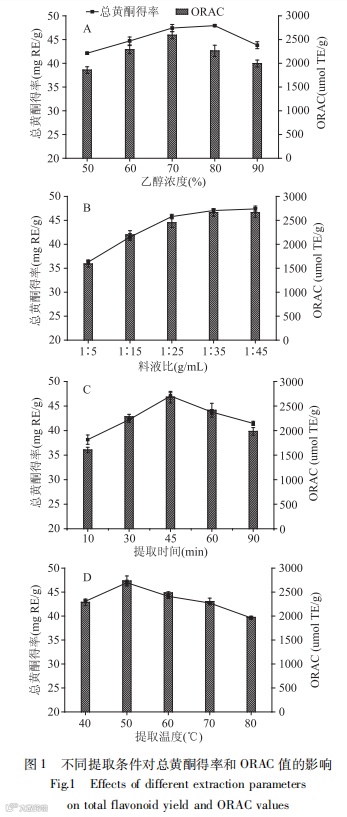
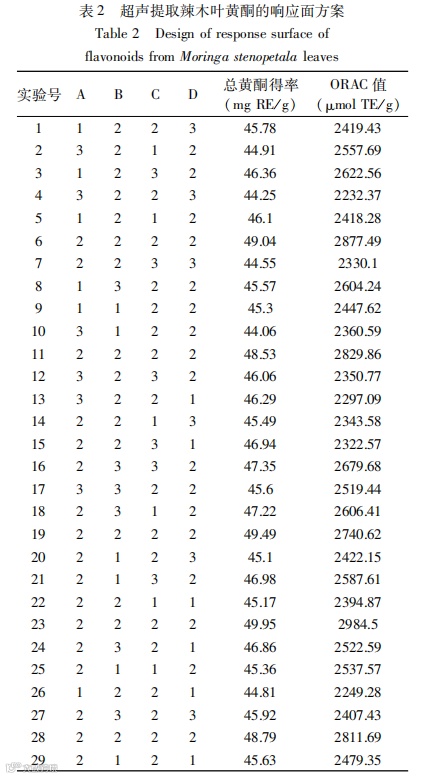
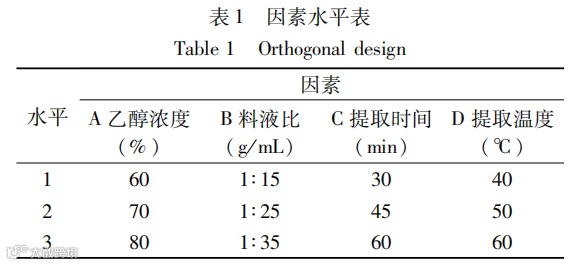
方法:采用超声波辅助提取法从辣木叶中提取辣木叶黄酮,以乙醇浓度、料液比、提取时间、提取温度为单因素,总黄酮得率和氧自由基吸收能力(ORAC)值为指标,进行单因素实验,确定最佳单因素条件,然后采用Box-Behnken实验设计和响应面分析实验,确定最佳提取工艺条件;在最佳提取条件下,提取辣木叶黄酮提取物,采用聚酰胺树脂吸附和乙醇洗脱对其进行纯化,比较其纯化前后提取物中黄酮的含量变化;最后,采用DPPH自由基清除能力、ABTS自由基清除能力和ORAC实验比较纯化前后辣木叶黄酮提取物的体外抗氧化能力。


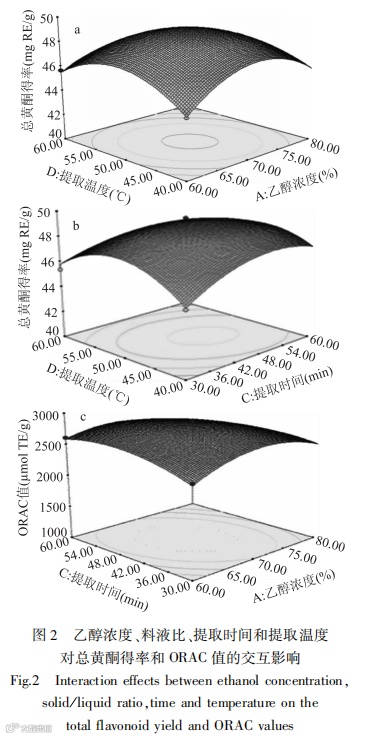
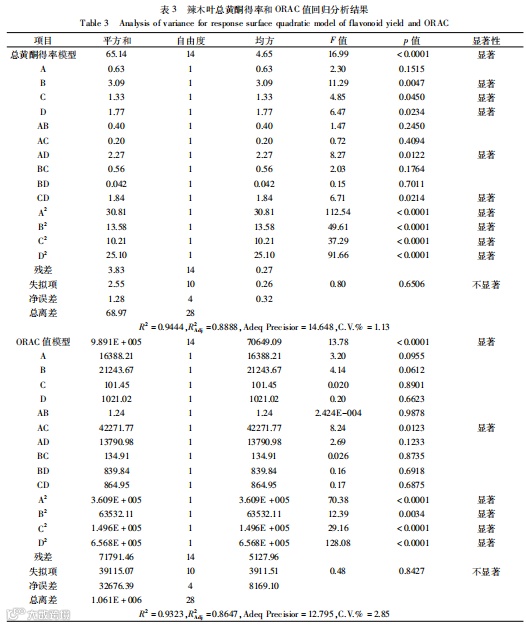
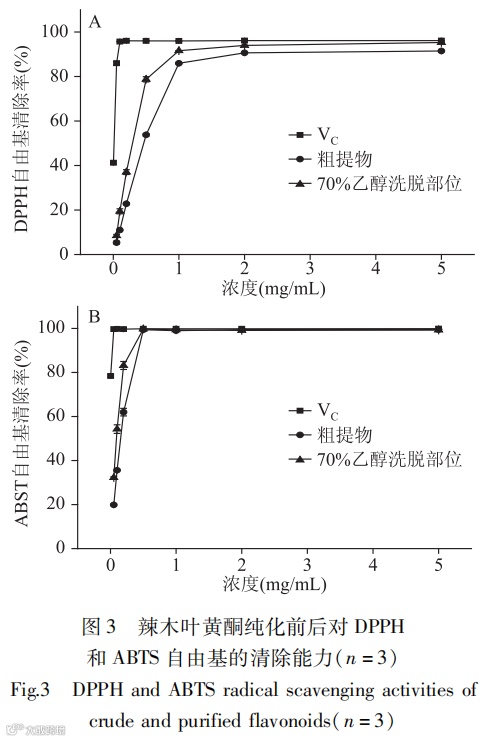
结果:1.通过单因素实验结合响应面分析实验,得出超声波辅助提取辣木叶黄酮的最优提取条件为:超声功率为300 W、乙醇浓度69.45%(v/v)、料液比1:26.82 g/mL,提取时间46.07 min、提取温度49.48 ℃,在此最佳提取条件下,总黄酮得率和ORAC值均达到最大值,分别为49.23 mg RT/g(芦丁当量)和2853.99 µmol TE/g (Trolox当量)。为验证预测模型的可信性和准确性,对预测模型的最优条件进行验证,并比较真实值和预测值的符合程度。结合实际可操作性,将最优工艺条件修正为:超声功率为300 W、乙醇浓度70%(v/v),料液比1:27 g/mL,提取时间46 min,提取温度50 ℃,在此条件下,总黄酮得率和ORAC值分别为48.93±0.44 mg RT/g和2747.17±301.51 µmol TE/g,与预测值(49.23 mg RT/g,2853.99 µmol TE/g)的误差仅为0.6%和3.7%,表明响应面分析法优化辣木叶黄酮的提取工艺具有较好的可行性和可信度。2.辣木叶黄酮粗提物中黄酮含量为21.90%,具有较显著的DPPH和ABTS自由基清除能力,并呈剂量依赖性,其活性略低于VC,其半数抑制浓度(EC50)值分别为0.45 mg/mL和0.10 mg/mL。3.经聚酰胺树脂吸附和70%乙醇洗脱,得到纯化后的辣木叶黄酮,其黄酮含量达到65.89%,ORAC值达到5923.48 µmol TE/g,此外,DPPH和ABTS清除活性也显著提高,其EC50值分别下降到0.26 mg/mL和0.05 mg/mL,且清除活性与VC相当。 


结论:超声波辅助提取法是一种高效提取辣木叶黄酮方法,辣木叶黄酮具有显著的DPPH自由基清除活性、ABTS自由基清除活性和氧自由基清除能力。聚酰胺树脂可有效提高辣木叶黄酮粗提取物中的黄酮含量和体外抗氧化活性,表明了辣木叶黄酮可开发为一种天然抗氧化剂,应用于食品和医药领域。


图片来源于图司机


Objectives: Moringa stenopetala leaves is a kind of new edible plant resource, which contains many active ingredients. Many studies have shown that the crude extract of M. stenopetala leaves has many beneficial biological activities, such as antioxidant, hypoglycemic, and hypolipidemic activities, which has potential application value in food, medicine and cosmetics. Ultrasonic-assisted extraction method was used to extract total flavonoids from M. stenopetala leaves. The extraction parameters were optimized to determine the optimal extraction conditions. The crude flavonoids extract of M. stenopetala leaves was purified by polyamide resin. The changes of flavonoids content and antioxidant activity of the flavonoids extract were comparatively analyzed before and after purification. The results will provide theoretical and technical reference for the high-efficient extraction of flavonoids from M. stenopetala leaves and the development and utilization of natural antioxidants.

Methods: The total flavonoids were extracted from M. stenopetala leaves by ultrasonic-assisted extraction (UAE). Ethanol concentration, solid-liquid ratio, extraction time and extraction temperature were taken as single factors, and the yield of total flavonoids and oxygen free radical absorption capacity (ORAC) value were taken as indicators to conduct single factor experiments. Then Box-Behnken factorial design (BBD) and response surface experiment (RSM) were used to determine the optimal extraction conditions. The crude flavonoid extract from M. stenopetala leaves was extracted under the optimal extraction conditions, and purified by polyamide resin adsorption and ethanol elution. The content of flavonoids in the extract was compared before and after purification. Finally, the antioxidant activities in vitro of the flavonoids extract before and after purification were compared by DPPH radical scavenging ability, ABTS radical scavenging ability, and ORAC assays.

Results: 1. Based on single factor experiments combined with RSM analysis, the optimal extraction conditions were as follows: Ultrasonic power 300 W, ethanol concentration 69.45% (v/v), solid-liquid ratio 1:26.82 g/mL, extraction time 46.07 min, and extraction temperature 49.48 ℃. Under the optimal extraction conditions, the yield of total flavonoids and ORAC value reached the maximum values. The total flavonoids yield and ORAC value of the extract were 49.23 mg rutin equivalent (RT)/g and 2853.99 µmol Trolox equivalent (TE)/g, respectively. In order to verify the reliability and accuracy of the prediction models, the optimal conditions of the prediction models were verified, and the agreement degree between the real values and the predicted values was compared. Given that the actual operability, the optimal extraction conditions are modified as follows: Ultrasonic power 300 W, ethanol concentration 70% (v/v), solid-liquid ratio 1:27 g/mL, extraction time 46 min, and extraction temperature 50 ℃. Under this conditions, the total flavonoids yield and ORAC value of the extract were 48.93±0.44 mg RT/g and 2747.17±301.51 µmol TE/g, respectively. Compared with the predicted values (49.23 mg RT/g and 2853.99 µmol TE/g), the errors were only 0.6% and 3.7%, indicating that RSM had good feasibility and reliability in optimizing the extraction process of flavonoids from M. stenopetala leaves. 2. The flavonoids content in crude flavonoids extract of M. stenopetala leaves was 21.90%. The flavonoids extract showed significant DPPH and ABTS radical scavenging activity in a dose-dependent manner. The half-inhibitory concentration (EC50) values were 0.45 mg/mL and 0.10 mg/mL, respectively. The antioxidant activity of the flavonoids extract was slightly lower than that of VC. 3. After polyamide resin adsorption and 70% ethanol elution, the flavonoids content of M. stenopetala leaves leaves reached to 65.89%, and the ORAC value was 5923.48 µmol TE/g. The DPPH and ABTS scavenging activities of purled extract were also significantly improved. The EC50 values were decreased to 0.26 mg/mL and 0.05 mg/mL, respectively, which was similar to VC.

Conclusions: Ultrasonic-assisted extraction is a high-efficient method for extracting flavonoids from M. stenopetala leaves leaves. The flavonoids from M. stenopetala leaves leaves have strong DPPH, ABTS, and oxygen free radical scavenging abilities. Polyamide resin can effectively increase the content of flavonoids and antioxidant activity in vitro of the flavonoids extract of M. stenopetala leaves, suggesting that the flavonoids from M. stenopetala leaves can be exploited as a natural antioxidant used in food and medicine fields.


图表赏析


《食品工业科技》青年编委专栏征稿

《食品工业科技》青年编委专栏征稿:食品营养素包埋与递送 


《食品工业科技》青年编委专栏征稿:杂粮与主粮复配的营养学基础 


详细内容请点击文末“阅读原文”。


编辑:汤梦怡
主编:冯媛媛

版权声明

《食品工业科技》具有以上论文在全世界范围内的复制权、发行权、翻译权、汇编权、广播权、表演权、信息网络传播权、转许可权及以上权利的邻接权,且作者已授权期刊同论文著作权保护期。如需转载,可联系《食品工业科技》编辑部010-87244116,或直接在文末撰写转载来源。



食品工业科技官方网站:
http://www.spgykj.com


点亮“在看”,为《食品工业科技》助力

【声明】内容源于网络
0
0
食品工业科技编辑部
《食品工业科技》编辑部与作者、读者的交流平台。《食品工业科技》既是反映当前国内外食品工业技术水平的窗口,又是新技术应用推广的桥梁,面向科研、生产,满足各层次需求。
内容 2790
粉丝 0
食品工业科技编辑部 《食品工业科技》编辑部与作者、读者的交流平台。《食品工业科技》既是反映当前国内外食品工业技术水平的窗口,又是新技术应用推广的桥梁,面向科研、生产,满足各层次需求。
总阅读4.0k
粉丝0
内容2.8k